
Mailchimp, Omnisend or Klaviyo for Your Shopify Store’s Email Marketing
Written and edited by: Dirk

Somewhere in online retail’s collective unconscious, a belief has somehow calcified into gospel and unfortunately for me it’s not a belief in sending your SEO person to the Sundance Film Festival every year . ) It goes more like … “If you’re on Shopify, you need to be on Klaviyo.” It’s whispered in Facebook groups, repeated in agency pitch decks, and echoed across countless Reddit threads with the certainty of settled doctrine. And like a lot of gospel it contains a kernel of truth wrapped up in assumptions that warrant interrogation.
Look Klaviyo is a great platform. No one seriously disputes that. With over 219,472 companies using it for marketing automation and in command of something like 63% worth of the e-commerce customer relationship management (CRM) tools market, its position atop the Shopify email hierarchy is well-earned. The Shopify investment in Klaviyo wasn’t charity. The integration mostly delivers for users.
Klaviyo’s strengths become most valuable at scale. For a store doing $500K in annual revenue, many of its most sophisticated features are capabilities you’re paying for but not yet using. The predictive analytics are impressive when you have enough customer data to make predictions meaningful. The behavioral segmentation is useful when your list is large enough to segment meaningfully.
For merchants approaching that threshold where DIY marketing starts to feel inadequate but enterprise-level complexity feels premature, the landscape is more nuanced than “just use Klaviyo” suggests. Let me walk you all through a more honest comparison.
The Current State of Email Marketing for Shopify
Before we talk our way through the three marketing automation platforms in question, I should probably put a few facts in context for anyone who came in late. Currently email marketing delivers an average return of $36 for every dollar spent, making it the highest-ROI channel for B2C brands according to HubSpot’s latest research. For e-commerce specifically, that figure climbs as far as $45 for every dollar invested. And automated email marketing work flows generate roughly 4x more revenue than one-off campaigns, because they’re triggered by actual consumer behavior, and that tends to make them timely, relevant and best of all … personalized.
You don’t have to spend long with those numbers to understand why your choice of CRM platforms matters. They also explain why agencies and consultants push premium solutions. Higher platform costs often mean higher implementation fees. So. The question isn’t whether email marketing is worth the effort. It’s which platform is best suited to deliver in the specific situation you’re currently in.
Really Understanding The CRM You’ll Be Buying
Each multichannel marketing platform operates on a fundamentally different philosophy about what email marketing should be.
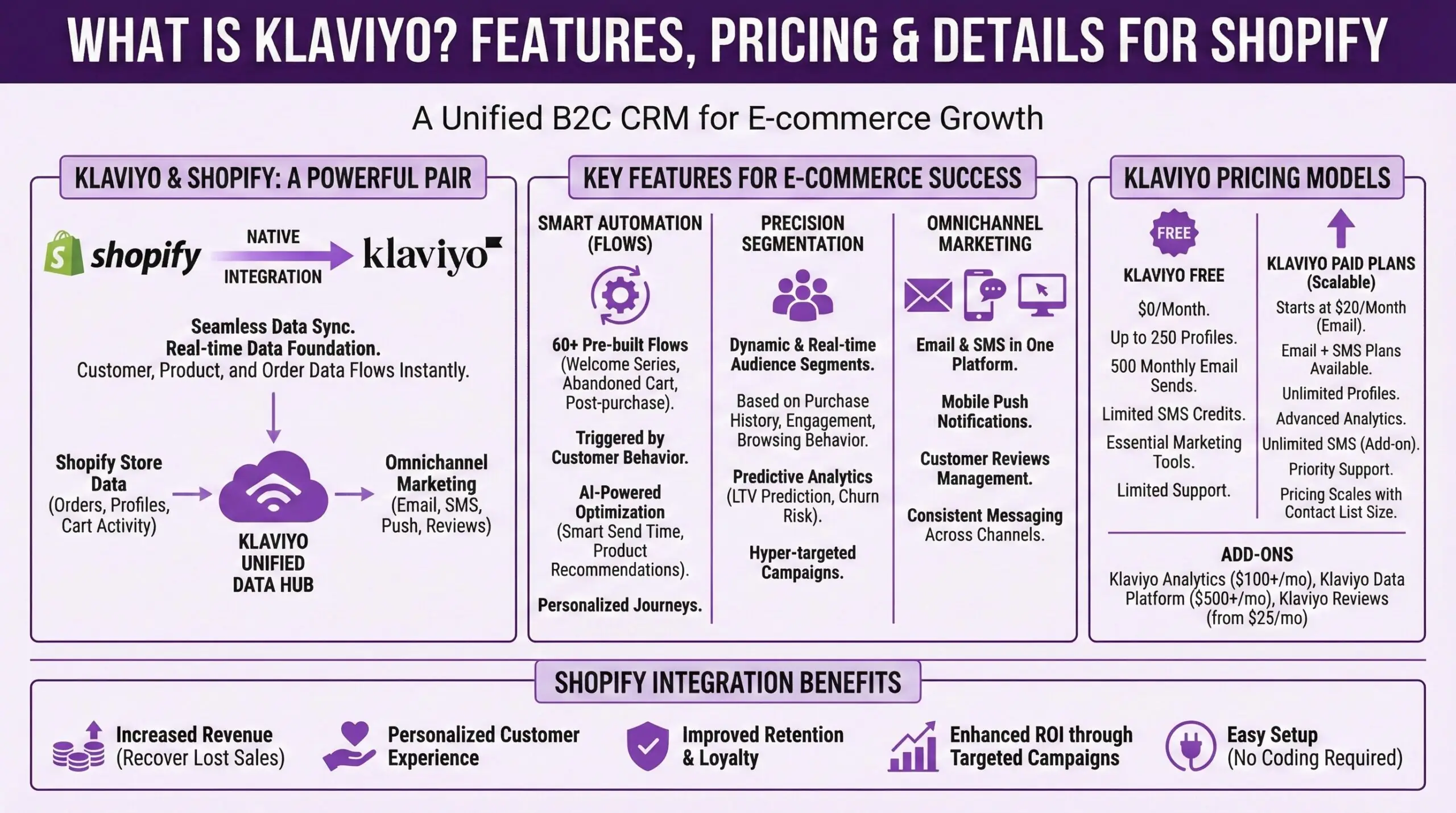
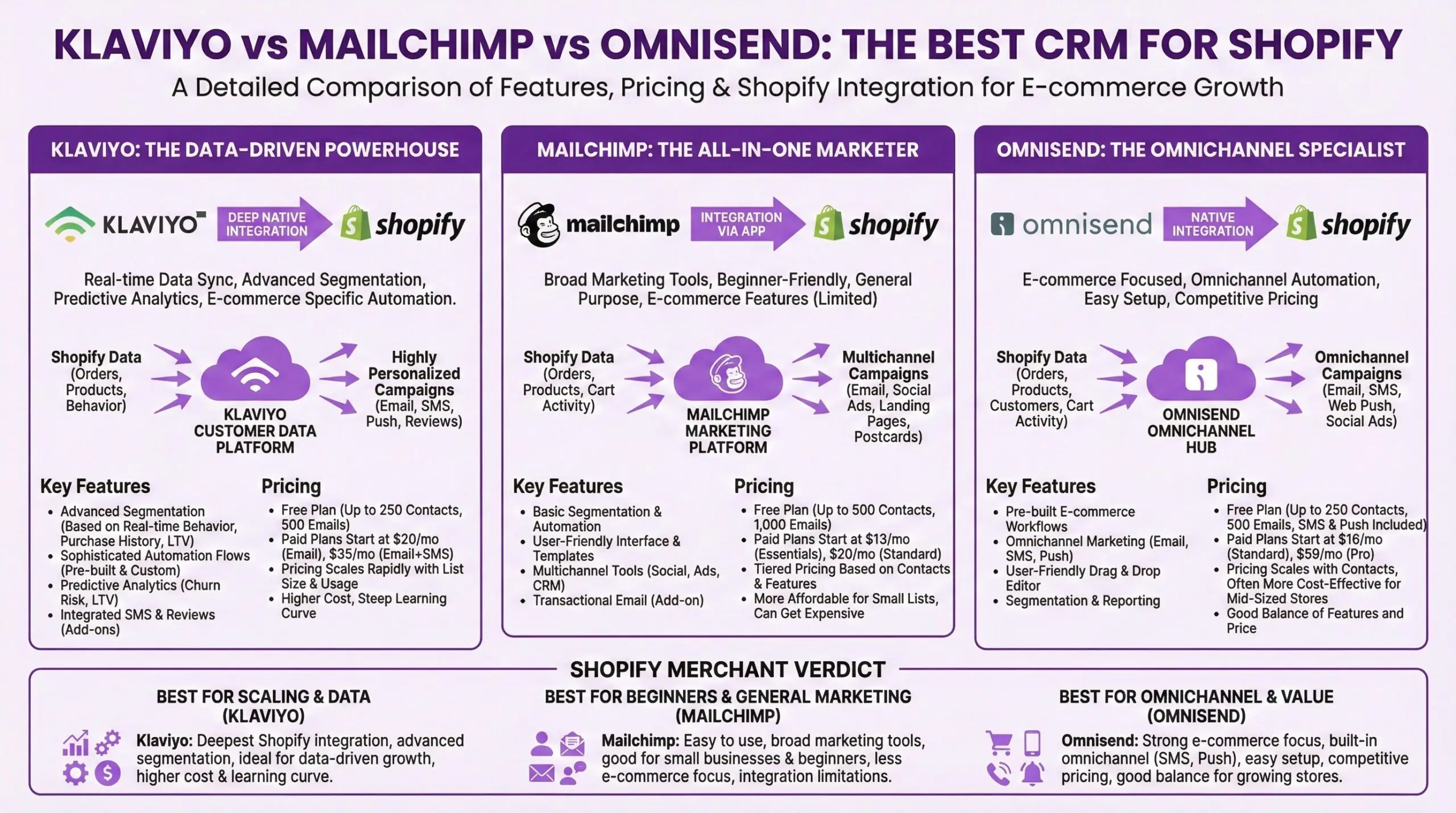
Klaviyo was built specifically for e-commerce from day one. Every feature assumes you’re running an online store, which creates remarkable depth for that use case and precisely nothing for anything else. The platform excels at behavioral data, predictive analytics, and granular customer lifecycle tracking. It’s built for marketers who want to manipulate every variable.
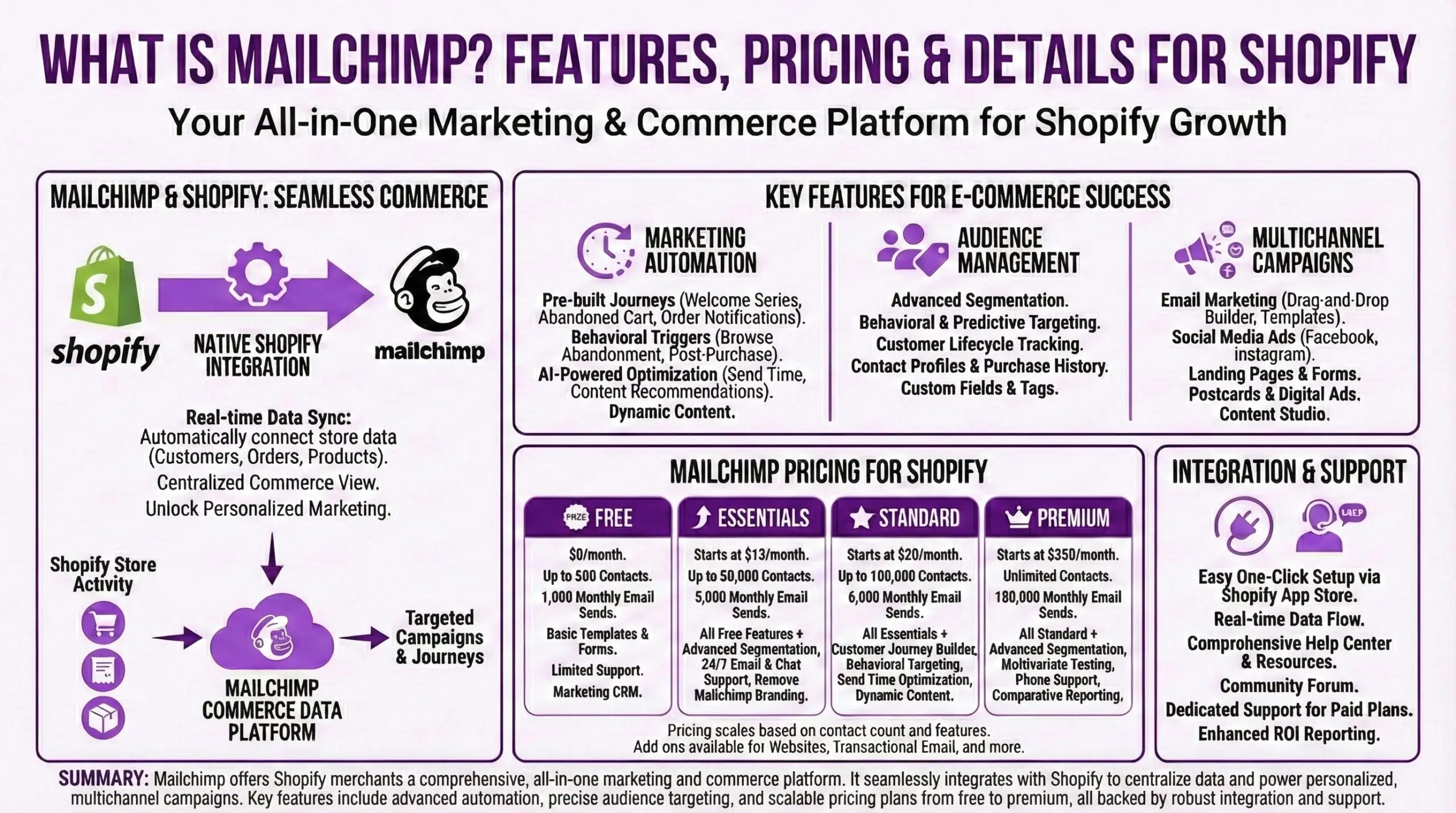
Mailchimp started as general-purpose email marketing and later bolted on .e-commerce features. This history shows in the breadth of functionality and the relative shallowness of Shopify-specific capabilities. After a decidedly public breakup with Shopify in 2019 over data-sharing disputes, Mailchimp and Shopify have reconciled, but the integration never quite recovered its former depth. Mailchimp serves businesses that need email to be one component of a broader marketing technology stack.
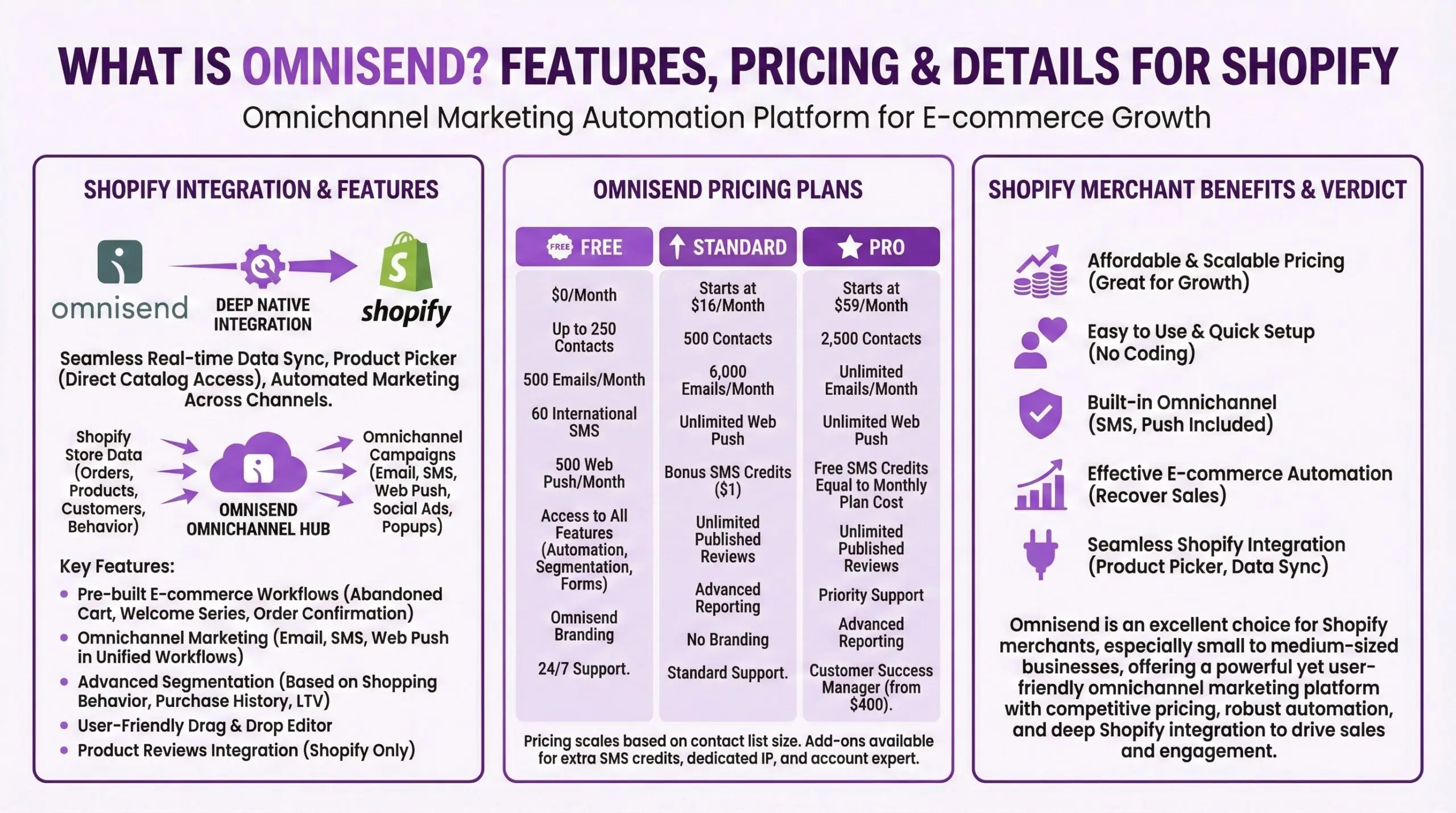
Omnisend positioned itself explicitly as a Klaviyo alternative for merchants who find Klaviyo’s pricing aggressive and its interface intimidating. It sacrifices some analytical depth for approachability and includes SMS and push notifications on all plans without the add-on bells and whistles.
The Real Cost of Each Marketing Platform
Like many if not most things in life, pricing comparisons in email marketing require context. Every vendor structures their tiers differently, and the advertised starting prices tell you almost nothing about what you’ll actually pay. Like. Let me illustrate with an example. Say you’re a Shopify store with 5,000 “active” email subscribers planning to send weekly campaigns plus automated flows.
Klaviyo charges based on active profiles rather than subscribers you actually email. This became notably more aggressive in February 2025 when they shifted from emailable contacts to all active profiles in your account. For 5,000 profiles, you’re looking at roughly $100 per month for email only. Add SMS capability and it jumps to $150 or more, depending on message volume. The price scales steeply as you grow, and there are “price cliffs” where moving from one tier to the next triggers disproportionate increases.
Mailchimp operates on a tiered feature model where the capabilities you actually need for effective e-commerce marketing (custom automations, predictive segments, advanced A/B testing) require Standard ($85/month for 5,000 contacts) or Premium plans. The free tier’s value diminished significantly in 2025 when they restricted automation to single-step sequences only. For comparable functionality to Klaviyo, expect to spend similarly once you add the features necessary for sophisticated .e-commerce work.
Omnisend structures pricing around contact reach rather than total list size. Their Standard plan runs approximately $65/month for reaching 5,000 contacts with 60,000 monthly emails. The Pro tier at roughly $99/month adds unlimited emails and monthly SMS credits equal to your plan price. Critically, all plans include the same features. You’re paying for volume, not capability access.
Klaviyo and Mailchimp both gate their most powerful features behind higher tiers. Omnisend stands out with inclusive pricing.
CRM Platform Integration Depth with Shopify
This is where e-commerce retailers have to take it upstairs and see if it wheezes, and the differences are, well, real differences.
Klaviyo maintains arguably the deepest native Shopify integration in the market. Customer data syncs in real-time. Browsing behavior, cart activity, purchase history, and product interactions all flow directly into segmentation and automation triggers. You can build flows based on specific product views, category browsing patterns, and predicted next purchase dates. The integration feels native because functionally it is. Shopify’s investment in the company ensured that.
Mailchimp has rebuilt its Shopify integration following the 2019 fracture, but ghosts of that separation linger. The current app syncs customers, products, and orders adequately. Product recommendations work. Abandoned cart emails function. But edge cases emerge regularly in community forums. Users report sync delays, product recommendation blocks pulling inactive items, and occasional data mismatches. It works, but it requires more monitoring than Klaviyo’s set-and-forget approach.
Omnisend slots between these poles. The Shopify integration is native and reliable, automatically syncing historical data upon installation. Product feeds for emails, discount code generation, and purchase-triggered flows all work smoothly. The integration covers everything most merchants need without the depth Klaviyo offers for advanced behavioral analysis.
Marketing Automation and Work Flow Capabilities
Campaign automation is what separates email marketing from a newsletter. All three platforms offer automation, but the capabilities vary.
Klaviyo’s visual flow builder permits genuinely complex conditional logic. You can branch automations based on dozens of customer attributes, purchase behaviors, email engagement metrics, and predictive scores. Want to send different abandoned cart sequences to first-time visitors versus returning customers versus VIPs who abandoned high-value carts? Klaviyo handles that elegantly. The learning curve is real, but the ceiling is exceptionally high.
Mailchimp rebranded its Customer Journey Builder to “Marketing Automation Flows” in mid-2025, which signals their continued investment in the capability. The visual builder is intuitive for basic sequences and struggles with complex branching logic. For standard .e-commerce flows like welcome series, abandoned carts, and post-purchase follow-ups, it works fine. For sophisticated behavioral targeting, you’ll hit walls.
Omnisend offers pre-built automation workflows specifically designed for .e-commerce that many merchants can implement with minimal customization. The abandoned cart recovery, welcome flows, and browse abandonment sequences work out of the box. The automation builder is less flexible than Klaviyo’s but considerably easier to learn. You can combine email, SMS, and push notifications within single flows without managing separate platforms.
Which Merchants Should Choose Which Platform
Let me be direct about fit, because honest recommendations serve everyone better than equivocation.
Choose Klaviyo if: You’re doing over $1 million annually and your email marketing sophistication has outgrown simpler tools. You have or plan to hire dedicated email marketing personnel who can exploit advanced segmentation and predictive features. You need enterprise-grade analytics and customer lifetime value tracking. Your business model involves complex purchase cycles, multiple product categories, or subscription elements that benefit from behavioral prediction.
Choose Mailchimp if: Email marketing is one component of a broader marketing technology stack and you need extensive third-party integrations beyond .e-commerce. Your team already knows the platform from previous roles or businesses. You need website building, social ad management, and email under one roof for simplicity. Your Shopify store is a side business or starter project where proven reliability matters more than .e-commerce-specific depth.
Choose Omnisend if: You’re in the $500K to $3M annual revenue range where sophisticated email matters but Klaviyo’s pricing feels aggressive for current capabilities. You want SMS and email unified in one platform without managing separate vendors. Your team is small and needs to move quickly with pre-built flows rather than building custom logic from scratch. You value 24/7 support regardless of plan tier. Cost predictability matters as much as feature depth.
CRM Migration Mistakes You Need to Avoid
Switching customer relationship management slash multichannel marketing platforms is the exact opposite if easy. Your existing work flows, segments, and templates don’t transfer automatically between any of these vendors. Plan for two to four weeks of rebuilding if you’re moving from an established setup, longer if you’re running complex automations.
Omnisend offers free migration support that includes moving contacts, three workflows, five segments, three forms, and one email template. That’s unusually generous and worth factoring into your decision if you’re considering a switch. Klaviyo provides migration resources but expects more self-service. Mailchimp’s migration support is minimal.
Working with a Shopify Marketing Agency or Expert
Many performance marketing agencies always have preferred platforms. (Like everyplace I’ve worked “coincidentally” wound up using SEMrush). Some marketers prefer Klaviyo because they’ve built expertise and can justify higher implementation fees. Others genuinely believe it’s the best tool regardless of client size. Others push its competitors because margins are better or setup is faster.
When you’re evaluating potential agency partners for email marketing implementation, ask …
-
- What platforms do you support, and how do you determine which fits a specific merchant? A good answer involves questions about your business, not a reflexive platform recommendation.
- What’s your pricing structure for implementation versus ongoing management? Understand whether platform choice affects their compensation.
- Can you show me results from clients at similar revenue levels on different platforms? Comparative case studies reveal more than single-platform portfolios.
- What happens if the platform they recommend isn’t working? Flexibility matters more than initial confidence.
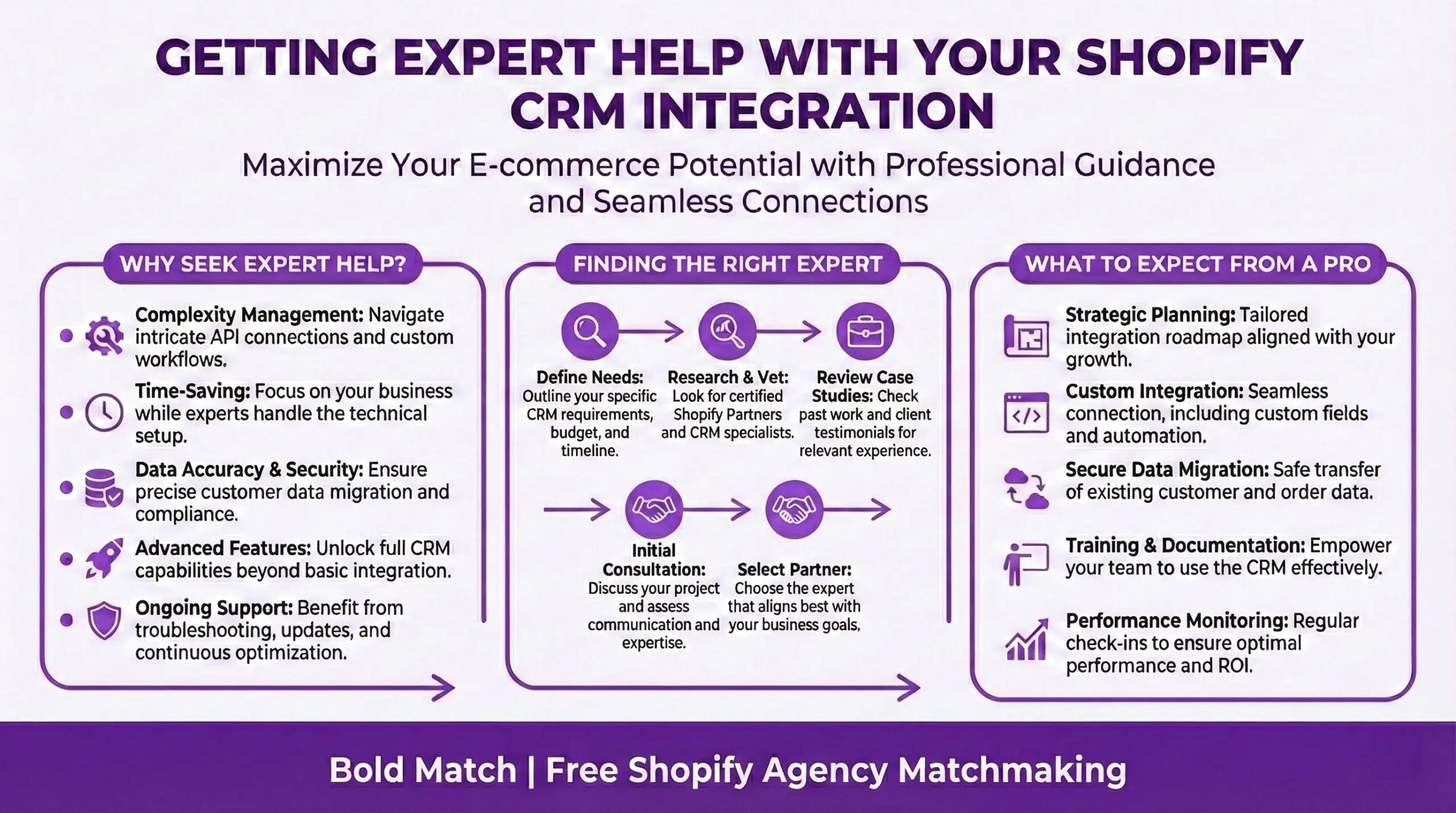
Bold Match connects Shopify merchants with vetted experts and partner agencies through our free matchmaking service. We don’t push specific platforms because our model doesn’t depend on implementation fees. The agencies in our network work across all the platforms I discussed here, and the matching process considers your specific situation rather than defaulting to conventional wisdom.
Maximizing Results With Your Multichannel Marketing Platform
“Klaviyo’s always the answer” makes sense for certain merchants and serves certain agency business models. It’s not universally true. For store owners approaching mid-size, the choice should reflect your current reality rather than your eventual aspirations. I mean. A platform you’ll outgrow in 18 months makes more sense than one you’ll underutilize for three years while paying premium prices for the privilege.
Start with a brutally honest assessment. How large is your list? How sophisticated are your current automations? What’s your realistic email marketing capacity given everything else competing for attention? Do you have dedicated personnel or is multichannel marketing one of many hats someone wears? Those answers should drive platform selection more than industry consensus or agency preferences. The best marketing platform is the one you will actually use effectively, not the one with the most impressive feature list gathering digital dust.
Klaviyo vs Mailchimp vs Omnisend for Shopify (Comparison)
|
Feature |
Klaviyo |
Mailchimp |
Omnisend |
|
Starting Price (500 contacts) |
$20/month |
$13/month (Essentials) |
$16/month |
|
Free Plan Contact Limit |
250 profiles |
500 contacts |
250 reachable |
|
Free Plan Email Sends |
500/month |
1,000/month |
500/month |
|
SMS Included |
Add-on pricing |
Add-on pricing |
Included (Pro) |
|
Push Notifications |
Included |
Not native |
Included all plans |
|
Shopify Integration Depth |
Excellent |
Adequate |
Good |
|
Automation Complexity |
Advanced |
Moderate |
Moderate |
|
Segmentation Capability |
Advanced behavioral |
Basic to moderate |
Good .e-commerce focus |
|
Pre-built .e-commerce Flows |
Extensive |
Limited |
Extensive |
|
Template Library |
~100 templates |
260+ templates |
100+ .e-commerce-focused |
|
A/B Testing |
Advanced |
Standard (paid plans) |
Standard |
|
Predictive Analytics |
Included |
Premium tier |
Not available |
|
Product Reviews |
Shopify only |
No |
Shopify only |
|
24/7 Support |
Paid plans |
Paid plans |
All plans including free |
|
Deliverability |
Strong |
Good |
Strong |
|
Ease of Use |
Moderate learning curve |
Beginner-friendly |
Beginner-friendly |
Frequently Asked Questions (FAQ)
Is Klaviyo worth the higher price compared to Omnisend or Mailchimp?Honestly. That 100% depends entirely on whether you’ll use the advanced features that justify the premium. Klaviyo’s predictive analytics, deep behavioral segmentation, and sophisticated flow logic deliver real value for brands with large lists and dedicated email marketing resources. For Shopify stores under $1 million in annual revenue with small teams, those capabilities often go unused while the invoices keep arriving. Omnisend’s lower pricing with equivalent core functionality makes more sense until your operation can actually exploit Klaviyo’s depth.
Can I switch email marketing platforms without losing my subscriber list?
Yes. Yes you can. Your subscriber list exports from any platform as a CSV file containing email addresses and whatever custom fields you’ve collected. What doesn’t transfer automatically are your automations, email templates, segments, and historical engagement data. Plan for rebuild time. Omnisend’s free migration support helps reduce that burden if you’re moving to their platform.
How do these platforms compare for SMS marketing alongside email?
It’s like this. Omnisend includes SMS credits in its Pro plan and allows building combined email and SMS automations within single flows. Klaviyo offers SMS as a separately priced add-on that integrates well but increases costs meaningfully. Mailchimp added SMS capabilities but they feel bolted on rather than native. For unified multi-channel marketing without vendor multiplication, Omnisend currently handles this most elegantly.
What happened with Mailchimp and Shopify? Is the integration reliable now?
Well. Mailchimp and Shopify parted ways in 2019 over data-sharing policy disagreements. The official integration returned to the Shopify App Store after they resolved those disputes, and basic functionality works reliably. However, the integration never regained the depth it had pre-separation, and community forums still surface occasional sync issues and feature limitations. It’s adequate for standard use cases and noticeably less robust than Klaviyo or Omnisend for advanced e-commerce automation.
Should I hire a Shopify Marketing Agency to help with email platform implementation?
Maybe. If you’re running complex automations, migrating significant subscriber lists, or implementing sophisticated segmentation strategies, professional help reduces errors and accelerates time-to-value. Simple implementations on user-friendly platforms like Omnisend or basic Mailchimp setups often don’t require agency involvement. Bold Match offers free matchmaking to connect merchants with vetted Partner Agencies suited to their specific needs and budget, which removes the guesswork from finding qualified help.
How long does it take to see results after implementing a new CRM?
It varies of course but expect four to eight weeks before meaningful data emerges. The first two weeks involve technical setup, list migration, and basic flow implementation. Weeks three and four see your first campaigns and automated sequences actually reaching customers. By week six, you have enough engagement data to start optimizing. Dramatic revenue attribution claims require even longer, usually three to six months of consistent execution with growing lists.
What’s the biggest mistake online merchants make when choosing an email platform?
Easy. Buying capability they won’t use. The most sophisticated platform becomes expensive dead weight if your team lacks the time, expertise, or list size to exploit its features. Start with what you’ll realistically implement in the next six months, not what sounds impressive in a demo. You can always upgrade later. Overspending from day one is harder to undo.
Do any of these CRM platforms help with email deliverability, or is that my problem?
Each of the platforms mentioned above maintain sender reputation infrastructure, authentication protocols, and compliance systems that handle the technical deliverability foundation. Your responsibility involves list hygiene, engagement-based sending practices, and content that doesn’t trigger spam filters. Klaviyo and Omnisend both show strong deliverability in independent testing. Mailchimp’s deliverability remains solid though slightly behind according to 2025 monitoring data. None of them can save you from purchased lists or aggressive sending to unengaged subscribers.