
Extensibility and the Future of Checkout Customization
Written and edited by: Eric
Hey everyone! How’ve you all been?
That’s right, it’s Eric Boisjoli again on Bold Match, and today we’ll be diving deep into something that’s fundamentally changing how Shopify stores customize their most critical conversion point: the checkout. If you’ve been anywhere near the Shopify ecosystem lately, you’ve probably heard whispers-warnings or maybe even full-blown panic about this thing called Checkout Extensibility.
Now, before you close this tab thinking that this is going to be another technical treatise that’ll make your eyes glaze over faster than a Tim Hortons donut, but in the opposite way, stick with me. Because what we’re really talking about here is the future of how growing merchants make their checkouts convert better, without breaking everything every time Shopify ships an update.
What Is Checkout Extensibility?
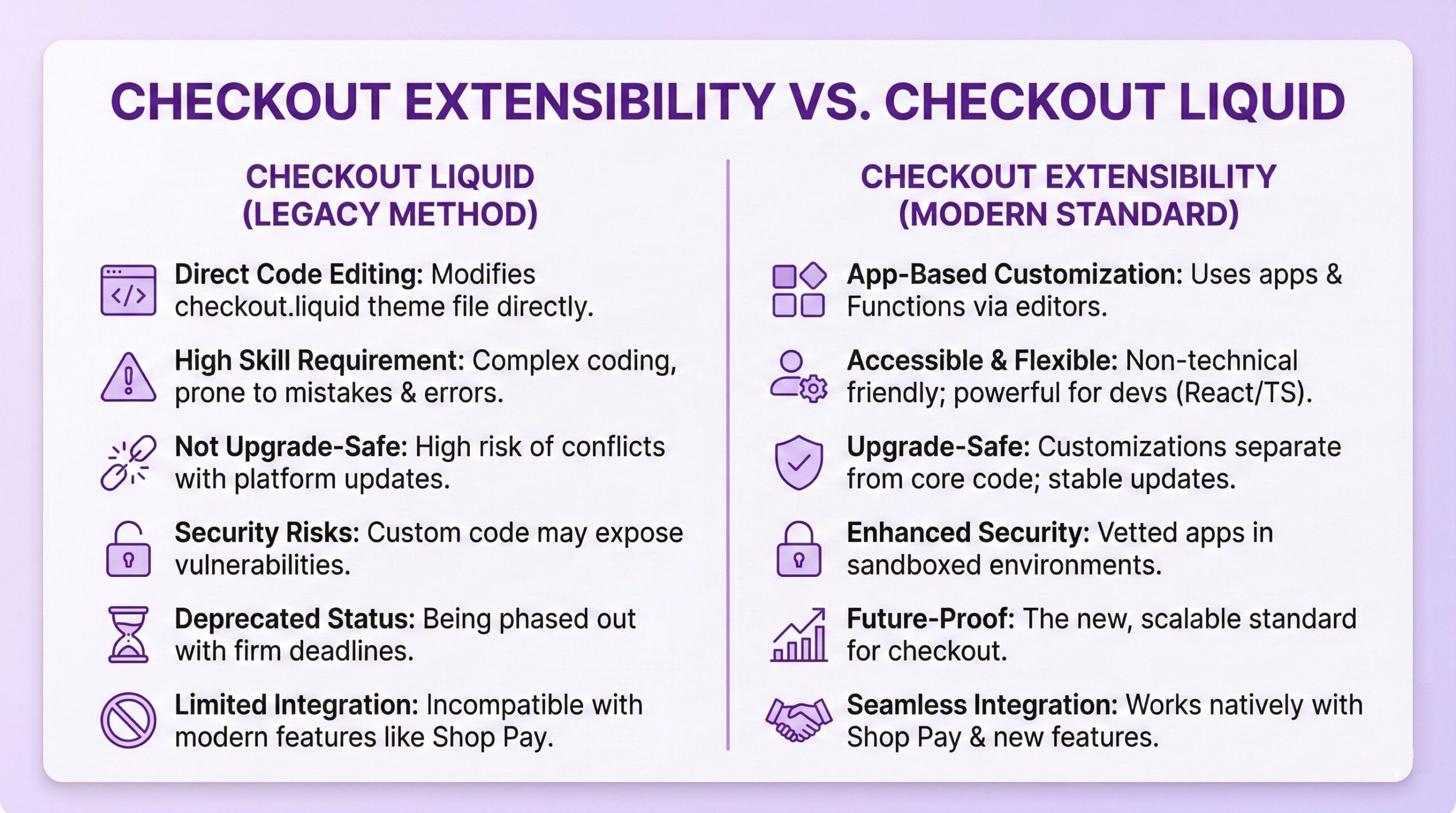
Let’s start with the basics, because honestly, Shopify’s documentation sometimes reads like it was written by engineers for engineers who already know what they’re writing about. Checkout Extensibility is essentially Shopify’s new framework for customizing your checkout that replaces the old checkout.liquid file. Think of it this way: the old system was like having complete access to your dirt biker’s engine where you could modify anything but also potentially break everything.
The new system is a bit more like having designated upgrade slots where you can plug in performance parts without accidentally disconnecting your brake lines. According to Shopify, customizations made with Checkout Extensibility work seamlessly with Shop Pay, which converts up to 50% better than guest checkout. That’s not a small number when you consider that the average conversion rate of e-commerce retail in 2024 was 1.65% according to IRP.data.
The fundamental shift here is from code-based customization to app-based “extensibility” (aka. the ability to be extended or stretched) So, instead of writing custom JavaScript and Liquid code that lives in your store’s theme files, you’re now using apps that hook into specific extension points that Shopify has predetermined as safe and sensible spots to customize checkout from.
Why Shopify Made This Massive, Merchant-Disrupting Move
Now. Obviously the development engineers over at Shopify didn’t just wake up one morning in June 2022 and decide to make thousands of merchants rebuild their checkouts for kicks and giggles. There were real, pressing, potentially problematic reasons behind this shift.
First, the security situation was becoming increasingly precarious. With ever changing regulations worldwide, including the introduction of card industry rules under PCI DSS v4, checkout.liquid was simply less secure than Checkout Extensibility. Every custom checkout.liquid file was essentially a potential vulnerability vector, and with payment data involved, and that was just not a threat surface size a platform could perpetually tolerate.
Second, the performance problems were piling up persistently. Custom checkout code could slow down the checkout process, and when the average cart abandonment rate sits at 70.19% according to Baymard Institute, every millisecond of additional load time translates to lost revenue.
Third, and this is probably the part that really matters most for growing retailers, the old system was demonstrably holding back innovation. Every time Shopify wanted to roll out new checkout features like one-page checkout or enhanced payment methods, they had to worry that they were breaking like thousands of custom implementations. It was like trying to upgrade a highway system where everyone’s built their own custom on-ramps.
What This Actually Means for Growing Merchants
If you’re at that stage where you’re transitioning from “we need any sale we can get” to “we need to optimize our conversion funnel,” Checkout Extensibility is actually phenomenal news. Checkout UI extensions let app developers (like me . ) build custom functionality that merchants can install at defined points in the checkout flow, including product information, shipping, payment, order summary, and Shop Pay. But here’s the catch that nobody’s really talking about loudly enough.
Checkout UI extensions for the information, shipping and payment step are available only to stores on a Shopify Plus plan. That’s right. If you’re on Basic, Shopify, or Advanced plans, you can only customize your Thank you and Order status pages. The actual checkout process where the money magic happens? That’s Plus territory only. For merchants in that growth phase where Plus’s $2,300/month starting price makes sense, this is actually advantageous. You’re getting access to customization capabilities that are both more powerful and more stable than what checkout.liquid ever offered. Our community of app developers has fully embraced Shopify Extensions launching over 860 extensibility-powered checkout apps with a range of capabilities.
Let’s “Pause” for a Technical Reality Check
Feel like I should paint you a picture of what working with Checkout Extensibility actually looks like, because the marketing materials don’t really do that and instead make it sound like you can just click a button and boom, have a fully-newly customized e-commerce checkout.
First, there’s the variably steep learning curve. What I mean is. If you or your developers have gotten too used to the wild west freedom of checkout.liquid, the structured nature of extensibility will feel constraining at first. Checkout UI extensions don’t have access to the DOM and can’t return DOM nodes. They can’t return div elements, for example. You’re working within Shopify’s component system, which means your store’s checkout will always look like a Shopify store checkout, just with your specific functionality added.
Second, there’s the app dependency situation. Every customization now needs to be an app, either a custom app that you build yourself or one you install from the App Store. Even for comparatively simple customizations, which might seem like overkill. Wanna add a post purchase product survey? That’s an app. Wanna show shipping or delivery date estimates? Another app. Pretty soon, your app stack’ll start looking like a late stage Jenga tower, and I think we all know how those end.
The Hidden Benefits Nobody’s Discussing
That said, for online retailers who eagerly embrace this change rather than resist it. The benefits will go beyond extensibilities out of the box “your checkout won’t break anymore” sales pitch.
Performance improvements are profound and provable. Without custom JavaScript executing on every page load, checkouts are faster. And when desktop maintains a higher conversion rate due to improved usability and user intent, every performance gain translates directly to revenue.
The upgrade-safe nature means you’ll never again have to choose between accepting Shopify’s latest features and keeping your customizations. Remember when one-page checkout rolled out and half the custom checkouts broke? Yeah. That kind of mass muck up is ancient history now.
Perhaps most importantly for growing merchants, the app ecosystem approach means you’ll never be alone when solving checkout challenges. Checkout Blocks saw the potential in Shopify Extensions early and empowers merchants on Shopify to customize checkout pages with code-free customizations like upsells, custom fields, delivery methods, address validation and more.
Making the Migration Without Losing Your Mind
So how do you actually make this transition without wanting to throw your laptop into the nearest lake? And a big lake. Like Great Slave Lake big. Or. No. Like Great Bear Lake big. Here’s the approach that seems to work best based on what’s happening across the ecosystem:
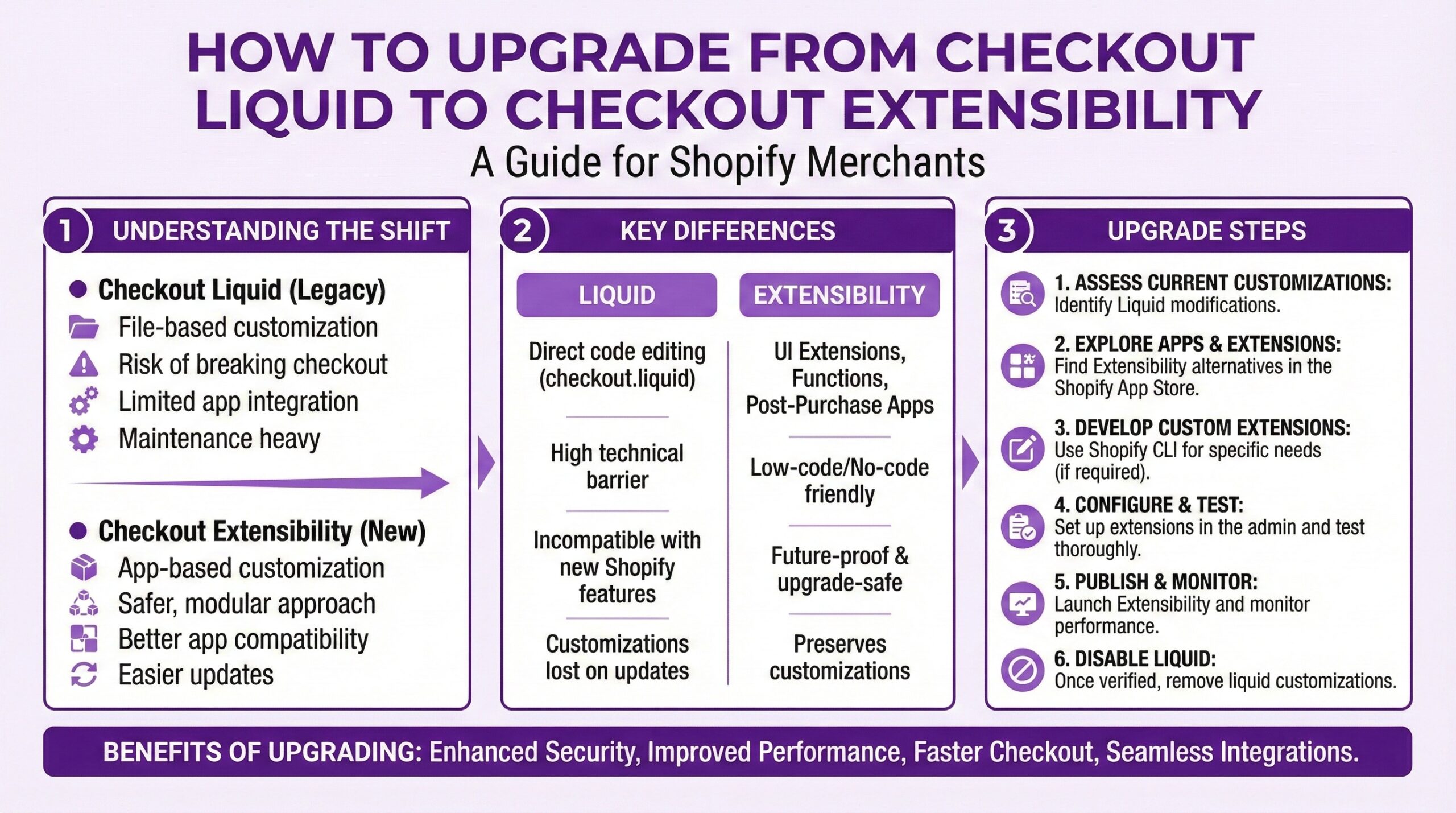
Start by auditing what you really will need. Many merchants discover that half their checkout.liquid customizations were workarounds for problems Shopify has since solved natively. That custom shipping calculator you legit loved? Shopify Functions handles that now. The complicated discount logic? There’s probably an app that’s calculating it better.
Next, prioritize based on business impact. Cart abandonment is a perennial challenge, with most consumers citing the unexpected costs, complex checkout processes, and insufficient trust as reasons. Focus on customizations that address such issues directly.
Then, brutally assess your build-versus-buy needs. With almost 1000 available checkout apps, chances are someone like me has already solved your challenge. Yes, apps have monthly fees, but compare that to the developer hours needed to build and maintain custom solutions.
The Future Is Always Already Arriving
What’s particularly fascinating about Checkout Extensibility is that it’s not just about replacing what we had with Shopify; it’s about enabling what we couldn’t do with Shopify before. The extensibility framework is designed to grow and evolve in ways checkout.liquid just never could.
We’re already seeing sophisticated implementations that would have been impossible or impractical with the old system. Dynamic shipping options that adjust based on cart contents, real-time inventory checking across multiple locations, progressive capture of customer information that reduces friction while maintaining compliance, these are becoming standard rather than special. The integration with Shop Pay alone makes this worthwhile for many merchants. When a payment method can increase conversion by up to 50%, fighting against the platform to maintain old customizations starts looking like a particularly poor business decision.
Upgrading to Checkout Extensibility
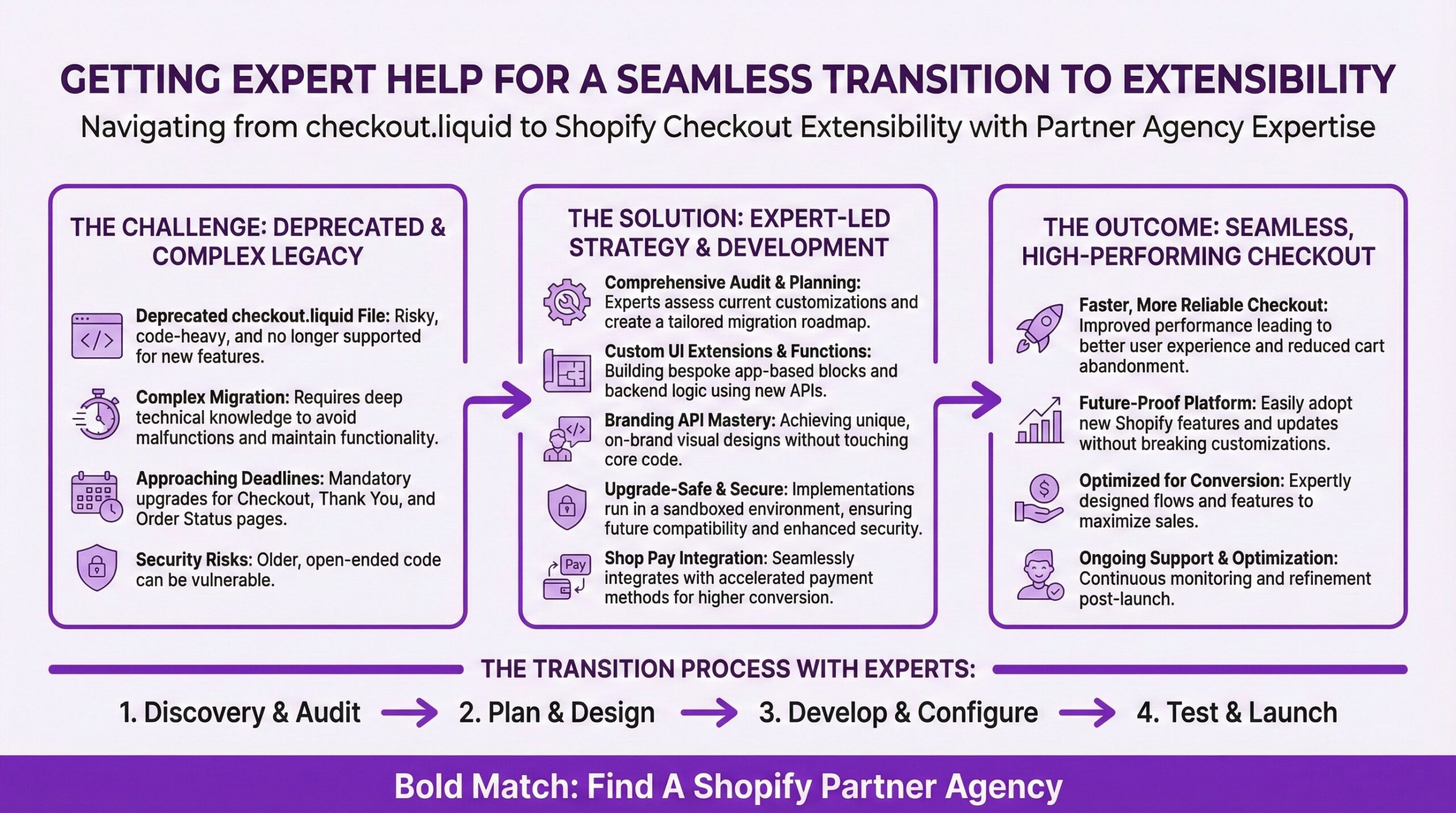
If you’re in that crucial growth phase where every conversion counts but you can’t afford to break things experimenting: If you’re not on Plus yet, start planning for it. The checkout customization limitations on lower tiers mean you’re leaving money on the table if you have any sort of conversion optimization needs beyond the basics. If you are on Plus, embrace this change fully.
The merchants who are thriving are those who’ve stopped trying to recreate their checkout.liquid customizations and started exploring what’s newly possible with extensibility. And regardless of your plan, start thinking about your checkout as a platform for apps rather than a template to customize. It’s a fundamental shift in mental model, but it’s one that aligns with where all of e-commerce is heading: composable, maintainable, measurable commerce stacks.
Checkout’s where browsers become buyers, carts become cash, and potential becomes profit. Checkout Extensibility isn’t just Shopify’s way of making checkouts easier to maintain; it’s their bet on how customization needs to work in an increasingly complex, compliance-heavy, conversion-critical world. And honestly? They’re right. If you’re finding yourself overwhelmed by the technical requirements of Checkout Extensibility, or you want to explore what customizations could genuinely move the needle for your conversion rates, and need helping hands. That’s exactly what we help merchants with at Bold Match. Now go make your tech stack work smarter, not harder! — Eric
Why was Checkout Liquid cancelled for Shopify?Checkout.liquid was customizable, perhaps even dexterously so but notoriously difficult to maintain and hard to upgrade besides. It wasn’t integrable with newer Shopify and Shopify Plus features, was incompatible with Shop Pay, had habitual performance issues and posed security risks. Shopify Checkout Extensibility is a secure, upgrade-safe, app-first approach to checkout experience customization and promises a more stable and consistent user experience.
What is Shopify Checkout Extensibility?
Shopify’s Checkout Extensibility is a collection of tools and APIs that allow online merchants and ecommerce developers to customize checkout processes. Extensibility is an App-based approach to checkout customization that offers retailers greater flexibility and more options to personalize checkout experiences, but does so without compromising store performance, security or scalability.
When Was the Deadline for Migrating to Checkout Extensibility?
The depredation for checkout.liquid and the deadlines for merchants migrating to Shopify Checkout Extensibility were August 13, 2024 and August 28, 2025. August 13, 2024 was the deadline to upgrade Information, Shipping, and Payment pages from checkout.liquid to Checkout Extensibility. And August 28, 2025 deadline to upgrade Thank You and Order Status pages and discontinue the use of associated script tags and additional scripts on those pages. Store owners who didn’t upgrade to Checkout Extensibility by those dates saw their pages revert to their defaults and lost any custom functionality.