
Onboarding Survival Guide for Your First 90 Days With a New Shopify Agency
Written and edited by: Jay
Hey! Congratulations! 🍾
I mean. You’re probably here because you’ve already done the hard part. You vetted agencies, compared proposals, sat through discovery calls, and signed on the dotted line. Congratulations. Now what? The contract is signed, the excitement is real, and then … silence. Or maybe not silence. Maybe a flurry of emails asking for logins and brand assets and “just a few documents” that somehow takes all week to assemble. Either way, those first few weeks with a new Shopify agency partner can feel surprisingly disorienting for something you just spent time and money choosing. And that’s completely normal. But “normal” doesn’t mean you can’t prepare for it.
You probably don’t need me to tell you something as obvious as this, but the first 90 days of any partner agency relationship are the foundation for everything that follows. The first three months represent peak churn risk across all agency models, with retainer-based e-commerce agencies losing around 8% of clients in the first six months alone. Roughly 23% of all customer churn can be traced back to poor onboarding experience. The relationship either builds momentum or it stalls. So let me walk you through what good onboarding should look like, what to expect from an agency partner, and how to set yourself up to get the most out of this investment.
Before Day One (Agency Onboarding’s Pre-Season)
Good agencies don’t wait until the official kickoff to start working. You should expect some form of pre-onboarding communication within a day or two of signing. This usually involves a welcome message introducing your primary points of contact, a questionnaire and intake forms covering your business goals and technical infrastructure, and a request for access credentials and brand materials.
That intake questionnaire matters more than you might think. The questions an agency thinks to ask before they start working can tell you a lot about how they’ll approach the work itself. If they’re asking about your revenue targets, your customer acquisition costs, how it compares to your customer lifetime value numbers, your top-performing products, and the dark spots or your pain points with your current Shopify store site, that’s a strong signal. If they’re only asking for your admin credentials, that’s a different signal entirely.
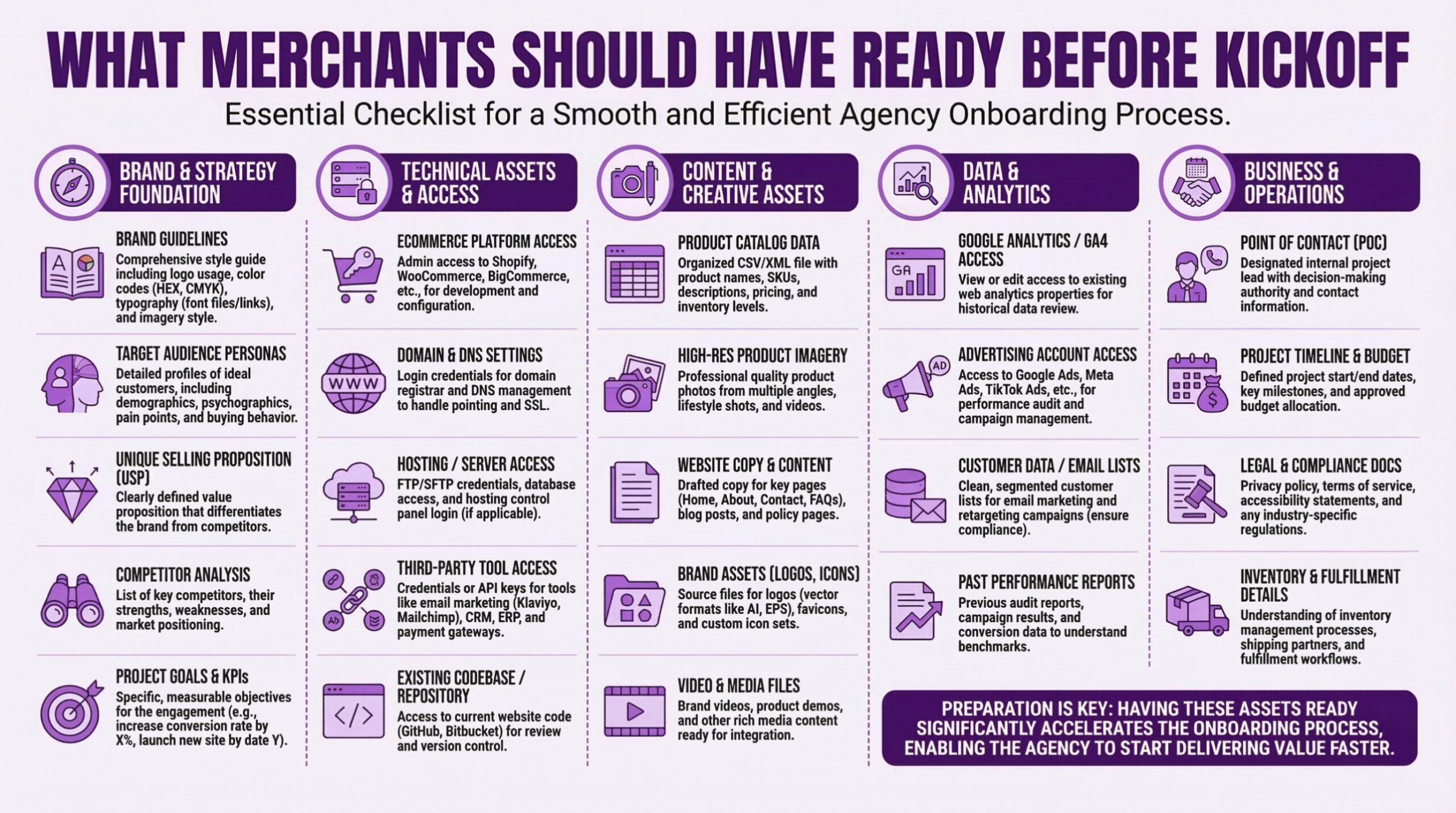
One practical tip for this phase. Create a shared document (a simple Google Doc will work fine) with all your brand assets, login credentials for relevant platforms, a summary of any previous agency work, and your four biggest priorities for your new engagement.
The Kickoff Calls and Getting Teams Aligned
Here’s where abstract project scopes turn into actual plans with actual people attached to them. A well-run kickoff call should introduce the core team members who’ll be working on your account (not just the salesperson who closed the deal), establish the communication rhythm and preferred channels you’ll be using, review and confirm the project scope, timeline, and key milestones, and set expectations about response times on both sides.
Now. Pay attention to who’s on this call. If the only person you’ve spoken with so far hands things off to an entirely new team and then disappears, that’s not necessarily a red flag. Agencies naturally separate their sales and delivery functions. But you should know who your day-to-day contact will be going forward. Having a dedicated account manager or project lead assigned to you is one of the strongest predictors of a healthy agency relationship. Research has identified dedicated success managers as a top onboarding best practice, noting that a single reliable point of contact eliminates the confusion that comes from being bounced between departments.
During this first week, expect your agency to conduct what’s usually called discovery or an audit. For Shopify stores, this means they’ll be looking at your current theme and site architecture, your analytics setup (Google Analytics, Shopify Analytics, any third-party tracking), your app stack and integrations, your checkout flow and conversion funnel, and any existing SEO foundation or technical debt.
This audit isn’t busywork. It’s how a professional partner agency figures out what they’re actually working with before making recommendations. Store owners sometimes get impatient here because it can feel like nothing visible is happening yet. But this is the part where good agencies separate themselves from the ones who just start rearranging furniture without checking the floor plan.
Discovery, Strategy, and First Deliverables
By the second or third week, the audit should be wrapping up and you should start seeing a strategy document or project roadmap. This is where the agency translates what they found during discovery into a plan of action. A solid roadmap will include specific deliverables with estimated timelines, clear ownership of tasks (what they’ll handle versus what they need from you), defined milestones for checking progress, and measurable success criteria so both sides know what “done” looks like.
The communication rhythm should be established by now. For most Shopify agency engagements, weekly check-ins are standard during the active build or optimization phase. Some retailers prefer quick 15-minute standups. Others prefer longer bi-weekly sessions. There’s no single right answer, but there should be an answer. If it’s been three weeks and you still don’t have a regular meeting cadence, ask for one. That’s not being demanding. It’s being a good partner.
Something that catches many first-time agency clients off guard during this period is how much the agency will need from them. Agencies aren’t vendors who disappear into a back room and emerge with a finished product. Especially in those first 30 days, expect requests for product photography, copy approvals, brand guideline clarifications, access to additional platforms or tools, and feedback on wireframes or design concepts. Your responsiveness during this window directly impacts the timeline. Timelines depend heavily on project scope, client responsiveness, and content readiness. After all, agencies can’t build what they don’t have the materials for, and delays on the merchant side compound quickly.
Visible Progress and the Feedback Loop
By the 30-to-45-day mark, you should be seeing tangible work product. What that looks like depends entirely on the scope of your engagement. If you hired for a store redesign, you should have design mockups or a staging site in progress. For ongoing optimization, you should see initial test results or performance recommendations. For marketing and SEO work, you should have content calendars, audit reports, or early campaign data.
This is also when the feedback loop becomes critical. Agencies that are good at this will proactively share progress reports, ask for your input at defined checkpoints, and adjust course based on what they’re learning. Agencies that are not so good at this will go quiet for stretches, deliver work that doesn’t match the brief, and get defensive when you ask questions.
Ok. A few things that are perfectly normal at this stage that sometimes worry merchants unnecessarily. Asking for a scope revision or timeline adjustment is not failure. Projects evolve. Initial assumptions get tested against reality. A good agency will flag when something needs to change rather than quietly falling behind schedule. Not every recommendation will be what you expected.
You hired experts, and sometimes expert advice means hearing that the feature you wanted isn’t the best use of your budget right now. That kind of pushback, delivered respectfully, is actually what you’re paying for. Results take time. If someone promises transformative changes in the first 30 days, be skeptical. Meaningful improvements in conversion rates, site performance, and search visibility usually take 60 to 90 days to materialize. A custom Shopify build alone usually takes 8 – 16 weeks depending on complexity.
The Keys To Good Merchant-Agency Partnerships
By the 60-to-90-day mark, you should have enough data and completed work to evaluate whether the relationship is working. This doesn’t mean every goal should be fully achieved. It means you should be able to answer three questions clearly.
First, is the communication working? Are you getting regular updates? Do you feel informed? Can you reach your point of contact when you need to?
Second, is the work quality meeting expectations? Are deliverables professional, on-brand, and aligned with what was discussed? When something isn’t right, does the agency fix it without drama?
Third, are you seeing evidence of progress toward your stated goals? Not necessarily final results, but directional movement. Better site speed. Cleaner analytics. Improved checkout flow. Content publishing on schedule. Whatever the agreed-upon metrics were, there should be signs of forward motion.
One pretty convincing report found that retainer-based agency relationships last an average of roughly 56 months when they work, versus 24 months for project-based engagements. That’s a big difference, and it suggests that merchants who invest in building a genuine ongoing partnership tend to get significantly more value than those treating agency work as a series of one-off transactions.
What You Can Do to Make Onboarding Smoother
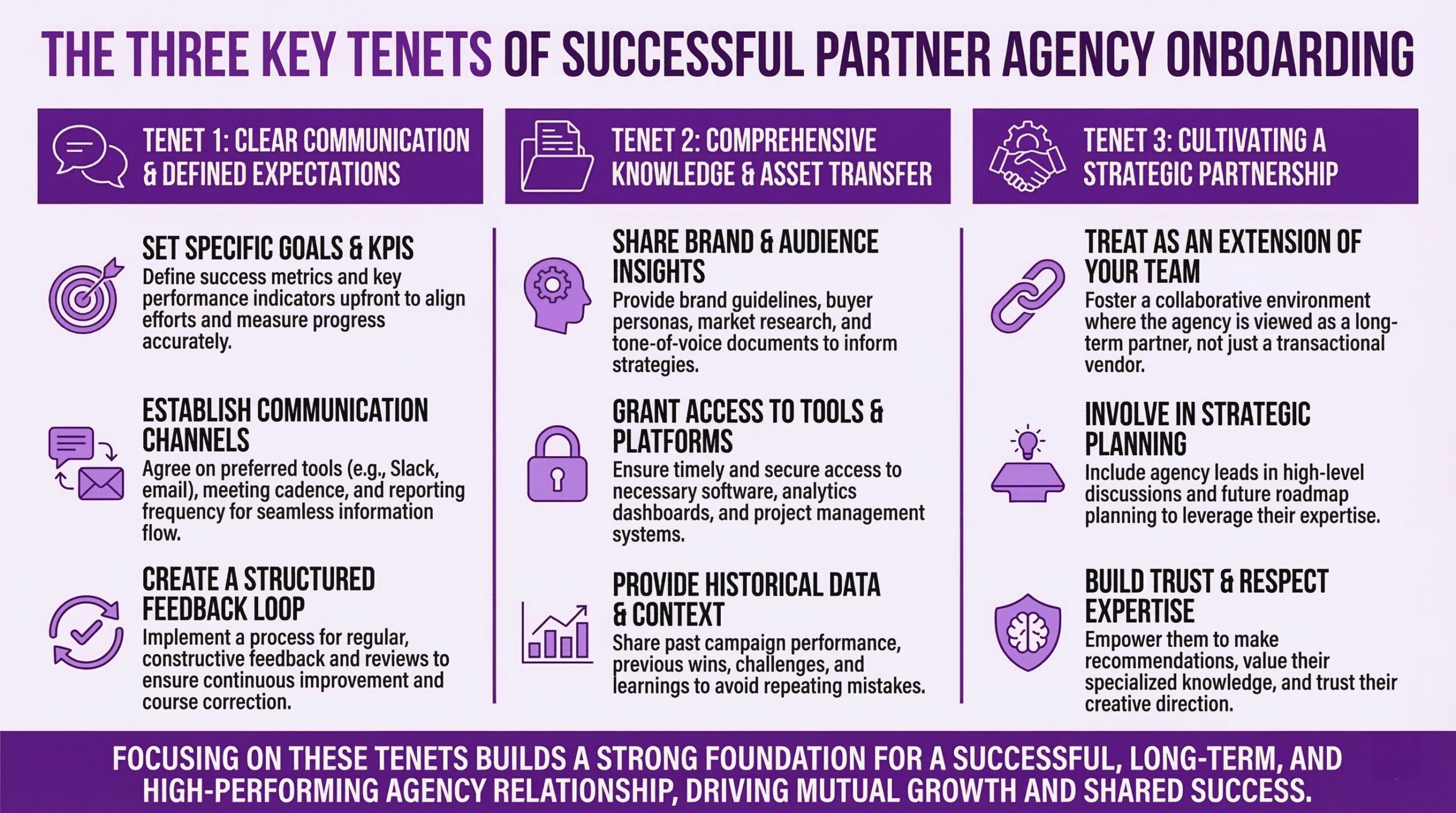
Shopify Agency onboarding is a two-way street. Some of the most productive partnerships happen when the retailer comes in prepared and stays engaged. Here’s what that looks like in practice. Designate a single decision-maker on your side. Nothing slows a project down faster than an agency waiting for approval from three different people who can’t agree. Pick one person who has the authority to sign off on deliverables and make that clear upfront.
Be honest about your budget, your timeline, and your internal constraints. If you know your developer is on vacation for two weeks in April, say so now. If there’s a hard launch date tied to a sales event, make that clear at kickoff. Agencies can plan around constraints. Surprises, not so much. Respond to requests promptly. I know, everyone’s busy. But that asset request sitting in your inbox for a week is blocking someone’s work. Even a quick “I’ll have this to you by Thursday” is better than radio silence.
Give feedback that’s specific and constructive. “I don’t like it” doesn’t help anyone. “The hero banner feels too dark for our brand, and I’d like to see our bestseller featured more prominently” gives an agency something to work with. And finally, trust the process. You hired professionals. Let them do what they do. Ask questions, absolutely. Push back when something doesn’t feel right, of course. But try to resist the urge to micromanage every design choice and technical decision. That’s not what you’re paying for.
When And How to Raise Any Concerns
Not every onboarding goes perfectly. Sometimes agencies miss deadlines, miscommunicate, or deliver work that doesn’t meet the brief. That happens even with good partners. What matters is how both sides handle it. If something feels off, address it directly and early. Don’t wait until Month Three to mention that the weekly calls stopped happening in Week Four. Most issues in agency relationships are communication problems disguised as quality problems. A quick, honest conversation (“I expected to see X by now and I haven’t. Can we discuss?”) usually resolves things faster than building a case in silence.
Persistent patterns are a different story. If you’re consistently not getting responses within a reasonable timeframe, if deliverables are repeatedly late or off-brief, if the team assigned to your account keeps changing without explanation, or if the agency becomes defensive rather than solutions-oriented when you raise concerns, those are signs of a deeper mismatch. At that point, document everything, have a formal conversation about the relationship, and know that it’s okay to part ways if the partnership isn’t working. The first 90 days exist partly as a proof-of-concept period for exactly this reason.
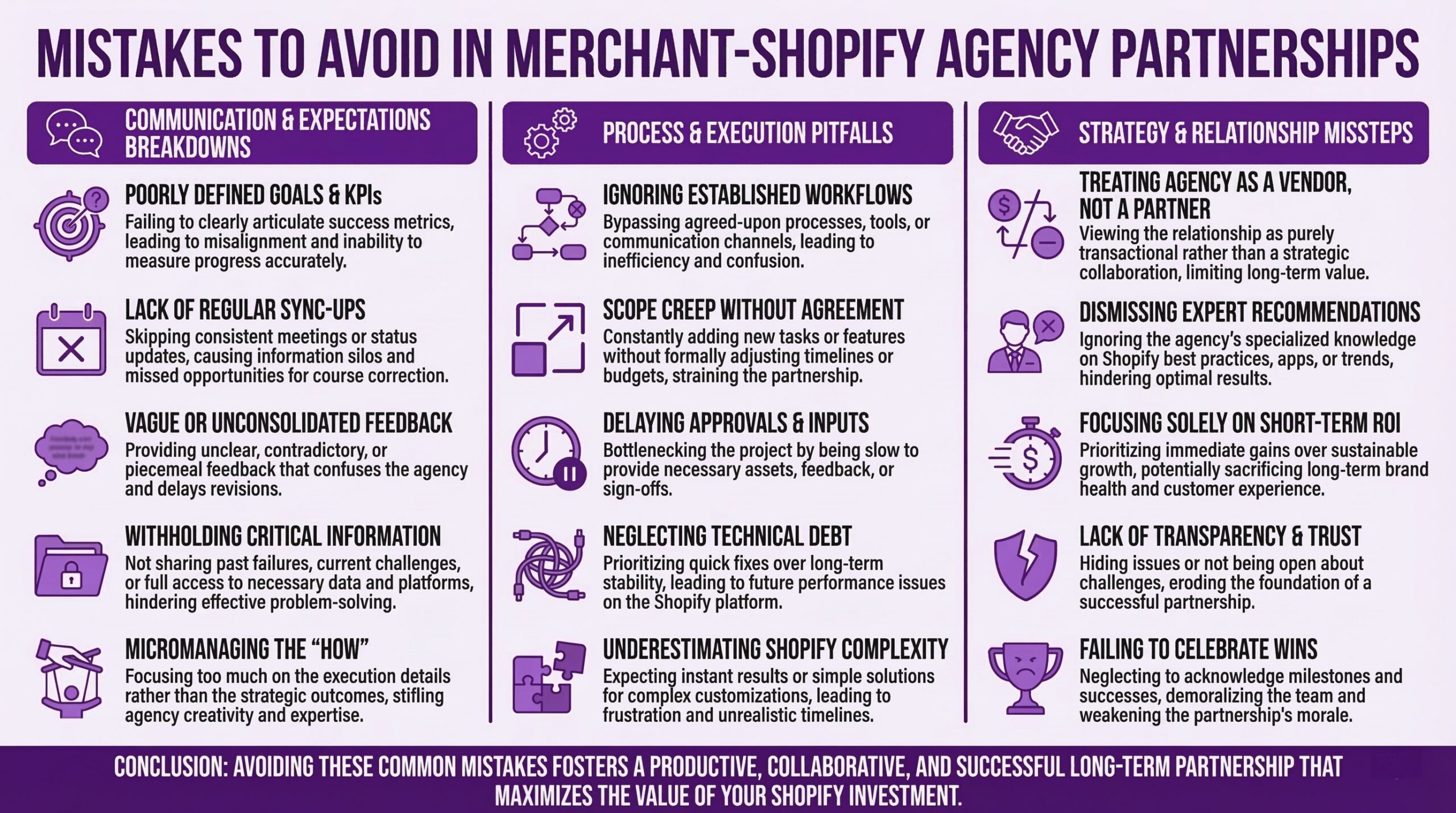
Build A Working Relationship With Your Agency
The best working relationships can’t be built overnight. It gets built through dozens of small interactions, honest conversations, and shared problem-solving across those first 90 days and beyond. According to industry data, structured onboarding programs can boost first-year retention by as much as 25%. Onboarding that includes a real human touchpoint (an actual phone call or one-on-one meeting, not just automated emails) yields up to 30% better 90-day retention compared to fully automated processes. The numbers are clear on this. The effort you put into the first three months pays compounding dividends.
So do the prep work. Show up to the kickoff ready. Respond to requests on time. Give honest feedback. And give the partnership room to breathe and develop. Three months from now, you’ll either have a partner who understands your business and is actively helping it grow, or you’ll have the clarity to know it’s time to find one who will. Either way, that’s a win. So. Keep building something awesome – JAY
Frequently Asked Questions (FAQ)
What should I prepare before my first meeting with a new Shopify agency?Well. You’ll want to gather your e-commerce brand’s assets (logo files, brand guidelines, photography), login credentials for your Shopify admin and any connected platforms (Google Analytics, email marketing, social accounts), a list of your current apps and integrations, and a written summary of your top three business priorities. Having these ready before the kickoff call saves at least a week of back-and-forth and demonstrates to your new partners that you’re organized and committed to a productive relationship.
How often should we expect to hear from an agency during onboarding?
That depends, but during the first 90 days, weekly communication is the standard for most active Shopify engagements. This usually takes the form of a brief status call or video meeting plus written updates via email or a project management tool. Some merchants prefer shorter, more frequent check-ins while others are comfortable with longer bi-weekly sessions. The format matters less than the consistency. If you haven’t established a regular rhythm by the end of Week Two, raise it with your agency contact.
How long before I start seeing results from my Shopify agency?
It depends on the engagement. For development work like a store build or redesign, you should see initial wireframes or mockups within the first few weeks. For ongoing optimization, early test results usually appear around the 30-to-45-day mark. SEO improvements generally take 60 to 90 days to show meaningful movement in search rankings. Be wary of any partner promising dramatic results in the first month. Meaningful, sustainable progress takes time, and any experienced agency partner will set realistic expectations about that upfront.
What’s a normal onboarding timeline for a Shopify agency partner?
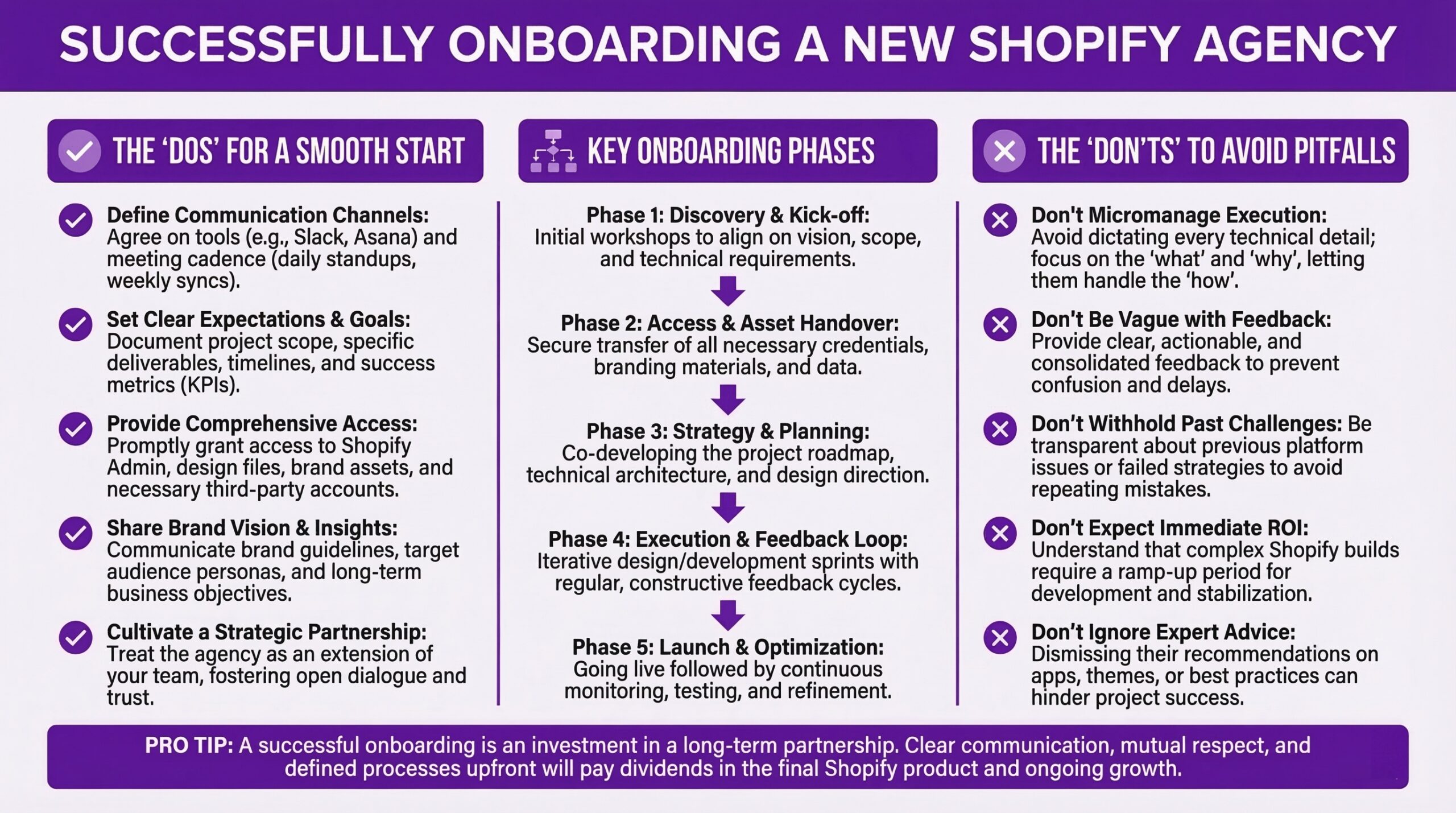
Most professional Shopify agencies follow a phased onboarding approach. The first week focuses on kickoff meetings, discovery, and gathering access and assets. Weeks two through four involve auditing your current setup and developing a strategic roadmap. Month two shifts into active execution with regular checkpoints and feedback loops. By the end of Month Three, you should have enough completed work and data to evaluate whether the partnership is delivering value. Custom store builds usually take 8 to 16 weeks depending on complexity, so longer project timelines are perfectly normal for larger-scope work.
What’s the most common reason agency-merchant relationships fail?
Communication breakdown. Not budget disagreements. Not creative differences. Communication. When a store owner doesn’t hear from their agency for stretches, or when the agency feels like they can’t get timely responses and approvals from the client, frustration builds quickly on both sides. Research consistently identifies poor onboarding experiences as a leading driver of client churn. Setting clear communication expectations at kickoff (preferred channels, response time targets, meeting cadence) goes a long way toward preventing these problems before they start.
How do I know if my agency is doing a good job during onboarding?
Look for three signals. First, they’re proactive in their communication. They don’t just respond when you reach out. They share updates, flag potential issues, and suggest improvements without being asked. Second, their work product matches what was discussed. Deliverables arrive on time (or with advance notice of delays), they reflect your brand and your goals, and revisions are handled professionally. Third, they can explain their decisions. A good agency partner doesn’t just tell you what they’re building. They tell you why, tied back to your business objectives.
Can I switch Shopify agencies if onboarding isn’t going well?
Yes. Yes you can and you should if the partner agency partnership clearly isn’t working out for you after honest attempts to address the issues. Before making that decision, document the specific problems, have a direct conversation with the agency leadership (not just your day-to-day contact), and give them a reasonable opportunity to course-correct. If the problems persist after that, make sure you retain ownership of all work completed to date, recover all access credentials, and request documentation of any changes made to your store. Most Shopify agency contracts include provisions for termination, so review yours before initiating the conversation.