
Do You Need a Shopify Expert or a Select, Plus or Premier Partner Agency?
Written and edited by: Jay
Hey gang! How’s your first week back in the office treating you! 👋
You guessed it. I’m Jay Myers and this is Bold Match. And before we go any further, if you’re joining me on this one mid-series, you might want to hit pause and reverse and then check out our previous Shopify Partner Track articles first. We’ve covered the differences between expert freelancers and partner agencies, how Select Partners earn their stripes, what happens when they climb to Plus status and the rare air that premier partner agencies occupy. Today (because I’m saving a Platinum Partners post that just says “Congratulations!” for closer to or specifically on April 1st) I thought I’d put all that together with a practical framework for figuring out which tier of help you actually need.
The Question Shopify Merchants Are Asking
When an e-commerce retailer asks whether they need an Expert or a Partner Agency, they usually aren’t asking a technical question about Shopify’s new official credentialing system. They’re asking something closer to … How much help do we really need and how specialized should that help be? The answer depends on what you’re trying to accomplish, the technical complexity you’re dealing with, and honestly, how much risk you can absorb if things go sideways. I mean, that reliable freelance consultant who nails your comparatively simple theme customization project is a better outcome than that Premier Partner Agency who treated your $33k conversion optimized store rebuild as an amusing afterthought between tackling their six-figure enterprise contracts. So let me try to break this down by what actually matters.
What Changed In Shopify’s Partner Program
Before we go further, a quick refresher on the landscape. Shopify overhauled its Partner Program back in January 2025. Their old system of vaguely designated “experts” and loosely defined credentials was replaced with a tiered structure that really is measuring something.
The Service Track now has five partner tiers that are based on Commercial Impact and Verified Skills credentials. Registered equals where everyone starts. Select means someone has demonstrated real commercial contribution and passed proctored assessments. Plus adds more credentialed team members and higher revenue thresholds. Premier and Platinum are invitation-only tiers for agencies working with enterprise brands and generating serious Shopify revenue. One important note that still confuses people. “Shopify Expert” isn’t an official designation anymore. The term stuck around in common usage because we all just kept using it, and it’s what store owners still search for.
But the Experts Marketplace became the Partner Directory, and the formal credentialing now runs through Shopify’s Service Tier system. So. When I use “Expert” elsewhere in this post, I’m only talking about freelance specialists and consultants, not an official Shopify status.
When a Freelance “Expert” Is What You Need
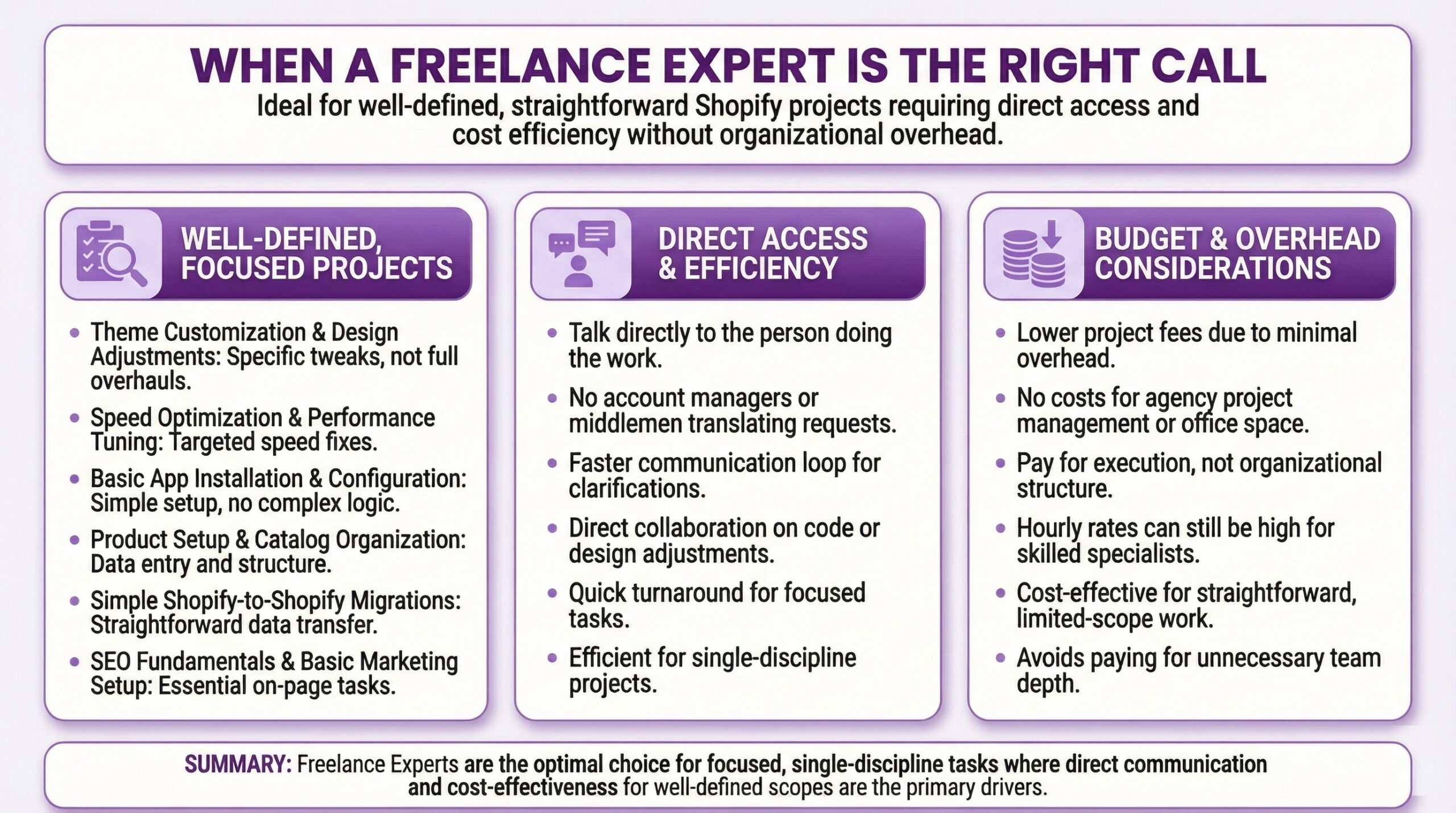
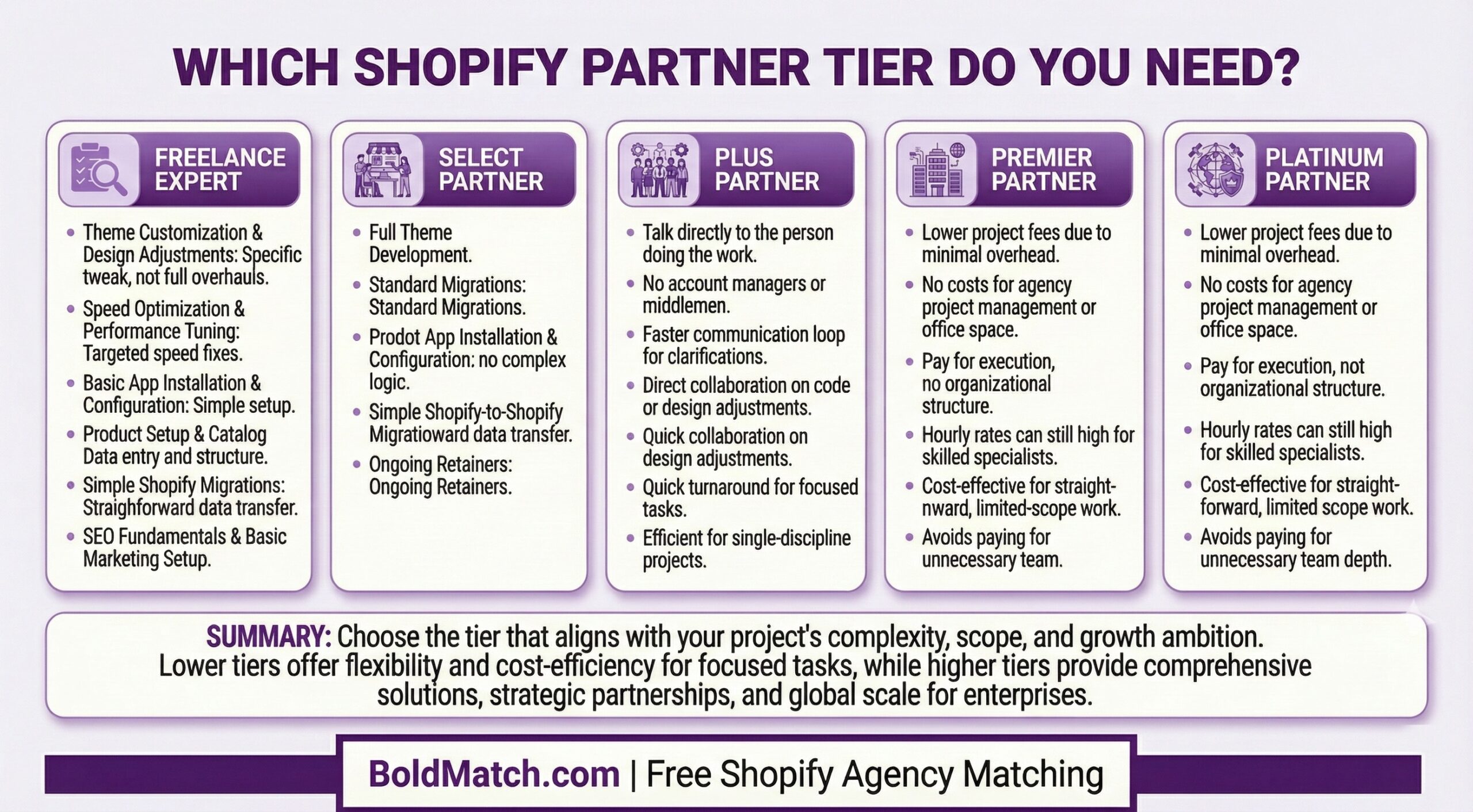
Freelance experts and small specialist consultancies make sense for a specific set of merchants in a specific set of situations. And I want to be clear here. “small” doesn’t mean “less capable.” It often means focused, specialized, and often more personally invested in your store’s success than larger operations can afford to be. Consider going the freelance route when your project is well-defined and truly straightforward. Theme customization. Speed optimization. Basic app configuration. Setting up product variants. These are projects where you do need someone who knows what they’re doing, but you don’t really need a whole tiger team of twelve “experts” with Gantt charts.
Hiring a freelancer will also make sense when what you want is direct access to the person actually doing the work. With agencies, you often wind up talking to account managers who translate your requests to designers or developers you’ll never meet. With a freelancer, you’re talking to the person writing code or adjusting your store’s UX. That direct access can matter. Budget constraints favor freelancers too. Not because they’re cheaper per hour necessarily, but because you’re not paying for organizational overhead. No project managers. No office space. No middle management layers. That efficiency typically translates to lower project costs for straightforward dev work.
The tradeoff with solo consultants is capacity and continuity. They’re one person. If they get sick, take vacation, or get overwhelmed with all their other projects, your priorities will suffer. And if they just disappear, which does happen, you’ll be starting over with someone new.
Questions to Ask Before Choosing An Expert Freelancer
-
-
- Do you have other specialists you work with for overflow?
- What’s the most complex project you’ve handled solo?
- How do you handle scope changes mid-project?
- What happens to my project if you get sick or need time off?
-
When You Need an Partner Agency at Any Tier
Partner agencies start making sense when projects get complicated enough that one person can’t handle them well. Or when the stakes are high enough that you need backup plans. Multi-discipline projects usually need agencies. If you’re doing a complete store redesign that involves new theme development, custom app integrations, migration from another platform, and ongoing marketing support, that’s multiple specialists working together. Freelancers can sometimes coordinate with one another well, but an agency will have established workflows for managing complicated projects.
Tight deadlines also favor agencies. More people means faster turnaround when needed. A freelance consultant working alone has hard limits on how much they can accomplish in a week. An agency partner can throw more resources (expert bodies) at a problem in a crunch.
Some risk assessment should also factor into your decision. Agency partners usually have more than one specialist who understands your project. So. If one of their experts leaves, the others are there to pick up the slack. That continuity can matter a lot when the work’s on some mission-critical system. And agencies usually carry professional liability insurance, which matters if something goes seriously wrong.

Choosing Between Select, Plus and Premier Partners
Once you’ve decided hiring a Shopify agency partner makes sense, you’ll have to sort your options by tier. Here’s how to think through it.
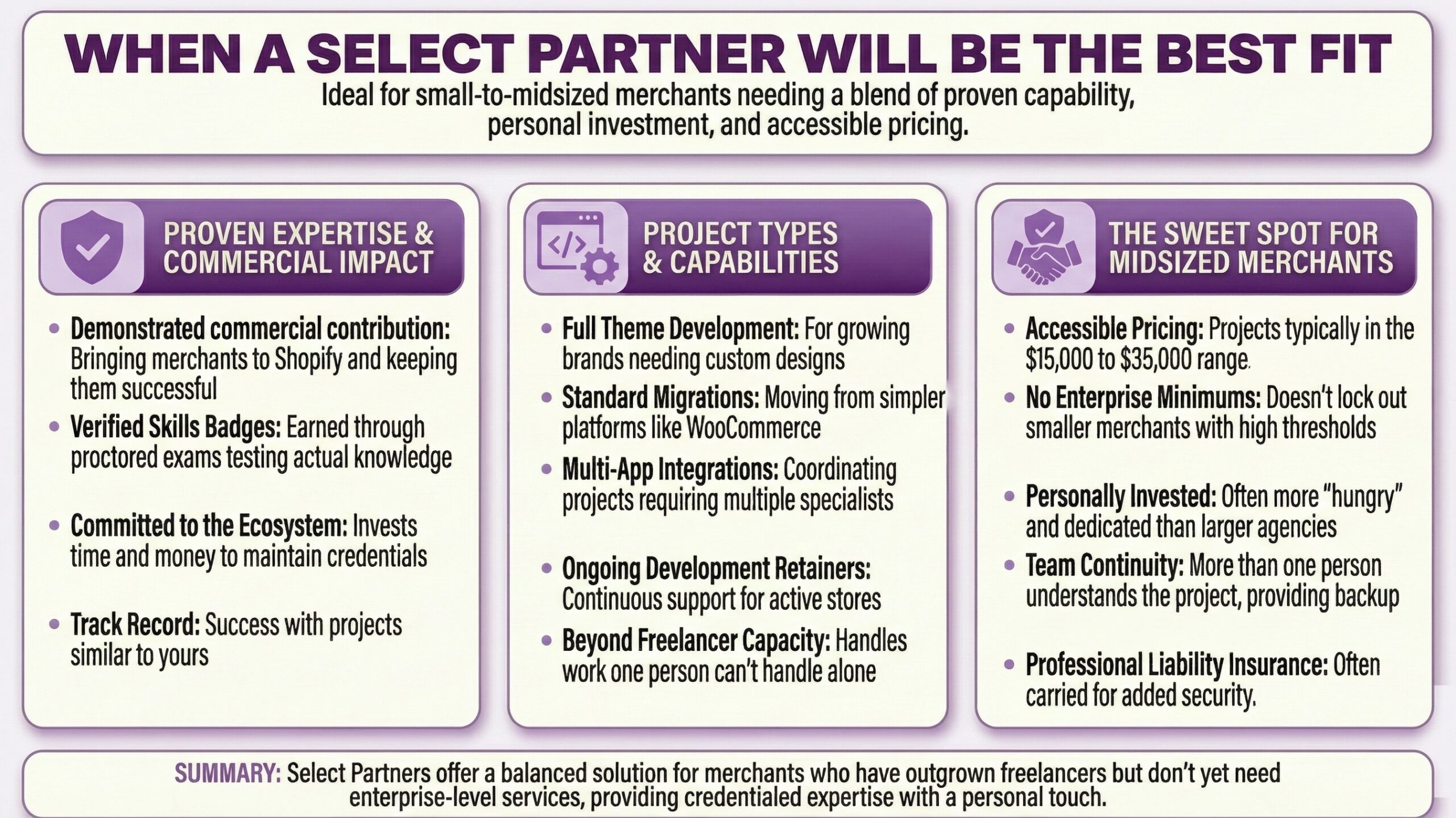
Shopify Select Partners are agencies who’ve taken the first major step beyond baseline partner status. They’ve demonstrated their commercial impact, which means they’re bringing real merchants to Shopify and keeping them successful. They’ve passed proctored skills assessments proving actual expertise. And they’re committed enough to invest time and money in maintaining their credentials.
For small-to-midsized e-commerce retailers in need of more or less straightforward web design or development work, Select Partner Agencies are often the sweet spot. They’re hungry enough to care about your project. They’re credentialed enough to deliver quality work. And they usually don’t have the minimum project sizes that lock out smaller merchants. Select Partners are your people when you need a theme customization that goes beyond what a freelance specialist could handle alone, a standard Shopify migration from a simpler platform, custom app integration work requiring multiple specialists, or ongoing retainer support without enterprise pricing.
Questions to Ask Before Choosing a Select Partner Agency
-
-
-
- How many credentialed team members do you have?
- Who specifically would work on my project?
- How long have you maintained Select status?
- What’s your track record with projects similar to mine?
-
-
Shopify Plus Partners operate in what the industry calls the “mid-market sweet spot.” Around 450 agencies worldwide hold Plus status. They’ve hit higher commercial impact thresholds and maintain more credentialed specialists than a Select Partner Agency.
Plus Partner Agencies make sense when the projects get tough. Platform migrations from Adobe Commerce or bearish legacy systems. ERP integrations with NetSuite, SAP, or Microsoft Dynamics. Custom checkout development beyond what standard apps provide. Multi-store architectures. B2B and D2C hybrid setups. The gap between Select and Plus isn’t just about capability. Plus Partners get better support from Shopify, earlier access to features, and dedicated partner resources. If your project requires navigating Shopify edge cases or upcoming platform changes, Plus Partners are better positioned to handle those conversations.
Questions to Ask Before Choosing a Plus Partner Agency
-
-
-
- Can you share references from projects with similar complexity?
- What percentage of your work is with Shopify Plus merchants?
- Which Verified Skills badges do your team members hold?
- What Shopify beta features or upcoming changes should I know about?
-
-
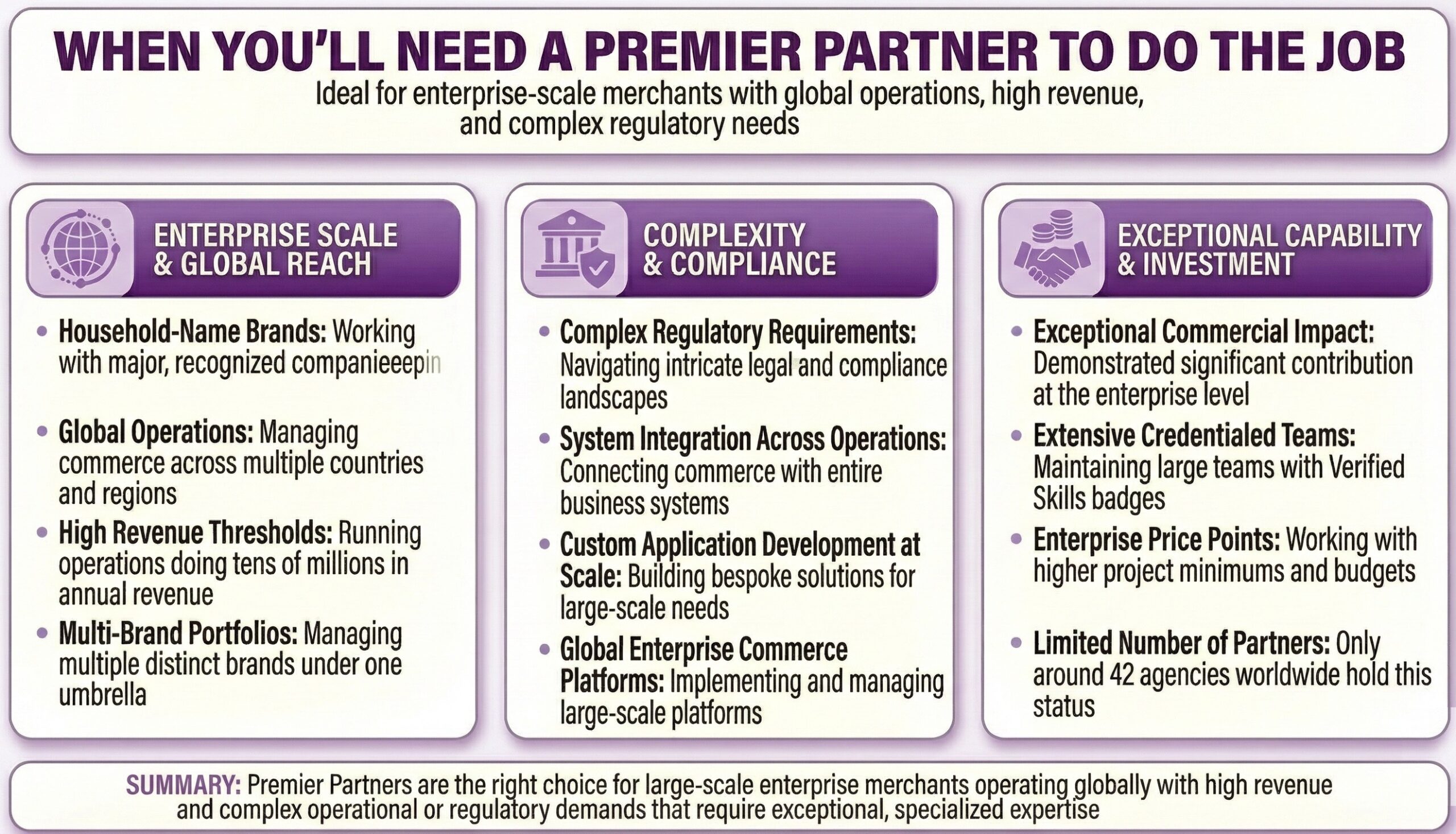
Shopify Premier Partners occupy air so rare that there are currently only around 42 of them worldwide. These agencies work with household-name brands and enterprise e-commerce operations. They’ve demonstrated exceptional commercial impact and maintain extensive credentialed teams. If you’re running an operation doing tens of millions in annual revenue, operating globally, or dealing with regulatory complexity that requires specialized expertise, Premier Partner Agencies might be appropriate. But for most growing merchants, the Premier tier exists to offer more capability than you need to pay for. If that’s where you are though, congratulations.
Questions to Ask Before Choosing a Premier Partner Agency
-
-
-
- How do you handle clients below your typical revenue threshold?
- Who would be my day-to-day contact versus project leadership?
- What’s your minimum engagement size?
- What enterprise-specific capabilities differentiate you from Plus Partners?
-
-
Shopify Platinum Partners are the apex air above the apex air. Like only roughly 14 agencies globally. These are major consultancies and systems integrators with enterprise capabilities and global reach. Think Oracle, Accenture, and a small handful of specialized commerce agencies. If your business is considering a Platinum Partner, you probably have procurement teams and RFP processes for that decision. My compliments on your success.🍾 For everyone else, Platinum is aspirational context, not a hiring consideration.
What About Shopify Agency Partner Price Differences?
Higher tiers usually cost more. But the relationship isn’t as straightforward as you might think.
-
- Freelance experts often charge lower project fees because they have less overhead. But hourly rates for skilled individual specialists can match or exceed agency rates. The savings come from efficiency and lack of markup, not from paying less for time.
- Select Partners typically charge $15,000 to $35,000 USD for substantial projects in their wheelhouse. That’s a rough range that varies significantly by region, specialization, and project scope.
- Plus Partners usually start around $35,000 and can run to $150,000 or more for complex implementations. The premium reflects team depth, specialized expertise, and capacity for sophisticated work.
- Premier and Platinum Partners work at enterprise price points. If budget is a primary constraint, these tiers probably aren’t appropriate for your project regardless of complexity.
The right partner for your project will usually cost less in the long run than the wrong one. An overqualified agency might charge more than you need to spend. An underqualified one might deliver work that needs to be redone. Matching capability to requirement is how you optimize the economics.
The Real Reality About Shopify Partner Tier Status
Let me level with you about what tier status can and can’t tell you.
-
- Tier status tells you about organizational scale and investment. Higher tiers mean more credentialed team members, higher commercial impact, and more Shopify ecosystem commitment. That’s meaningful context for evaluating capability.
- Tier status tells you about resource access. Higher-tier partners get better Shopify support, earlier feature access, and dedicated account management. Those benefits can translate into better outcomes for your project.
- Tier status doesn’t guarantee fit. A Plus Partner focused on fashion brands might be wrong for your B2B industrial supplies business. Specialization matters as much as tier. Sometimes more.
- Tier status doesn’t guarantee availability or enthusiasm. A Select Partner who’s genuinely excited about your project and has bandwidth might outperform a Plus Partner treating you as a low-priority fill-in.
Remember, You Don’t Have to Do This By Yourself
If this all felt like a lot to sort through, you are not wrong. Choosing between Expert Freelancers and the various tiers of Shopify Partner Agencies involves matching your specific needs to available capabilities while accounting for budget, timeline, risk tolerance, and just plain cultural fit. That’s genuinely complicated. Which is exactly why we built Bold Match. Our matchmakers understand the tier system, know the experts and the agencies, and can connect you with the right level of help for what you’re actually trying to accomplish. The matching process is free, would be our genuine pleasure and takes the guesswork outta finding and hiring expertise appropriate to your needs.
Whether you end up with a lone freelancing consultant who nails your theme customization or a Plus Partner Agency who adeptly tackles your complex migration, the goal is the same. Getting you the right help at the right scale for where your business is right now. And as you grow into needing more sophisticated partners, we’ll be here for that conversation too. Now. Go keep building something awesome! – Jay
The Do You Need A Shopify Expert or A Shopify Agency Partner Comparison Table
Reference guide for matching your needs to the right level of help.
|
Service Type |
Freelance Expert |
Select Partner |
Plus Partner |
Premier Partner |
|
Theme Customization |
✓ Primary |
✓ Can handle |
✓ Overkill |
✗ Not focused |
|
Store Setup |
✓ Primary |
✓ Can handle |
✓ Overkill |
✗ Not focused |
|
Speed Optimization |
✓ Primary |
✓ Can handle |
✓ Can handle |
✗ Too small |
|
Basic App Integration |
✓ Primary |
✓ Can handle |
✓ Overkill |
✗ Too small |
|
Full Theme Development |
✓ Possible |
✓ Primary |
✓ Can handle |
✓ Can handle |
|
Standard Migration |
✓ Simple ones |
✓ Primary |
✓ Can handle |
✗ Too small |
|
Multi-App Projects |
✗ Capacity limit |
✓ Primary |
✓ Can handle |
✓ Can handle |
|
ERP Integration |
✗ Usually not |
✗ Usually not |
✓ Primary |
✓ Primary |
|
Complex Migration |
✗ Usually not |
✗ Limited |
✓ Primary |
✓ Primary |
|
Custom Checkout |
✗ Usually not |
✗ Limited |
✓ Primary |
✓ Primary |
|
Shopify Plus Setup |
✗ Usually not |
✓ Limited |
✓ Primary |
✓ Primary |
|
Headless Commerce |
✗ Rarely |
✗ Limited |
✓ Primary |
✓ Primary |
|
Global Enterprise |
✗ No |
✗ No |
✗ Limited |
✓ Primary |
|
Ongoing Retainer |
✓ Direct access |
✓ Team support |
✓ Full service |
✓ Enterprise SLA |
Frequently Asked Questions (FAQ)
What is a Shopify Expert and how is that different from a Shopify Partner?This is probably the single most confusing thing about Shopify’s ecosystem, so let me try to clear it up. “Shopify Expert” was the official designation for freelancers and agencies listed in the old Shopify Experts Marketplace before Shopify replaced it with the Partner Directory in 2024. The term stuck around in everyday usage because everyone still says it, including us sometimes, and it’s what merchants search for. But technically, the formal credentialing now runs through the Partner Program with its tiered structure from Registered through Platinum. When someone calls themselves a “Shopify Expert” today, they usually mean they’re a specialist who works in the Shopify ecosystem. When someone is a “Shopify Partner” at a specific tier, that’s an official designation from Shopify based on demonstrated commercial impact and Verified Skills credentials.
How do I choose between a Shopify Expert Freelancer and a Shopify Partner Agency?
It won’t always be easy but you should start by assessing your project’s complexity and your risk tolerance. Freelance experts work well for well-defined, straightforward projects where you want direct access to the person doing the work. Theme customizations, speed optimization, basic app configuration. Agencies make more sense when projects involve multiple disciplines, tight deadlines, or stakes high enough that you need backup plans. If your project needs a designer, a developer, and ongoing support coordination, that’s usually agency territory. If it’s a focused technical task one skilled person can handle, a freelancer might be more efficient and cost-effective. The comparison between freelance experts and partner agencies goes deeper on this question.
What is the difference between Shopify Partner Program tiers?
Well. Shopify’s Service Track has five tiers. Registered is the baseline where everyone starts. Select means an agency or individual has demonstrated commercial impact and earned Verified Skills badges through proctored assessments. Plus requires higher thresholds for both metrics and more credentialed team members. Premier and Platinum are invitation-only tiers for agencies working with enterprise brands and generating substantial Shopify revenue. Each tier brings additional benefits from Shopify including better support, marketing resources, and co-selling opportunities. For merchants, higher tiers indicate greater organizational investment in the Shopify ecosystem, though fit and specialization matter as much as tier for any given project.
When should I hire a Shopify Select Partner versus a Plus Partner?
Select Partners are often the sweet spot for small-to-midsized merchants in need of more or less standard e-commerce agency work. Things like …Full theme development, migrations from simpler platforms, multi-app integration, ongoing retainer support. Plus Partners make sense when projects get genuinely complex. Platform migrations from legacy systems like Magento, ERP integrations with NetSuite or SAP, custom checkout development, multi-store architectures. The gap between tiers isn’t just capability but also access to Shopify resources. Plus Partners get better support and earlier feature access, which matters for projects involving platform edge cases. Right around 450 agencies hold Plus status worldwide compared to roughly 505 Select Partners.
What do Shopify Premier and Platinum Partners do differently?
Feel like there’s an easy “billing” joke here but in all seriousness … There are only around 42 Premier Partner Agencies worldwide and they work with household-name brands and enterprise operations. They’ve demonstrated exceptional commercial impact and maintain extensive credentialed teams. Platinum Partners represent the apex tier with roughly 14 agencies globally, including major consultancies and systems integrators like Oracle and Accenture. These tiers handle global enterprise commerce platforms, complex regulatory requirements, system integration across entire business operations, and multi-brand portfolio management. For most growing merchants, these tiers are more capability than needed. If your business is considering Premier or Platinum Partners, you’re probably operating at scale with procurement processes for those decisions already in place.
How much do different Shopify Agency Partner tiers cost to hire?
Honestly. Their pricing varies significantly by region, specialization, and project scope, but rough ranges exist. Freelance experts often charge lower project fees due to minimal overhead, though hourly rates for skilled individuals can match agency rates. Select Partners usually handle substantial projects in the $15,000 to $35,000 USD range. Plus Partners typically start around $35,000 and can run to $150,000 or more for complex implementations. Premier and Platinum Partners work at enterprise price points with higher minimums. The key insight is that matching capability to requirement usually optimizes economics better than simply choosing the cheapest option. An underqualified partner whose work needs redoing costs more than appropriate expertise upfront.
Can a Shopify Expert freelancer handle my Shopify Plus store?
Technically yes. Shopify Plus doesn’t require specific partner tiers for implementation or support. Skilled freelance experts with Plus experience can handle many Plus-specific tasks including checkout customizations, automation workflows, and API integrations. But Plus implementations often involve enough complexity and moving parts that agency support makes more sense. Plus Partners in particular have demonstrated experience with mid-market and enterprise merchants and maintain team depth for sophisticated work. If your Plus store needs a focused technical task one person can handle, a freelancer might work fine. If you’re doing a full Plus implementation or major overhaul, agency resources become more valuable.
What are Shopify Verified Skills badges and why do they matter?
Well. Verified Skills badges are credentials earned by passing proctored (aka monitored) assessments through Shopify Academy. They demonstrate proficiency in specific areas like Shopify development, checkout solutions, POS operations, and solution planning. Unlike older certifications you could get by clicking through quizzes, these assessments are AI-monitored, timed, and designed to test actual knowledge. They cost money to take, usually between $99 and $199, and expire after two years. The badges attach to individuals rather than organizations, which affects how agencies maintain their tier status. For merchants evaluating partners, asking about which specific badges team members hold and whether those badges match your project’s needs can reveal useful information about relevant expertise.