
The Shopify Retailer’s Guide to Print on Demand (POD)
Written and edited by: Jay
Hey there, Jay Myers here again
Hopefully you recall that in this Dropshipping Guide, I described Print-On-Demand as “technically a subset of dropshipping” with crucial differences? Well, I got a few questions about that so I figured it’d be we worth it to dig deeper into what I meant and the subject generally.
Let’s start by assuming that you agreed with me. That you also think that dropshipping “generic” products from AliExpress or Taobao or Spocket or wherever the heck the darn Spocket people go to dance when it’s time, is a race to the bottom, but are still wondering about print-on-demand because creating and selling your own designs wouldn’t be generic. That was a good catch. POD does in fact solve one of dropshipping’s fundamental problems. If you’re doing it right, you won’t be competing with other retailers selling identical products.
You’ll be competing based on creativity creativity of your work and how well your brand is suited to some market niche. But before you start dreaming about selling millions of clever t-shirts while you sleep, let me be clear about what print-on-demand actually is and isn’t. It’s still a strategy that’ll require real work, real investment, and a real commitment to customers. The only difference is you’re adding a creative layer to the fulfillment model. So let’s break this topic down the same way we did with dropshipping. Whether you’re considering POD for the first time, currently struggling with it or looking to scale, I’ll try and give you the unvarnished truth about what actually works.
What Print on Demand Will Mean in 2026
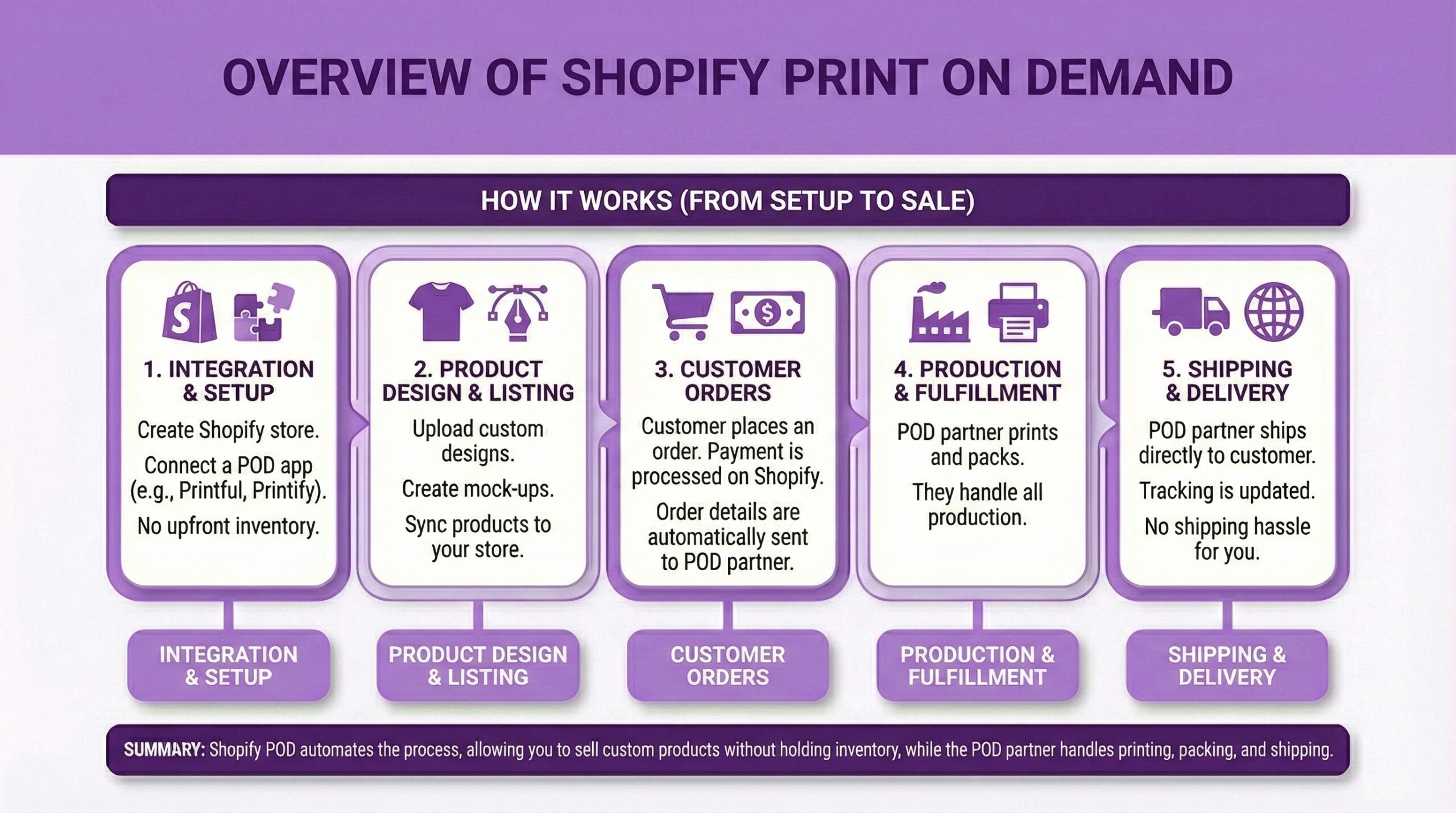
Print-on-demand means exactly what it sounds like it means. Every product involved is only “printed” after a consumer orders it. So. There’s no inventory, no upfront printing costs, no boxes of unsold merchandise sitting in storage or a warehouse. When someone buys your design, it goes onto the t-shirt, mug, or phone case they’ve chosen and your POD partner prints it and ships it to them. The key difference from dropshipping and Manufactured On Demand (MOD) media on vinyl or blu ray? You own the designs. Which means actual differentiation. No one else can sell your products unless they steal your designs, which is a different problem entirely.
POD is legitimate for the same reason any creative commercial endeavor is legitimate. You’re offering unique value through original designs, building a brand identity that resonates with a target audience, and solving the consumer problem of self-expression or gift-giving in ways that mass-produced products can’t. But just like dropshipping, print-on-demand isn’t a passive income machine.
Success requires understanding design trends, a deep understanding of your desired audience, managing quality control across multiple product types, and yes, dealing with customer service issues when that perfect design doesn’t look so perfect on the actual whatever when it arrives.
Should You be Considering Print on Demand?
It depends. If you’re carefully evaluating POD as a potential business model maybe. You’re already asking smarter questions than most. I mean. The e-commerce retailers who succeed with it approach print on demand strategically, not because they saw some guru on TikTok claiming that they made $55,555 a month selling crimson capybara cartoons on CamelBak gear.
When Does POD Make Strategic Sense?
POD works best when you have something unique to say visually. This might be original artwork or illustrations, clever typography and messaging that resonates with some specific sub-culture, designs in design styles that tap into underserved niches or communities, or the ability to quickly capitalize on a pop culture trend.
It’s particularly powerful for testing product ideas before committing to bulk inventory, building a brand around a specific aesthetic or message, creating merchandise for an existing audience or community, or offering personalized products without the complexity of a big in-house operation.
Print on Demand’s Creative Requirements
No. You won’t need to be Blu, Banksy or Basquiat, but you will need to be capable of consistent creative output. One viral design won’t sustain a business. You need dozens, eventually hundreds of designs to find what resonates. If you’re not a designer yourself, budget for hiring freelance designers or purchasing commercial licenses for designs. Factor in design tools like Adobe Creative Suite or Canva. Plan for the time investment in research, creation, and iteration. And understand that design theft is rampant in print on demand. Your best sellers will be copied.
Setting Up Your Store for POD Success
Your store needs to showcase designs effectively while building trust. This means high-quality mockups that accurately represent products, detailed size charts and product specifications, clear information about production and shipping times, robust review systems that include customer photos, and policies that address common print-on-demand issues like color variations. The biggest mistake? Using default mockups from platforms like Gelato or Zazzle. Invest in unique mockup templates or photography that makes your brand stand out. Consumers won’t be able to touch or feel print on demand products before buying. So the visuals need to do all the selling
Problems if You’re Already a POD Merchant
If you’re already more or less successfully designing and selling print-on-demand products but struggling with quality issues, poor margins, or being buried by customer complaints, you aren’t alone. You’re just hitting the reality check that most print on demand retailers eventually run into.
Diagnosing Your Current Challenges
The most common POD problems fall into predictable categories. Quality inconsistency where the same design prints differently on different products or batches. Design positioning issues where graphics appear off-center or sized incorrectly. Color matching problems where vibrant designs look dull on actual products. Shipping delays during peak seasons when print partners get overwhelmed. Consumer expectation gaps where products don’t match what they imagined.
Margin challenges are particularly acute in print-on-demand. Product base costs are high, typically 60-70% of retail price. Add platform fees, transaction costs, and marketing expenses, and many retailers discover that they’re barely breaking even or actually losing money per sale.
Upgrading Your POD Operations
Start by auditing your current POD partner performance. Order samples of your best sellers regularly. Document quality issues with photos. Track fulfillment times and accuracy. Compare costs across different providers for your core products. Many problems trace back to using a single partner (e.g. an Apliiq, a SPOD or a Gooten) for everything. Different providers excel at different products. Printful might nail t-shirts but struggle with mugs. Printify might offer better prices but longer shipping. Successful POD merchants often use multiple providers strategically.
You should also diversify your product offerings thoughtfully. I mean. It’s an obvious thing to say but not every design will work on every product. That Colorado River toad illustration that works on posters might look terrible on phone cases. So. Test extensively before adding new products.
Optimizing Your Design Strategy
Don’t hop onto the hamster wheel of creating random designs and just hoping one or two stick. Obviously some testing will be involved, but you should be systematic with regards to your approach to developing design collections and you should develop them with telling a cohesive brand story. Build series that encourage multiple purchases. Create seasonal variations of successful designs. Find out what’s actually selling (not what you think looks cool) by taking advantage of market research tools like Merch Informer, SpyAMZ or Sale Samurai to analyze successful designs. And study sellers in your niche to understand why certain designs resonate.
Most importantly. Just don’t forget what I said about theft. Protect your work. Watermark display images. Register copyrights for your best sellers. Use reverse image searches to find thieves. Have DMCA takedown templates ready. Design theft is unavoidable, but you can minimize that.

Give Your Customers Better Experiences
POD customer service will hinge on setting accurate expectations upfront. Be transparent about production times adding to shipping times. Show actual product photos and videos from customers, not just mockups. Address common concerns proactively in product descriptions. Create detailed FAQs covering color variations between screen and print, sizing differences across product types, care instructions for printed products, and what consumers can do if they’re unhappy with the quality.
Which reminds me. Respond to reviews and any complaints you receive about the quality of your products both quickly and generously. The cost of any replacement will be far less than the damage that a negative review can do. Trust me. To that end. You’re also going to want to build relationships with the support teams of your print partners. Remember. They’re the ones you’ll actually be relying on to expedite reprints and resolve any issues and they may do it faster if they know you.
Scaling Your Print on Demand Operation
If your designs are attracting an audience and your suppliers are reliable and reliably getting it done, so you finally feel ready to scale significantly … Congratulations! Take a second to soak that in and maybe even celebrate it. I mean. You’ve actually arrived in the territory where most print POD brands plateau. Going forward, your challenge won’t be your conversion rate. It’ll be maintaining the quality standards you’ve established, and your profit margins up while you grow.
Building Your POD Systems for Scale
Scaling sustainably will require systems beyond basic print on demand integration. Implement design asset management to organize hundreds of designs efficiently. Create templates and workflows for rapid design iteration. Build quality control processes that catch issues before customers do. Develop financial tracking that shows true profitability per design and per product
This is also where automation will become crucial. You’ll want to use bulk upload tools for new designs. Set up automated email campaigns for repeat customers. Implement chatbots for common customer service questions. But never automate quality control or design creation entirely.
Operational Efficiency + Supply Chain Optimization
-
- Once you’re scaling, consider hybrid fulfillment models. Keep your best sellers in stock for faster shipping and better margins while using print on demand for long-tail designs. This requires capital and complexity but can transform unit economics.
- Explore exclusive partnerships with print on demand providers for better rates or priority production. Volume commitments might secure 10-20% cost reductions. Some providers offer white-label services that remove their branding entirely.
- Develop multiple brands targeting different niches rather than one general store. A successful POD business might run separate brands for pet lovers, fitness enthusiasts, and parents. Each with its own aesthetic and voice.
POD Niche Mastery, Diversification and Protection
Success at scale attracts competition and copycats. Diversify beyond print on design into complementary revenue streams. License your best designs for wholesale. Create digital download versions. Build an email list for affiliate marketing to your audience. Consider trademarking your brand and core slogans. While individual designs get copied, protected brand names and taglines provide some moat. Build brand loyalty that transcends individual products.
When to Consider Getting Expert Helping Hands
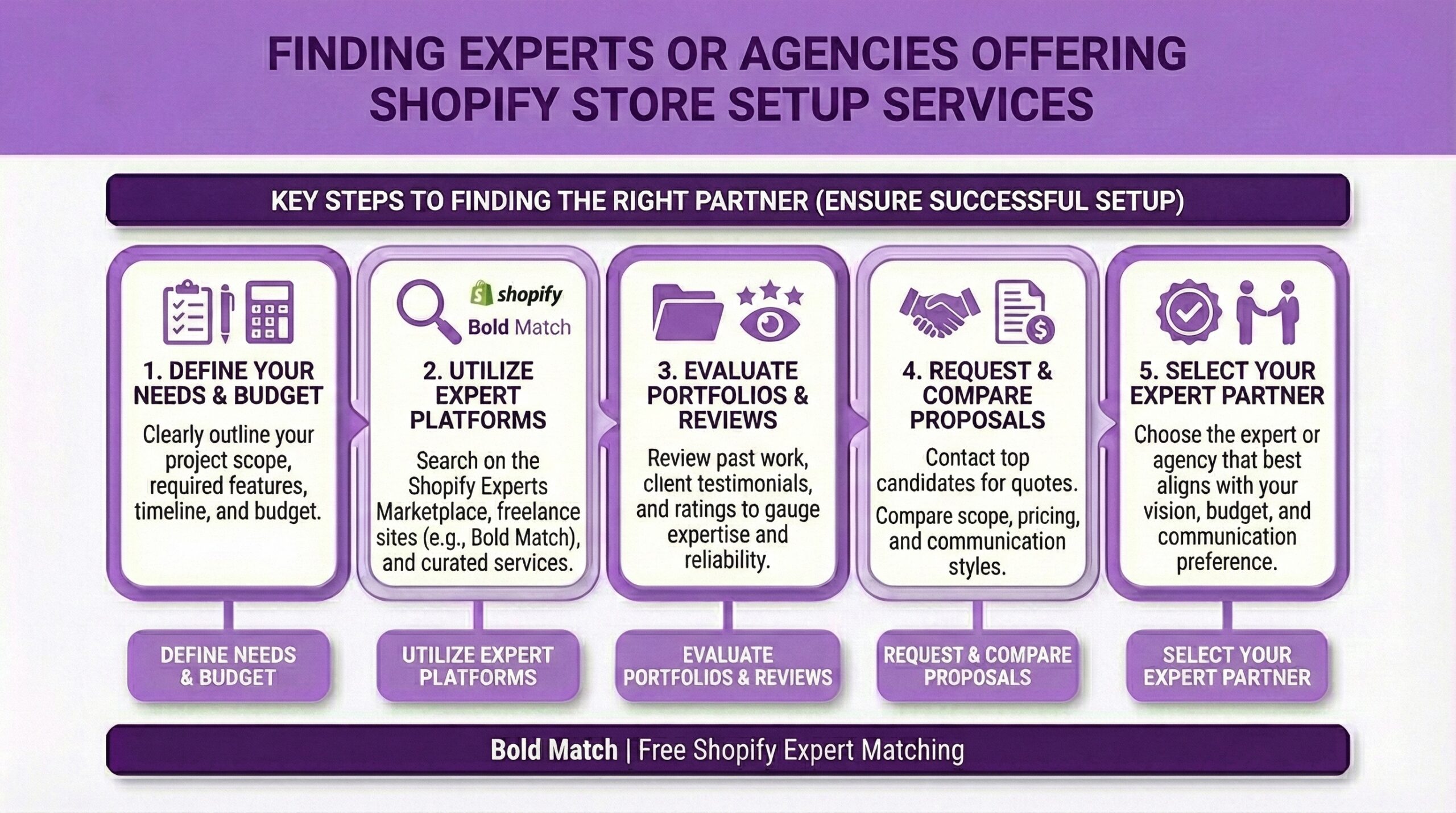
You need specialized help when technical limitations prevent efficient scaling, design production can’t keep pace with demand, marketing costs are scaling faster than revenue, or international expansion requires complex logistics. A good Shopify Agency can help optimize your store for conversions, integrate multiple POD providers efficiently, or develop custom solutions for unique needs. But agencies can’t fix a fundamental issue like poor design quality or unrealistic margins.
The Foundations for Print On Demand Success
Regardless of which of the stages above you’ve reached, certain fundamentals never change:
Design Quality Standards: Never compromise on design quality for quantity. Your brand’s reputation will depend on every single product meeting consumer expectations.
Customer-First Approach: Every decision should prioritize long-term customer relationships over short-term profits. This means honest mockups, realistic shipping times, and generous return policies.
Continuous Learning: Stay informed about design trends, platform changes, and new POD technologies. The landscape shifts constantly.
Financial Discipline: Maintain clear visibility into your true costs and margins. Too many print on demand businesses fail because they mistake revenue for profit.
Keep Your Marketing Authentic: Focus on genuinely connecting with your target audience rather than using manipulative tactics. Sustainable POD businesses are built on community, not tricks.
Your Future with Print on Demand
2026 will bring new opportunities and challenges for POD. Like AI design tools will democratize design, but it’ll also flood the market with mediocre designs. Sustainability concerns will push providers toward eco-friendly options. Personalization technology will enable mass customization at scale. The merchants who thrive will be those who combine creative excellence with business fundamentals. Print on demand isn’t easier than traditional e-commerce. It just shifts the challenges from inventory management to creative production.
Success requires understanding that POD is a creative business with logistics attached, not a logistics business with creativity sprinkled on top. Build a brand that resonates with a specific community solving specific problems and print on demand will be a powerful retail model.
Remember, whether you’re just starting out, fixing current problems, or scaling up an existing operation, POD is not a shortcut to easy money. It’s a legitimate business model that rewards creativity, consistency, and customer focus. Do those things well, and print on demand can be sustainable and profitable. The key is approaching it with realistic expectations about the work required, the challenges inherent in the model, and the operational fundamentals that drive success in every retail venture. Keep building something awesome.
Starting a Print on Demand (POD) Store on Shopify
Comprehensive Planning Reference
|
Point |
Details and Data |
Strategic Considerations |
|---|---|---|
|
Business Model Fundamentals |
POD eliminates inventory risk by producing items only after purchase. You own the designs (unlike generic dropshipping), creating genuine differentiation. However, base costs typically consume 60-70% of retail price versus 30-50% for traditional dropshipping. The math works differently: lower per-unit margins offset by higher customer loyalty and repeat purchases from design-driven brands. |
POD is a creative business with logistics attached, not logistics with creativity sprinkled on. Success requires consistent creative output—one viral design won’t sustain operations. Budget for ongoing design investment, not just startup costs. |
|
Platform & Subscription Costs |
Shopify Basic starts at $39/month (2025 pricing). Transaction fees range 2.4-2.9% plus $0.30 per transaction depending on plan tier. Additional costs: premium themes ($150-350 one-time), apps for reviews/email/SEO ($20-200/month cumulative), and domain registration ($14-20/year). |
The $39 headline obscures true operating costs. Realistic monthly overhead for a functional POD store: $100-300 before marketing spend. Factor in product sampling costs—ordering your own products at wholesale to verify quality before selling is non-negotiable. |
|
POD Supplier Landscape |
Printful: Premium quality, reliable fulfillment, higher base costs. Best for brands prioritizing quality over margin. Printify: Marketplace model connecting multiple print providers—more product variety and competitive pricing, but inconsistent quality across providers. CustomCat: Strong ratings for print quality and US-based fulfillment. Gooten: Excels at home décor products. Monster Digital: Competitive on apparel pricing. |
No single platform dominates for good reason. Start with one to learn the process, then add strategically based on what actually sells. Most successful POD stores use 2-3 providers to balance quality, cost, and product range. Never go exclusive with one provider. |
|
Quality Control Reality |
Print quality varies significantly by provider, product type, print method (DTG vs. sublimation vs. screen print), and even individual print facilities within the same provider network. Fulfillment reliability averages 3-7 business days production plus shipping. Returns and reprints typically run 2-5% of orders. |
Order samples of every product you plan to sell—in multiple colors and sizes. What looks perfect on screen may disappoint on fabric. Factor 3-5% of revenue into quality-related customer service costs. Your reputation depends on products you never physically touch. |
|
Store Setup & Theme Selection |
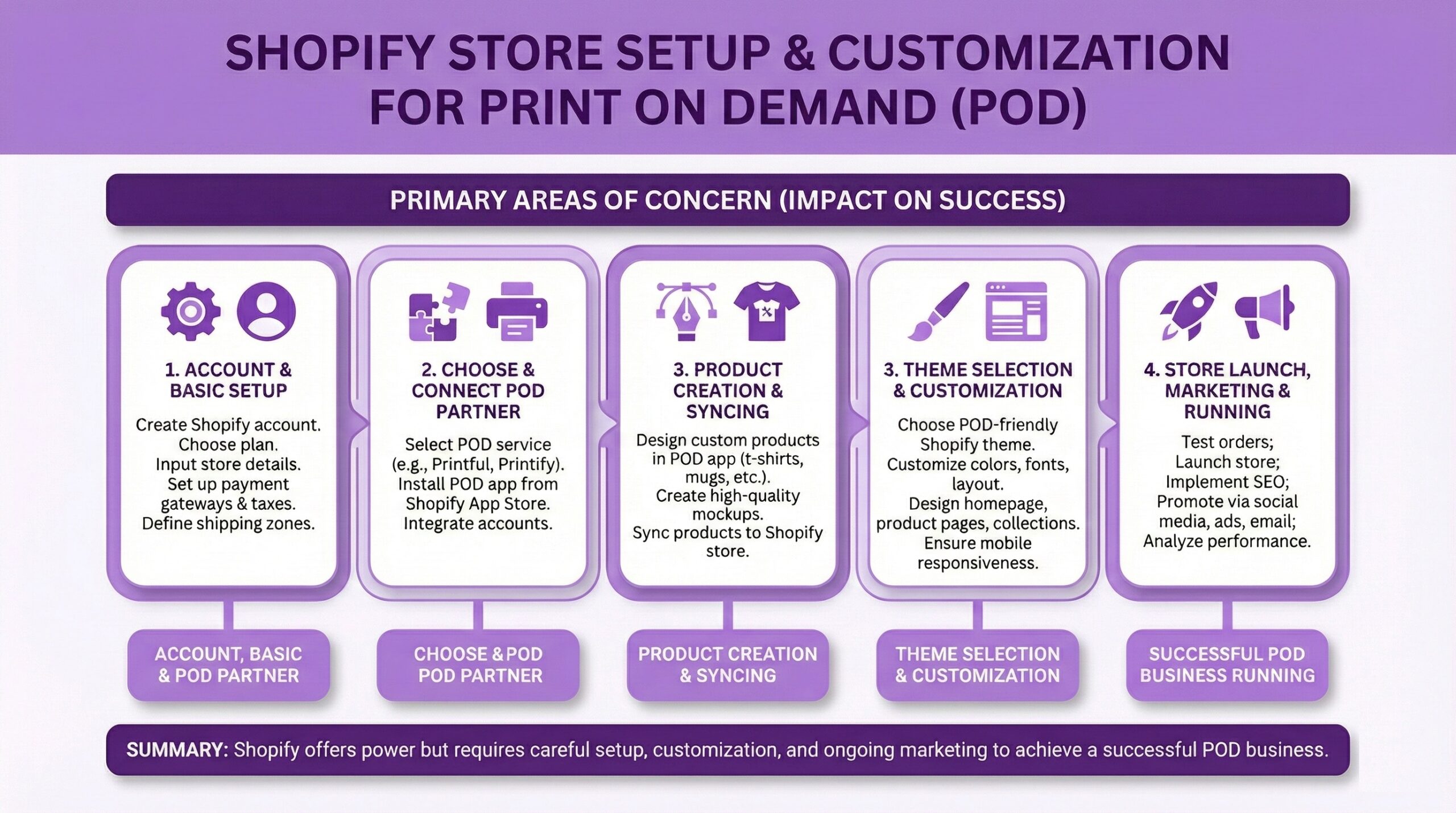
Free themes: Dawn (Shopify’s default, clean and fast), Craft (editorial focus), Colorblock (bold layouts). Premium options: Impulse ($350, conversion-optimized), Prestige ($350, luxury positioning), Broadcast ($280, storytelling focus). Customization via Shopify’s theme editor or Liquid template language for deeper modifications. |
Theme choice matters less than execution. A well-optimized Dawn store outperforms a poorly configured premium theme. Invest in professional product photography and compelling copy before theme upgrades. Mobile experience is non-negotiable—verify every design decision on actual phones. |
|
Product Integration Mechanics |
POD apps (Printful, Printify, etc.) sync directly with Shopify, automatically importing product mockups, variants, and pricing. Orders flow automatically to fulfillment partners. Inventory is always ‘in stock’ since production is on-demand. Tracking information pushes back to customers automatically. |
Integration is genuinely seamless—the technical barrier is low. The challenge shifts entirely to design quality, niche selection, and marketing execution. Don’t let easy setup create false confidence; the real work happens after the store is live. |
|
Product Selection Strategy |
Top sellers by volume: t-shirts, hoodies, phone cases, mugs, tote bags. Higher-margin opportunities: all-over print items, premium apparel (organic cotton, heavyweight), home décor (canvas prints, throw pillows). Emerging categories: activewear, pet products, stationery. |
Start narrow. 5-10 products across 25-50 designs beats 50 products across 10 designs. T-shirts are saturated but still convert; the niche determines success, not the product category. Test with your best designs on proven products before expanding catalog breadth. |
|
Design Creation Pipeline |
Options: Hire freelance designers ($50-500+ per design depending on complexity), use DIY tools (Canva, Adobe Express, Photopea), license existing artwork, or develop in-house capability. Technical requirements: 300 DPI minimum, transparent backgrounds for most products, CMYK color profiles, provider-specific templates and safe zones. |
Understand your provider’s specifications before commissioning designs. A $200 illustration that bleeds incorrectly is worthless. Budget for iteration—your first designs rarely become bestsellers. Plan for 25-50 quality designs minimum at launch; fewer and your store looks empty. |
|
Store Optimization Essentials |
Conversion fundamentals: high-quality mockups (lifestyle shots outperform flat lays), compelling product descriptions emphasizing design story and audience connection, clear sizing guides with actual measurements, trust signals (reviews, secure checkout badges), streamlined checkout with Shop Pay enabled. |
Product pages are your only salespeople. Generic descriptions (‘Great quality t-shirt!’) kill conversions. Tell the story behind each design. Who is this for? What does wearing it say about them? SEO matters but won’t save poor creative—focus on conversion before traffic. |
|
Fulfillment & Customer Experience |
Production typically 2-5 business days. Shipping adds 3-10 days domestic, 2-4 weeks international. Order tracking available through most providers. Returns/exchanges require clear policies—most POD merchants offer reprints for quality issues but limited returns on customized goods. |
Set shipping expectations clearly and repeatedly: product pages, cart, confirmation emails. ‘Ships in 1-2 weeks’ prevents more complaints than overnight shipping. Consider offering domestic-only shipping initially to simplify operations and reduce international fulfillment headaches. |
|
Content & Social Strategy |
Platform priorities by POD niche: Instagram/Pinterest for visual/lifestyle brands, TikTok for trending/humor designs, Facebook for community-driven niches, YouTube for tutorial/educational content. Email marketing ROI typically exceeds social for repeat purchases. User-generated content (customers wearing products) builds trust. |
Don’t spread thin across all platforms. One channel done excellently beats five done adequately. Build email list from day one—it’s the only audience you actually own. Social algorithms change; your email list doesn’t disappear overnight. |
|
Paid Advertising Approach |
Meta (Facebook/Instagram): $5-15 CPA typical for POD, interest-based targeting for niche designs. Google Shopping: higher intent but requires product feed optimization. TikTok Ads: lower CPMs, works for trend-driven designs. Retargeting: essential for converting abandoned carts (typically 70%+ of visitors). |
Don’t advertise until organic sales prove product-market fit. Ads amplify what’s already working—they won’t fix fundamental design or niche problems. Start with $10-20/day testing budgets. If you can’t profit at small scale, scaling won’t help. |
|
Financial Projections (Realistic) |
Typical POD unit economics: $25 retail price, $15 base cost, $10 gross margin. After transaction fees (~$1), marketing costs ($3-8 per acquisition), and returns (~$0.50), net margin ranges $0.50-5.50 per unit. Profitable scale typically requires 50+ orders monthly minimum. |
The ‘passive income’ narrative is fantasy. POD is a real business requiring real work, real investment, and real commitment. Expect 6-12 months to profitability with consistent effort. Most POD stores fail from underinvestment in design and marketing, not from platform or supplier issues. |
Frequently Asked Questions (FAQ)
Is POD more profitable than regular dropshipping?Not necessarily. Print-On-Demand’s base costs typically eat 60-70% of retail price compared to 30-50% for traditional dropshipping. Your profit per unit is often lower. The advantage comes from owning your designs, which means less direct competition and potential for brand loyalty. The math works differently too. Traditional dropshipping might net $10 profit on a $30 product. POD might only net $5 on a $25 t-shirt. But consumers buy multiple designs from print-on-demand brands they love. They rarely buy multiple generic phone cases from dropshippers.
How many designs do I need to start a POD store?
Honestly. It depends. So start with 25-50 quality designs minimum. Fewer than that and your store looks empty. But here’s what matters more than quantity. Coherence. Those designs should tell a consistent story about who you are and who you serve. One mistake beginners make is uploading everything they create. Random funny sayings, nature photography, abstract art, and political slogans in the same store. Pick a lane. You can always launch another store for another niche.
What about POD’s copyright-trademark issues?
This is usually where print-on-demand brands die. Using any copyrighted material without permission, including fan art of popular characters, band names, sports team logos, or movie quotes, will eventually get you sued or shut down. “But everyone else is doing it” isn’t a legal defense. Those stores selling Baby Yoda shirts without licenses? They’re one cease-and-desist away from losing everything. Create original designs or obtain proper licenses. Period.
Can I use AI tools to create POD designs?
You can, but even being generous AI-generated designs are probably best described as the new clipart. Obvious, generic, and everywhere. Consumers can spot them instantly. So. I wouldn’t. Originality is why POD doesn’t just equal dropshipping. The legal landscape around AI-generated art is also murky. Copyright protection for AI-created works remains unclear. Build your brand on designs you definitively own.
When should I move from POD to buying inventory?
When you have 5-10 consistent sellers doing 50+ units monthly each, predictable seasonal patterns you can forecast, enough capital to invest in inventory, and storage space or fulfillment partner ready. Start hybrid. Keep best sellers in stock while everything else stays print-on-demand. This improves margins and shipping times on proven products while maintaining catalog breadth. Never go all-in on inventory until you have six months of data showing consistent demand.
Is POD just a gateway to “real” e-commerce?
No. Honestly. That’s at least a bit like asking if digital products are “just” a gateway to physical products. Print-on-demand is a legitimate model that even Amazon used a variation of for media until a few years ago, not training wheels. Some merchants build million-dollar brands entirely on POD. Others use it strategically alongside other fulfillment methods. The question isn’t whether print-on-demand is “real” e-commerce. It’s whether POD serves your business goals and customer needs. For creative brands serving niche communities with unique designs, print-on-demand might be the perfect permanent model.