
Pros and Cons of Freelance Shopify Experts vs Agencies
Written and edited by: Jay
That’s right, everyone. We’re back!
I’m Jay Myers from Winnipeg and that’s Eric Boisjoli, also from Winnipeg, and we co-founded Bold Match. And now that we’ve covered what Shopify Experts actually do and how the certified service partner program works, we thought we’d tackle the decision making part.
Should you hire a lone freelancer or a whole agency? Mostly. Your answer will depend on what you’re trying to get done, how much risk you can tolerate to get it done and whether or not it can even be completed practically by a specialized specialist or just work better suited to a team of experts with various specialties. But most store owners approach this decision backward, starting with budget instead of requirements. And as Eric would say, that’s like choosing a twin tip longboard before knowing if you’ll be doing ollies and pop-shuvitsors at your skatepark or downhill cruising.
The debate’s confusing, with misconceptions from both directions. Freelancers aren’t always cheaper. Agencies aren’t always better. Some of the best Shopify devs work solo by choice, commanding rates that exceed agency pricing. Some agencies are just three freelancers in a WeWork space calling themselves a company. The label tells you less than you’d think. What actually matters is matching your needs to the right delivery model. Let’s start with what each option means in practice then work through the specific scenarios where one wins.
Understanding Freelance Shopify Experts
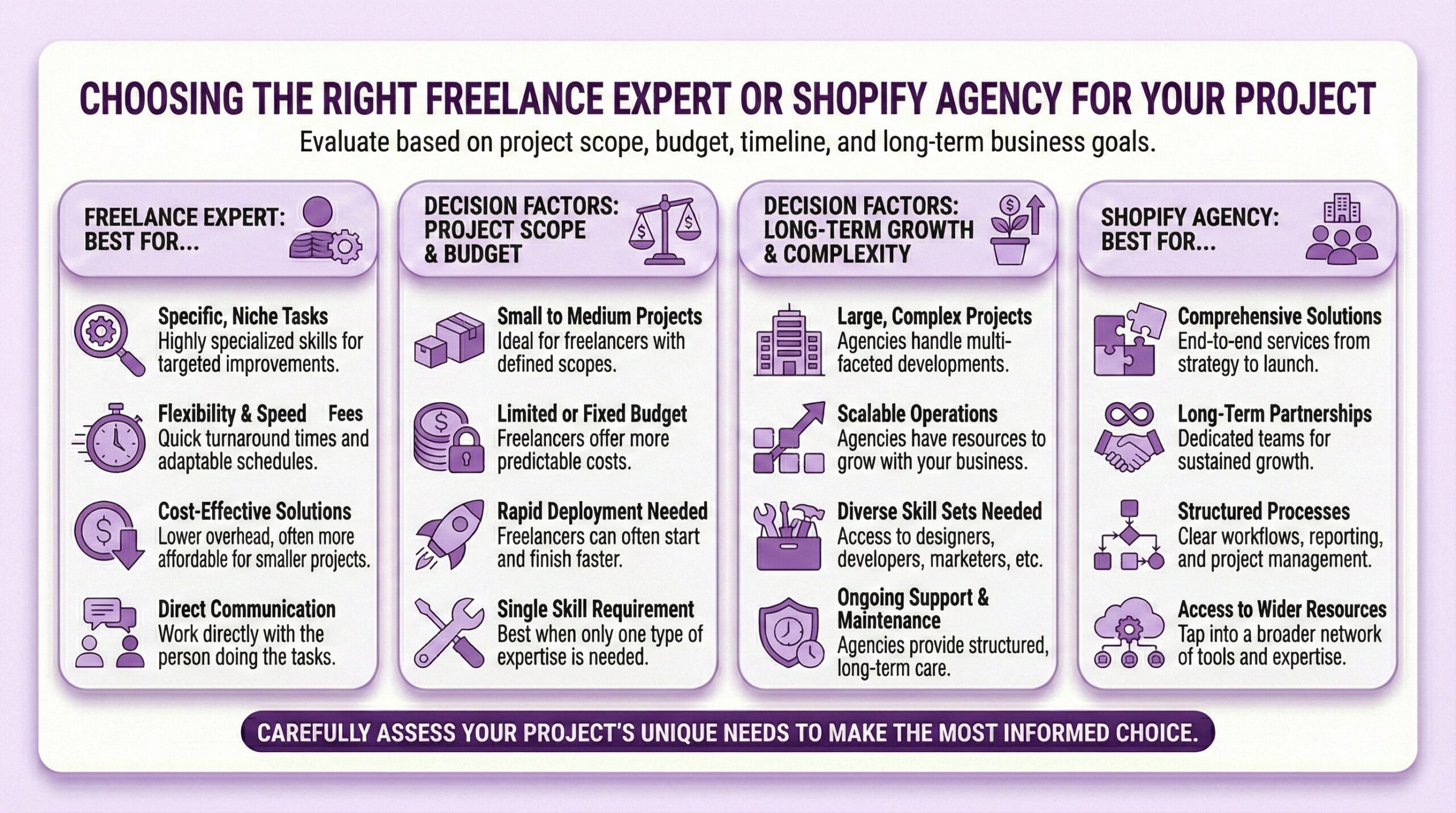
You’ve heard of Fiverr and Upwork and ShopExperts and StoreTasker right? Well, they’re “Freelance Shopify Experts” so to speak, the actual freelancers are independent contractors who’ve met Shopify’s Certified Service Partner requirements, maintain their “Partner” status through ongoing client work and are still referred to as “Shopify Experts” even though Shopify’s replaced the Experts Marketplace with the Partners Directory as slang for solo specialist or consultant, though many often partner with other freelancers to tackle projects beyond either’s core competencies. The best ones tend to have waiting lists. The mediocre ones always tend to be available immediately, which really should tell you something.
Seriously though. The immediate advantage of hiring a freelancer is direct communication. You’re talking to the person doing the work. No account managers, no telephone game, no wondering if your feedback actually reached the designer, developer or SEO person. When Eric used to jump into technical details about API rate limits or webhook architecture, I appreciated that our freelancers could have that conversation with him directly without any translation layers.
Freelancers typically specialize deeply rather than broadly. You’ll find freelancers who only do SEM or only email marketing automation but aren’t full stack Digital Marketers, who only build custom checkout experiences, who only handle migrations from specific platforms. And that specialization will mean they’ve seen your exact problem before, probably multiple times. They know the edge cases, the gotchas, the shortcuts that work and the ones that’ll break everything.
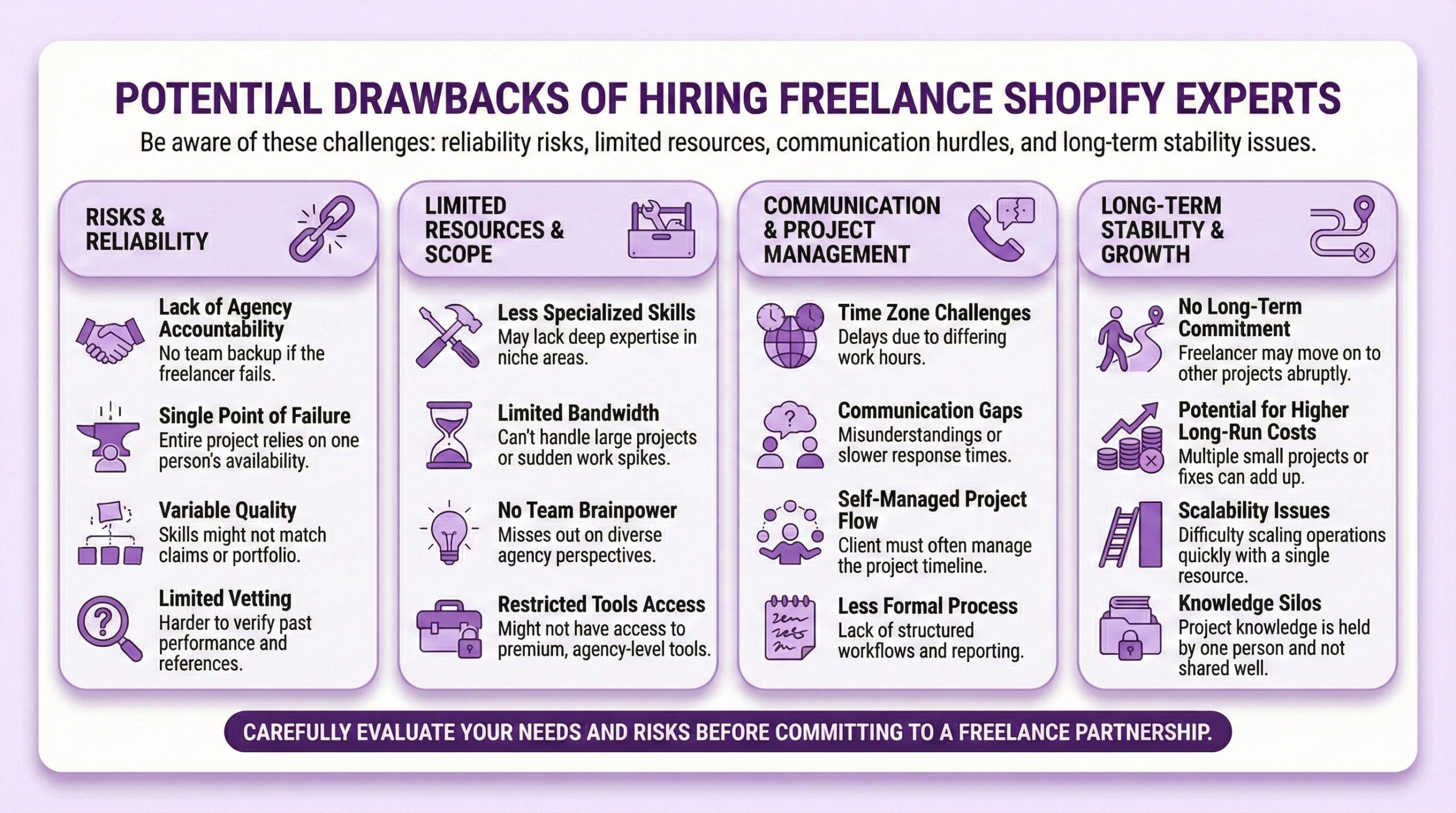
But here’s what you have to get about the freelancer mindset. They’re running a business while doing the work. So. Every hour spent on project management, invoicing, or scope discussions is an hour not billing. This creates natural efficiency pressures but also availability constraints. They won’t have time to hand hold or give you options the way agencies can. When a freelancer says they’re booked for three weeks, they mean it. There’s no bench of developers to pull from.
The risk profile with freelancers is binary. If they’re good, suited to your exact need (that’s need not needs) and available, you’ll probably get excellent value. If they get sick, take vacation, or land a bigger project, you’re stuck. No backup, no redundancy, no alternate resources. This isn’t just a theory of mine. I’ve seen multiple merchants left hanging when a freelancer disappeared mid-project, got overwhelmed or shocker got a full-time job offer that they simply couldn’t refuse.
Understanding Shopify Partner Agencies
You’ve heard of us, right? Sorry to joke, but one main reason we landed on Bold Match and a Shopify Merchant-Agency matching service as a way to give back to the e-commerce community is that your exposure to expert agencies has likely been limited to one or two you’ve already worked with, the “100,000+ partners across 50 countries” in Shopify’s somewhat unwieldy directory, and whichever firms paid the closest attention to their SEO team whenever you also found this site. Which is to say … Not exactly an actionably representative sampling. So here’s the deal. Expert Agencies are just companies that provide site design, web development and/or marketing services through teams of Shopify specialized specialists in those areas.
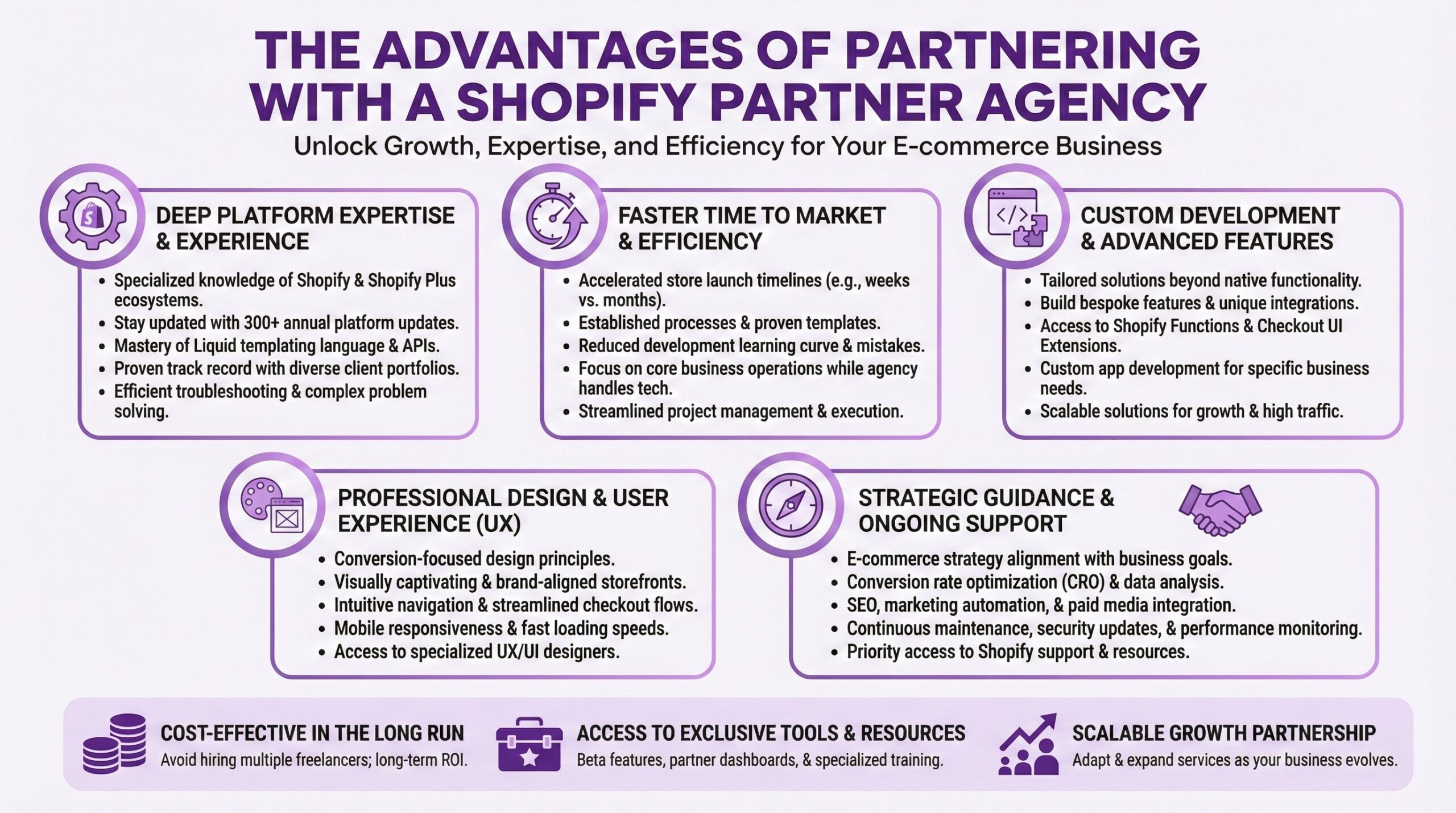
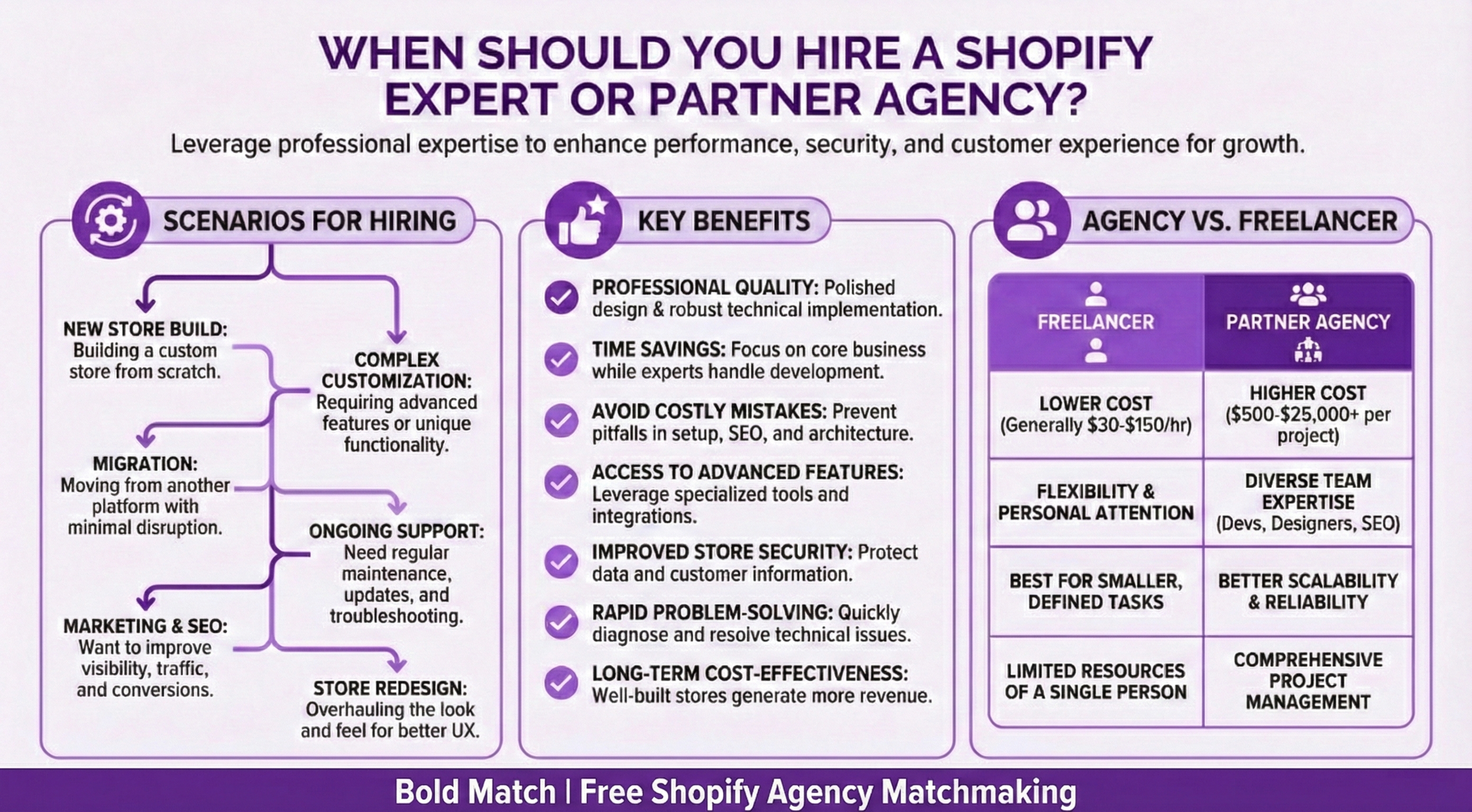
Some agencies have five people, others have five hundred. Some focus exclusively on Shopify, others treat it as one platform among many. Opting to hire an agency is trading the simplicity of working with an individual specialist for the greater bandwidth and comprehensive capabilities that come with teams of experts. So. The primary advantage partner agencies offer is resources. Full-service agencies have developers, designers, project managers, QA testers, marketers and strategists. In other words. When your seemingly simple theme customization suddenly requires custom JavaScript that breaks your checkout flow and needs a redesign to fix properly, an agency can handle that scope creep internally. When a freelancer would’ve needed to bring on a partner or punt entirely.
Whenever one of our merchant friends asks about their respective virtues when it comes to complex projects, Eric usually points out that agencies provide infrastructure that freelancers can’t match. Version control systems, staging environments, automated testing, documentation standards. Things that aren’t sexy, but prevent disasters. And he’s right. The behind-the-scenes processes agencies maintain can become critical when projects go beyond basic customization.
Then there’s the simple thing that agencies provide continuity that freelancers can’t guarantee. When your account manager goes to Cape Verde on holiday, someone else knows your project so it isn’t put on hold while they’re hiking around Santo Antão. If your lead developer gets hired away, their code is documented and the other developers on the team can pick your project up and keep running. That’s redundancy and redundancy costs money, so agencies charge more, but they can typically guarantee that your project won’t depend on a single expert’s availability.
Since that means that you can get what you pay for, I think the only real downside of partnering with a Shopify agency is that they add layers and processes. Everything will take longer with agencies. That quick question you’d text a freelancer becomes an email to an account manager who’ll schedule a call to discuss requirements that get documented in a scope change request. That’s absolutely necessary for complex projects but it can get to be a lot when it’s a simple one.
Cost Structures and What You’re Really Paying For
Let’s forget the hourly rates for a second. They’re notoriously misleading. I mean. A partner agency charging $150 per hour for three developers with varying areas of expertise who can deliver all of what you need might end up costing less than a freelancer at $100 an hour who might need to phone a friend to really understand the best way to deliver on your requirements.
Freelance experts typically charge in one of three ways. Hourly rates for ongoing work, project-based pricing for projects with a defined scope, or retainers for their continued availability. The best freelancers won’t do hourly work anymore because they know what their expertise is worth and what most problems will take to solve and will estimate their hours then quote you whatever to solve your problem based on that experience. Which can work out because you’ll do the same math.
Now. Specialized agencies have more complex pricing structures that reflect their overhead. You’re paying for project management, quality assurance, documentation, and the ability to scale resources. A typical agency project includes discovery, design, development, testing, and deployment phases, each with a variety of associated costs. So. What looks expensive actually includes safeguards that prevent expensive failures, and make allowances for the unexpected.
The real cost difference appears in project overruns and scope changes. Freelancers often underbid to win work, then struggle when the scope of a job inevitably expands. Certified agencies build buffers into their bids and have “order change” processes there to protect both parties. Neither approach is inherently better but understanding the difference will help you budget appropriately.
Some Specific Scenarios When Expert Freelancers Win
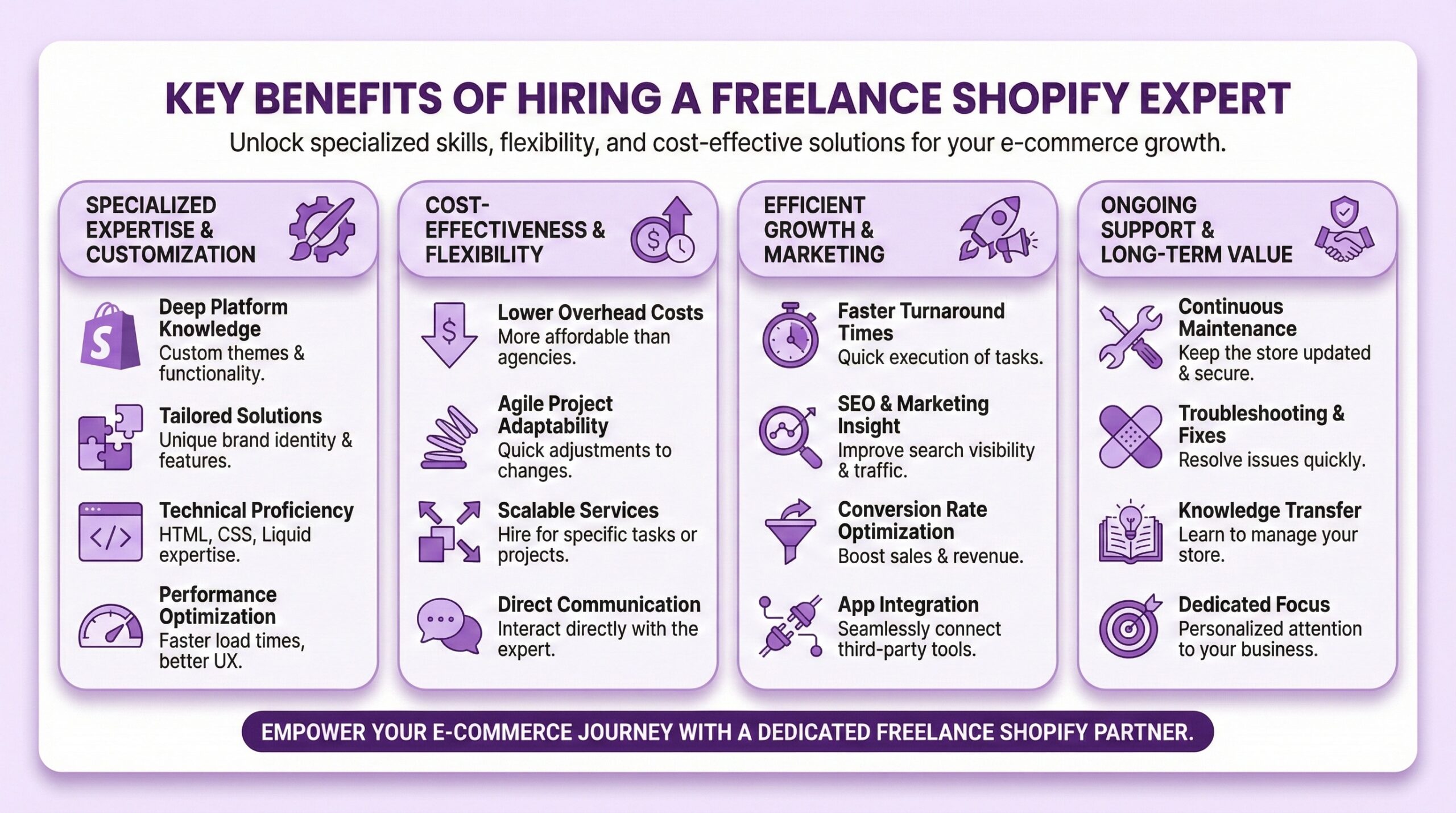
Have a small, defined job and a limited budget that’ll require flexibility and narrow specialization:
For “Easy” Theme Customizations: With “easy” being the key word. Do you need your product pages redesigned, your homepage hero updated, or your collection pages optimized. The scope is clear, the timeline is tight, and you know exactly what you want. Like your average theme development specialist Shopify freelancer will knock this out faster and cheaper than any agency. One or two meetings, zero process, just execution.
Specialized Technical Problems When your store has a specific performance issue, needs a particular integration, or a focused technical challenge. You need someone who’s solved this exact problem before. The freelancer who’s built fifty custom inventory sync systems knows more about that specific challenge, than an agency that’s done ten.
For Ongoing Maintenance or Small Updates If you’re operating a small or smallish Shopify store and only need an expert for the occasional tweak, a seasonal update or a minor or two improvement here and there. Having a freelancer on a monthly retainer will usually work out for you but won’t cost you agency minimums. And if you’re lucky, they’ll learn your store, get to understand your preferences, and do good unceremonious work.
For That Tightly Budgeted MVP when you’re testing out some new retail concept, or launching a side project, or bootstrapping growth and it only needs to be good enough to get going, hiring a well reviewed freelance expert can arguably be the both the best and the fastest way to get at least the minimum viable product version of it shipped, so to speak. And, you can always upgrade to agency support once you’ve proven the concept.
Some Specific Scenarios Where Partner Agencies Win
Have a large or complex project, that will require a range of skill sets and project management:
For Store Migrations. Seems obvious, but if you’re moving from another e-commerce platform to Shopify or even replatforming within Shopify, it’s going to require coordination across multiple applicable disciplines. You don’t want a marketer handling your data migration, a developer doing your UI/UX design implementation, or a designer in charge of preserving your old site’s SEO. Trust me. Plus. Those things all need to happen in sequence and agencies have the project management infrastructure to orchestrate all those moving parts. When Eric talks up how intense and complex a store migration can be he is not exaggerating. One expert juggling all these elements is a recipe for disaster.
For Custom App Development. Here’s another obvious one. I mean. Building custom functionality will require architecture design, development, testing, deployment, and ongoing maintenance. And an Agency can assign specialized experts to each. Frontend developers for UI, backend developers for logic, DevOps engineers for deployment. They can also provide long-term support. Which is not nothing. A custom app will 100% need to be updated if Shopify changes their API or makes another switch like from Liquid to Extensibility. Your freelancer might not be available, but Agencies have an SLA.
For a “Complete” Store Redesign. When you aren’t just “tweaking” your theme. When you’re “reimagining” your customer experience. It’s gonna require user research, design, development, and usually integration with multiple systems. Agencies bring strategists who specialize in conversion optimization, designers who can create comprehensive systems not just prettier product pages, and devs who can implement that all coherently.
For Scaling Your e-Commerce Operation. If you’re growing fast and need to move even faster on the multiple fronts that typically entails … e.g. on New features for BFCM, on international expansion and so multi-lingual SEO, a wholesale channel launch, all simultaneously. Only an agency is going to have the personnel bandwidth to run parallel streams. No freelancer, no matter how talented, can do more than one thing at one time.
For Enterprise Integrations. I feel almost silly including this one, because connecting Shopify to your ERP (Enterprise Resource Planning), or implementing any complex B2B workflows, or building “robust” omni-channel commerce infrastructure will clearly require enterprise-experienced expertise. Which is to say an agency that has experience with corporate procurement, security requirements, and the patience for endless stakeholder meetings.
The Hybrid Approach to Hiring Shopify Experts
Gonna be stereotypically Manitoban and super honest. Eric and I created Bold Match because finding Shopify Expert Agencies was harder than it should have been, not because we were anti using Freelance Shopify Experts. We both know merchants just like you who’ve used both strategically successfully. I mean. Maintaining relationships with freelancers you trust for quick updates, and any other small specialized tasks, but engaging agencies for major projects isn’t indecision. It’s optimization.
Your freelance theme developer knows your store intimately and can make quick updates efficiently. But when you need a custom application built, you engage an agency with the infrastructure to deliver enterprise-grade code. You’re matching the solution to the problem rather than forcing everything through one model. Some store owners even use freelancers to audit agency work or agencies to rescue failed freelancer projects. There’s no rule saying you have to pick a side and stick with it. The best approach is whatever works.

Red Flags and Green Flags With Experts
Whether evaluating freelance specialists or Shopify agencies, certain signals indicate quality or disaster.
Red Flags With Freelance Experts: Immediately available. No contracts or terms of service. Unwilling to provide references. Prices that seem too good to be true. No questions about your business goals. Promises everything is easy. Never mentioning potential complications. Remember experienced devs are basically edge case addicts, experienced designers inherently wary of running afoul of varying stakeholder tastes and experienced SEOs understandably shellshocked by Google’s weather-like peculiarities.
Green Flags With Freelance Experts: Has a waiting list or limited availability. Has clear contracts and payment terms. Is proactive about defining the scope of the project. They take the time to ask about your business, not just the aforementioned project. Provides you a range of options with trade-offs. Either has references from “similar” projects or is so honest that they admit up front that you’ll be getting them at an otherwise “suspicious” discount, because you’ll be their way of expanding their skillset. Which is a thing all experts do and frankly all experts should do but you want one who’s willing to be honest.
Red Flags With Expert Agencies: They don’t have Shopify-specific case studies. They outsource everything to contractors. They don’t include the technical people (the actual Shopify experts) in sales conversations. They promise curiously unrealistic timelines. No discussion of post-launch support. Extremely high minimum budgets without justification.
Green Flags With Expert Agencies: They have Shopify Plus Partner status. They have clear process documentation. They get their tech people involved in your conversations early on. They lay out realistic timelines that include buffers to account for unknowns. Comprehensive proposals that address edge cases. The post-launch support is included.
Deciding Between Freelancers and Shopify Agencies
If your project can be completely-comprehensively laid out on a single page and doesn’t touch your critical operations, maybe start by looking at a freelancer. But. If you’re betting your brand on the outcome, need guaranteed availability, or require multiple skill sets, go with a specialized agency. Budget matters but shouldn’t drive the decision. I mean. A failed $5,000 StoreTasker project that needs a $25,000 Bold Match rescue costs more than just doing it right. That said, paying an agency $50,000 for what a freelancer could do for $10,000 would also just be burning money.
Consider your own capabilities too. If you can manage a freelancer, provide clear requirements, and handle project coordination, you might not need agency overhead. If you want to hand off the project and get back a finished product, you need agency project management. The truth is that both models work when properly matched to requirements. The disasters happen when merchants hire freelancers for agency-scale projects or agencies for freelancer-appropriate tasks. Know what you actually need, not what you think you can afford, and choose accordingly.
Well, that’s it for us today. Eric has to and run and refactor our webhook retry logic to use exponential backoff instead of fixed intervals and I’ve gotta go record a pod on guest checkout. Hope you’re finding tons of value in the resources we’re building and the connections we’re making! If this guide helped clarify the pros and cons of Agencies and Freelancers, that is exactly why we’re here … To help merchants like you implement the strategies that separate good Shopify stores from great ones. And as always, if you’ve outgrown what you can handle internally and need to bring on vetted Agency Expertise, you know where to find us. Keep building something awesome! – Jay and Eric
Frequently Asked Questions (FAQ)
How much more do Shopify agencies charge compared to Shopify freelancers?
The sticker price comparison is misleading. Sure, agencies might quote $150-200 hourly versus a freelancer’s $100-150, but that’s not the whole story. Agency rates include project management, QA testing, documentation, all the boring stuff that prevents disasters. Freelancers either bill extra for that or, more commonly, skip it entirely. For basic work like theme tweaks? Yeah, agencies cost 2-3x more and it’s probably not worth it. But complex projects? The gap shrinks to maybe 20-30% because agencies have systems that actually work at scale. Here’s what really matters though. Agency quotes are usually accurate. Freelancer projects? I’ve seen too many “quick $2,000 jobs” turn into $8,000 nightmares. Pick your poison accordingly.
What happens if my freelance Shopify Expert disappears mid-project?
Welcome to my personal nightmare and the reason I sleep better with agencies. This happens way more than anyone talks about. Your freelancer goes dark, stops responding to emails, maybe their grandmother died for the third time this year. Now what? If you were smart, you didn’t pay everything upfront and you have admin access to everything. If you weren’t, you’re screwed. Best case, you find another freelancer who has to decipher half-finished work, which usually costs more than starting fresh. Worst case, you’re three weeks from launch with broken code and no documentation. This is why the 50% upfront rule exists. Also why you demand regular commits to a repo you control. With agencies? Someone else on the team picks up the work.
Can Shopify agencies handle urgent projects better than freelancers?
Define urgent. Your store’s down and you need it back up in two hours? Call that freelancer who answers their phone on Sundays. Agency process will kill you here. But need a complete store overhaul for Black Friday and it’s already October? Agencies can throw five developers at it while your solo freelancer can only code so many hours before their brain melts. True emergencies are interesting. Agencies have escalation procedures, war rooms, people who can be pulled off other projects. Freelancers have… coffee and determination. Both charge premium rates for rush work though. We’re talking 50-100% markups minimum. Urgency is expensive no matter who’s doing the work.
Should I hire a local Shopify Expert or does remote work fine?
For 95% of Shopify work, location doesn’t matter. I’ve worked with developers in Poland, designers in Argentina and agencies in Toronto. The best Shopify talent is distributed globally, and limiting yourself to local options dramatically reduces quality and increases cost. Time zone alignment probably matters more than physical location. Like a freelancer three time zones away will probably be manageable. Any more than that might be a problem. The only time local matters is when you need regular in-person meetings or content that’s so-specifically localized an out of towner likely couldn’t imagine it. But again. Even enterprise projects can run successfully fully remote.
How do I know if a Shopify Agency is just outsourcing to Freelance Experts?
Easy. Ask to meet the team. Not the sales guy, not the account manager, the actual living humans who’ll touch your code, your images or your SEO meta tags. Real agencies introduce you to employees with company email addresses, LinkedIn profiles that match, maybe even their faces on the website. Fake agencies get squirrelly when you ask who’s doing the work. You’ll hear “we have a network of experts” or “we assign the best resource for each task” which translates to “we’re marking up StoreTasker or ShopExperts.” Some outsourcing is normal, nobody keeps a 3D rendering specialist on salary, but the core team should be actual employees. If they won’t introduce you to developers before you sign, run.
What’s the minimum budget for working with a Shopify agency?
Depends on the agency, but most agencies won’t touch projects under $10,000, and many start at $25,000. Monthly retainers begin around $3,000-5,000. This isn’t greed, it’s math. Their overhead means smaller projects literally lose them money. If an “agency” takes your $3,000 project, they’re either brand new and desperate, not really an agency, or they’re about to give you $3,000 worth of disappointment. Some agencies do smaller discovery projects for $2,500-5,000, basically paid proposals, but that’s just buying a roadmap, not actual implementation. Under $10,000? You’re shopping for freelancers whether you know it or not.
Can I hire a Shopify Agency for strategy and a Freelance Expert for execution?
Theoretically. I mean. You can try, but it usually ends messily. Agencies hate creating strategies for others might muck up because execution always deviates from plan and they get blamed for failures they couldn’t control. Meanwhile. Freelancers resist implementing agency strategies because they disagree with the approach or find the documentation insufficient. When it works, it’s because the agency provides true technical specifications, not just strategic recommendations, and the freelancer is genuinely interested in pure execution. Honestly? Pick a lane. Either trust an agency to handle everything or find a freelancer who can think strategically. Mixing models just adds coordination overhead that nobody wants.
How long should I expect to wait for a good Shopify Expert or Agency?
Good freelancers are typically booked 2-4 weeks out, sometimes longer for specialists. Agencies can usually start discovery within a week or two, but might not begin actual development for 4-6 weeks depending on their pipeline. Anyone immediately available for a major project is either new, not very good, or between contracts for a reason. The best Experts and agencies have waiting lists. If you need someone good, plan ahead. If you need someone immediately, prepare to pay premium rates or accept compromise on quality.