
The Top 24 Shopify Agency Red Flags, Ranked by Their Relative Predictive Power
Written and edited by: Jay

Hey there, Shopify merchants!
That’s right. It’s me here. Jay Myers. The co-founder of this whole Bold Match place again. I was thinking that my last few Next Big Thing posts have been a bit serious as befits the run up to BFCM, but I was thinking that we could have some fun, tackling a must tackle topic.
I mean. You probably landed on this post because you’re looking for a Shopify agency partner. You’ve got an e-commerce brand to scale and 36 tabs open in each of your two different browsers trying to figure out which kinds of experts in which kinds of agencies might actually be able to help you do that. Everyone’s telling you what they want you to hear because they think it’s what you’ll want to hear.
Every firm’s a firm of “synergistic digital ecosystem architects” or “disruptive paradigm shifters” offering you “pioneering frictionless solutions” they’ll deliver by “leveraging cross-functional synergies,” and sure. If you’d clicked that Get Matched button up there on the right, instead of whatever you did instead you’d be working through a shorter (vetted) list, but it would still be a list to whittle down.
So. To lend you a hand with that, I’ve compiled this admittedly joke-dense, but also completely honest list of warning signs that you should be watching out for as you sort through your expert agency options and settle on one. I’ve ranked these red flags by how accurately they predict project failure in my opinion. Not by how scary they sound. Not by what makes good LinkedIn content. By their actual predictive power based on the agency + merchant relationships that I have personally observed over the years. Ready? Ok. Let’s get to this then …

The Heavy Hitters (80%+ Predictive Power)
24. They Can’t Show You Their Own Shopify Store
If a Shopify web development agency doesn’t run their own demo store or can’t demonstrate hands-on experience wrangling with the platform’s daily operational realities, they’re consultants playing developer. Real expertise comes from living in the trenches, not reading documentation.
23. Don’t Have Clear Project Handoff Processes
In other words. Don’t forget to ask them what happens when your project ends. Blank stares or vague promises about “flexible ongoing support solutions” might mean that you’ll be ghosted the moment final payment clears. Legitimate agencies have well documented transition procedures.
22. They Promise Page One Rankings in 30 Days
If you have any friends in digital marketing and you tell them that someone told you this, they’ll either laugh, sigh, roll their eyes or some combination of two or all three. Seriously. Any Shopify SEO agency guaranteeing instant rankings is either lying or planning to tank your domain with black-hat tactics. SEO takes months. Anyone saying otherwise is as trustworthy as a crypto bro.
21. Zero Questions About Your Current Tech Stack
This one’s so unlikely and therefore for suss that it should arguably be a bit higher on my list. Professional agencies investigate before prescribing. Not asking’s how web devs end up with conflicts, broken features, and problems requiring emergency fixes. So. If they don’t start by asking you about your existing apps, integrations, custom code, and just plain jury rigs, they’ll be flying blind from that point forward, so everyone and anyone worth partnering with will ask.
20. Sites In Their Portfolio Look Strangely Similar
Ever see one of those dance battle films where the hero or heroine wins by adding like tap or break dancing to their classical ballet or ballroom routine? Yeah. Branding and Identity or UX/UI professionals are a lot like that. Good designers design portfolios that show off their range. So when every site in their portfolio could be the same template with different logos, you’re looking at an assembly line, not a Shopify design agency. Cookie-cutter approaches inevitably turn into cookie-cutter problems.

The Warning Sirens (70-79% Predictive Power)
19. Communication Goes Through Multiple Layers
This one’s a simple matter of time management in the context of typically being billed by the hour. In other words. If you need to explain your projects requirements to a salesperson who then explains them to a project manager who explains them to a developer, who’ll then need to talk to your overworked in-house dev to figure out what was actually said in that first zoom call, prepare for a very expensive game of telephone. Having direct developer access really matters.
18. They Trash Your Current Setup Without Analysis
This is one of those things that’s especially true of development work (seriously, see above) but is also just generally true. Like even an (in heavy irony quotes) good chakra aligned authenticity alchemist will ask after the thinking behind your brand messaging map and run through the KPI’s associated with how and where it’s been applied before suggesting changes Expert agencies that immediately declare everything needs rebuilding are often just justifying bigger invoices. Good Shopify experts identify what’s working so they can succeed, by building on that.
17. They Don’t Have Shopify Specific Certifications
This isn’t the kind of thing that could happen with an agency you found here, but it does happen. You see. Being a Shopify Partner is essentially entry-level. Look for Shopify Plus Partner status, certifications specific to the apps you have or will need customized, or documented platform expertise. Generic ecommerce development experience doesn’t translate to mastery of Shopify..
16. They Can’t Explain Their QA Process
“We test everything” isn’t a Quality Assurance process in the classic sense of that term. How do they test the “everything” in question? On what devices? On which browsers? For what edge cases and why those particular ones? What about app conflicts? No actual specifics means no actual process, which means that you and your customers will be your new (whatever’s) beta testers.
15. Unrealistic Timeline Promises
Not unlike my note re quick SEO results, if you’re hearing promises that your store’s migration from WooCommerce can be complete in a week? Or that your custom app will be finished in three days? Those are BAD as in maybe just run away bad signs. Not endearingly ambitious timelines. They’re lies. Rushed work means broken online stores and e-commerce lost revenue.

The Yellow Flags (60-69% Predictive Power)
14. They Push Preferred Apps Despite Your Needs
Look. There will be options associated with just about everything you could possibly want. Like if you need an SEO/SEM tracking and research tool MOZ and Brightlocal and SEMRush all make those, but if you need local search data SEMrush doesn’t have to the same degree or if you badly need a toxic link audit, neither Moz nor Bright will meet your needs. Similarly. When every solution involves apps they get a commission for, you’re dealing with a Shopify apps agency that prioritizes kickbacks over your success. Solution-first thinking beats tool-first thinking every time.
13. No Discussion of Post-Launch Support
Rebuilding or redesigning your e-commerce store is step one. Who handles hiccups and or updates? Subsequent security patches? The adjustments when Shopify’s API changes again? Expert agencies that avoid these conversations are planning their exits before they even enter.
12. Scope Creep in their Initial Proposal
If the proposal includes services you didn’t request or problems you didn’t know existed, you’re being upsold (believe me! I know upselling when I see it . ) So. Start focused. See how everything goes. Then. Expand based on the results, not your good-to-great sales pitch induced fears.
11. They Claim Everything Is “Simple” or “Easy”
It admittedly trite to say even in this context but Shopify development is complex. Just ask Eric. So expert agencies habitually dismissing the various challenges that complexity entails are either inexperienced or dishonest. You want partners who respect you and the platform’s nuances.
10. They Don’t Have Clear Pricing Structures
Let me be clear here because this can be complicated. “It depends” is a valid answer to cost questions. “We’ll figure it out as we go” is not. Professional agencies provide clear rate cards, project estimates, or retainer structures. Ambiguous pricing will often equal ambiguous invoices.
 Just Proceed-With-Caution (50-59% Predictive Power)

9. Limited Communication and Availability
Partner agencies should offer regular check-ins and have response times measured in days at maximum, not normally. Poor communicators create bottlenecks. Full stop. Consumers move fast. The marketplace moves fast. Your business moves fast. Your agency should move fast too.
8. They Never Ask About Your Budget
This is another red flag that’s so unlikely and would therefore be such a red flag that it should be higher on the list. Professional agencies align solutions with resources. Those who don’t ask about your budget either don’t care about delivering value or are planning to push you past your limits.
7. Offers One-Size-Fits-All Packages
Even if your business isn’t exactly quote unquote unique in its vertical it’s trying to be. So. The solutions you’re being offered should be too. Rigid packages signal rigid thinking. In a context that rewards dynamic thinking. Look for Shopify agencies that customize approaches, not just colors and fonts.
6. No References from Similar Verticals
This one’s as simple as the simple fact that even a great Shopify agency that’s mostly done work for Law Firms and Financial Firms and Real Estate films might struggle to wrap its head around a fashion brand or beauty brand. Industry experience matters. Generic success stories rarely predict specific success.
5. Overtly Overpromise on Customization
Don’t get me wrong here. Customizations are normal and necessary. Recommending then isn’t suspicious. Constantly hearing … “We can make Shopify do anything” is, because it usually equals “We’ll hack together something that breaks during the next platform update.” You want a partner who demonstrably understands the platform’s limitations working on your workarounds.
Just Trust Your Gut Warnings (40-49% Predictive Power)
4. Their Team Changes Constantly
This may sound harsh. But. If you’re being introduced to a new project manager every month, you’re dealing with either high turnover or poor organization or both and both can spell trouble for your project continuity.
3. They Excessively Badmouth Other Agencies
We all have competitors in our respective spaces but in real life they’re also often our friends. People we look forward to seeing at ShopTalk or SubSummit every year. Know what I mean? Having confidence in your brand doesn’t require bashing your competitor’s. Agencies spending more time criticizing than explaining their own value are deflecting from their own weaknesses.
2. No Collaborative Tools or Standard Systems
Even the flakiest professionals act like professionals and professional agencies use things like project management platforms, version control solutions, and systematic communication to seem like well professionals. Email-only operations almost always lead to lost requirements and missed deadlines.
1. The Biggest Red Flag: They Don’t Listen
You know your vertical. You know your store. You know your ideal customer profile. What I mean is … The agencies that talk over you, dismiss your concerns, or push solutions without showing you they really understand your problems aren’t partners. They’re problems themselves.
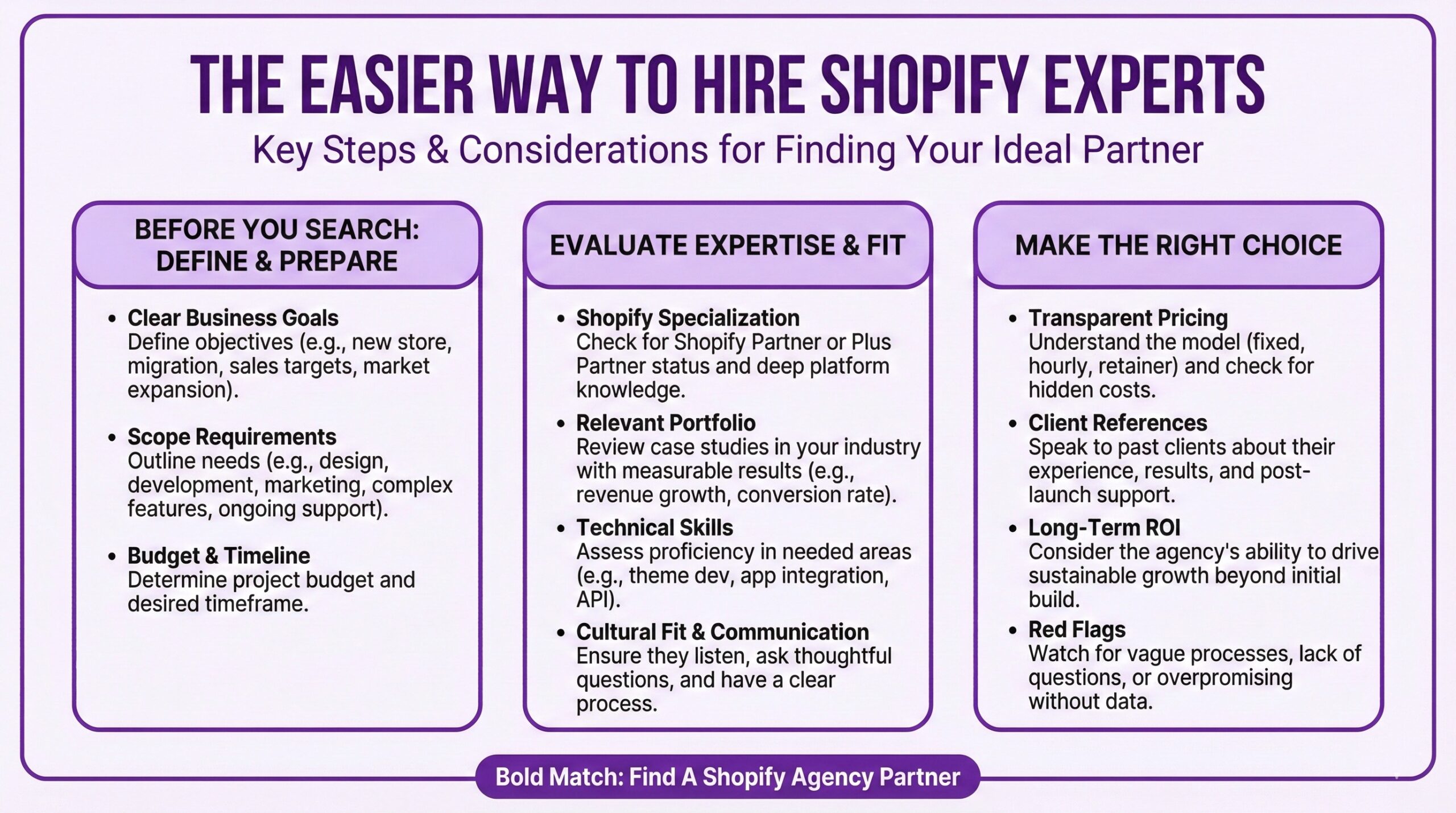
The Easier Way to Hire a Shopify Agency
Finding the right experts or expert agency shouldn’t feel like navigating a minefield. But it often does because too many agencies optimize for closing deals, not delivering results. Use this list as your filter. The more red flags you spot, the faster you should run. One or two might be manageable. Five or more? That’s not a partnership. That’s a disaster waiting to happen. Remember. The best agencies earn trust through transparency, demonstrate expertise through specifics, and build relationships through results. Everything else is just marketing.
Ok, it’s Friday so that’s it for me today. Hope you’re finding tons of value in the resources we’re building and the connections we’re making here! If this post helped clarify your agency selection process, that’s exactly what we’re trying to do. Help retailers like you implement the strategies that separate good e-commerce brands from great ones. So. As always, if you’ve just realized that you’ve outgrown what you can handle internally and need reliable Shopify Agency Expertise, you know where to find us. Keep building something awesome! – Jay
Frequently Asked Questions (FAQ)
What does a Shopify expert agency actually do?Shopify agencies are just web design, development or marketing agencies that specialize in designing, building and optimizing online stores using Shopify;s ecommerce platform rather than being generalists. They handle everything from initial store setup and custom theme development to app integration, migration from other platforms, and ongoing optimization. The best agencies combine technical development skills with ecommerce strategy to help merchants increase sales, not just launch websites.
How should I choose a Shopify expert agency?
Just start with whatever your specific needs are. If you need a complete store build? Look for Shopify development agencies with strong portfolios in your retail vertical. Trying to expand your consumer reach? Find agencies with proven performance marketing results. Then verify their expertise through Shopify Partner status, client references, and detailed case studies. Ask about their process, timeline, and post-launch support. The right agency asks as many questions as they answer.
How are agencies different from freelancers?
This is an easy one. Shopify agencies offer teams, processes, and redundancy. When your freelancer gets sick or overwhelmed, work stops. Agencies provide continuity, diverse expertise, and structured project management. However, freelancers often cost less and provide more direct communication. Choose freelance experts for specific, contained tasks. Choose expert agency partners for complex projects requiring multiple skill sets or ongoing support.
What’s the cost of hiring a Shopify agency?
There isn’t really one way to answer that question. You see. Costs vary wildly based on scope and agency tier. Basic store setups start around $5,000-$15,000. Custom development projects range from $15,000-$50,000. Enterprise Shopify Plus builds can exceed $100,000. Ongoing retainers typically run $2,000-$10,000 monthly. Remember: cheaper isn’t better if it means redoing everything in six months.
Should I hire a specialized or full-service agency?
Depends on your needs. Specialized agencies excel in their niche, whether that’s conversion rate optimization, Shopify SEO, or custom app development. Full-service agencies handle everything but might lack deep expertise in specific areas. Start with your biggest pain point and expand from there.
Can Bold Match Help Me Find a Shopify Agency?
Yes. Yes we can. Bold Match is 100% free for both merchants and expert agencies. We’re a nonprofit service that connects Shopify merchants and e-commerce retailers with pre-vetted expert agencies that our human matchmakers can actually vouch for based on your specific needs. We evaluate agencies on actual performance metrics, not marketing promises. No fees, no bias, just matches based on proven expertise and their suitability to a given project.