
Search Optimizing Shopify Product Pages For Fun and Profit
Written and edited by: Dirk
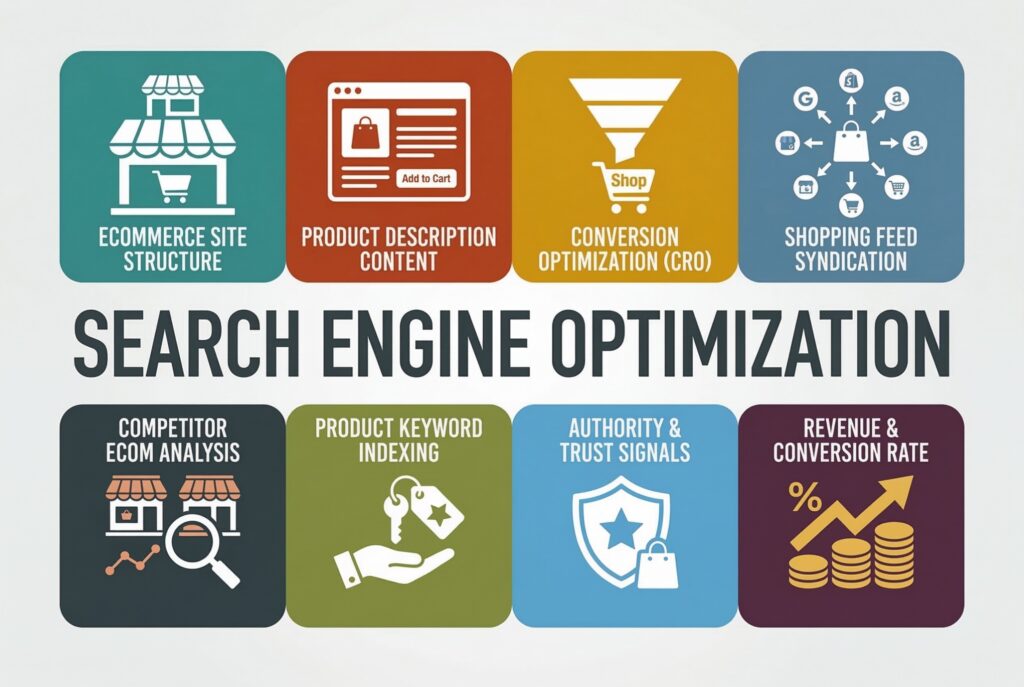
There’s this scene near the beginning of Godard’s Alphaville where Eddie Constantine’s Outland’s Agent 003 Lemmy Caution arrives in a city that looks exactly like mid 1960s Paris, except everything familiar has been reorganized by a machine intelligence that clearly doesn’t understand why humans care about beauty, or ambiguity, or the particular way a sentence can mean two things at once. The supercomputer Alpha 60 has optimized everything for function. Language has been stripped to pure utility. Poetry is illegal.
I think about this sometimes when I read Shopify product descriptions. Not because Shopify is a noirish Nouvelle Vague dystopia. It’s actually one of the better platforms for e-commerce SEO, and we’ll get into the specific reasons why. But because most product pages are written as if their only audiences will be machines, or worse, as though they were written by a machine that learned about commerce from reading other machines’ descriptions of e-commerce. So either nigh-incomprehensible marketing verbiage or flat, functional, forgettable. The product is round. The product is blue. The product is 12 ounces. The product ships in 3-5 business days.
Both approaches have always represented a slew of missed opportunities. Now, in an era where AI systems are actively reading your product pages to decide whether to recommend your products in conversational (use case focused) search results, it’s something closer to negligence. So I’ll try to make this a guide to making your Shopify product pages work harder, for both the algorithms that rank them and the humans who actually buy things. I’ll cover traditional SEO, Shopify’s specific advantages, and the GEO best practices that’ll help determine whether any one of the various AI Answer Engines mention you or your products when some shopper somewhere asks Claude or ChatGPT or Gemini or Perplexity “What’s the best inflatable green frog costume for inclement weather?”
Ensuring Your Products Shine in Search Results
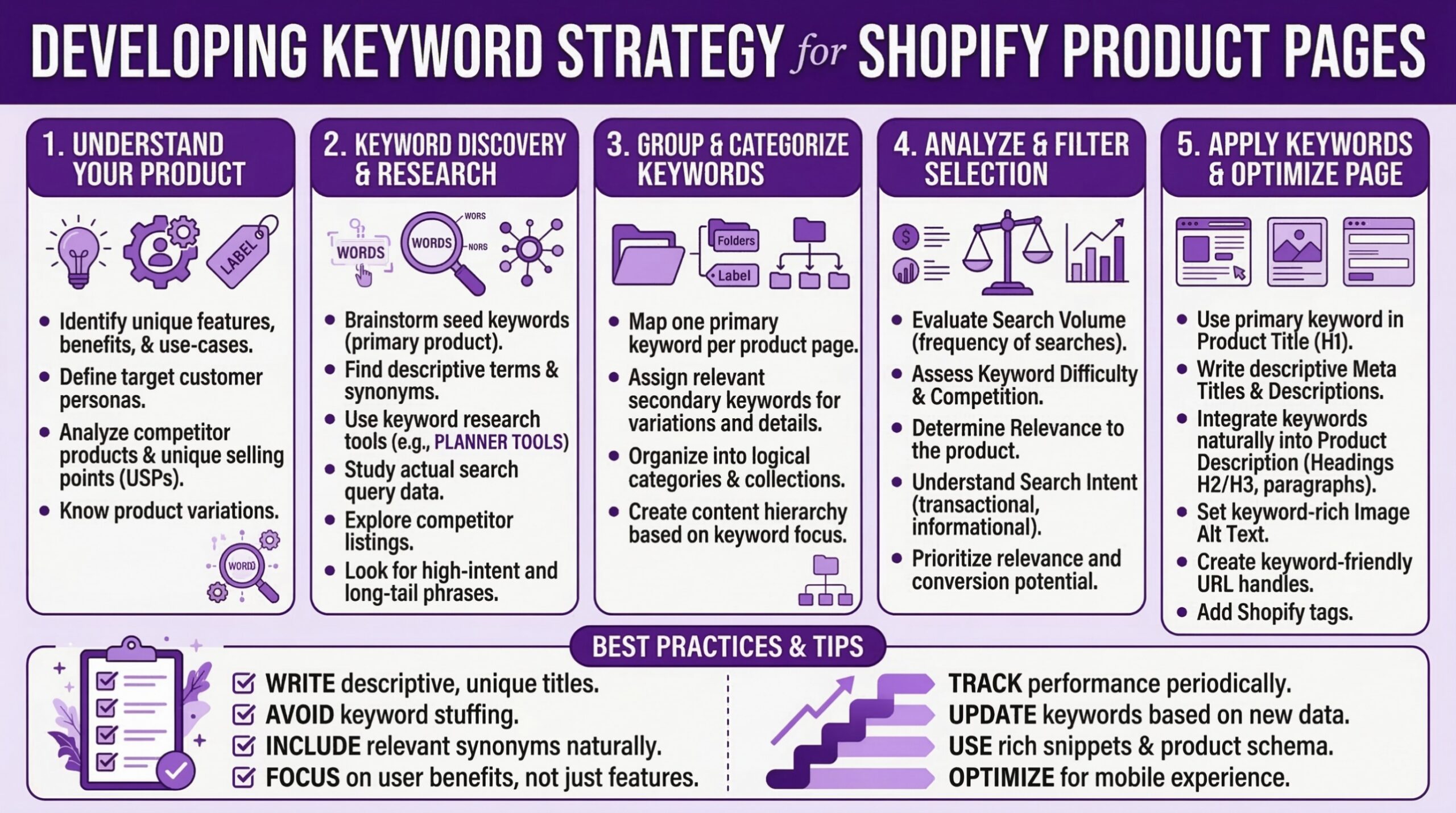
Before we get to all the interesting stuff and newly minted acronyms we need to address the structural basics. I know. Everyone wants to skip ahead to the cool AI visibility section. But optimizing for generative engines without solid traditional Search Optimization is like trying to run a film festival before you’ve even booked a venue. The fundamentals aren’t that exciting, but they’re foundational.
Product Titles and Meta Titles. Ok so Shopify generates your page’s meta title from the product title by default, and then appends your store name to the end of it. This is a problem. Shopify’s default meta titles can waste up to 30 characters on the store name alone, pushing critical keywords past the 60-character display limit where Google truncates them.
Fix this. Go into each product’s SEO settings in the Shopify admin (it’s under “Search engine listing” at the bottom of the product editor) and write custom meta titles that lead with the product name and primary keyword. Your store name can go at the end if there’s room, or you can drop it entirely. “Women’s Waterproof Hiking Boot, Gore-Tex” tells both Google and a potential customer more than “The TrailBlazer Pro 2.0 | Mountain Gear Co.”
Your H1 tag on Shopify product pages is automatically pulled from the product title, so think carefully about what you name your products. The title needs to work as both a customer-facing product name and an SEO signal. Find the balance between brand identity and search relevance.
Meta Descriptions. Most Shopify stores either leave the meta description blank (in which case Google generates its own snippet from the page content, usually poorly) or stuff it with keywords in a way that reads like a ransom note assembled from a thesaurus. Neither approach works.
Write meta descriptions that function as miniature advertisements. Under 160 characters. Include the primary keyword naturally. Give the shopper a reason to click. “Waterproof Gore-Tex hiking boot with Vibram soles and ankle support. Free returns. Rated 4.8 stars by 1,200+ hikers.” That’s a description that pulls its weight in the search results.
Product Descriptions That Actually Describe Products
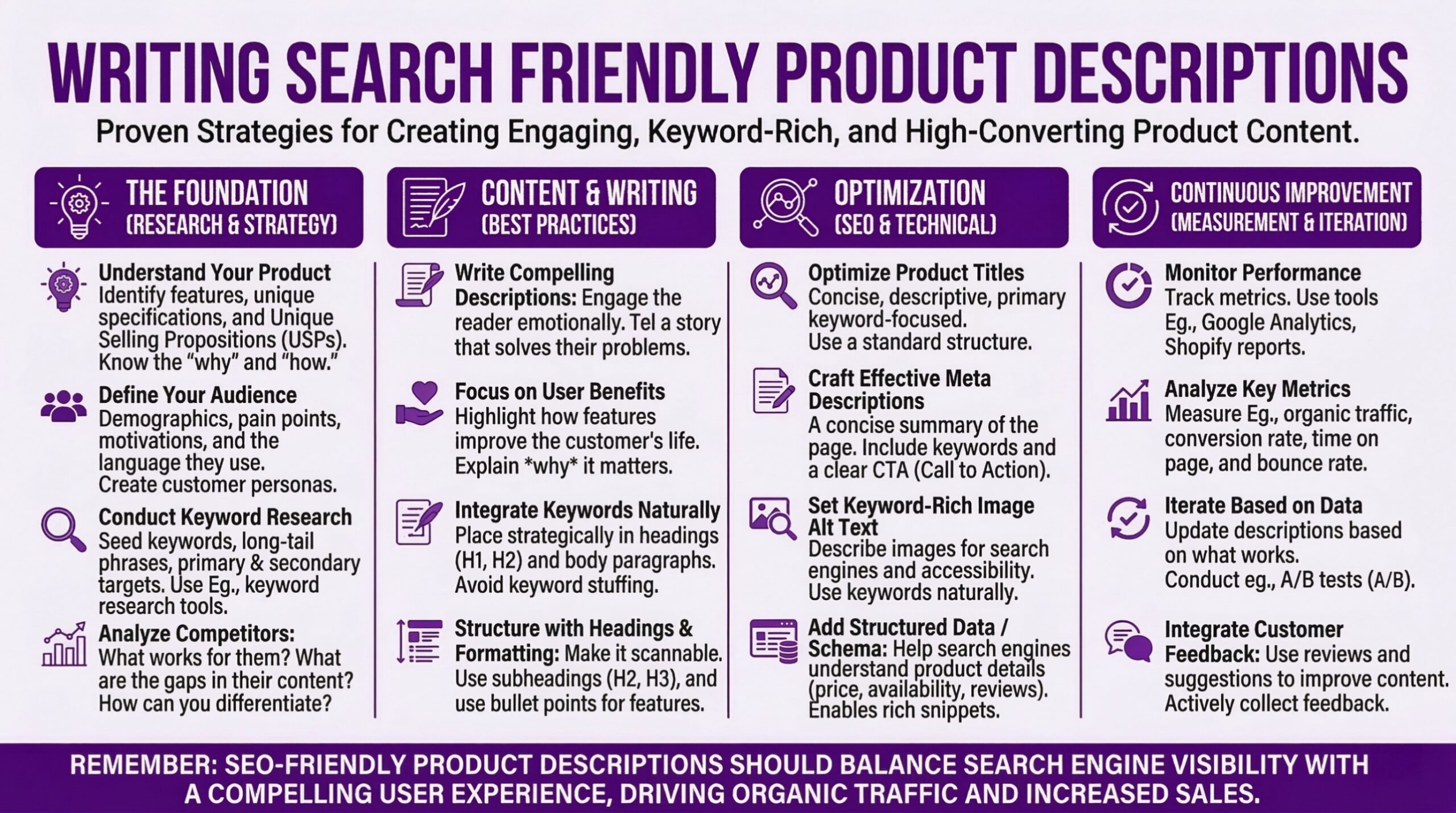
Paradoxically product descriptions are where most store owners fail, and it’s where the biggest SEO opportunity lives. Like. This SEMrush analysis of the keywords that triggered AI overviews found that these features appeared on roughly 16% of all queries, and that percentage is climbing. In other words. Product descriptions are doing double duty now. They need to convert human shoppers and provide the kind of clear, structured, substantive content that both search engines and Answer Engines can parse and reference.
Stop Copying Manufacturer Descriptions. This is probably the most common mistake. One SEO consultant found that stores using copy-pasted manufacturer descriptions (the same text that appears on hundreds of other sites) were essentially invisible to Google because of duplicate content penalties. Write your own. Every product. Yes, it takes time. That’s why it works.
Write for the Question Behind the Search. Someone searching for “lightweight carry-on suitcase” isn’t just looking for a suitcase. They’re usually asking “Will this fit in the overhead bin on my budget airline without getting gate-checked?” Your product description should answer the questions your shoppers are actually asking, not just list specifications.
Structure your descriptions with the shopper’s decision-making process in mind. Open with the benefit or the problem the product solves. Follow with specific features that support that benefit. Close with social proof, sizing information, or anything that removes a barrier to purchase. This structure isn’t just good copywriting. It’s also exactly what AI systems need to confidently recommend your product. Generative engines prefer content that clearly states what a product is, who it’s for, and what problems it solves.
Keyword Integration That Doesn’t Sound Like Keyword Integration. Natural language is the standard now. I shouldn’t need to say this 27 years after the first SES, but keyword stuffing persists on Shopify stores like a B-movie villain who refuses to stay dead. Use your primary keyword once in the product title, once in the first paragraph of the description, and then use variations and related terms throughout. “Hiking boots,” “waterproof trail shoes,” “Gore-Tex footwear for rough terrain.” The semantic field matters more than exact-match repetition.
Fortunately, Shopify lets you edit the URL handle for each product, and this is worth doing. Keep it short, descriptive, and keyword-relevant. You can’t remove the /products/ prefix from the URL (that’s one of Shopify’s known limitations compared to platforms like BigCommerce or WooCommerce that offer full URL control) but you can make the slug after it count.
The Product Image Search Optimization Problem
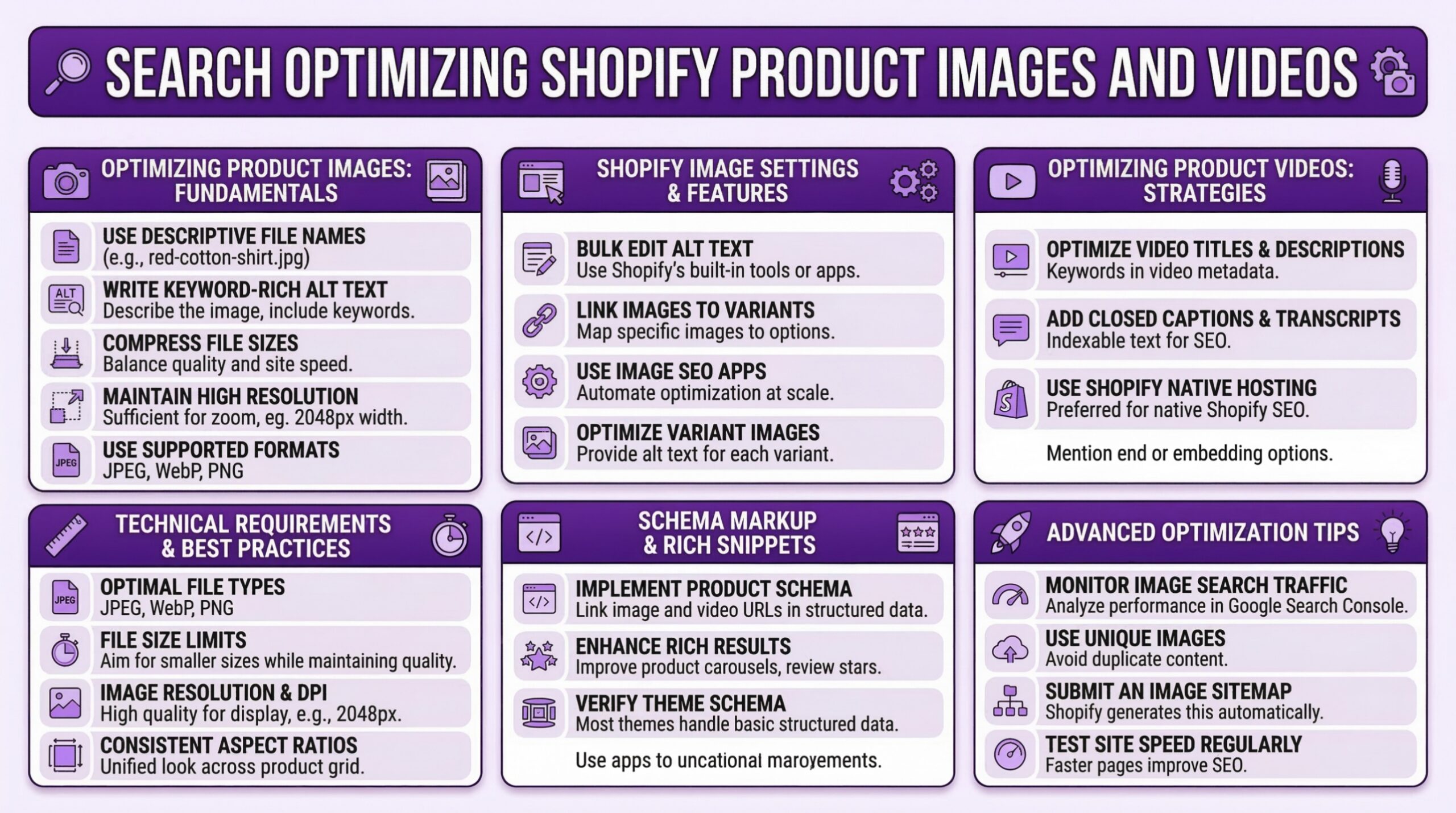
Personally, I’ve never been able to wrap my head around why this is true, but product images are arguably the most neglected SEO asset on e-commerce stores, which is ironic considering they’re usually what most merchants spend the most money creating.
Image Alt Text. Every product image should have descriptive alt text. Not “IMG_4532.jpg.” Not “product photo.” A sentence that describes what’s in the image in a way that helps a visually impaired shopper using a screen reader, and simultaneously tells search engines what the image depicts. “Women’s charcoal grey waterproof hiking boot with red lacing on a mossy trail surface” is doing real work. “Hiking boot” is doing almost nothing.
Thankfully, Shopify makes this easy to edit in the product image gallery. Click on any image, and there’s an alt text field right there. The fact that most merchants leave it blank suggests either nobody told them, or they didn’t think it mattered. It matters.
Image Compression and Format. Shopify automatically serves WebP format images to browsers that support it, which is a meaningful advantage over platforms where you’d need a plugin or manual conversion to achieve the same thing. But Shopify can’t fix images that were uploaded at absurd file sizes. A Digital Applied analysis noted that an unoptimized 2MB JPEG takes 3-5 seconds to load on a 4G mobile connection, well past Google’s 2.5-second Largest Contentful Paint threshold. Compress your images before uploading. Tools like TinyPNG or Squoosh handle this in seconds.
Name your image files descriptively before uploading them, too. Shopify uses the original filename as the default, and “waterproof-hiking-boot-charcoal-gore-tex.jpg” tells search engines something useful. “DSC_0094_final_v2.jpg” tells them nothing.
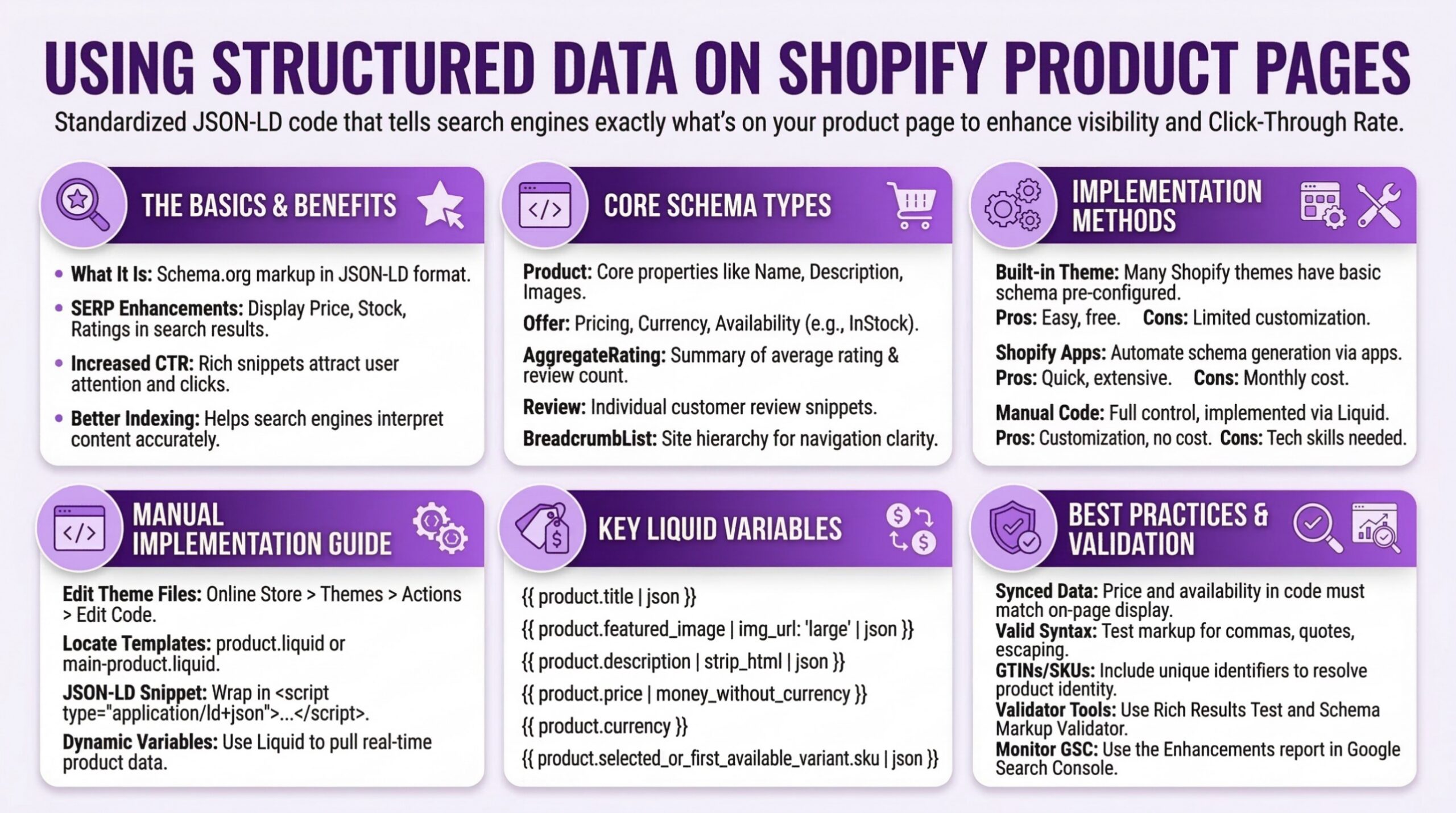
Implementing Schema Markup and Structured Data
This is where things get technical, and where Shopify offers some genuine built-in advantages worth understanding.
What Shopify Gives You By Default. Most Shopify themes include basic Product schema markup out of the box, usually covering the product name, price, availability, and sometimes review ratings. This structured data is what enables rich snippets in Google search results (those product cards showing price, star ratings, and stock status that stand out from plain text listings). Structured data can boost click-through rates significantly, with some analyses suggesting rich snippets can improve organic CTR by up to 82%. But “basic” is the operative word. Many Shopify themes generate incomplete schema, missing fields like brand, SKU, review count, shipping details, or return policies that Google uses to display richer results. And some older themes still use the outdated Microdata format rather than JSON-LD, which is Google’s recommended approach.
Things You Should Add. At minimum, audit your product page schema using Google’s Rich Results Test. Enter a product URL and see what Google actually reads. If fields like brand, aggregate Rating, SKU, or review data are missing, you have work to do. You have two paths for fixing this. The app route involves installing a schema markup app from the Shopify App Store (options include JSON-LD for SEO or Schema App). These are generally easy to set up and handle the heavy lifting without code. The manual route involves editing your theme’s Liquid templates to add custom JSON-LD blocks, which gives you full control but requires either developer skills or a developer. For merchants “about to be mid-sized,” the app route usually makes more sense. Get schema right now, then invest in custom implementation as soon as your catalog, and your budget justify it.
Beyond Product Schema. Don’t stop at product pages. Add BreadcrumbList schema to help Google understand your site hierarchy. Add FAQPage schema to any FAQ content on product pages (this can help you capture featured snippets). And add Organization schema to your homepage so search engines, and AI Answer Engines can correctly identify your business.
Optimized Internal Linking and Site Architecture
Shopify’s site architecture follows a predictable pattern. Homepage to collections to products. Blog posts live in a separate /blogs/ directory. This hierarchy is clean and Google understands it well, but most merchants don’t do enough to reinforce it through internal linking.
Every product page should link to related products within the description text itself, not just through the “You May Also Like” widget that your theme generates automatically. Write contextual links into your descriptions. “If you’re looking for a lighter option for summer trail running, our [Trailwind Mesh Runner] is built on the same sole with a breathable upper.” That kind of internal link passes authority, keeps shoppers browsing, and gives search engines a clear signal about the topical relationship between your products.
Link from blog posts to product pages. Link from product pages to relevant blog content. If you’ve written a buying guide about “How to Choose Hiking Boots for Different Terrain Types” and you have five products that the guide covers, every one of those products should link to the guide, and the guide should link to every one of those products.
Collection pages deserve attention here, too. Most Shopify retailers leave collection pages as bare product grids with no text whatsoever. Adding even 100-150 words of unique descriptive content to a collection page can help it rank for high-volume category keywords that individual product pages can’t compete for.
Product Pages and Generative Engine Optimization (GEO)
The landscape here has shifted dramatically, and merchants who act now will build advantages that compound over time.
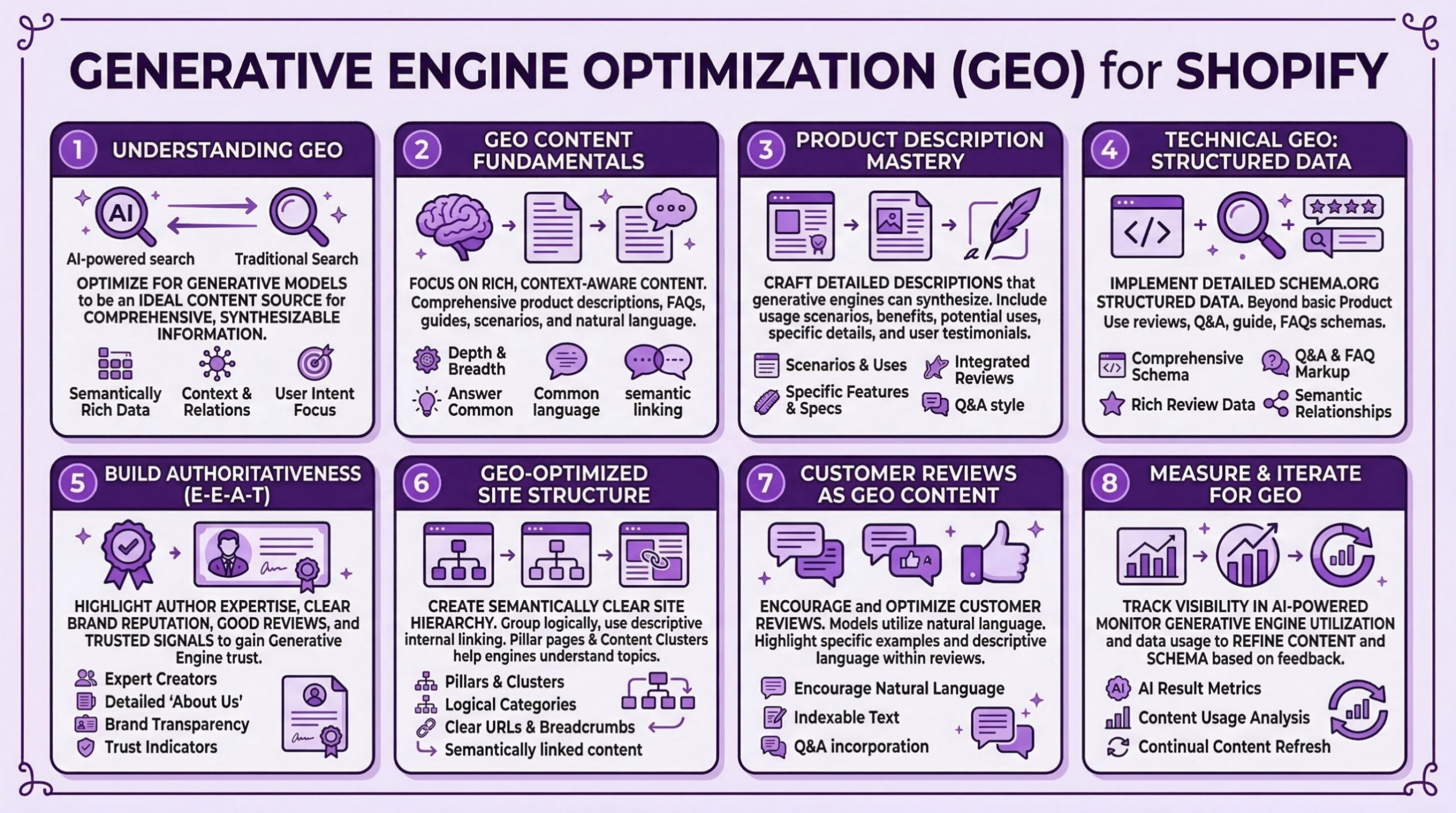
Generative Engine Optimization is the practice of structuring your content so that AI-powered search tools (Google’s AI Overviews, ChatGPT, Perplexity, Claude, Copilot) can parse, understand, and confidently reference your products when answering conversational queries. According to Shopify’s own enterprise data, AI-driven traffic to Shopify sites grew 8x year-over-year in 2025, and AI-driven orders grew 15x. That’s not a rounding error. That’s a channel.GEO doesn’t replace SEO. It builds on it. Think of traditional SEO as the foundation and Generative Engine Optimization (AIO, LLMO, AEO) as a new floor being added to the building. Without the foundation, the floor collapses. But with only the foundation and no new floor, you’re leaving livable space on the table.
What AI Systems Want From Your Product Pages. AI models don’t rank pages. They synthesize answers by pulling from multiple sources and deciding which content is trustworthy, clear, and relevant enough to cite. The signals that influence this decision overlap significantly with good SEO practice, but with some important distinctions.
Clarity over cleverness. AI systems interpret language literally. If your product description says “This bad boy is an absolute beast on the trail,” an AI model processing that sentence has no useful product information to work with. “This waterproof hiking boot features a Vibram Megagrip outsole and 200g PrimaLoft insulation, designed for technical trails in cold and wet conditions” gives the AI everything it needs to recommend your product when someone asks for a boot that handles mud and cold weather.
Structured data matters even more. The schema markup we discussed earlier isn’t just for Google’s rich snippets anymore. AI systems use structured data as a primary signal for understanding product attributes. Clean, complete JSON-LD product schema (with price, availability, brand, aggregate ratings, and return policy) makes your product machine-readable in exactly the way generative engines require.
Entity clarity across platforms. Here’s something most merchants don’t think about. AI systems cross-reference information across your website, your social media profiles, your Google Merchant Center feed, and third-party review platforms to build confidence in what your brand actually is. If your product descriptions on Shopify describe your boots as “premium outdoor footwear” but your Google Shopping feed lists them as “casual walking shoes,” that inconsistency reduces the AI’s confidence in recommending you. Consistent entity signals across platforms are a foundational requirement for GEO visibility.
Practical GEO Moves for Product Pages. Answer the questions shoppers ask conversationally. Add FAQ sections to your highest-traffic product pages with questions phrased the way someone would actually ask an AI assistant. “Is this boot waterproof enough for stream crossings?” not “Product waterproof rating specifications.” The conversational phrasing matches how users query AI tools, and the direct answer format is exactly what generative engines prefer to cite.
Write product descriptions that include use cases and comparisons naturally. “This mid-weight boot sits between our lightweight Trail Runner (designed for day hikes on maintained paths) and our heavyweight Expedition Pro (built for multi-day backcountry trips in winter conditions).” That kind of contextual positioning helps AI systems understand where your product fits in a recommendation landscape.
Invest in your product feeds. Shopify’s native integration with Google Merchant Center is an advantage here, since clean, complete product feed data makes your products eligible for Google’s AI shopping carousel. Make sure your feed includes accurate and detailed product types, GTIN/UPC codes, and descriptive product categories. Shopify handles the data sync, but the quality of what gets synced is on you.
Monitor how AI platforms present your brand. Ask ChatGPT, Perplexity, and Google’s AI Overview about your product category. See who gets mentioned. See what content gets cited. This isn’t vanity searching. It’s competitive intelligence. If a competitor’s product page is getting cited and yours isn’t, compare the two pages. The differences in structure, specificity, and schema completeness will usually be obvious.
Shopify-Specific SEO Advantages You Should Be Using
Honestly. Shopify isn’t perfect for SEO. The fixed URL structures (/products/, /collections/) limit your control compared to fully self-hosted platforms, and the platform’s reliance on apps for advanced functionality can create page speed issues if you install too many. But it has several meaningful advantages that merchants often overlook.
Server-side rendering is a big one. Shopify renders pages server-side by default, which means search engines and AI crawlers see your content immediately without needing to execute JavaScript first. This is a significant advantage over headless or JavaScript-heavy storefronts where content visibility depends on client-side rendering. Shopify’s own GEO playbook highlights this as a built-in advantage for both SEO and AI discoverability. Automatic SSL, sitemap generation, canonical tags, and robots.txt are all handled for you. On WooCommerce, you’d be managing each of these through separate plugins with varying quality. On Shopify, they just work.
Shopify Magic’s AI product description generator can be useful as a starting point for writing unique descriptions at scale, but treat it as a first draft, not a finished product. The output tends to be generic and needs the same humanization and specificity work we’ve been discussing. And Shopify’s built-in multilingual SEO support (including hreflang tags) gives international merchants a technical foundation that competitors like BigCommerce simply don’t include natively.
Measuring The Search Rankings Metrics That Matter
SEO work without measurement is guesswork, and product page optimization is no exception.
Set up Google Search Console (free, essential, non-negotiable) and monitor which product pages are appearing in search results, what queries they’re ranking for, and how often impressions convert to clicks. Pay particular attention to click-through rates. If a product page gets lots of impressions but few clicks, your meta title and description are probably failing to differentiate you in the results.
Track organic traffic to product pages in Google Analytics and compare it against your paid traffic costs. Every organic visit to a product page is a visit you didn’t pay for. Over time, well-optimized product pages can meaningfully reduce your customer acquisition costs and your dependence on ad platforms you don’t control.
For GEO, measurement is still maturing as a discipline. The basic approach involves periodically querying AI platforms with questions relevant to your product categories and tracking whether your products appear in the responses. More sophisticated approaches involve tools like Scrunch, Goodie AI, or Semrush’s Enterprise AIO, which monitor brand visibility across AI platforms automatically. The important thing is to start tracking, even manually, so you can see whether your optimization work is actually moving the needle.
The Honest Complexity of SEO in the GEO Era
I’ve covered a lot of ground here, and I want to be straightforward about something. This is genuinely complex work. Writing unique descriptions for a catalog of 200 products is a project. Auditing and fixing schema markup across a Shopify theme requires either technical skill or the budget to hire it. Building a GEO strategy on top of a solid SEO foundation is a layered, ongoing investment.
Basically any one of these tasks is manageable for a motivated store owner with time and patience. All of them together, done well and maintained over time, usually require professional help. That’s not a sales pitch. It’s an observation from years of watching merchants try to do everything themselves, burn out, and end up with partially optimized stores that underperform in every channel.
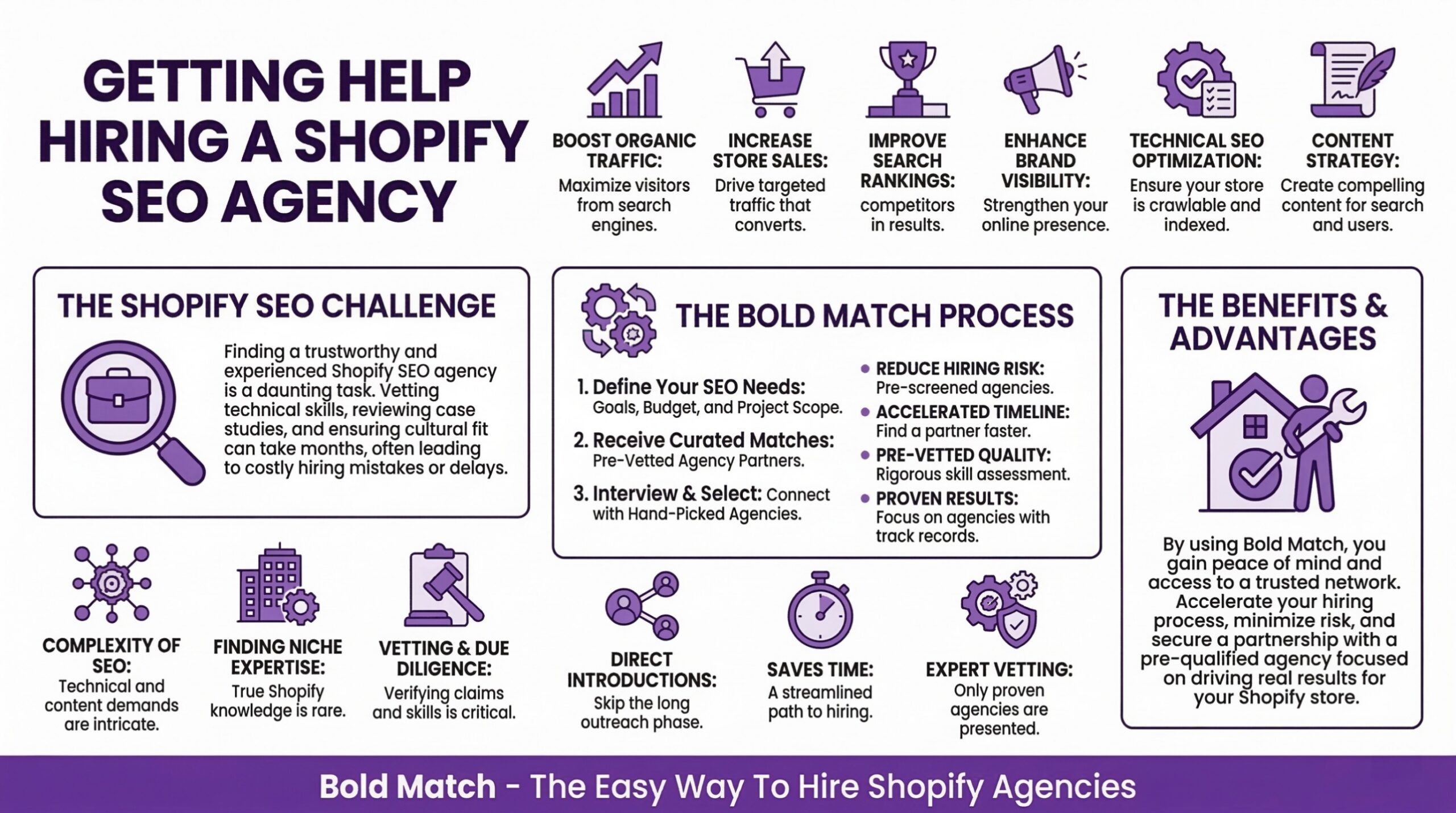
If you’re reading this and thinking “I need someone who actually knows how to do all of this for my store,” that’s exactly what Bold Match is for. It’s a FREE matchmaking service that connects Shopify merchants with vetted Shopify Agency Partners who specialize in exactly this kind of work. No commissions, no hidden costs, just introductions to people who can help. The SEO and GEO landscape is only getting more layered, and having the right partner makes the difference between keeping up and falling behind.
Frequently Asked Questions (FAQ)
How long does it take for Shopify product page SEO to show results?It depends but you should think of product page SEO is a slow-burn investment, not an overnight transformation. Most merchants start seeing measurable improvements in search impressions within 4-8 weeks of making changes, with meaningful ranking movement and traffic gains usually appearing in the 60-to-90-day range. Factors like your site’s existing domain authority, the competitiveness of your product category, and how many pages you’re optimizing all affect the timeline. The good news is that well-optimized product pages continue generating organic traffic for months or years after the initial work, unlike paid ads that stop the moment your budget runs out.
Should I use a Shopify SEO app or hire a developer for schema markup?
For most growing merchants, a schema markup app is the right starting point. Apps like JSON-LD for SEO or Smart SEO can implement Product, BreadcrumbList, and Organization schema without code changes, and they usually cost under $10/month. Where a developer becomes worth the investment is when you need custom schema beyond what apps support, when you have a large catalog with variant-specific markup needs, or when your theme’s default schema conflicts with app-generated markup (which can create duplicate structured data errors). Start with an app, validate everything through Google’s Rich Results Test, and upgrade to custom implementation when the scale of your catalog demands it.
Do product descriptions really need to be unique for SEO?
Yes. Google treats duplicate content (including manufacturer descriptions used across hundreds of competing stores) as a signal that your page adds no unique value. Stores that rewrite their product descriptions in their own voice, with original details about use cases, comparisons, and shopper-relevant information, consistently outrank stores that copy-paste the same text everyone else has. This matters even more for GEO. AI systems building recommendations from multiple sources are more likely to cite content that offers distinct perspective or unique product information rather than boilerplate specifications.
What is GEO, and why should Shopify merchants care about it?
GEO stands for Generative Engine Optimization. It’s the practice of structuring your content so AI-powered search tools (Google’s AI Overviews, ChatGPT, Perplexity, and similar platforms) can parse, understand, and recommend your products when shoppers ask conversational questions. Shopify’s own data shows AI-driven traffic to Shopify sites grew 8x year-over-year in 2025, with AI-driven orders growing 15x. GEO doesn’t replace traditional SEO. It builds on it. Clean schema markup, unique product descriptions, consistent entity signals, and conversational FAQ content on product pages are all practical GEO steps that Shopify merchants can implement today.
What SEO advantages does Shopify have over other e-commerce platforms?
Shopify handles several technical SEO fundamentals automatically that other platforms require plugins or manual configuration to achieve. These include SSL certificates, XML sitemap generation, canonical tags, robots.txt files, and server-side rendering (which ensures search engines and AI crawlers can see your content immediately). Shopify also offers native multilingual SEO with hreflang tag support, built-in Google Merchant Center integration for product feeds, and automatic WebP image conversion. The main limitation compared to platforms like WooCommerce or BigCommerce is the fixed URL structure (/products/, /collections/) that you can’t modify. But in practice, the SEO work that matters most for product pages (descriptions, meta tags, schema, images, internal linking) is fully within your control on Shopify.
How do I optimize Shopify product images for SEO?
Three steps. First, compress images before uploading using tools like TinyPNG or Squoosh. Shopify automatically serves images in WebP format to supported browsers, but it can’t fix files that were uploaded at unnecessarily large sizes. Second, name your image files descriptively before uploading. Use “waterproof-hiking-boot-charcoal-gore-tex.jpg” instead of “IMG_4532.jpg.” Third, write descriptive alt text for every product image. Alt text should describe what’s visually in the image in a way that’s useful for both screen readers and search engines. “Women’s charcoal waterproof hiking boot on rocky trail” is working for you. “Boot” is not.
Can I do product page SEO myself, or do I need an agency?
You can absolutely handle the fundamentals yourself. Writing unique product descriptions, editing meta titles and descriptions, adding alt text to images, and cleaning up URL handles are all tasks you can do in the Shopify admin without any code. Schema markup apps make structured data accessible without developer skills. Where professional help becomes valuable is at scale (optimizing hundreds of product pages), for technical implementation (custom Liquid code for advanced schema, site speed optimization, fixing indexation issues), and for strategic work (keyword research, competitive analysis, GEO monitoring, and ongoing content optimization). Bold Match connects Shopify merchants with agency partners who specialize in exactly this kind of work, at no cost.
How often should I update my product page SEO?
Product page SEO isn’t a one-and-done project. At minimum, review and refresh your highest-traffic product pages every 3-6 months. Update meta descriptions if click-through rates are declining. Add new FAQ questions based on customer support inquiries. Refresh product descriptions with seasonal language or new use cases. Monitor Google Search Console for pages that are losing impressions or ranking positions, and prioritize those for attention. For GEO, periodically check how AI platforms respond to queries about your product categories and adjust your content based on what you observe. The merchants who treat product page optimization as an ongoing discipline consistently outperform those who set it and forget it.