
Choosing The Best Global Growth Model for Shopify
Written and edited by: Jay
Hey there gang. Hope everyone anywhere north of this “potentially historic” winter storm is practicing staying warm. ❄️
That’s right. I’m Jay Myers again and once again this is Bold Match. And you? You’ve hit the moment most mid-size e-commerce merchants dream about and simultaneously dread. Your domestic sales are solid. Your product-market fit is proven. International customers are finding you organically, and you’re leaving money on the table where money gets left in posts like this each and every time a consumer from Marseille or Mumbai hits currency conversion fees or abandons checkout because duties weren’t 100% clear.
The question isn’t whether to expand internationally. It’s how to expand. For Shopify merchants, this decision usually boils down to one of two models that are really more like two and half or three models … Shopify Markets (or Markets Pro) or Expansion Stores. On paper, both global growth solutions handle all of the technical requirements of international commerce. But in practice, of course, they represent fundamentally different operational philosophies with wildly different cost structures and scalability profiles besides.
This isn’t a features comparison. It’s a business model decision that will determine how fast you can move, how much control you retain and whether your international operations become a competitive advantage or an operational albatross hanging off your brand.
What’s Actually at Stake When You Choose
Before diving into capabilities and trade-offs, let’s take a sec and just talk about what you’re really talking about.
It almost seems too obvious to say, but that’s generally how most things we have to say sound, so I have to start by saying that when you expand your e-commerce brand internationally, you won’t just be translating your homepage and adding Euro pricing. You’ll be making binding commitments about legal structure, financial operations, customer experience, and team organization. The expansion model you choose today will basically determine whether launching your next market takes three days, three weeks, or three months.
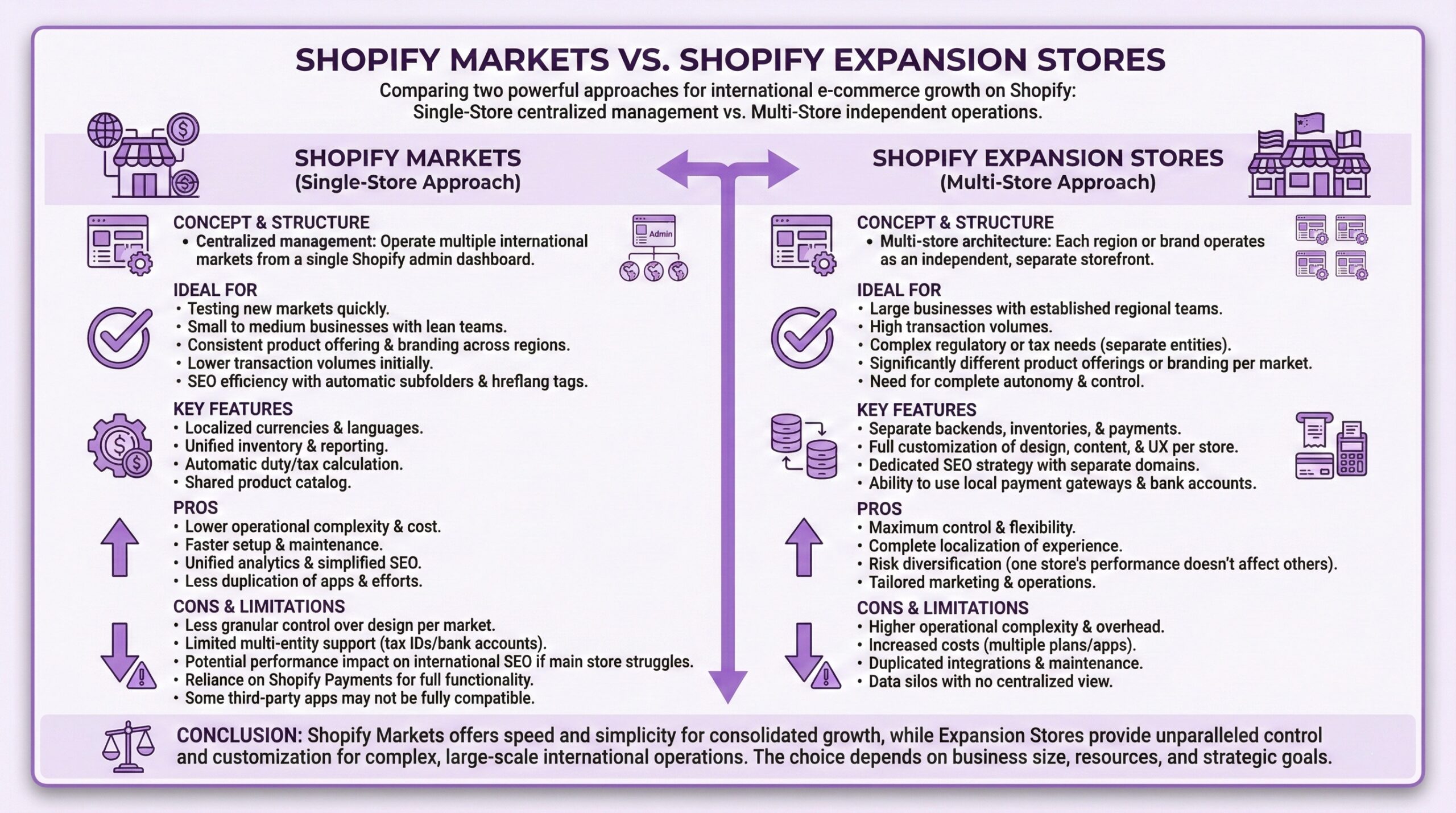
In 2025, global e-commerce hit $6.86 trillion, representing 20.5% of all retail transactions worldwide. Digital wallets now drive 66% of global spending. Cross-border commerce isn’t exotic anymore. It’s table stakes. Your international strategy needs to accommodate this reality without creating the operational complexity that kills momentum. The choice between Markets and Expansion Stores fundamentally comes down to centralization versus autonomy. Do you want one store serving multiple regions with configurable rules, or do you want separate stores that operate independently? Neither approach is exactly better. Both excel in different contexts.
Understanding Shopify Markets
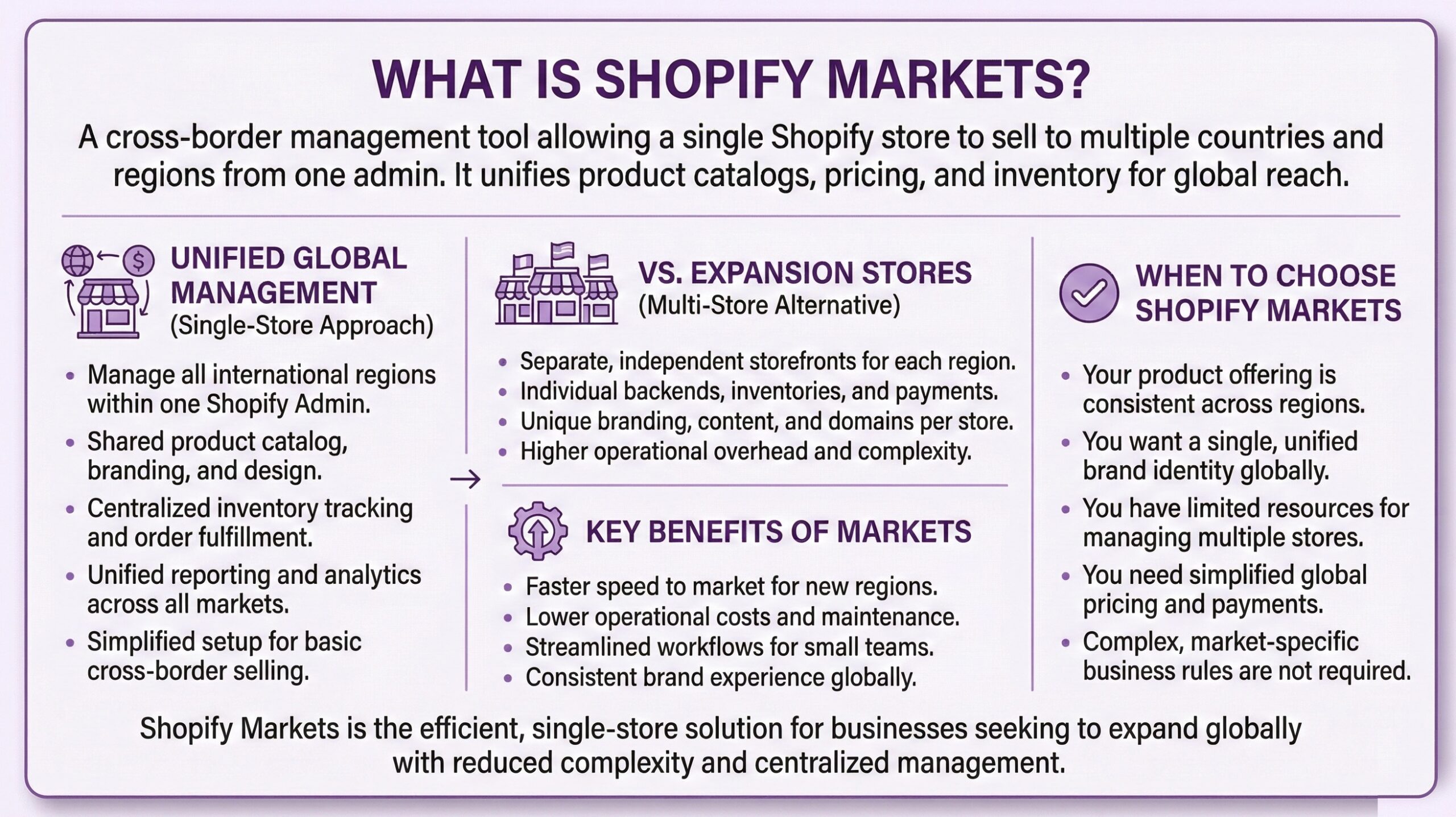
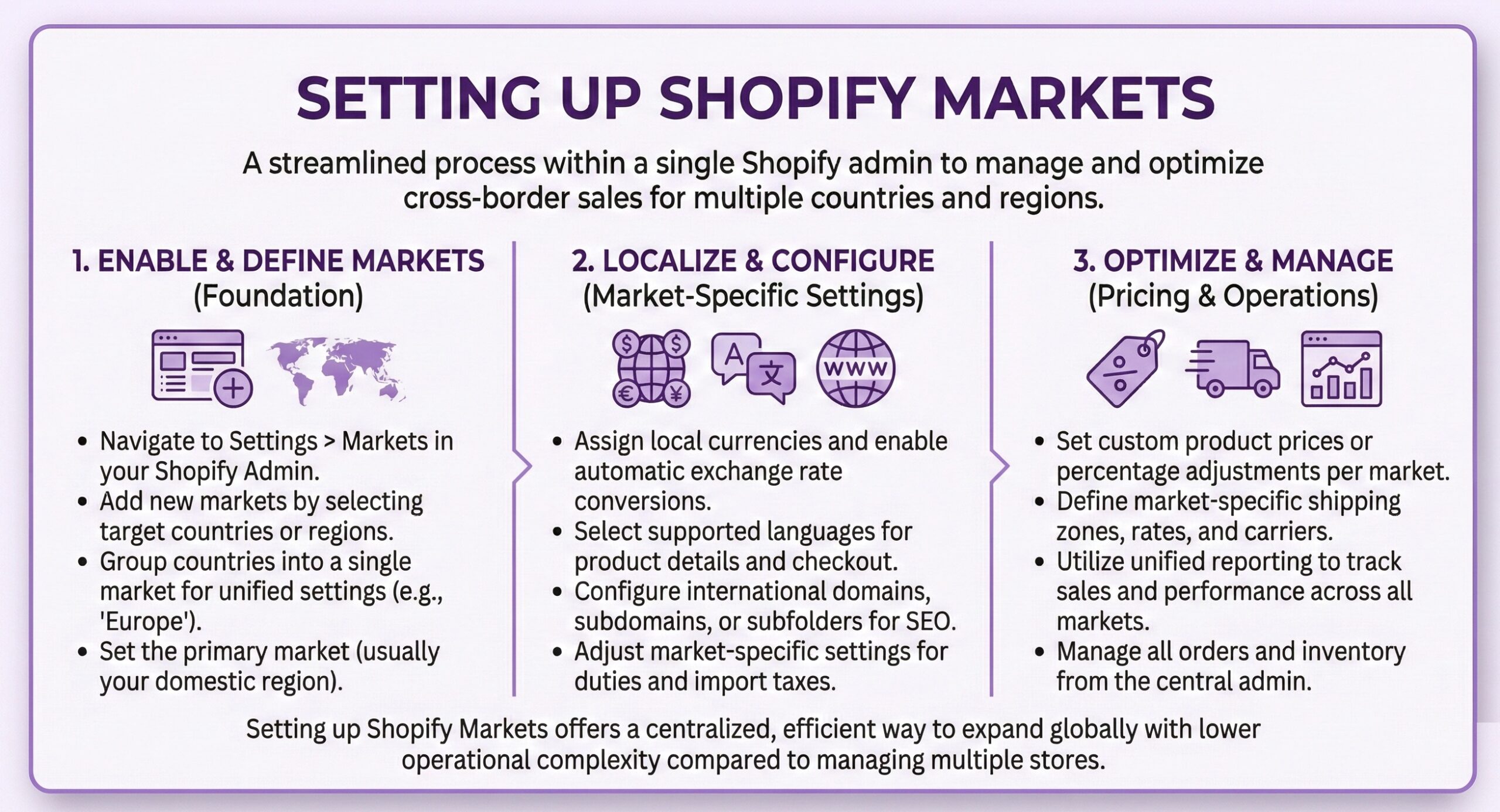
Shopify Markets gives Shopify store owners a single store architecture with regionalized customer experiences. In other words. One catalog. One admin panel. One set of apps and integrations. You get the picture. Regional differences are handled through configuration layers rather than separate storefronts. So. When a shopper from Germany visits your store, Markets serves them Euro pricing, German language options, and localized checkout with VAT calculated automatically. When someone from Toronto arrives ten seconds later, they see Canadian dollars, English language content, and local shipping rates. Same store. Different presentation.
Your technical implementation relies on Shopify’s subdomain or subfolder structure. Which is to say that you can serve markets through paths like yourstore.com/en-ca or yourstore.com/en-gb. Shopify handles the hreflang tags, market-specific sitemaps, and currency conversion automatically. Your team manages everything from a single control panel. This centralization creates obvious operational advantages. Product updates happen once. Marketing campaigns deploy across all markets simultaneously. Analytics aggregate into unified dashboards. Your tech stack will remain lean because any integrations will only need to connect to one store.
The 2025 updates to Markets addressed what used to be the biggest constraint. Multi-entity functionality now allows one store to map markets to different legal entities. You can onboard Shopify Payments per entity, enabling region-specific payment methods while maintaining centralized operations. This means a UK subsidiary can accept domestic payment methods that settle into a British bank account, while your US entity processes American cards separately.
That said, these multi-entity capabilities come with limitations. Most third-party payment gateways still attach to the primary entity. Subscription apps usually can’t switch entities per market. If you need secondary markets to settle locally with specialized payment methods beyond PayPal or manual options, you’ll likely need expansion stores for those specific regions. Markets works exceptionally well when you operate primarily under one legal entity, or when your entity separation requirements are straightforward enough that Shopify’s multi-entity framework covers them. The model favors speed and operational simplicity over granular control.
Understanding Expansion Stores
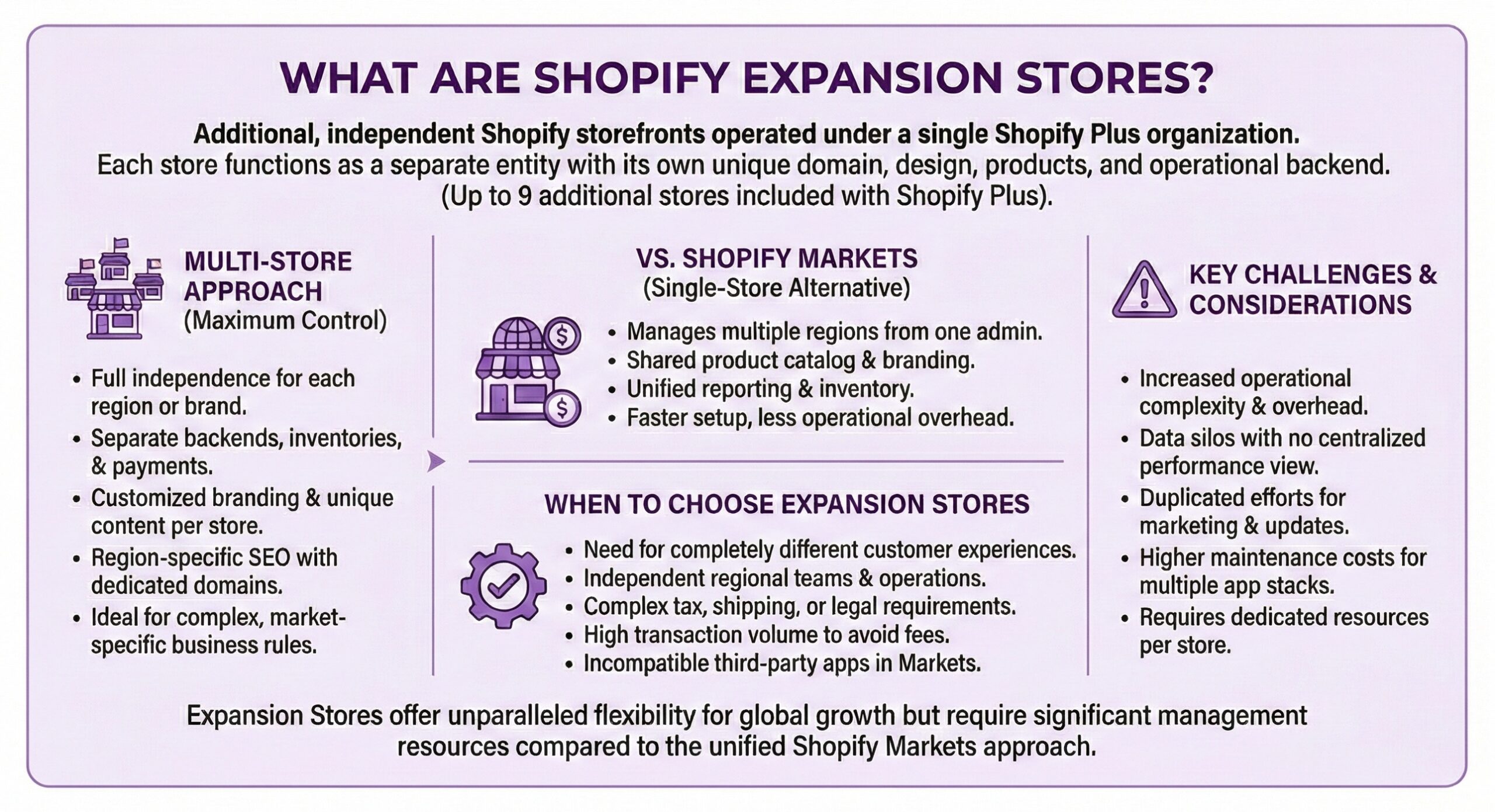
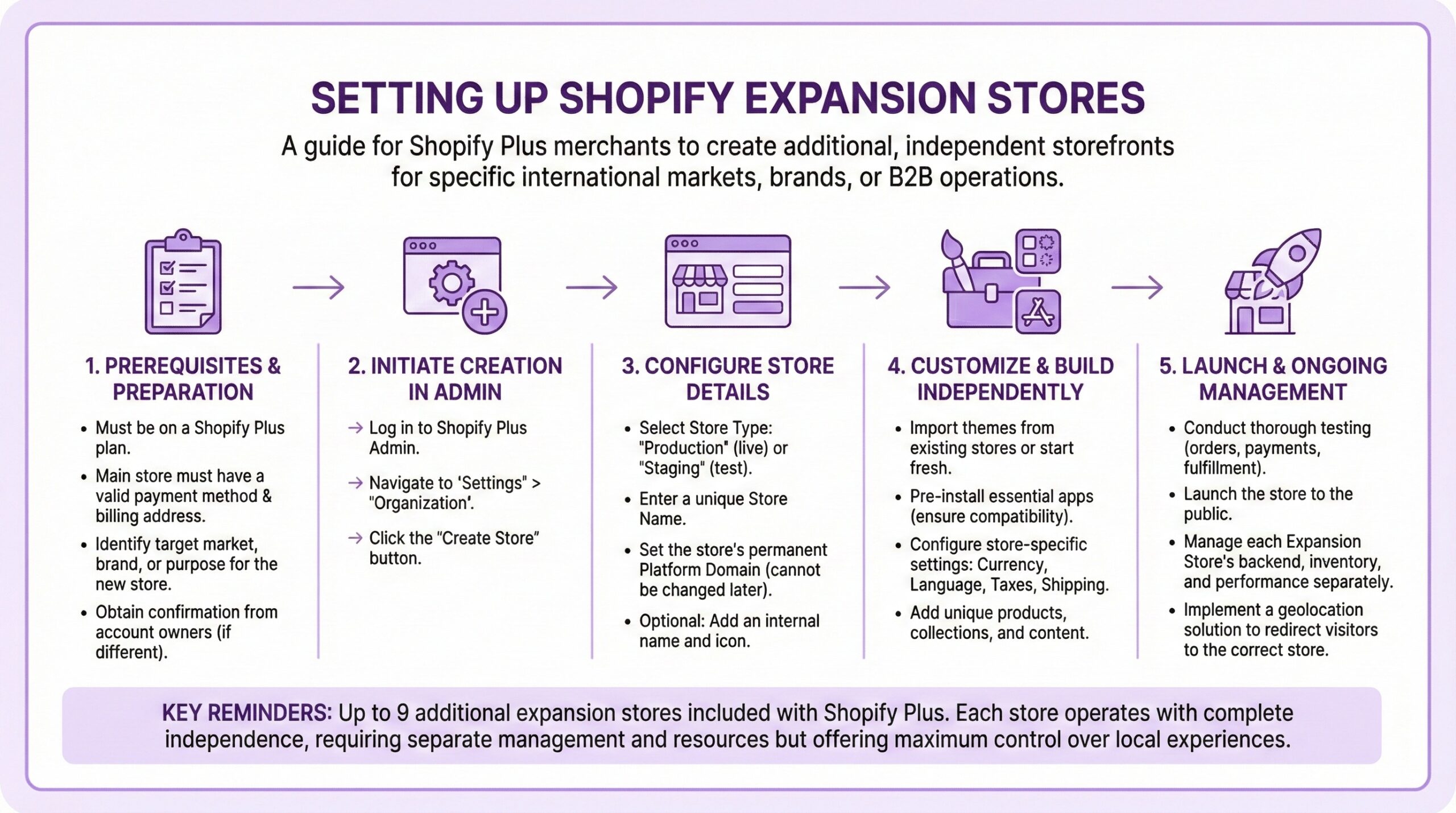
Expansion Stores means running multiple independent Shopify stores under one organization. Each store functions as a completely separate environment with its own admin, catalog, customer database, checkout flow, and analytics. Think of it like operating regional franchises under one corporate umbrella. Your French store runs on brand.fr with Euro pricing and French payment gateways. Your UK store operates on brand.co.uk with Sterling and British carriers. Your US store uses brand.com with dollars and domestic fulfillment. Each store connects to regional bank accounts, handles local taxes independently, and maintains operational separation.
This architectural separation provides maximum flexibility but creates substantial duplication. Every product you add goes into multiple catalogs. Every content update gets replicated across stores. Every app you install multiplies by the number of markets you serve. Analytics fragment across dashboards unless you’re on Shopify Plus with multi-store reporting.
The value proposition becomes clear when you need hard boundaries between regions. If different legal entities operate your international presence, Expansion Stores makes compliance straightforward. Each entity gets its own store with clean separation of finances, data, and operations. Your EMEA team doesn’t see North American analytics. Your North American team can’t accidentally modify Asian product catalogs.
Regional autonomy also matters when markets operate dramatically differently. Maybe your European catalog includes products unavailable in Asia due to regulatory constraints. Maybe your US team runs aggressive promotional calendars while your UK operation maintains premium positioning. Maybe you’re preparing to hand off market operations to local distributors who’ll own their regional stores outright.
The cost structure reflects this operational independence. On standard Shopify plans, each expansion store requires a separate subscription. You’re paying for multiple stores, multiple app subscriptions, and multiplied integration costs. Shopify Plus merchants get up to nine expansion stores included, making the economics more favorable at enterprise scale.
When Each International Model Makes Sense
Most merchants wrestling with this choice get buried in feature matrices. The real determining factors are structural, not technical.
Choose Shopify Markets if: You operate under a single legal entity or have straightforward multi-entity requirements that Shopify’s framework accommodates. Your product catalog remains consistent across regions, even if pricing varies. Speed matters more than granular control, because you want to test or launch markets in days rather than months. Your team operates centrally rather than through regional divisions. You’re comfortable with Shopify Payments and its currency conversion fees in exchange for simplified operations. Your fulfillment runs from centralized warehouses or uses basic regional routing. SEO consolidation under one domain carries strategic value.
Choose Expansion Stores if: Multiple legal entities operate your international business with distinct tax IDs and banking requirements. Regional catalogs differ substantially due to regulatory constraints, localization requirements, or strategic positioning. Different teams manage regional operations with hard data separation requirements. You need settlement in local currencies through region-specific payment gateways beyond Shopify Payments’ scope. Regional warehouses require precise fulfillment control without shared inventory logic. You’re planning eventual hand-off to franchisees, distributors, or acquired regional operators. Compliance demands or operational governance make centralization impractical.
What you’ll quickly see looking at it that way is straightforward. Markets is optimized for operational efficiency and speed. Expansion Stores is optimized for control and for separation. Neither approach is incomplete or wrong. They solve different business problems.
What 2025’s Multi-Entity Updates Actually Changed
Until recently, the conventional wisdom was simple. If you needed payments settling into different bank accounts for legal entities in different countries, you ran expansion stores. That was the only option. Multi-entity settlement was Expansion Stores’ primary technical advantage. The 2025 updates to Shopify Markets fundamentally shifted this dynamic. Multi-entity payment processing now exists within Markets, allowing one store to map markets to entities and localize both payouts and alternative payment methods.
Here’s what this enables in practice. Your UK market can process payments through a UK legal entity, settle into a British bank account in pounds, and offer UK domestic payment methods like direct debit. Your US market processes through your American entity, settles in dollars, and provides US-specific options. All of this happens through one Shopify store with Markets configuration.
The technical limitation is that this works primarily through Shopify Payments. Most third-party gateways still attach to the primary entity. If a significant portion of your revenue comes from markets where Shopify Payments isn’t available or where you need gateway-specific features beyond Shopify’s scope, you’ll face constraints.
What hasn’t changed is governance and data separation. Markets still operates as one store. Your regional teams share admin access. Analytics aggregate rather than isolate. If you need genuine operational autonomy between regions, whether for team structure or compliance requirements, Expansion Stores remains the cleaner architecture. The practical takeaway is that multi-entity payment settlement is no longer a binary forcing function toward Expansion Stores. But it’s also not a complete replacement for expansion stores’ separation capabilities.
The Real Costs Beyond The Subscription Fees
The published pricing is straightforward. Shopify Markets comes with three free markets on most plans, with additional markets costing $59 monthly each on Advanced plans. Shopify Plus includes up to nine expansion stores within the base subscription.
These line-item costs tell maybe twenty percent of the story.
When you run Expansion Stores, multiplication happens everywhere. Apps that cost $50 monthly for one store cost $250 for five stores. ERP integrations you built once need rebuilding for each environment. Your ESP connects to five separate customer databases instead of one. Analytics tools either fragment across stores or require enterprise multi-store aggregation at premium pricing.
More insidiously, operational costs compound. Content updates that take thirty minutes in Markets take three hours across expansion stores when you’re replicating changes. Product launches require five separate uploads with five separate review cycles. Campaign management demands regional coordination that wouldn’t exist in a centralized model.
Markets avoids this multiplication but introduces different costs. Currency conversion fees add up when you’re processing international transactions through Shopify Payments. If you’re doing $500k monthly across five markets, those conversion fees hit harder than the $295 you’d pay for five additional Markets subscriptions.
The efficiency trade-off skews heavily toward Markets for lean teams. When you’ve got three people managing international operations, the operational overhead of expansion stores becomes genuinely punitive. When you’ve got regional teams anyway and distinct operational requirements, the cost differential matters less than control and compliance.
Some SEO Implications Worth Worrying About
Search optimization is one of the clearest differentiators between these models, and it’s not just about technical implementation.
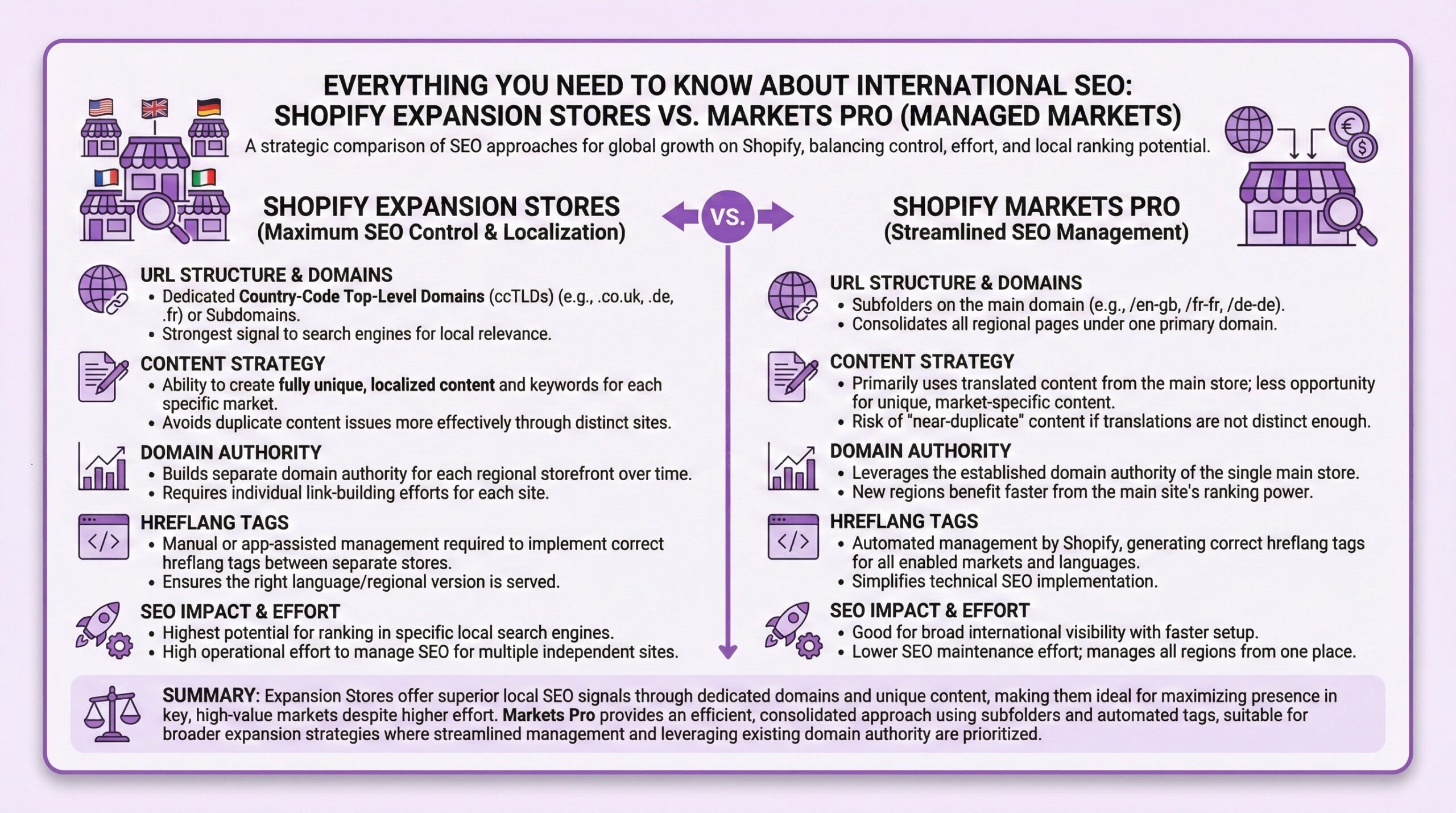
Shopify Markets uses subfolders or subdomains under your primary domain. When Google sees yourstore.com/uk, yourstore.com/de, and yourstore.com/fr, it understands these as regional variations of the same entity. Your domain authority consolidates. Link equity accumulates to one root domain. Shopify generates hreflang tags automatically, telling search engines which version to serve based on geography and language.
This matters substantially for mid-size brands building authority. Every quality backlink, every earned mention, every content asset contributes to one domain’s strength. You’re not splitting equity across multiple properties.
Expansion Stores requires separate domains or subdomains. Your brand.fr, brand.co.uk, and brand.com each build authority independently. Hreflang implementation requires manual configuration or apps because Shopify’s native functionality doesn’t span separate stores. Your SEO team manages international signals across multiple properties rather than within one consolidated structure.
For established e-commerce brands with strong domain authority already built in each market, this separation might not matter. For growing retail brands trying to build that authority, the consolidation advantage of Markets accelerates progress.
The counterargument favoring Expansion Stores comes when markets need genuinely distinct content strategies. Maybe your UK store targets different search terms than your US store. Maybe regulatory differences mean your product positioning shifts substantially between regions. In these scenarios, separate domains provide strategic flexibility that subfolder structures constrain.
The technical SEO advantage goes to Markets. The strategic flexibility advantage goes to Expansion Stores. Which matters more depends on your growth stage and market positioning.
The Tension Between Speed and Control
Every operational decision includes trade-offs. With international expansion infrastructure, the trade-off axis is unusually clear.
Shopify Markets optimizes for velocity. You can configure a new market in under an hour. Add the country group. Set pricing rules. Configure shipping. Enable payment methods. You’re live. Testing a hypothesis about Australian demand doesn’t require spinning up infrastructure. You add Australia as a market, run ads for thirty days, evaluate results, and either scale or shut it down.
This speed compounds when you’re managing ongoing operations. Product updates happen once. Campaigns deploy globally with regional variations configured through Markets settings. Your team operates from one dashboard with everything visible. When something breaks, you’re troubleshooting one system instead of five.
Expansion Stores optimizes for precision. Each market gets exact configuration. Payment gateways connect directly to local providers. Fulfillment logic ties to specific warehouses without shared routing rules. Regional teams operate with complete autonomy within their environments. When European regulations change, your EMEA store adapts without touching North American operations.
This precision matters when differences between markets exceed what configuration layers handle elegantly. Maybe your product catalog actually differs substantially due to regulatory approvals. Maybe your promotional strategy runs on completely different calendars because market maturity varies. Maybe your pricing logic requires calculations that Markets’ rules engine doesn’t accommodate gracefully.
Neither velocity nor precision is inherently superior. The right answer depends on whether your growth constraints stem from speed or control. If you’re testing market hypotheses and trying to figure out where to invest, Markets’ velocity wins. If you’re managing mature operations across genuinely distinct markets with different requirements, Expansion Stores’ precision becomes valuable.
When Hybrid Approaches Make Sense
The binary framing of Markets versus Expansion Stores oversimplifies how many successful international operations actually work.
You can run Shopify Markets for most regions while using targeted Expansion Stores for markets that demand it. Maybe you serve most of Europe through Markets, but Portugal requires a separate legal entity for some regulatory reason related to your vertical. You run South African operations through an expansion store while handling Sri Lanka, Taiwan, and Brazil through Markets configuration.
This hybrid approach optimizes costs and complexity where it matters. Markets handles regions where centralization works. Expansion Stores covers edge cases where entity separation is mandatory. The downside’s that hybrid architectures introduce their own hiccups. You’re managing both models simultaneously. Consumers might need redirecting between your Markets store and expansion stores depending on location. Your team needs to understand when to make updates in Markets versus in separate stores.
Hybrid makes most sense when you’re tackling your international expansion phases. Start with Markets to validate new regions quickly. When a market grows large enough to justify dedicated infrastructure and local entities, spin out an expansion store for that specific market. That’ll let you move fast early without committing to operational overhead before you’ve proven out regional traction.
The Migration Question You Will Have To Answer
Here’s one scenario you’ll wanna think through before you’re actually living it.
You launched international sales through Markets two years ago. It worked well for testing. Now you’re doing serious revenue in the UK and Germany. Regulatory requirements or strategic considerations mean you need separate legal entities in both markets. You need to migrate to Expansion Stores for those regions. Platform migrations are never convenient, but moving from Markets to Expansion Stores is particularly involved. You’re not just moving data. You’re fundamentally changing your operational architecture.
Each new expansion store requires rebuilding the catalog. Importing historical order data for customer service context. Migrating customer accounts and login credentials. Reconnecting payment processors to new entities. Reconfiguring shipping logic with regional carriers. Rebuilding integrations with ERPs, OMS, and ESPs. Updating DNS and domain structure. Implementing proper redirects so existing SEO equity doesn’t evaporate.
Then there’s the transition period. Customers in those markets might hit the old Markets experience until you’ve switched everything over. Orders in flight need handling through whichever system processed them. Historical data lives in Markets while new data accumulates in expansion stores. This doesn’t mean you shouldn’t start with Markets. For many businesses, the speed and cost advantages justify the model even knowing migration might happen later. The key is making that decision consciously rather than being surprised when growth forces your hand.
The inverse migration, from Expansion Stores to Markets, is technically simpler but strategically weird. You’d only consolidate stores if operational complexity exceeded the value of separation. That’s rare once you’ve already invested in separate infrastructure.
Choosing Markets or Stores Without Regrets
Think a convincing case can be made that the big issue with international expansion is that you’re making this choice with incomplete information. You don’t know which markets will hit. You don’t know what regulatory changes will emerge. You don’t know how your organizational structure will evolve. Given that uncertainty, here’s a way to think through it designed to minimize your later regret.
-
- If you’re under $5 million in annual revenue and testing international waters, start with Markets. The operational simplicity and cost efficiency matter more at this stage than theoretical control you don’t need yet. Most emerging markets don’t require entity separation immediately. You can validate traction before committing to infrastructure.
- If you’re over $10 million with an established international presence, or if you’ve already got legal entities in target markets, Expansion Stores probably fits better. You’ve got the scale to absorb operational overhead. The precision and control provide actual value rather than theoretical benefits.
- If you’re in between, the decision hinges on team structure and strategic timeline. Central teams favor Markets. Regional divisions favor Expansion Stores. Aggressive expansion timelines favor Markets. Methodical, compliance-heavy rollouts favor Expansion Stores.
What will inevitably matter more than getting this all right on day one will be understanding the implications of whichever choice you make as well as you can. Markets locks you into Shopify Payments for full functionality and creates data consolidation that might constrain regional autonomy later. Expansion Stores commits you to operational duplication and forces entity decisions up front.
Neither model prevents success. Both enable it when they match your operational reality.
What Good International Infrastructure Actually Looks Like
Regardless of which model you choose, the fundamentals of successful international operations remain consistent. Customers need to land in the right currency, language, and region-specific experience from their first visit. They shouldn’t be clicking through country selectors or seeing prices in currencies they don’t use. Geolocation needs to work automatically while respecting data privacy regulations. Checkout has to feel local. That means appropriate payment methods, clear duty and tax calculation, and shipping options that make sense for the region. A customer in Amsterdam shouldn’t see USPS as a shipping option. A buyer in Tokyo shouldn’t have to wonder whether the price includes import duties.
Your fulfillment logic should route orders sensibly. Products ship from regional warehouses when available. When inventory isn’t available locally, customers get clear communication about cross-border shipping timelines and costs. These operational fundamentals work the same in Markets or Expansion Stores. The difference is where you configure them. Markets handles everything through one store’s settings. Expansion Stores requires configuration per store but provides more granular control over regional behavior. The infrastructure choice determines implementation complexity. It doesn’t determine whether you meet customer expectations.
What’s The Bottom Line for Expanding Merchants?
If you’re running a Shopify store doing $2-15 million annually and looking at international expansion seriously, Shopify Markets gives you the fastest path to testing global hypothesis. Lower upfront costs, simpler operations, better SEO consolidation. The 2025 multi entity updates closed what used to be the biggest gap. You can handle entity separation without Expansion Stores in many scenarios
That said, the trade-offs are real. You’re trading precision for speed. Currency conversion fees add up. Regional teams can’t quite operate with “complete” autonomy. Some compliance scenarios still require separation Markets simply doesn’t provide. Expansion Stores will give you maximum control but at maximum cost. When you need it, nothing else works. When you don’t need it, the operational overhead can kill momentum.
For most merchants reading this, the answer is Markets to start. Prove traction in new regions. Get revenue flowing. Understand which markets matter. Then make expansion store decisions for specific markets when growth justifies the infrastructure. What matters more than this specific choice is understanding that international expansion represents a genuine competitive advantage. Your competitors are probably letting international traffic bounce off currency conversion fees and ambiguous shipping policies. Servicing those consumers properly, whether through Markets or Expansion Stores, captures revenue others are leaving on the table
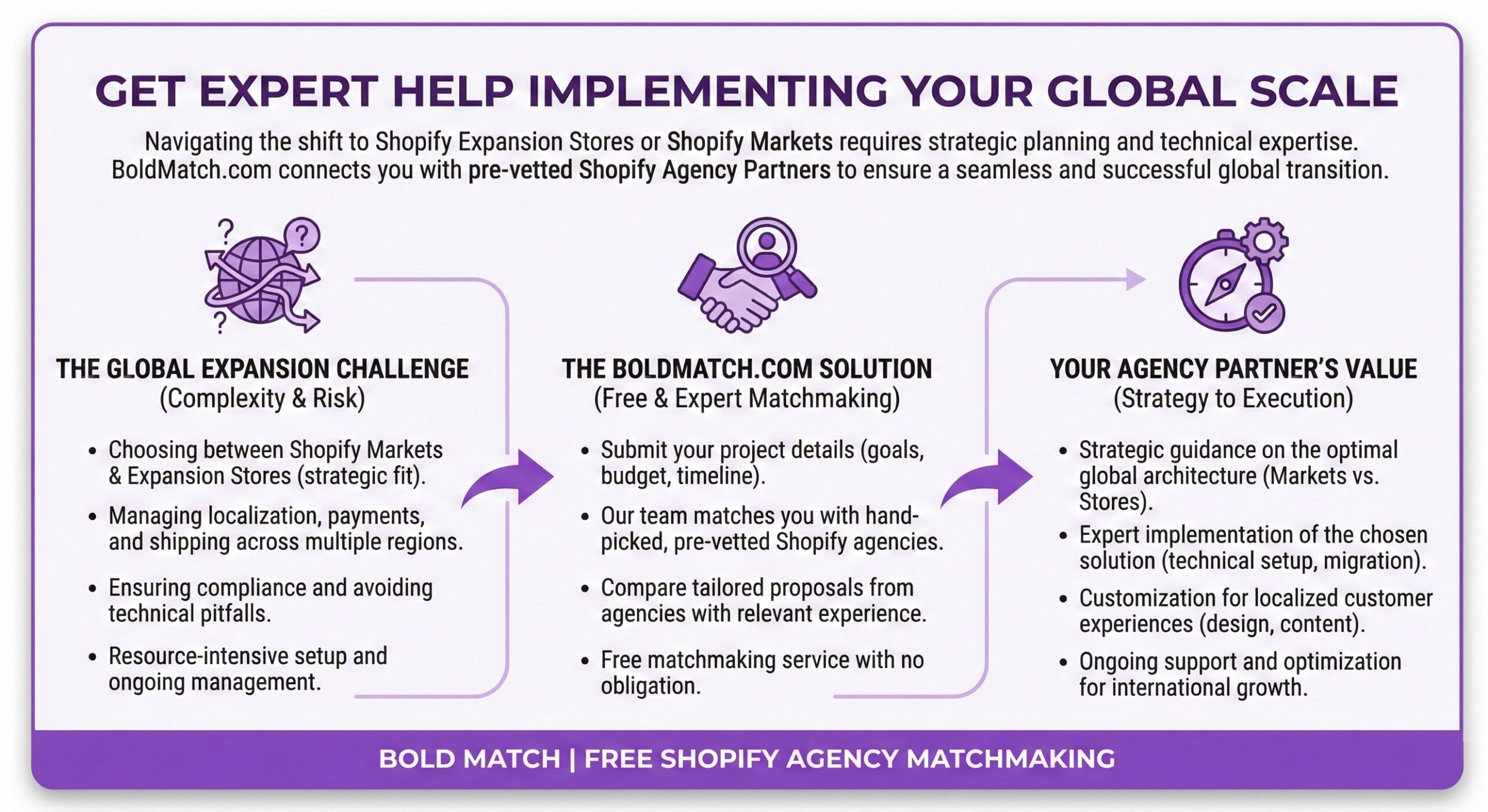
If you need help, we’re here. So. I think that’s gonna be it for me for today. Until next time, keep building something awesome! – Jay
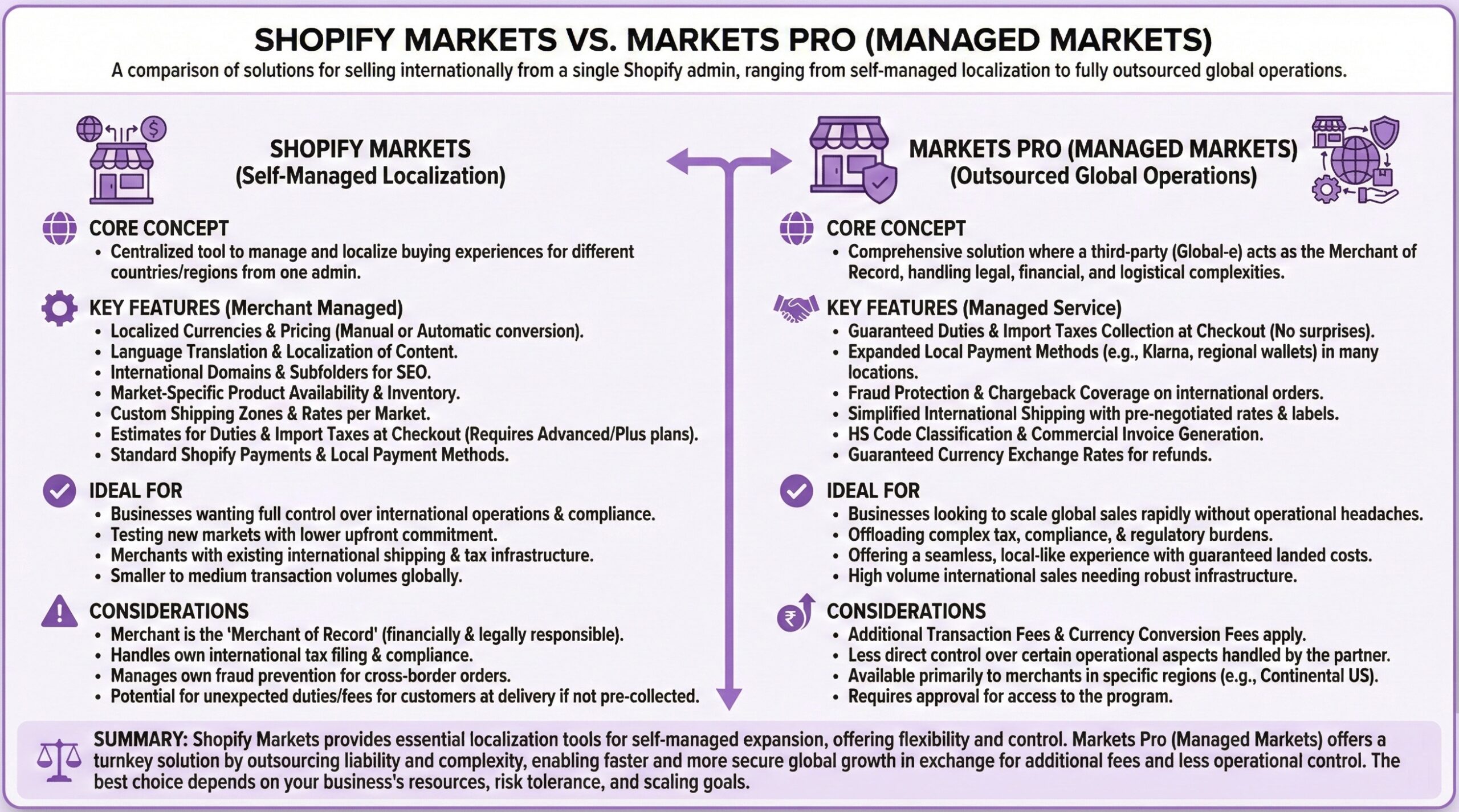
Shopify Markets vs. Managed Markets (Markets Pro)
|
Capability |
Shopify Markets |
Managed Markets (Markets Pro) |
|
Core Business Model |
Self-serve international selling |
Merchant of Record (MoR) service powered by Global-e |
|
Who’s the Merchant of Record |
You are (responsible for all compliance) |
Global-e becomes MoR (assumes legal responsibility) |
|
Best For |
Small to mid-size merchants wanting DIY international expansion with full control |
US-based merchants wanting turnkey international operations without compliance burden |
|
Availability |
All Shopify plans globally |
US-based merchants only; requires application and product review |
|
Primary Value Proposition |
Control and flexibility with lower transaction fees |
Operational simplicity and compliance outsourcing |
|
Setup Complexity |
Moderate; requires configuring markets, currencies, taxes, shipping per region |
Simple; Global-e handles most operational complexity after approval |
|
Monthly/Subscription Cost |
First 3 markets included; $59/month per additional market on Advanced plan |
No monthly fee; pay-as-you-go transaction-based pricing only |
|
Transaction Fees (Post-Oct 2025) |
Standard Shopify Payments processing fees + 1.5% currency conversion |
3.5% (Basic/Grow/Advanced) or 3.25% (Plus) + 1.5% currency conversion + Shopify Payments fees |
|
Transaction Fees (Pre-Oct 2025 Legacy) |
Standard fees |
6.5% flat (includes processing) + 2.5% currency conversion |
|
Currency Conversion Fee |
1.5% when using Shopify Payments |
1.5% (included in bundled transaction fee for post-Oct 2025 merchants) |
|
Who Pays Currency Conversion |
Merchant absorbs cost or builds into pricing |
Can be passed to customer through pricing adjustments |
|
Tax Registration Requirements |
Merchant responsible for registering in each jurisdiction where required |
Global-e handles all tax registrations as MoR |
|
Tax Calculation |
Automated for duties and import taxes (extended to all plans Feb 2025) |
Automated with Global-e handling all compliance |
|
Tax Remittance Responsibility |
Merchant must file and remit taxes in each jurisdiction |
Global-e remits all taxes to authorities as MoR |
|
Customs & Duties Management |
Merchant calculates and displays; customer pays at checkout |
Global-e manages and guarantees duty amounts; handles customs clearance |
|
Customs Clearance |
Merchant or customer handles |
Global-e handles pre-customs clearance for faster delivery |
|
Duty & Tax Guarantees |
Estimated amounts shown; variances possible at delivery |
Guaranteed at checkout; Global-e absorbs any variance |
|
Payment Methods Variety |
Standard Shopify Payments options plus limited regional APMs |
Extensive local payment methods globally through Global-e network |
|
Local Payment Method Setup |
Requires individual gateway integrations or Shopify Payments support |
Automatic access to Global-e’s payment network |
|
Currency Exchange Rate Protection |
Standard Shopify Payments rates apply |
Guaranteed exchange rate for 30 days on refunds (prevents currency fluctuation losses) |
|
Fraud Protection Responsibility |
Merchant handles chargebacks and fraud |
Global-e assumes fraud liability on international orders |
|
Chargeback Handling |
Merchant manages all chargebacks |
Global-e handles chargebacks on international transactions |
|
Product Restrictions Management |
Merchant responsible for researching and complying with regional restrictions |
Automatic filtering based on regional import/carrier restrictions |
|
Prohibited Products Review |
Merchant self-manages compliance |
Product catalog reviewed by Global-e; restricted items automatically excluded |
|
HS Code Assignment |
Merchant adds codes manually (or uses apps) |
Automatic HS code assignment by Global-e with country-specific adjustments |
|
Commercial Invoice Creation |
Merchant creates or uses Shopify defaults |
Global-e automatically creates and remits commercial invoices |
|
Shipping Options |
Merchant negotiates carrier rates or uses Shopify Shipping |
Exclusive Global-e negotiated rates for economy, standard, express (1-5 day worldwide express) |
|
Shipping Speed (Express) |
Varies by merchant’s carrier relationships |
1-5 days worldwide express shipping available |
|
Fulfillment Requirement |
Flexible; can fulfill from anywhere |
Must have at least one US fulfillment location |
|
Payout Frequency (Post-Oct 2025) |
Standard Shopify Payments schedule (daily/weekly based on plan) |
Daily payouts through Shopify Payments |
|
Payout Frequency (Pre-Oct 2025) |
Standard schedule |
1st, 8th, 15th, 22nd of each month after fulfillment; 1-3 business days to bank |
|
Payout Timing |
After payment processing |
After order fulfillment (pre-Oct 2025); immediate with Shopify Payments (post-Oct 2025) |
|
Payout Currency |
Multiple currencies possible with multi-entity setup |
USD only (for pre-Oct merchants); currency determined by Shopify Payments (post-Oct) |
|
Payout Holds for Tax Remittance |
N/A (merchant handles taxes separately) |
Pre-Oct: Global-e holds funds until tax remittance complete; Post-Oct: immediate via Shopify Payments |
|
Multi-Entity Support |
Yes, on Plus/Commerce plans with limitations |
Not applicable (Global-e is the merchant of record) |
|
Merchant Control Level |
High; merchant controls all operational decisions |
Lower; Global-e manages many operational elements |
|
Operational Complexity |
Higher; merchant responsible for all international operations |
Lower; Global-e handles operational complexity |
|
Compliance Burden |
Full responsibility for researching and meeting all regional requirements |
Minimal; Global-e assumes compliance as MoR |
|
Speed to Market (New Regions) |
Fast; configure new market in hours to days |
Very fast; no additional compliance research required |
|
Customer Experience Control |
Full control over checkout, policies, communications |
Shared; Global-e manages payment processing and compliance elements |
|
Returns Process |
Merchant manages returns according to own policies |
Merchant manages but currency rate guaranteed for 30 days |
|
Market Eligibility |
Available globally |
US-based merchants only |
|
Shopify Payments Required |
No, but needed for full multi-currency/multi-entity features |
Yes, required |
|
Shop Pay Support |
Full support across all markets |
Supported for international customers with upgraded checkout |
|
Product Category Restrictions |
None from Shopify Markets itself |
Some product categories prohibited or restricted (requires approval review) |
|
Application/Approval Process |
None; activate immediately |
Required; 24-48 hour product review before activation |
|
Deactivation Flexibility |
Immediate; can enable/disable markets anytime |
Can deactivate anytime but requires contacting Shopify Support |
|
Best Use Case: Volume |
Any volume; particularly cost-effective for lower international volume |
Medium to high international volume where compliance burden exceeds fee costs |
|
Best Use Case: Compliance Comfort |
Merchants comfortable managing international compliance |
Merchants wanting to outsource all compliance complexity |
|
Best Use Case: Control Preference |
Merchants who want maximum operational control |
Merchants prioritizing speed and simplicity over control |
|
Profit Margin Impact |
Lower transaction fees but higher operational costs (time/compliance) |
Higher transaction fees but lower operational costs |
|
Geographic Limitations |
None; sell to any region globally |
Must be US-based to use service |
|
Fulfillment Location Flexibility |
Can fulfill from any location globally |
Requires US fulfillment location (can have additional locations elsewhere) |
|
Express Shipping Availability |
Depends on merchant’s carrier contracts |
Guaranteed 1-5 day express delivery worldwide through Global-e network |
|
Inventory Management |
Standard Shopify inventory across markets |
Standard Shopify inventory; Global-e doesn’t change inventory management |
|
Order Management Complexity |
Merchant manages all orders in standard Shopify admin |
International orders managed through standard workflow; Global-e is customer of record |
|
Analytics & Reporting |
Full access to all market data in Shopify analytics |
Full access; international orders appear with Global-e as customer |
|
Brand Control at Checkout |
Complete; customers check out on your branded store |
Complete; checkout remains on your store (Global-e works behind scenes) |
|
Local Domain Support |
Full support for market-specific domains/subfolders |
Full support within Markets framework |
|
Language Localization |
Via Shopify Translate & Adapt app or third-party solutions |
Same; uses standard Shopify localization tools |
|
Pricing Strategy Flexibility |
Full control; set any pricing logic per market |
Full control; can adjust prices by market to offset fees or optimize margins |
|
Marketing to New Markets |
Merchant handles all marketing strategy and execution |
Merchant handles marketing; Managed Markets handles operational execution |
|
Customer Support Responsibility |
Merchant provides all customer support |
Merchant provides support; Global-e handles compliance/customs questions |
|
Hidden Costs |
Compliance research, tax registration fees, legal consultation, chargeback risks |
Higher transaction fees; potential product restrictions limiting catalog |
|
Total Cost of Ownership |
Lower fees but higher time/compliance investment |
Higher fees but significantly reduced operational burden |
|
Scalability Pattern |
Scales with merchant investment in compliance and operations |
Scales immediately to new markets without additional compliance setup |
|
Risk Profile |
Merchant bears all compliance, fraud, tax risks |
Global-e assumes compliance, fraud, customs risks as MoR |
|
Learning Curve |
Moderate to high; must learn international compliance |
Low; Global-e handles complexity |
|
Ideal Customer Profile |
Merchants with in-house international operations expertise or willingness to learn |
Merchants wanting to test/scale international without building compliance infrastructure |
Choose Shopify Markets if:
-
-
-
- You want maximum control over international operations
- You have (or can build) compliance expertise in-house
- Your international volume doesn’t justify Managed Markets’ fee structure
- You’re comfortable managing tax registration, remittance, and customs
- You’re based outside the United States
- You need multi-entity support with separate legal entities
- Lower transaction fees matter more than operational simplicity
-
-
Choose Managed Markets if:
-
-
-
- You’re US-based and eligible
- Compliance complexity overwhelms your operational capacity
- You want to test international markets without infrastructure investment
- Speed to market matters more than transaction fee optimization
- Fraud protection and guaranteed exchange rates provide valuable risk mitigation
- Express worldwide shipping (1-5 days) provides competitive advantage
- You prefer outsourcing international operations over building in-house expertise
-
-
Consider Hybrid Approach: Use Shopify Markets for regions where you have compliance capability (or lower volume doesn’t justify fees), while using Managed Markets for complex markets where compliance burden exceeds fee costs.
Note: Managed Markets was formerly called “Markets Pro” until June 2024 rebranding. Shopify also rebranded “Shopify Markets” to “International” in help documentation, though “Markets” remains the commonly used term.
Pricing updated for post-October 14, 2025 Managed Markets fee structure. Legacy merchants (activated before October 14, 2025) remain on 6.5% + 2.5% structure until migrated.
Shopify Markets vs. Expansion Stores Comparison Table
|
Capability |
Shopify Markets |
Expansion Stores |
|
Store Architecture |
Single store with configurable regional variations |
Multiple independent stores, one per region |
|
Best For |
Brands with centralized operations, one or compatible entities, speed-focused market testing |
Brands with multiple distinct entities, regional teams requiring autonomy, complex compliance requirements |
|
Primary Entity Structure |
Optimized for single entity; multi-entity available with limitations on Plus/Commerce |
Clean entity separation per store; each ties to independent legal entity |
|
Initial Setup Time |
Hours to configure new market |
Days to weeks per new store including catalog migration |
|
Admin Experience |
One dashboard managing all markets |
Separate admin per store, requires switching between environments |
|
Catalog Management |
Single catalog with market-specific availability rules (complex for extensive regional differences) |
Independent catalogs per store; full flexibility but manual duplication required |
|
Pricing Control |
Automatic currency conversion or manual fixed pricing per market |
Complete pricing independence per store, no conversion dependencies |
|
Multi-Entity Payment Processing |
Available on Plus/Commerce with Shopify Payments; limited third-party gateway support |
Native support for any payment gateway per store with direct entity connection |
|
Local Currency Settlement |
Multi-currency payouts available but with conversion fees when settling outside primary currency |
Direct settlement into regional bank accounts in local currency, no conversion fees |
|
Payment Methods Localization |
Domestic methods available per entity through Shopify Payments; third-party options limited |
Full local payment provider options including specialized gateways per market |
|
Tax & Duty Calculation |
Automatic duties and import taxes across all plans (2025 update); centralized tax logic with market rules |
Independent tax configuration per store with complete regional control |
|
Regulatory Compliance |
Shared compliance framework across markets; entity separation limited |
Complete compliance isolation per jurisdiction with clean audit trails |
|
Content & Translation |
Centralized content with translations layered by market; themes apply globally |
Independent content per store; complete localization freedom with manual duplication |
|
Product Availability by Region |
Market-specific availability through rules (often requires product duplication workarounds) |
Native per-store catalog control; straightforward regional exclusions |
|
Domain Structure |
Subfolders (store.com/uk) or subdomains (uk.store.com) under primary domain |
Separate domains or subdomains (store.co.uk, store.de) per market |
|
SEO Authority |
Consolidated under one domain; automatic hreflang tags and market-specific sitemaps |
Authority split across multiple domains; manual hreflang configuration required |
|
Search Console Management |
Unified property and reporting |
Separate properties per domain requiring independent monitoring |
|
Geolocation & Redirection |
Native automatic redirection (with GDPR/UX limitations); third-party apps recommended |
Requires third-party apps for cross-store redirection and unified customer routing |
|
Inventory Management |
Centralized with cross-warehouse order routing through location priority |
Per-store inventory with direct warehouse connection; no cross-store routing |
|
Fulfillment Control |
Automated routing with configurable warehouse priority; less granular control |
Complete fulfillment autonomy per store with regional warehouse dedication |
|
Order Routing Complexity |
Automated but less precise for complex multi-warehouse scenarios |
Fully customizable per-region fulfillment logic without shared dependencies |
|
App Integration Approach |
Single integration serving all markets |
Separate integrations required per store (multiplies app costs) |
|
ERP/OMS Connection |
One connection point for all markets |
Multiple connections, one per store, increasing IT overhead |
|
ESP/CRM Integration |
Unified customer database across markets |
Fragmented customer data unless consolidated through external tools |
|
Subscription App Compatibility |
Most apps attach to primary entity, limited per-market switching |
Full per-store subscription capability with independent logic |
|
Analytics & Reporting |
Unified dashboard with market segmentation |
Fragmented unless using Shopify Plus multi-store reporting |
|
Team Access & Permissions |
Shared access across all markets; difficult to isolate regional team permissions |
Complete access isolation per store; regional teams operate independently |
|
Regional Team Autonomy |
Limited; changes affect global store unless carefully scoped |
Full autonomy; teams manage independent environments without cross-contamination |
|
Data Security & Isolation |
Shared data environment across markets |
Complete data separation per jurisdiction for compliance and privacy |
|
Financial Reporting |
Consolidated ledger with market breakdowns |
Separate financial reporting per store/entity with clear separation |
|
Subscription Cost |
Base plan + $59/month per additional market beyond included three (Advanced plan) |
Standard plan cost per store (or 9 stores included on Shopify Plus) |
|
App Cost Structure |
One set of app fees across all markets |
App fees multiplied by number of stores (some vendors offer multi-store discounts) |
|
Total Cost of Ownership |
Lower for centralized operations; conversion fees on transactions |
Higher due to duplication; no conversion fees with local settlement |
|
Operational Overhead |
Minimal; changes deploy across markets from single control point |
Substantial; updates require replication across all stores |
|
Content Update Velocity |
Fast; one update affects all markets (with translation considerations) |
Slow; manual updates across multiple stores |
|
Campaign Deployment |
Centralized with market-specific variations configurable |
Requires independent campaign setup per regional store |
|
New Market Launch Speed |
Very fast; configure and launch in hours to days |
Slow; full store setup required taking days to weeks |
|
Product Launch Coordination |
Single upload with market availability rules |
Multiple uploads across stores with separate workflows |
|
Scalability Pattern |
Vertical (add markets to existing store) |
Horizontal (add new stores for new markets) |
|
Franchise/Distributor Readiness |
Difficult; shared environment complicates handoff |
Natural; can transfer store ownership to regional partner |
|
Risk Distribution |
Single point of failure affects all markets |
Issues isolated to individual stores |
|
Migration Complexity |
Difficult to migrate to Expansion Stores when growth requires entity separation |
Complex to consolidate into Markets; rarely done |
|
Ecosystem Flexibility |
Constrained to Shopify-compatible solutions across markets |
Freedom to choose regional apps, gateways, partners per store |
|
Ideal Growth Stage |
Early international expansion, market testing, centralized sub-$10M operations |
Established multi-market presence, $10M+, entity requirements, regional teams |
Frequently Asked Questions (FAQ)
What’s the main difference between Shopify Markets and Expansion Stores?
Well. Shopify Markets lets you sell internationally from one store with regional configurations for currency, language, and pricing. Expansion Stores means running separate independent Shopify stores for each market. Markets optimizes for operational simplicity and speed. Expansion Stores provides maximum control and entity separation at higher operational cost.
Can I settle payments into different bank accounts with Shopify Markets?
Yes, with limitations. The 2025 multi-entity updates allow Markets to process payments through different entities and settle into corresponding bank accounts when using Shopify Payments on Plus or Commerce plans. Most third-party payment gateways still attach to your primary entity. If you need specialized regional gateways beyond Shopify Payments’ scope, you’ll likely need Expansion Stores.
How much does each option actually cost?
Shopify Markets includes three markets on most plans. Additional markets cost $59 monthly on Advanced plans. But factor in currency conversion fees on international transactions. Expansion Stores requires separate Shopify subscriptions per store unless you’re on Plus (which includes nine stores). App costs multiply across stores. The real cost difference comes from operational overhead. Markets keeps operations lean. Expansion Stores creates substantial duplication but avoids conversion fees through local settlement.
Which is better for SEO?
That depends. You see. Shopify Markets consolidates domain authority under one primary domain, generates automatic hreflang tags, and simplifies international SEO management. Shopify Expansion Stores splits authority across multiple domains and requires manual hreflang configuration. For growing brands building domain authority, Markets provides clear advantages. For established brands with strong authority in each market already, the difference matters less.
Can I switch from Markets to Expansion Stores later?
Yes! Yes you can, but migrations are complex. You’ll need to rebuild catalogs in new stores, migrate customer data, reconfigure payment processors, update domain structures, and maintain proper redirects. The transition period requires careful management to avoid disrupting active orders or losing SEO equity. This doesn’t mean avoiding Markets initially, but make the choice knowing migration has real costs if your business outgrows the model.
Do I need separate legal entities for international expansion?
No. Not necessarily. Many merchants start selling internationally under their domestic entity through Shopify Markets. As revenue grows in specific markets, regulatory requirements, tax optimization, or operational considerations might drive entity formation. Markets now supports multi-entity structures on Plus/Commerce plans. Expansion Stores makes multi-entity operations straightforward from day one. Your decision should reflect current entity structure and realistic timeline for entity expansion, not theoretical future requirements.
How do consumers know they’re shopping in the right store or market?
Easy. Both models require geolocation to direct customers to appropriate regional experiences. Markets includes native redirection but with UX and compliance limitations. Expansion Stores requires third-party apps to route between separate stores. In both cases, quality geolocation solutions that detect customer location and present appropriate currency, language, and regional experiences are essential infrastructure, not optional features.
What happens to my international sales if I’m already using one model?
Your existing international sales continue uninterrupted regardless of your current setup. If you’re reevaluating your model because growth exposed limitations, you can maintain operations while planning migration. The key is understanding whether your constraints stem from the model itself or from incomplete implementation. Many perceived model limitations actually reflect configuration choices or missing supporting tools rather than fundamental platform restrictions.
Do I need an Partner Agency or Shopify Expert to implement international expansion?
Maybe but not necessarily. Shopify Markets configuration is straightforward enough that some merchants handle initial setup themselves. The challenge comes with edge cases related to tax registration requirements, payment gateway configurations for specific regions, hreflang implementation for SEO, and integration with existing ERPs or fulfillment systems. Expansion Stores multiplies this complexity across every market you add. If you’re running a lean team or lack in-house technical resources, working with a Shopify Partner who specializes in international expansion can compress your timeline from months to weeks and help you avoid costly configuration mistakes that surface only after you’ve started processing orders.
How do I find the right Shopify Agency for international Shopify expansion?
Happily. You’re in the exact right place to ask that question and generally, you’ll want to look for partners with documented experience in your target regions and your specific expansion model. An agency partner who has implemented dozens of Markets configurations might have limited Expansion Stores experience, and vice versa. Ask about their familiarity with multi-entity payment setups, regional tax compliance, and cross-border fulfillment logic. References from merchants at similar scale matter more than generic case studies. Bold Match connects Shopify merchants with vetted agencies based on these specific requirements, which removes the guesswork from finding partners who actually understand international commerce infrastructure rather than just claiming expertise on their site.