
Is Today the Day to Make the Move to Shopify Plus?
Written and edited by: Eric
Hey everyone, Eric Boisjoli here. Hope the post-Halloween two-four is being kind. 🎃
So look. If you’re running a Shopify store that’s been growing steadily, at some point you’ve probably found yourself staring at that Shopify Plus pricing page wondering if it’s time. “When do I actually need Plus?” is usually followed by some version of “Is it just for the big brands or would it actually help me right now?” The honest answer is that Shopify Plus isn’t about a magic revenue number. It’s about recognizing when your current setup starts costing you more than an upgrade would. Sometimes that’s a financial calculation around transaction fees.
Sometimes it’s plain operational pain from manual processes that could be (should be) automated. Sometimes it’s hitting walls on checkout customization or B2B functionality that Shopify’s standard plans simply don’t support. What I want to do here is give you a framework for making that decision. No. Not a sales pitch for Plus. Not a checklist of features you may or may not need. Just a “clear-eyed” assessment of when the economics and operational realities that may make upgrading to + the smart move, and when staying put makes more sense.
Shopify Plus usually makes financial sense for online retailers generating $1 million or more in annual revenue, though the math can work earlier if you’re hitting specific operational limitations. The key indicators are transaction fee savings that offset the higher subscription cost, B2B or wholesale requirements, checkout customization needs, international expansion plans, and automation demands that exceed what the standard plans can offer you. And if none of those apply to you right now, there’s no shame in growing into Plus later.

The Cost Difference Between Shopify and Plus
Let’s start with the numbers because they’re more nuanced than most merchants realize.
Standard Shopify Plans run from $39 per month for Basic up to $399 per month for Advanced. The Advanced plan is usually where serious merchants land before considering Plus. It includes custom reports, calculated shipping rates, and the lowest transaction fees of the standard tiers.
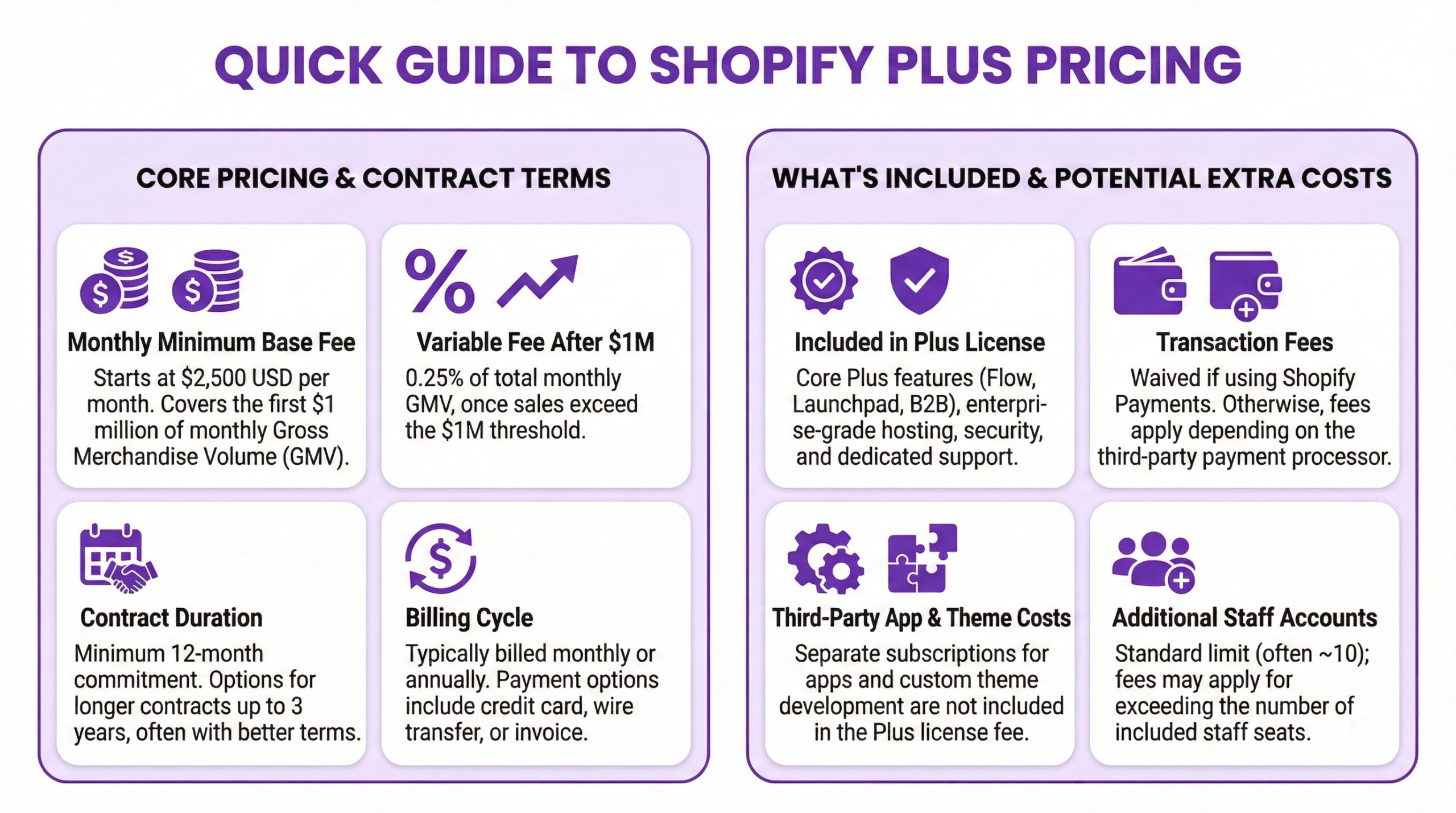
Shopify Plus starts at $2,300 per month on a three-year contract or $2,500 per month on a one-year commitment. That’s a significant jump in commitment from Advanced, which is one of several reasons why the decision deserves careful analysis.
You’ve probably already guessed that the subscription fee isn’t the whole story though. Transaction fees on third-party payment processors drop dramatically on Plus. Advanced Shopify charges 0.5% per transaction when you use a non-Shopify Payments gateway. Shopify Plus drops that to 0.15% to 0.20%. For merchants processing significant volume through third-party gateways, that difference compounds quickly.
Credit card processing rates through Shopify Payments are also lower on Plus. Advanced charges 2.4% plus 30 cents per online transaction. Plus retailers typically see rates around 2.15% plus 30 cents, though the exact rates will vary by negotiation and volume.
What’s The Breakeven Math for Shopify Plus?
Let me walk through the actual calculations so you can run your own numbers.
Scenario 1: Monthly Revenue of $83,000 (roughly $1M annually)
On Advanced Shopify at $399 per month with 2.4% credit card rates and 0.5% third-party transaction fees (assuming you use a non-Shopify gateway for 50% of transactions), your monthly platform and processing costs work out to roughly $2,400 to $2,800 depending on your payment mix. On Shopify Plus at $2,300 per month with lower processing rates and 0.15% third-party fees, your monthly costs land around $2,500 to $2,700. At $1M annual revenue, the economics are essentially a wash. You’re paying roughly the same but getting significantly more capability. Whether that capability matters depends on your operational needs.
Scenario 2: Monthly Revenue of $150,000 ($1.8M annually)
This is where the math starts tilting clearly toward Plus. The transaction fee savings on $150,000 in monthly sales can easily exceed $400 to $600 per month compared to Advanced. Add in the lower credit card rates and you’re potentially saving enough to offset most of the subscription increase while gaining enterprise features.
Scenario 3: Monthly Revenue of $250,000 ($3M annually)
Once you hit this volume, staying on Advanced is usually leaving money on the table. The transaction fee differential alone can save $800 to $1,200 monthly. Plus the infrastructure benefits matter more at this scale since you’re more likely to experience traffic spikes that test standard plan limits.
The general rule of thumb? Shopify recommends considering Plus once you hit approximately $80,000 in monthly sales. That’s roughly $960,000 annually. At that threshold, the economics start working in your favor even before you factor in operational benefits.
One important note on variable pricing. Once your monthly revenue exceeds $800,000, Shopify Plus shifts from a flat fee to a variable platform fee of 0.25% of monthly sales, capped at $40,000 per month. This only matters if you’re doing $9.6M or more annually, but even this overview would’ve been incomplete without that not, and it really is worth understanding the full pricing model.
Operational Signals That You’re Ready for Plus
Turns out that revenue thresholds are pretty darn useful guides, but they’re not the whole story. Some merchants need Plus features at $750,000 in annual sales. Others are fine on Advanced well past $2M. The difference really comes down to operational complexity
Your Store’s probably ready for Shopify Plus if…
Your checkout needs are outgrowing standard customization. Shopify Plus offers Checkout Extensibility, which lets you modify checkout flows, add custom fields, implement conditional logic, and create personalized experiences based on customer behavior or cart contents (https://analyzify.com/hub/exploring-shopify-plus-features). Standard plans give you basic branding options. If you’ve been frustrated by checkout limitations, Plus removes those walls.
You need B2B and wholesale functionality. Shopify Plus includes native B2B features like company accounts, custom price lists, payment terms, volume-based pricing, and the ability to run B2B and D2C operations from a single admin. On standard plans, you’d need third-party apps that add cost and complexity. If wholesale is becoming a meaningful part of your business, native B2B tools can simplify operations significantly.
You’re expanding internationally and need multiple storefronts. Plus includes nine expansion stores at no additional cost, allowing you to create localized experiences for different markets with separate currencies, languages, and product catalogs. On standard plans, each additional store requires a separate subscription.
Your team is drowning in manual processes. Shopify Flow, the automation platform exclusive to Plus, lets you build if-this-then-that workflows without code. Tag VIP customers automatically. Route orders by location. Trigger restock alerts. Adjust pricing based on inventory levels. If your team spends hours on tasks that could be automated, Flow can reclaim that time.
You need higher API limits for integrations. Plus provides significantly higher API call limits, which matters if you’re running complex integrations with ERP systems, inventory management platforms, or custom applications. Hitting API limits on standard plans can break critical integrations during high-traffic periods.
You’re experiencing performance issues during traffic spikes. Plus stores run on dedicated infrastructure that can handle over 10,000 checkouts per minute. Standard plans share server resources. If your site has struggled during flash sales or promotional events, Plus provides headroom.
When to Wait to Make the Move to Plus
Not every signal means you need Plus immediately. Here are situations where staying on Advanced (or lower) makes more sense.
Your revenue is under $500,000 annually and you’re not hitting operational walls. The economics don’t favor Plus at this scale unless you have specific feature requirements. Invest the difference in marketing, inventory, or team growth.
Your business model is straightforward D2C with no B2B component. If you’re selling direct to consumers with standard checkout flows and no wholesale ambitions, you may not use half the features Plus offers. Advanced handles most D2C requirements well.
You don’t have technical resources to leverage advanced features. Checkout Extensibility and Shopify Functions are powerful but require development expertise to implement. If you’re a solo founder without agency support, you might not extract full value from Plus capabilities.
Your app stack already handles your automation needs. Third-party apps like Mechanic or Arigato can provide Flow-like automation on standard plans. If your current setup works, upgrading just for native automation may not make sense yet.
Question About Migrating to Shopify Plus
If you’re coming from another e-commerce platform entirely, whether that’s Magento or WooCommerce or BigCommerce or even some something else entirely, jumping straight to Plus rather than standard Shopify often makes sense if your revenue justifies it. The rationale is practical. Migration is disruptive regardless of which Shopify tier you choose. If you’re going to go through the process of moving your online store, your data, and your custom integrations, it’ll be worth landing on the platform tier that better fits your brand’s current scale.
Migrating to standard Shopify and then upgrading to Plus six months later means going through platform transitions twice. Shopify Plus also provides better migration support. You get a dedicated Launch Engineer who helps with the transition, which is particularly valuable for complex migrations with significant data and integration requirements.
Making the Right Choice for Your Retail Brand
Here’s a simple framework for deciding if today is the day.
Step 1: Calculate your current total platform cost. Add your subscription fee plus transaction fees plus payment processing fees plus any third-party apps that handle functions Plus includes natively (B2B, automation, multi-store management).
Step 2: Calculate your projected Plus cost. $2,300 to $2,500 monthly subscription plus lower processing fees minus apps you’d no longer need.
Step 3: Compare the numbers. If Plus costs roughly the same or less while providing features you need, the decision is straightforward. If Plus costs more, quantify the value of the additional capabilities. Does checkout customization increase conversion enough to justify the difference? Does automation free up staff time worth more than the subscription delta?
Step 4: Assess your operational pain points. Are you hitting limits that create friction? Struggling with manual processes? Unable to implement features your business requires? Those qualitative factors matter as much as the pure economics of it.
Step 5: Consider your trajectory. If you’re growing 30% year over year, you might hit the Plus threshold in 12 months anyway. Starting the relationship earlier gets you access to dedicated support and enterprise features during a growth phase when they’re most valuable.
Shopify Plus Features Worth Knowing About
I’ll keep this bit brief since feature overviews can fill entire articles. But here’s what matters most for merchants evaluating the jump.
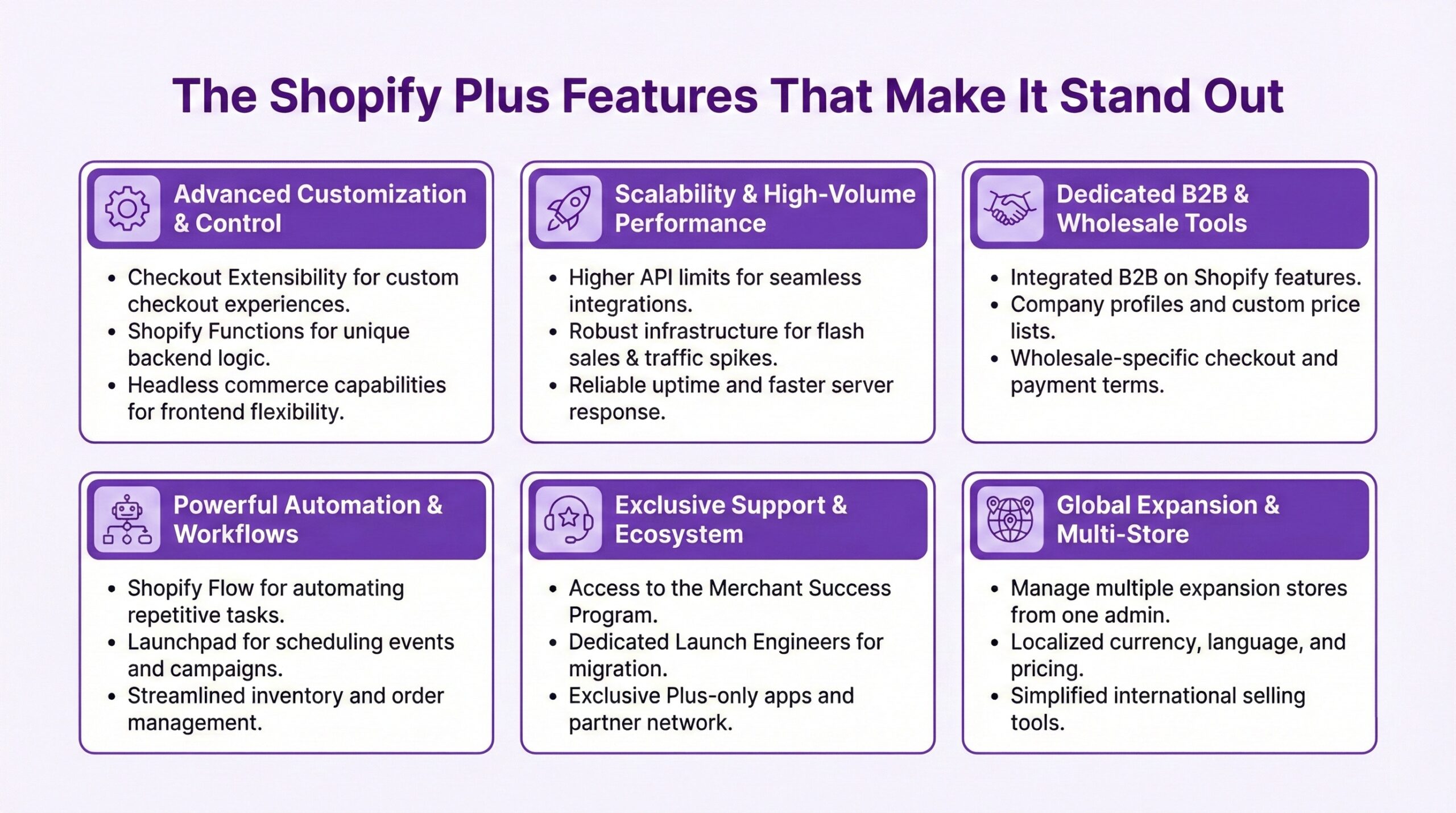
Checkout Extensibility replaces the older checkout.liquid system and Shopify Scripts. It provides a more flexible, upgrade-safe way to customize checkout experiences. Note that Shopify Scripts were deprecated in August 2025 and replaced by Shopify Functions.
Shopify Flow is the visual automation builder. Create workflows triggered by events across your store. No code required for most use cases, though complex scenarios benefit from developer involvement.
Launchpad schedules and automates campaign execution. Coordinate price changes, product visibility, theme updates, and inventory adjustments for product launches or sales events without manual intervention at launch time ().
B2B on Shopify includes company accounts, custom catalogs, price lists, payment terms, and purchase order checkout. Run wholesale and retail from one admin.
Expansion Stores let you create up to nine additional storefronts for international markets or separate brands without additional subscription fees.
Organization Admin provides centralized management across multiple stores with unified user permissions, analytics, and reporting.
Merchant Success Manager gives you dedicated support from someone who understands your specific business rather than general support channels.
Just a Word on Contract Commitments
Plus requires either a one-year or three-year contract. The three-year commitment gets you the lower $2,300 monthly rate versus $2,500 for one year. This matters for your decision. You’re not just choosing a monthly subscription. You’re committing to $27,600 to $30,000 annually for at least a year. Make sure you’re confident in your growth trajectory before signing. The good news is that upgrading from standard Shopify to is seamless from a technical perspective. There’s no re-platforming required. Your existing store, products, customers, and orders stay intact. You’re unlocking additional functionality on the same platform you already know and like.

Getting Help Getting Expert Agency Help
If you’re still on the fence, talking to partner agencies who work with e-commerce retailers at your scale can provide useful perspective. They’ve seen which businesses benefit most from Plus and which would be fine waiting. Bold Match connects Shopify merchants with vetted agencies who can assess your specific situation. It’s free and we don’t take commissions from either side. Whether you’re trying to decide about Plus or just need implementation help once you’ve made the call, getting expert input beats guessing. Right. Think that’s gonna be it for me today. I should probably go run some API load tests. Then maybe head over to The Plaza at The Forks to work on my frontside 180s before the concrete gets too cold. Now, you get out there and make your tech stacks work smarter, not harder! — Eric B.
Frequently Asked Questions (FAQ)
What revenue level makes Shopify Plus worth it?Frankly. That’s a tricky one. Most sources recommend considering Shopify Plus once you hit approximately $80,000 in monthly sales, which works out to roughly $960,000 annually. At this threshold, the transaction fee savings begin offsetting the higher subscription cost. That said, specific operational needs like B2B features or checkout customization can make Plus worthwhile at lower revenue levels if those capabilities are essential to your business.
How much does Shopify+ actually cost per month?
Easy. Shopify Plus starts at $2,300 per month on a three-year contract or $2,500 per month on a one-year commitment. This is the base subscription fee. If your monthly revenue exceeds $800,000, the pricing shifts to a variable platform fee of 0.25% of monthly sales, capped at $40,000 per month. Most merchants pay the flat fee unless they’re doing nearly $10M or more annually.
What’s the difference in transaction fees between Advanced and Plus?
Shopify Advanced charges 0.5% per transaction when using a third-party payment gateway. Shopify Plus drops that to 0.15% to 0.20%. For a merchant processing $100,000 monthly through a third-party gateway, that’s a difference of $300 to $350 per month in fees. Credit card processing rates through Shopify Payments are also lower on Plus, usually around 2.15% compared to 2.4% on Advanced.
Can I upgrade from standard Shopify to Plus without migrating my store?
Yes. Yes you can. Upgrading from any standard Shopify plan to Shopify Plus is seamless. There’s no re-platforming required. Your existing store, products, customers, orders, and integrations remain intact. You’re essentially unlocking additional features and capabilities on the same platform. The process involves working with a Shopify Plus advisor to transition your contract and enable Plus-exclusive functionality.
What features does Shopify Plus include that standard plans don’t?
The major Plus-exclusive features include Checkout Extensibility for full checkout customization, Shopify Flow for visual workflow automation, Launchpad for scheduling campaigns and product launches, native B2B capabilities with company accounts and custom pricing, nine expansion stores for international or multi-brand operations, unlimited staff accounts, higher API limits, and a dedicated Merchant Success Manager for personalized support.
Is Shopify+ worth it just for it’s B2B features?
That obviously depends on how central B2B is to your business. Shopify Plus includes native B2B features like company accounts, custom price lists, payment terms, volume-based pricing, and the ability to run wholesale and retail from a single admin. On standard plans, you’d need third-party apps to approximate this functionality, and those apps add monthly costs and complexity. If wholesale represents a significant revenue stream, native B2B tools often justify the upgrade even below the typical revenue threshold.
How long is the Shopify Plus contract commitment?
Shopify Plus requires either a one-year or three-year contract. The three-year commitment offers the lower monthly rate of $2,300 compared to $2,500 for the one-year term. This means you’re committing to at least $27,600 to $30,000 annually. Make sure your growth trajectory and operational needs justify that commitment before signing.
What happens if I outgrow Shopify Plus?
That’s another easy one. You see. Shopify Plus is designed to scale with high-growth brands. The platform can handle over 10,000 checkouts per minute and supports stores processing hundreds of millions in annual GMV. Brands like Kylie Cosmetics, Heinz, and Gymshark all run on Plus. If you exceed $800,000 in monthly revenue, the pricing shifts to a variable model capped at $40,000 per month, which keeps costs predictable even at very high volume. For most online merchants, there’s no practical ceiling to outgrow.
Shopify Advanced vs Shopify Plus Comparison Table
|
Feature |
Shopify Advanced |
Shopify Plus |
|
Monthly Cost |
$399 |
$2,300 to $2,500 |
|
Third-Party Transaction Fee |
0.5% |
0.15% to 0.20% |
|
Credit Card Rate (Online) |
2.4% + 30¢ |
~2.15% + 30¢ (negotiable) |
|
Staff Accounts |
15 |
Unlimited |
|
Storefronts Included |
1 |
10 (1 primary + 9 expansion) |
|
Checkout Customization |
Basic branding only |
Full Checkout Extensibility |
|
Shopify Flow Automation |
Not available |
Full access |
|
Launchpad Campaigns |
Not available |
Full access |
|
Native B2B Features |
Not available |
Full B2B suite |
|
API Call Limits |
Standard |
Significantly higher |
|
Dedicated Support |
Standard channels |
Merchant Success Manager |
|
Theme Storage |
20 themes |
100 themes |
|
International Markets |
Up to 3 |
Up to 50 |