
22 Questions to Ask in Your Second Partner Agency Call
Written and edited by: Eric

Hey everyone, Eric Boisjoli here. Filling in for Jay Myers for this one post since he’s busy winter wonderlanding or doing whatever award winning entrepreneurs do between Christmas Day and New Year’s Day. You know. Skiing the slopes of Mont-Tremblant or Revelstoke? Ice skating? Relaxing at his cozy cabin? Playing with his ridiculously wonderfully awesome kids? Compulsively answering Slack messages?⛷️
So. Anyway. This topic is arguably actually more his lane than mine. He’s the one who usually writes about the business side of agency relationships while I geek out on the technical stuff. But I’ve sat in on enough of these calls over the years to have opinions. Many, many, opinions. And this really is another one of those times where Bold Match exists precisely because this process is harder than it should be.
Now. Let’s talk about your second agency call.
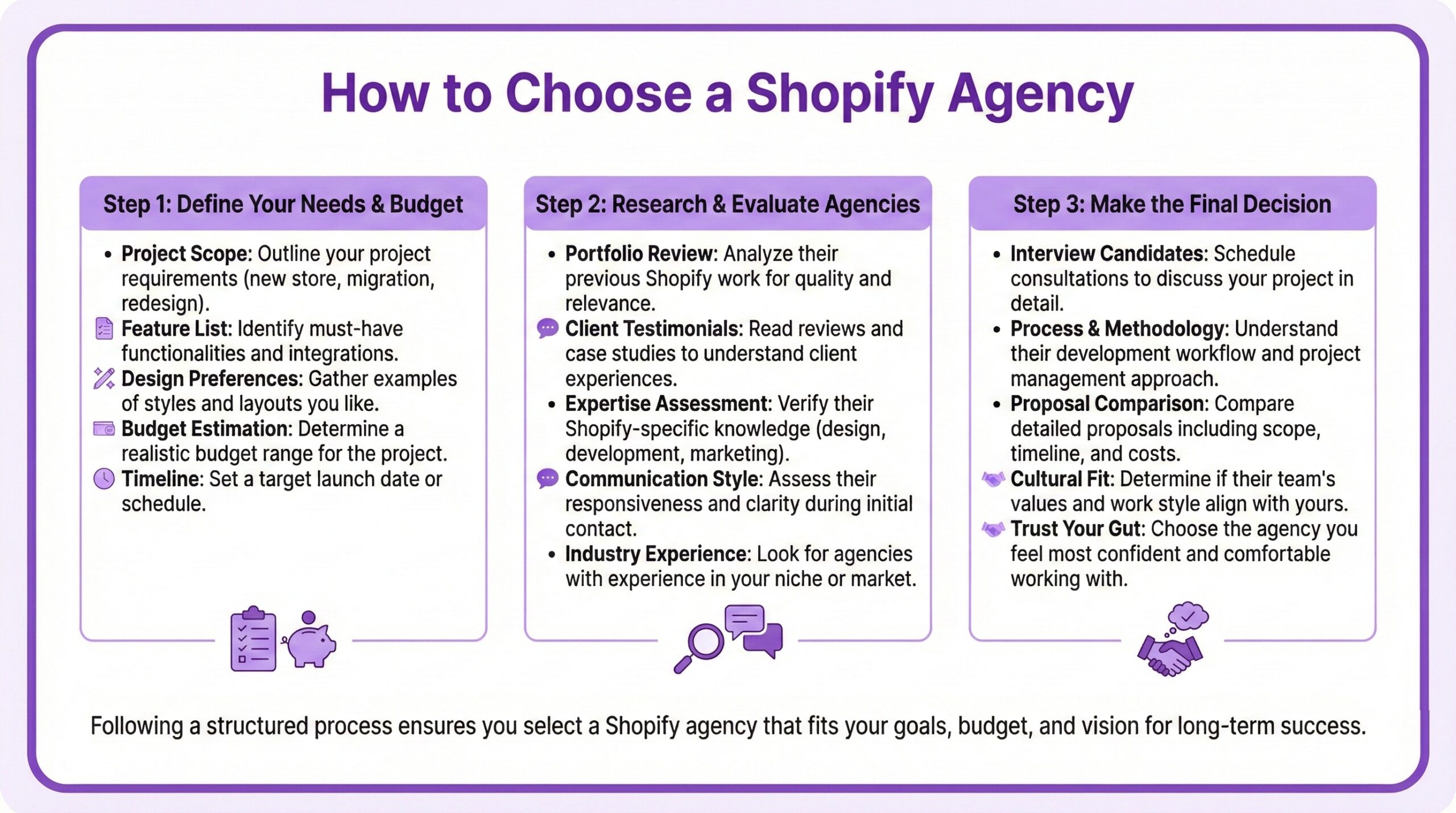
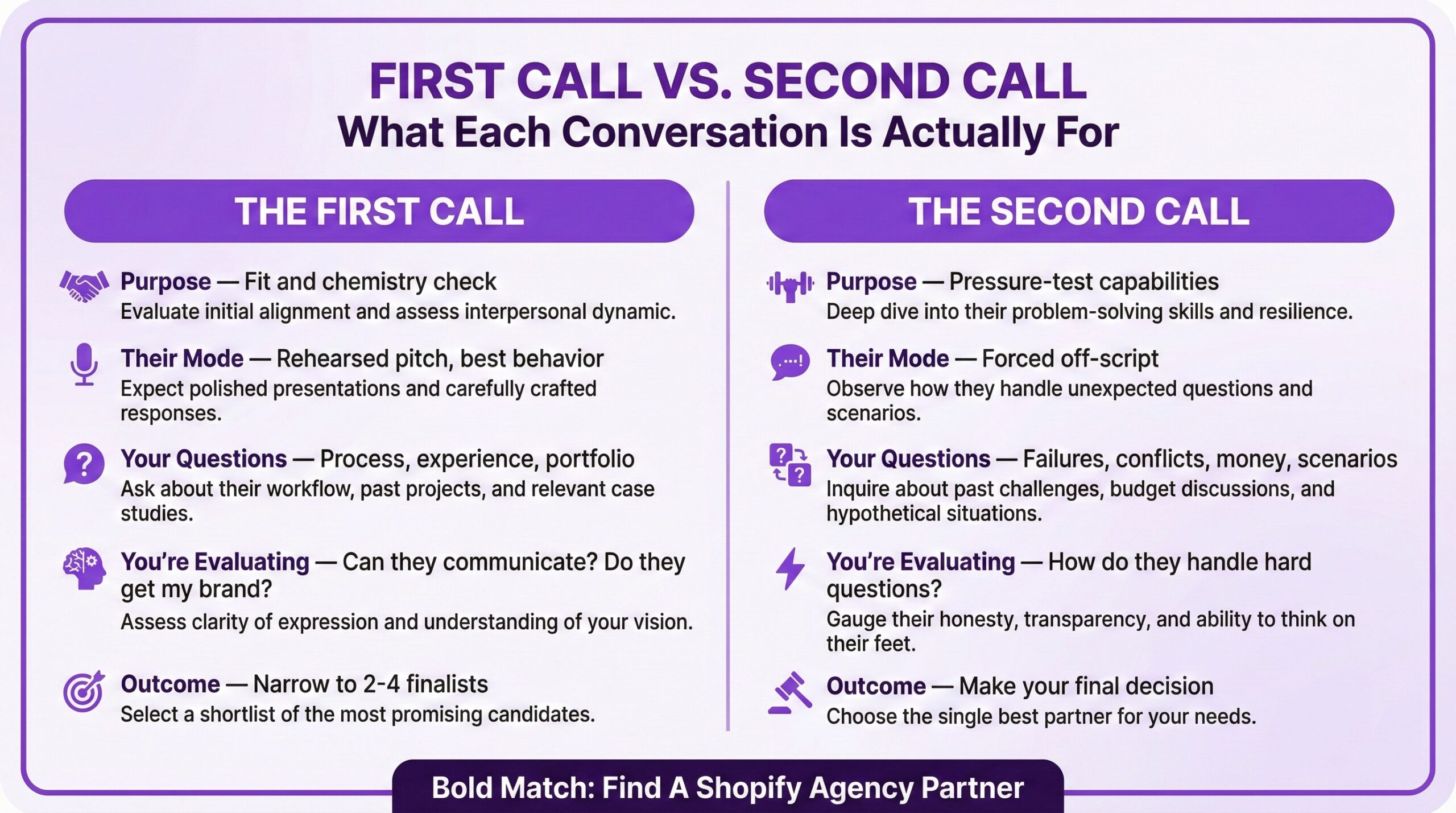
Why the Second Call Matters More Than the First
Ok so you’ve had the first call. Their experts sounded expert. They seemed great. Polished deck. Confident answers. Good energy. They understood your e-commerce niche, your brand’s peculiar vertical and dropped some smart observations about your current store site.
They all seem great on the first call. That’s what first calls are for. That’s why Partner Agencies rehearse them. They know the questions merchants like you are going to ask because everyone asks the same questions. “Tell me about your process.” “What’s your experience with brands like ours?” “What would you do differently with our website?” They’ve answered them hundreds and hundreds of times.
The first call is only a pitch. The second call is where you find out if they’re actually great or just great at first calls. By the second call, you’ve probably narrowed your maybe list down to two or three finalists. You’ve reviewed their proposals. The pricing is roughly comparable. Everyone claims to be experts. Now you need to figure out which one will actually deliver when things get complicated.
Because things will get complicated. The twenty-two questions below are designed to reveal rather than confirm. To hopefully disrupt the rehearsed script. They try to surface how the partner agency thinks under a bit of pressure, handles some ambiguity, and responds when someone asks something that’s a little uncomfortable. Pay attention to the reactions as much as the answers. Agencies that get defensive or evasive are telling you something important. Just like Shopify Agencies that get energized by hard questions are telling you something.
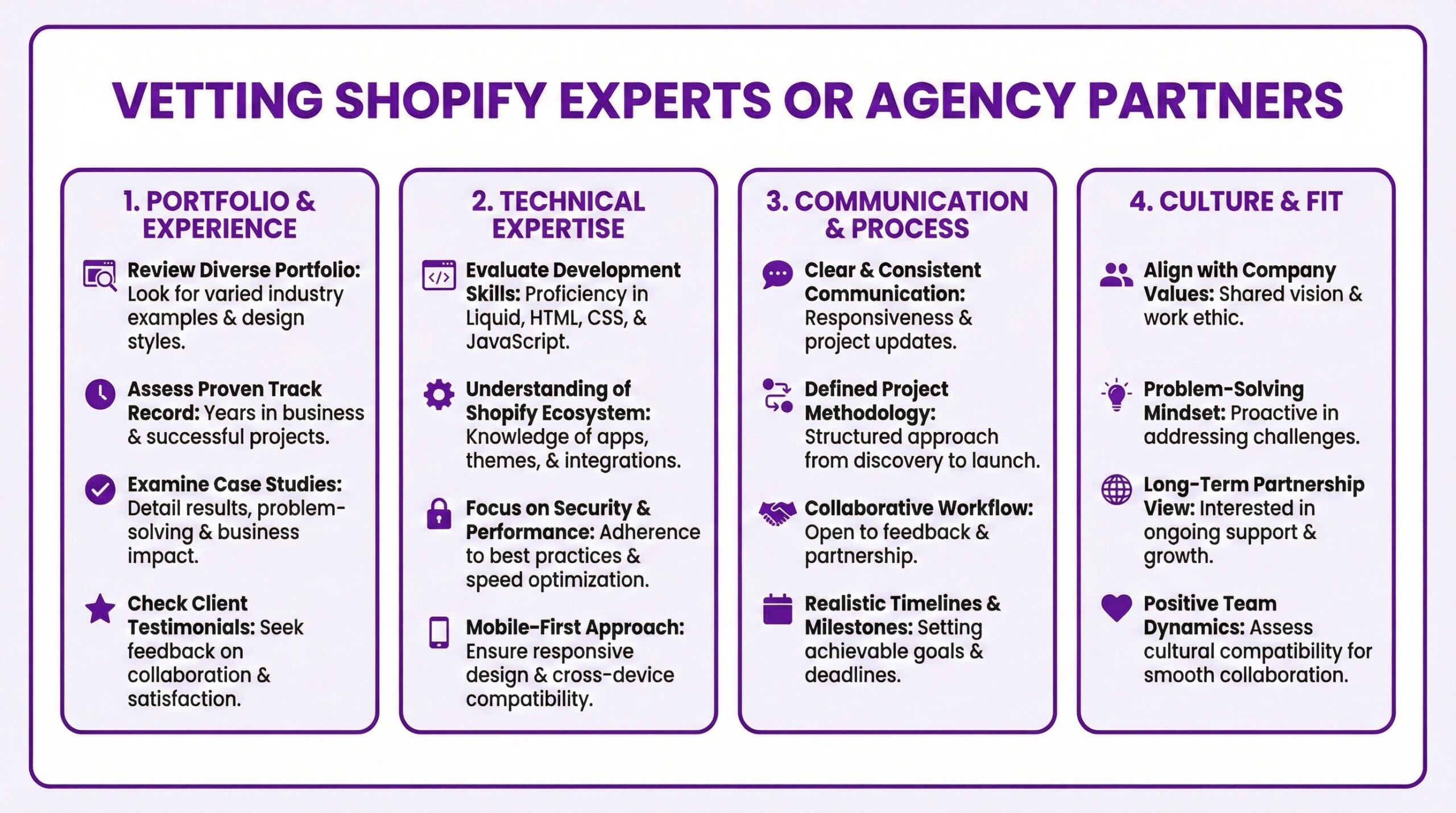
Process Stress Tests Questions
These questions expose how the expert or agency handles things when the project stops being theoretical and starts being messy.
“Walk me through a project that went sideways and how you handled it.”
Every partner agency has had projects go wrong. The ones who claim otherwise are either lying or too new to have been tested. What you’re listening for is ownership. Do they blame the client? Do they explain what they learned? Did they have a recovery process or did they just push through and hope for the best?
“What’s the most common reason clients fire you, and what have you changed because of it?”
This question tends to catch people off guard. Some agencies will deflect with “that rarely happens” which is almost never true. The good ones will give you a real answer. Maybe they used to struggle with communication cadence. Maybe they had a period where they grew too fast and quality slipped. The answer matters less than the self-awareness behind it.
“If we disagree on a design direction, what happens?”
You want to understand their conflict resolution process before you’re in a conflict. Do they defer to the client on everything? That sounds nice until you realize you’re paying for expertise they won’t actually deploy. Do they dig in and fight for their recommendations? That’s good unless they can’t distinguish between battles worth fighting and ego protection. The best answer involves structured feedback processes and clear decision rights.
“What does your QA process look like before anything goes live?”
Vague answers here are a red flag. You want specifics. Do they have a staging environment? Who tests? Is there a checklist? How do they handle browser and device coverage? An expert agency that can’t clearly articulate their QA process probably doesn’t have one.
Scope and Boundary Probing Questions
These questions reveal how the partner agency thinks about project boundaries and what happens when boundaries are tested.
“What’s explicitly not included in this proposal that I might assume is?”
Every proposal has edges. The question is whether those edges are clearly marked or whether you’ll discover them mid-project when you ask for something and get a change order. Good agencies will walk you through the boundaries proactively. Great agencies will have already addressed this in the proposal itself.
“If we need to cut 20% of the budget mid-project, what goes first?”
This hypothetical reveals their prioritization framework. Do they know what’s essential versus nice-to-have in their own scope? Can they make trade-off recommendations quickly? Or do they freeze up because they’ve never thought about it?
“How do you handle scope changes after kickoff?”
Scope changes happen. The question is whether there’s a process for evaluating and pricing them or whether every change becomes a negotiation. You want to hear about change request procedures, documentation requirements, and approval workflows. If the answer is “we’re flexible,” that’s not a process. That’s a future argument.
“What’s the handoff look like when the project ends?”
Some agencies treat launch day as the finish line and disappear. Others have structured handoff procedures including documentation, training sessions, and transition support. Ask specifically what you’ll receive. Codebase access? Documentation? Training videos? A warranty period for bugs?
Team and Capacity Questions
The people on the sales call are rarely the people who do the work. These questions help you understand who you’re actually hiring.
“Who specifically will be working on my account, and can I meet them before signing?”
The sales team and the delivery team are often different people. You want to meet the project manager, lead developer, or designer who’ll actually be in the weeds with you. Their communication style and expertise matter more than the person who closed the deal. If the expert agency resists this request, that’s worth noting.
“What percentage of your team’s capacity is my project?”
This question reveals both how they think about resource allocation and how important your project is to them. If you’re 5% of their capacity, you might get deprioritized when bigger clients have emergencies. If you’re 50% of their capacity, their business depends on you, which creates different dynamics. Neither is automatically good or bad, but you should know.
“What happens if my primary contact leaves the agency?”
People leave agencies. It happens. The question is whether there’s a knowledge transfer process or whether your project context walks out the door with them. Good agencies have documentation practices and overlap periods. Agencies that depend entirely on individual knowledge are riskier.
“How many projects like mine are you running simultaneously right now?”
This helps you gauge attention and also expertise. If they’re running twelve migration projects at once, they probably have strong systems for it. If yours is the only one, you might be getting more attention but less pattern-matched expertise. Context matters here.
Reference Reframing Questions
Every expert agency will give you references. Those references will say nice things. That’s why they were chosen as references. Here’s how to extract more signal.
“Can I speak to a client whose project didn’t go perfectly?”
This request separates confident agencies from nervous ones. Confident agencies know that imperfect projects handled well are actually better references than easy wins. They demonstrate resilience. If an agency partner can’t or won’t provide this, ask yourself why.
“Can you connect me with someone who decided not to continue with you after a project?”
This is an aggressive ask and some agencies will decline. But the ones who can provide it are showing real transparency. A former client who had a fine experience but chose not to continue for budget or strategic reasons is a legitimate reference. A former client who left angry and the agency knows it tells you something about self-awareness.
“What would your most frustrated current client say about you?”
This is a variation you can ask the agency directly. It requires them to articulate their own weaknesses from a client perspective. The answer reveals self-knowledge. “They’d probably say we’re slow to respond to Slack messages” is honest and specific. “I don’t think any of our clients are frustrated” is either naive or evasive.
Uncomfortable Money Questions
These are the questions most merchants are too polite to ask in the moment. Ask them anyway.
“What’s the actual total I should budget, including the things you’re about to recommend as add-ons?”
Proposals often show the base price. Then after kickoff, you discover you need premium hosting, a specific app subscription, third-party integrations, and a photography budget. A good expert agency will give you a realistic all-in number upfront. A great expert agency will have included a “recommended additional budget” section in the proposal.
“What triggers additional charges outside the SOW?”
You want the specific list. Extra revision rounds? Content changes after copy approval? Additional pages beyond the original count? The clearer this is upfront, the fewer surprises later.
“If this project runs 30% over timeline, what happens to the cost?”
Timeline overruns are common. Sometimes it’s the agency’s fault. Sometimes it’s yours. Sometimes it’s nobody’s fault. The question is how the contract handles it. Fixed-price projects should stay fixed unless scope changes. Hourly projects can balloon. Understand the model and the protections.
“What’s your policy on fixing bugs you introduced?”
This should be free and unlimited for some reasonable period after launch. If an agency partner charges you to fix their own mistakes, that’s a significant red flag. Get the warranty terms in writing.
Not Quite “Edge Case” Scenario Questions
Hypotheticals reveal how agencies think when they can’t rely on rehearsed answers.
“It’s Black Friday morning and the checkout is broken. What happens?”
You want to hear about emergency response procedures. Is there a dedicated support line? What’s the escalation path? What’s the expected response time for critical issues? An agency that says “that won’t happen” hasn’t been in business long enough.
“We realize two weeks before launch that a key integration won’t work. What’s the process?”
This tests their problem-solving approach. Do they have a framework for evaluating alternatives? Can they make trade-off recommendations under pressure? Do they see this as a joint problem or your problem?
“Six months from now, we hate the design. What are our options?”
This one often produces awkward silence, which is itself informative. Some agencies will offer to revisit at additional cost. Some will point to the approval process and wash their hands. Some will explain how their process minimizes this risk. The answer tells you how they think about long-term relationships versus one-time projects.
How-to Read the Room Your Second Call
The specific answers to these questions matter, but pay equal attention to how the agency responds to being asked hard questions.
Good post second call signs:
-
-
-
- They seem energized by the questions
- They give specific examples rather than generic reassurances
- They acknowledge past mistakes and explain what changed
- They ask clarifying questions to make sure they understand what you’re really asking
- They’re comfortable saying “I don’t know, let me find out”
-
-
Concerning post call signs:
-
-
-
- Defensiveness or dismissiveness
- Vague answers that don’t actually address the question
- Redirecting every answer to their strengths
- Claiming they’ve never had the problems you’re asking about
- Impatience with the line of questioning
-
-
The expert agencies that get annoyed when you ask hard questions will definitely get annoyed when the project gets hard.
Before You’ve Found Your Finalists
Everything above assumes you’ve already identified two or three potential expert agency partners worth evaluating deeply. If you’re still earlier in the process and trying to find those finalists, that’s exactly what Bold Match does. We connect e-Commerce Retailers with vetted agencies based on your project’s specific needs. Free, no commissions, no obligation. The screening questions we provide after matching merchants with agencies are designed for first calls. This guide is for what comes after. Alright. That’s it for me today. Jay should be back next week and can reclaim his territory. I need to go review some pull requests then maybe see if the ice at The Forks is thick enough for the river trail yet. Hope you all have Happy New Years! Now get out there and make your tech stacks work smarter, not harder! — Eric B.
Frequently Asked Questions (FAQ)
How many partner agencies should I be evaluating by the 2nd call stage?It really does depend on how the first calls went but two to four is usually the right range. Fewer than two means you don’t have real comparison. More than four becomes time-consuming for both you and the agencies without proportionally better outcomes. If you can’t narrow to this range after first calls, you may need clearer evaluation criteria.
Should I share these questions with the expert or agency in advance?
Honestly. Opinions vary on that approach. Being radically transparent and sharing questions in advance lets the partner agency prepare thoughtful answers but also lets them rehearse. Not sharing keeps responses more authentic but might produce less substantive answers to complex questions. A middle ground is sharing the general topics without the specific questions.
What if an expert agency refuses to answer some of these questions?
Look. Some questions, particularly around connecting you with dissatisfied clients, may get declined. That’s not automatically disqualifying. But pay attention to how they decline. “We don’t share client contact information without their explicit permission, but I can tell you about a challenging project” is reasonable. Changing the subject or getting defensive is a different signal.
How long should a second call with prospective agency partner be?
That’s almost impossible to say definitively, but plan for 45 to 60 minutes. This is longer than a typical sales call because you’re going deeper. Let the agency know in advance that you have a structured set of questions so they can allocate appropriate time and possibly bring relevant team members.
What if both finalist agencies give great answers?
Congratulations! Seriously. This is a great problem to have. At that point, secondary factors matter more. Pricing and payment terms. Cultural fit and communication style. Specific relevant experience. Geographic or timezone considerations. Sometimes it comes down to which team you’d rather spend the next several months working closely with.
What’s the biggest mistake merchants make in second calls?
Gonna say being way too accommodating. Retailers often soften their questions or accept vague answers because they don’t want to seem difficult. But the second call is your best opportunity to pressure-test the relationship before you’re contractually committed. The agencies worth hiring will respect the diligence.