
When to Fire Your Shopify Agency (and How to Do It Right)
Written and edited by: Jay

Hey there! Jay Myers here, your friendly neighborhood co-founder of Bold Match. 🕸️
I’m not going to pretend that every agency partnership that eventually fails will be the agency partner’s fault. Sometimes it’s a simple mismatch. Sometimes it’s a complicated communications breakdown. Sometimes it’s a problem on your side. But sometimes the agency really is the problem. And when that’s the case, knowing when and how to make a clean break can save your e-commerce brand months of frustration, and tens of thousands of dollars. So. Let’s talk about firing your Shopify agency. Not the theoretical version. The real one.
The Numbers Behind Agency Churn
Before we get into the warning signs you should be looking out for, let’s ground this all in reality. According to Focus Digital’s analysis, the average “digital marketing agency” suffers somewhere between 18% and 42% client churn annually depending on whether they’re retainer or project based firms. Project based agencies see clients leave at roughly 2.3 times the rate of retainer based shops.
What’s driving those departures? Well. That’s a good question. Digiday’s research found that 77% of clients who ended agency relationships cited below expected expectations performance or low quality campaigns as their primary reason. The second most common reason was cultural friction between the client and agency teams. In other words. Performance failure and cultural mismatch account for the vast majority of agency exits. The question is whether you’re recognizing those patterns early enough to act on them.
Watching for Agency Warning Signs
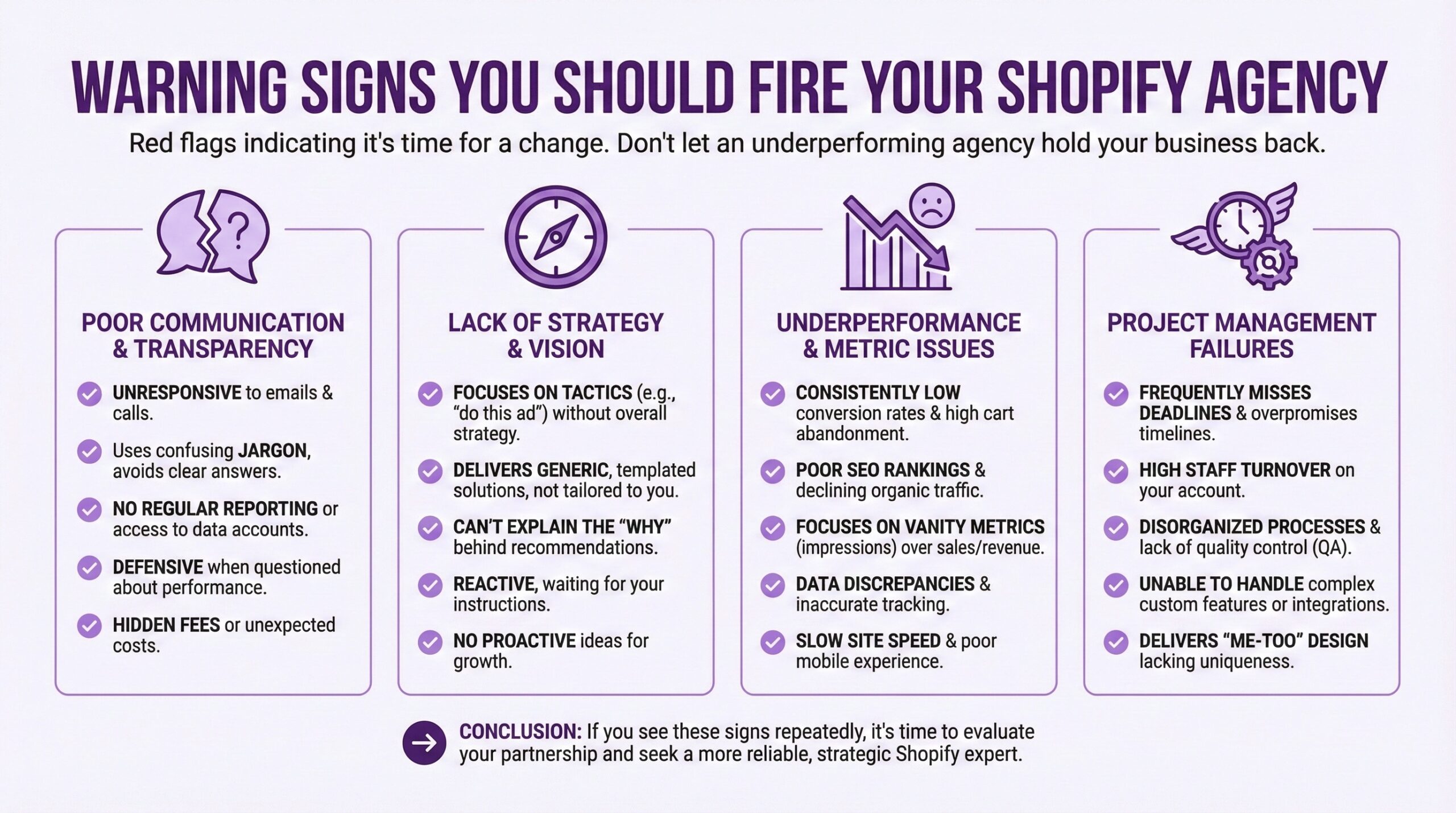
If you’ve read my piece from November on agency red flags, you know we track the predictive power of different warning signs. Some of those red flags should make you pause during the vetting process. But what about warning signs that emerge after you’ve already signed a contract and started working? Here are some patterns I’ve seen destroy more agency relationships than any others.
Communication Deterioration: When an agency starts going dark, something’s wrong. Maybe they’re overwhelmed with other clients. Maybe your point of contact left and nobody told you. Maybe they’ve mentally written off your account already. The specific reason is less important than the pattern. Healthy agency relationships have predictable communication rhythms. Weekly status calls. Monthly performance reviews. Quarterly strategic planning sessions. When those rhythms break down without explanation, your account’s a lower priority than whatever else is consuming their attention. Watch for these specific behaviors. Emails that used to get same day responses now take three or four days. Status meetings get rescheduled repeatedly. Deliverables arrive late without proactive heads up. Questions about strategy that start getting vague non answers
The Revolving Door Problem: Staff turnover at agencies is normal. But constant turnover on your specific account can become a serious problem. Every time your primary contact changes, institutional knowledge about your brand walks out the door. You end up paying for the new person to learn what the previous person already knew. Management changes and constant personnel turnover both rank among main reasons clients end agency partnerships. When agencies list why relationships end 56% point to client side changes. But that obscures the fact that agency side changes trigger as many exits.
If you’re on your third account manager in eighteen months, something structural is badly broken. Either your agency partner can’t retain expert talent or they are cycling junior staff through your account to keep costs down while billing you senior rates.
Scope Creep Without Value Add: Partner agencies that are forever finding reasons to expand the scope of engagements might be making genuinely strategic suggestions. Or they might just be padding their invoices. The difference will only be 100% clear after you examine what the expansions in questions actually delivers. Does that new initiative they’re proposing address a documented problem you’re experiencing? Does it align with goals you’ve discussed? Can they articulate specifically how it’ll move metrics? Legitimate scope expansion comes with rationale. Invoice padding comes with buzzwords.
Results That Don’t Compound: The first few months of any Shopify agency engagement should establish baselines and foundational work. But after six months, you should see measurable momentum. Not hockey stick growth necessarily. But directional improvement that builds on itself.
When results plateau early and stay flat, something’s structurally wrong with either the strategy or the execution. Maybe both. Agencies often blame external factors. Algorithm changes. Competitive pressure. Market seasonality. And sometimes those explanations are legitimate. But pattern recognition matters here. If every quarter brings new explanations for why results haven’t materialized, with promises that next quarter will be different, you’re witnessing a failure cycle that won’t self correct.
When Frustration Becomes a Fireable Offense
Recognizing warning signs is different from deciding to end the relationship. Sometimes warning signs indicate fixable problems. Sometimes they indicate fundamental incompatibility that no amount of effort will resolve.
Here are some suggestions for distinguishing between the two.
Try to Fix It First (But Set a Deadline) Most agency problems are communication problems. Before you fire anyone, have a direct conversation about your concerns. Not a passive aggressive hint. An explicit statement of what’s not working and what needs to change. Give them specific metrics and a specific timeline. Not “we need better results” but “we need to see a 15% improvement in qualified traffic within 60 days or we’ll need to reevaluate the partnership.”
Document this conversation in writing. If things don’t improve, you’ll want that record.
Recognize When Fixing Is Impossible: Some problems can’t be fixed with better communication. Cultural misalignment. Fundamental disagreements about strategy. Skill gaps the agency lacks capacity to address.
If your agency doesn’t understand your customers, no amount of feedback will change that. If they’ve never successfully executed the type of campaign you need, hoping they’ll figure it out on your dime is expensive optimism. Trust your pattern recognition. If the same problems keep recurring despite explicit feedback and documented commitments to change, you’re dealing with a structural limitation rather than a communication gap.

How to Fire Agencies (Without Making Things Worse)
Deciding to end the relationship is only half the challenge. How you execute that exit determines whether the transition goes smoothly or creates additional problems.
Review Your Contract First: Before you do anything else, read your contract carefully. Pay attention to notice periods, termination clauses, and any provisions about intellectual property or deliverables. Most agency contracts require 30 to 60 days notice for termination. Some include early termination fees. Others have provisions about who owns the work product created during the engagement.
If your contract includes automatic renewal, make sure you’re not about to accidentally lock yourself into another term.
Document Everything Before You Say Goodbye: Before you notify the agency of your decision, make sure you have copies of everything you need. Creative assets. Analytics access. Platform logins. Strategic documents. Historical performance data. Once you announce you’re leaving, assume you won’t get anything else from them. Agencies vary in how professionally they handle departures. Some will bend over backward to ensure smooth handoffs. Others will immediately deprioritize your account and become difficult to reach.
Don’t leave yourself dependent on their good behavior.
Have a Plan for What Comes Next: The worst time to start looking for a new agency is after you’ve fired your current one. That’s a scramble that leads to poor vetting and desperation decisions. Ideally you’ve already identified potential replacements before you pull the trigger. At minimum you should have a plan for who handles critical functions during any transition gap.
If you’re running paid campaigns, what happens to those when the agency stops managing them? If they’ve been handling your email marketing, who takes that over? If they have access to your Shopify admin, how quickly can you revoke that access and transfer it to someone else? Transition planning isn’t glamorous. But failing to plan transitions is how merchants end up with broken campaigns, missed deadlines, and revenue drops that take months to recover from.
What to Remember Before Firing Your Partner Agency
When it’s time to have the actual firing conversation, be direct, be professional, and be brief. You don’t need to justify your decision or argue your case. A simple statement works better. “We’ve decided to move in a different direction. Our last day with the agency will be [date]. Here’s what we need from you during the transition.” Avoid the temptation to air grievances or explain everything they did wrong. That conversation never goes anywhere productive.
It often damages the relationship further and makes the remaining transition period more difficult than it needs to be. If they ask for feedback, you can provide it. But keep it high level and forward looking. “We needed faster communication and more proactive strategic recommendations” is better than a detailed litany of every missed deadline and disappointing deliverable. Put It in Writing. Follow up your conversation with written confirmation. Include the termination date, outstanding deliverables you expect before that date, and any transition requirements specified in your contract. This creates a record and ensures there’s no confusion about timeline or expectations.
Getting a Fresh Start With a Fresh Partner Agency
Firing an agency partner isn’t a failure. Sometimes it’s the smartest business decision you can make. The merchants who struggle aren’t the ones who end relationships that aren’t working. They’re the ones who stay in dysfunctional partnerships too long because making a change feels harder than continuing to tolerate mediocrity. If you’ve recognized warning signs, tried to address them, and concluded that the relationship can’t be fixed, act on that conclusion … quickly. The longer you wait, the more painful and expensive leaving will become.
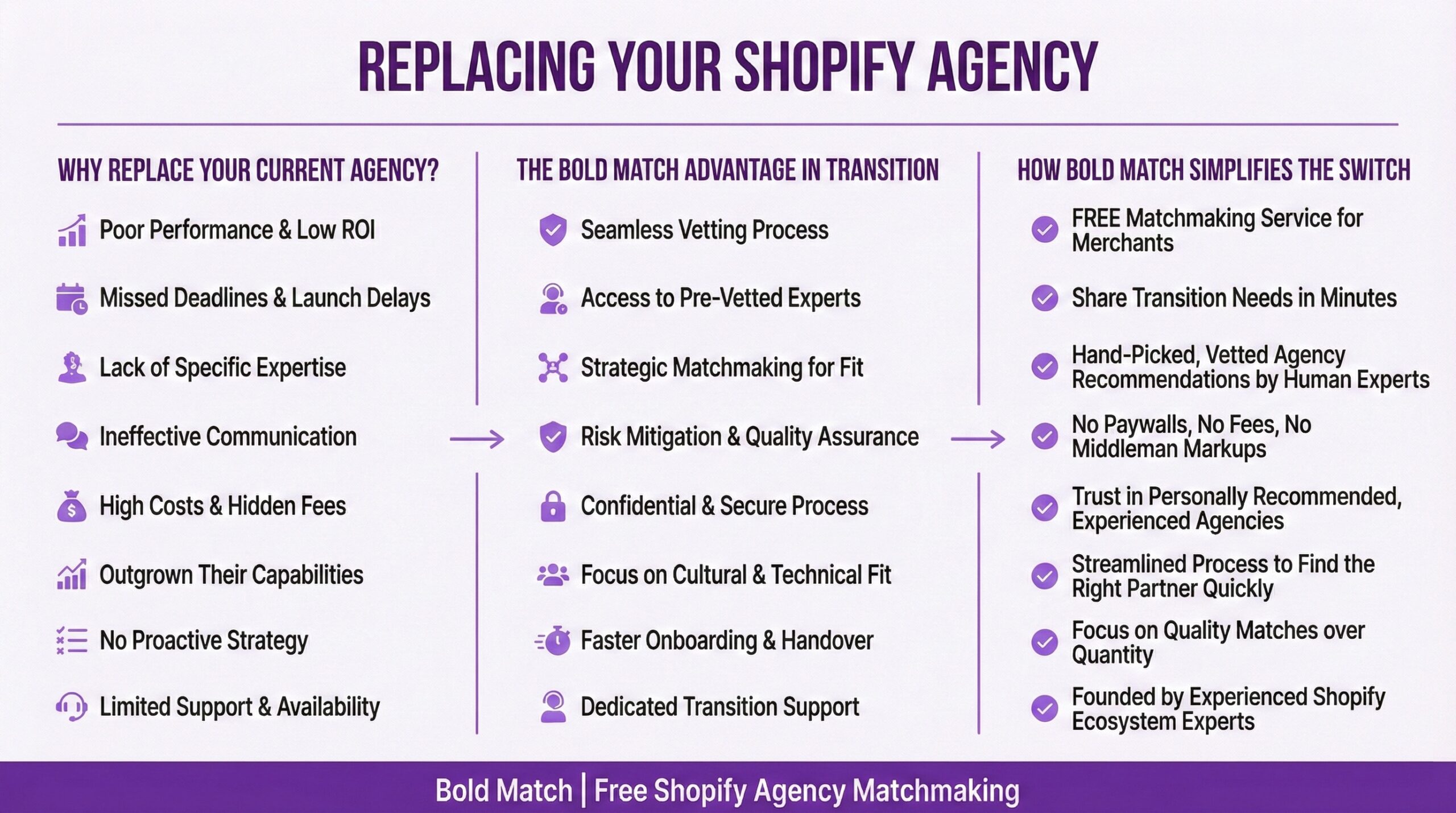
Finding the right replacement doesn’t have to be overwhelming. That’s exactly the kind of decision we built Bold Match to help with. We can help connect you with vetted partner agencies that will actually fit your needs, your business model and your communication style.
Well, I think that’s gonna be it for me today gang. So until next time. Keep building something awesome! – Jay
Frequently Asked Questions (FAQ)
What are the warning signs that my Shopify Agency relationship is failing?Well. The most reliable warning signs include deteriorating communication patterns where responses slow down and meetings get rescheduled repeatedly, high turnover among the staff assigned to your account, scope expansion without clear value rationale, and results that plateau early without showing compounding improvement over time. Focus Digital’s 2025 research found that retainer agencies maintain clients for an average of 56 months while project based agencies average only 24 months, suggesting that engagement structure itself predicts relationship durability.
How much notice do I need to give my Shopify agency before terminating?
Most partner agency contracts require 30 to 60 days written notice before termination. Some include early termination fees or automatic renewal clauses that require notice by specific dates. Review your contract carefully before initiating any termination conversation. The notice period gives both parties time to transition work, transfer assets, and ensure continuity of critical business functions.
Should I hire a Shopify Expert or a Partner Agency to replace my current agency?
The choice between an individual Shopify Expert and a full service Shopify Partner Agency depends on your specific needs. Experts often work well for focused technical projects or ongoing maintenance while agencies offer broader capabilities across design, development, and marketing. For complex engagements requiring multiple skill sets and sustained attention, agencies usually provide more structural continuity even if they cost more per hour. Bold Match can help you evaluate which model fits your situation.
How do I find a new Shopify Agency Partner before firing my current one?
Happily. You’re in the right place to get a helping hand with that. Seriously though. Start vetting replacements while you’re still in your current relationship. That gives you time to evaluate options without desperation pressure. Look for agencies with documented experience in your specific industry and at your business scale. Check references from merchants similar to your operation. Have substantive conversations about strategy rather than just reviewing portfolios. The goal is finding alignment before you need to make a rushed decision.
What should I document before ending my Shopify agency relationship?
Before announcing your departure, secure copies of all creative assets, analytics access credentials, platform logins, strategic documentation, and historical performance data. Export any reports or dashboards that live in agency controlled tools. Verify that you own the code, design files, and content created during the engagement. Assume that once you announce termination, getting additional materials from the agency becomes significantly more difficult.
Can I fire my Shopify agency partner if there’s time left on my contract?
Most contracts allow termination before the term expires, though you may face early termination fees or requirements to pay through a specific date regardless of when work actually ends. Some contracts have exit provisions tied to performance benchmarks or material breaches. Review your agreement carefully and consider consulting a lawyer if substantial money is at stake. The cost of staying in a broken relationship often exceeds the cost of early termination fees.
How long does it take to transition from one Shopify agency to another?
That’s hard to say with certainty but a well planned agency transition usually takes four to eight weeks from termination notice to full handoff with the new partner. Complicated migrations involving custom integrations, ongoing campaigns, or extensive platform customizations can take longer. Build buffer time into your planning. Rushing transitions creates gaps that damage performance and cost more to fix later than they save in compressed timelines.
What’s the best way to have the firing conversation with my Shopify agency?
Be direct, professional, and brief. State your decision clearly without extensive justification or recounting of grievances. A simple message works well. “We’ve decided to move in a different direction. Our last day with the agency will be [date]. Here’s what we need from you during the transition.” Follow up immediately with written confirmation that documents the termination date, outstanding deliverables, and transition expectations. Avoid emotional conversations that damage the remaining working relationship.