
Here’s What to Expect During Your First Shopify Agency Discovery Call
Written and edited by: Jay

Yesterday I realized I did something backwards.
It’s me Jay Myers and as you may recall, right after Thanksgiving I wrote a 22 Questions to Ask in Your Second Partner Agency Call, post that assumed that you’d already survived a first one. Then right after New Years I put together that Exactly What Kind of Partner Agency Do You Need piece, which assumed that you’d already decided to make calls in the first place. But I never wrote the middle piece. The one where we talked through actually hopping on that zoom call for the first time, but having almost no idea what was about to happen.
So today, let’s try and fix that. Your first partner agency discovery call can feel a lot like a job interview where you’re not entirely sure who’s interviewing whom. The Shopify agencies you’ll be talking to have done hundreds of them on the low end. You’ve maybe done three. And even if you have a higher count on that score, you haven’t done nearly as many. For obvious reasons that information asymmetry can work against you unless you understand what’s actually happening beneath the studiously polished chit chat and needs/capability overviews.
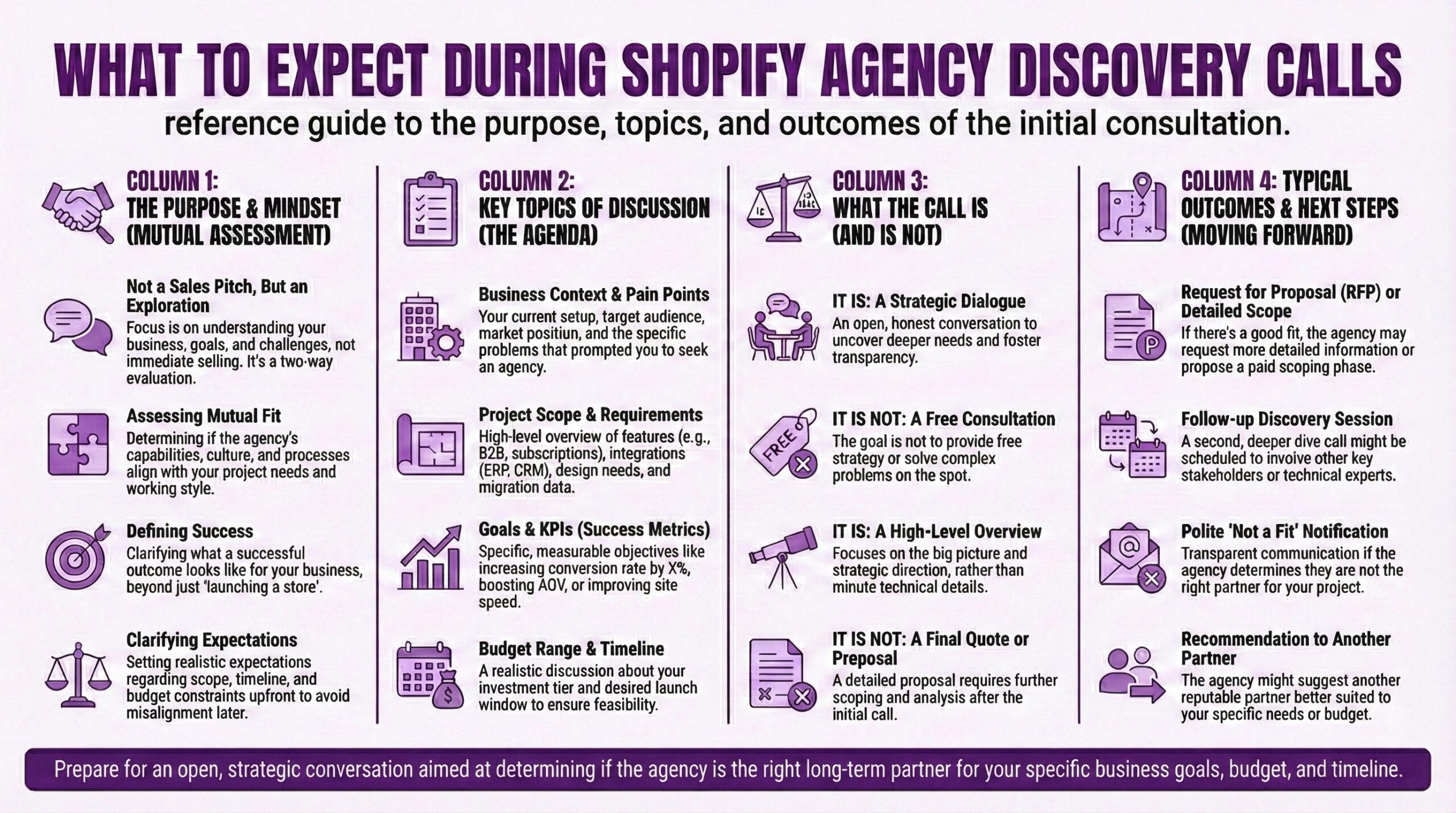
What Partner Agency Discovery Calls Actually Are
Discovery calls are mutual due diligence disguised as friendly conversations. The prospective agency partner wants to figure out if you’re a good client for them. You should be figuring out if they’re the right partner for you. Both sides are evaluating fit, budget, timeline, and whether they actually want to work together.
Most first calls run 30 to 45 minutes. Some agencies block an hour but rarely use all of it. The structure usually follows a predictable arc. Introductions and rapport building for the first five minutes. Your business background and project overview for ten to fifteen. Their capabilities pitch for another ten. Questions from both sides. Next steps discussion at the end.
The agency already knows something about you. They’ve looked at your store. They’ve probably checked your traffic estimates through SimilarWeb or a similar tool. They have a rough sense of your revenue tier based on your Shopify plan and how you described your needs in whatever intake form you filled out. You’re not starting from zero. They’re validating assumptions and filling in gaps.
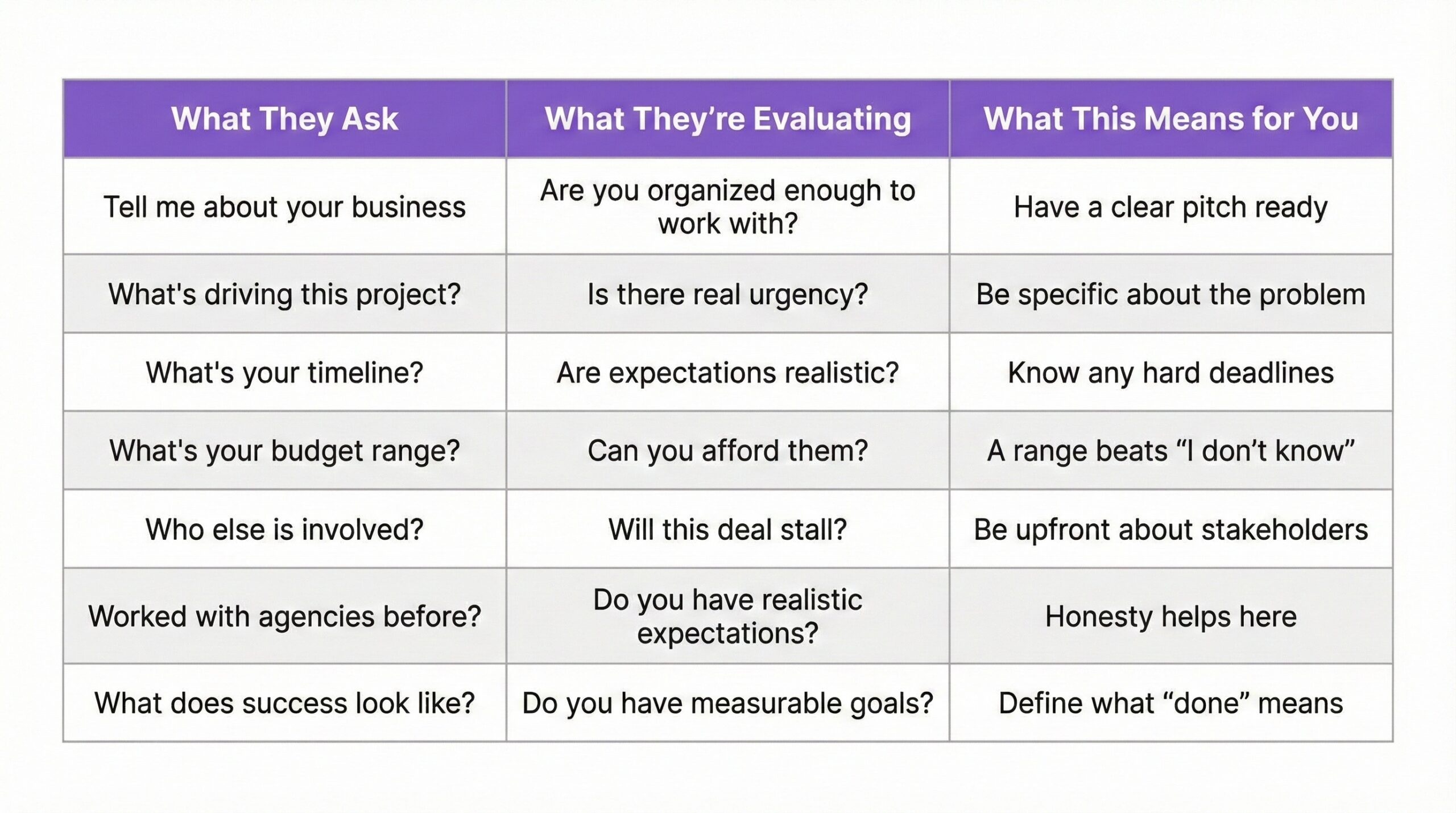
What They’re Asking vs. What They’re Evaluating
Every question a partner agency asks serves multiple purposes. Here’s how to decode what’s really happening.Understanding this subtext doesn’t mean you should game your answers. It means you should be honest while being organized. The retailers who impress agency experts often aren’t the ones with the biggest budgets. They’re the ones who clearly understand their own business.
How to Prepare For A Call Without Overthinking It
You don’t need a 30-page requirements document. But walking in cold wastes everyone’s time. Know your numbers. Rough annual revenue. Average order value. Monthly traffic. Conversion rate if you track it. You don’t need to share all of this, but having it ready signals that you run a real business. Clarify the problem you’re trying to solve. “We need a redesign” is vague. “Our mobile conversion rate is half our desktop rate and we think the checkout flow is the problem” gives the agency something to work with.
Have a budget range in mind. Agencies will ask. “I don’t know” is a valid answer but it usually means they’ll quote high to test your ceiling. Having a range, even a broad one, helps everyone calibrate expectations. If you genuinely have no idea what things cost, our guide to Shopify agency pricing can help you benchmark. Know your timeline constraints. Are you trying to launch before Black Friday? Migrating before a contract renewal deadline? Have nothing driving urgency at all? Timeline shapes everything from pricing to which agencies can even take you on.
Identify your decision makers. “I need to check with my business partner” is fine. Just be upfront about it. Partner agencies have been burned by merchants who went through an entire sales process only to reveal that someone else held the checkbook.
Red Flags That Show Up During Agency Calls
Not every agency is right for every store owner. First calls often reveal misalignment if you know what to watch for.
They do most of the talking. If an agency spends 40 minutes on their capabilities deck and five minutes learning about your business, they’re selling you a solution before understanding your problem.
They quote before scoping. Any agency that throws out specific dollar figures on a first call without detailed requirements discussion is either desperate or planning to change-order you later. Rough ranges are fine. Exact quotes are suspect.
They badmouth competitors excessively. Mentioning genuine differences between their approach and others is reasonable. Spending ten minutes trashing other agencies suggests insecurity or a pattern of deflecting blame.
They claim expertise in everything. No agency is genuinely excellent at design, development, SEO, paid media, email marketing, conversion optimization, and custom app development. Specialists outperform generalists. An agency that claims mastery across all domains probably delivers mediocrity across all of them.
They pressure you to decide quickly. “This rate is only available if you sign by Friday” is a sales tactic, not a business reality. Legitimate agencies let good fits develop on reasonable timelines.
For a comprehensive list, our red flags ranked by predictive power covers the 24 warning signs that correlate with project failure.
What Happens After Your First Agency Call
Reliable agencies usually follow up within 48 hours. Sometimes with a proposal. Sometimes with a request for more information. Sometimes with a second call to go deeper on requirements. If you don’t hear back within a week without explanation, that’s data. It suggests either poor communication habits or that they’ve quietly decided you’re not a priority client. Neither interpretation reflects well on them.
Expect to talk to multiple agencies before making a decision. Three to five conversations gives you enough data to compare approaches and spot outliers in pricing or timeline estimates. If one agency quotes half what everyone else does, something’s off. If one agency needs twice as long, either they’re being more thorough or they’re overloaded. Both are worth understanding. Once you’ve narrowed to a shortlist, take a look at that 22 Questions post. The first call establishes basic fit. The second call stress-tests it.
Signs You Should Work With a Shopify Agency
Too many merchants treat discovery calls like they’re applying to agencies and that framing frankly gives away too much power. Don’t get me wrong. They’re also evaluating you but you’re the one with money to spend and an e-commerce brand to improve. They’re the ones competing for your project. The best partner agencies actually prefer working with informed, prepared store owners. Because it means fewer misunderstandings, cleaner scopes, and projects that don’t derail halfway through because their expectations were never aligned.
The discovery call isn’t a test you pass or fail. It’s the first conversation in what could be a long working relationship. Approach it like you would any important business decision. Curious but skeptical. Friendly but not naive. Ready to learn but also ready to walk away if the fit isn’t right. Well. I think that’s gonna be it for me for today. So. Until next time, gang, please do keep building something awesome! – Jay
What A Shopify Agency’s Asking vs. What They’re Evaluating
|
What The Partner Agency Asks |
What They’re Evaluating |
What This Means for You |
|
“Tell me about your business” |
Are you organized enough to work with? Do you understand your own operations? |
Have a clear, concise pitch ready. Know your revenue tier, product mix, and customer base. |
|
“What’s driving this project?” |
Is there real urgency or just vague dissatisfaction? Will you actually pull the trigger? |
Be specific about the problem. Conversion dropping? Outgrowing your platform? Launching new channel? |
|
“What’s your timeline?” |
Are your expectations realistic? Do they have capacity to take you on right now? |
Know any hard deadlines. “Before Black Friday” is useful. “As soon as possible” is meaningless. |
|
“What’s your budget range?” |
Can you afford them? Are you serious or just price shopping? |
A range is better than “I don’t know.” Research typical costs beforehand so you’re not caught off guard. |
|
“Who else is involved in this decision?” |
Will this deal stall because you need approval from someone who isn’t on the call? |
Be upfront if there are other stakeholders. Agencies hate surprise decision-makers appearing late. |
|
“Have you worked with agencies before?” |
Do you have realistic expectations? Will you be high maintenance or a dream client? |
Honesty helps here. If past relationships failed, briefly explain what went wrong without venting. |
|
“What does success look like?” |
Do you have measurable goals or just vibes? Will scope creep become a problem? |
Define what “done” means. Specific metrics beat vague outcomes every time. |
Frequently Asked Questions (FAQ)
How long should a first partner agency discovery call take?
Most first calls run 30 to 45 minutes. If an agency schedules less than 30 minutes, they’re probably using a high-volume sales process. If calls consistently run over an hour, they may be inefficient with scoping. Neither is automatically disqualifying, but both are worth noting.
Should I share my budget on the first expert agency call?
Sharing a range is usually better than refusing to discuss budget at all. Agencies need to know if you’re in their ballpark. Giving a range like “between $15,000 and $25,000” helps them calibrate without anchoring you to a specific number. If you genuinely don’t know what things cost, say so and ask what projects like yours typically run.
What makes a Shopify Expert different from a Shopify Partner Agency?
Shopify Experts are individual freelancers or small teams who’ve passed Shopify’s vetting process. Shopify Partner Agencies operate at larger scale with full teams across multiple disciplines. Experts often work best for focused projects. Agencies handle complex builds and ongoing relationships. The distinction matters when you’re evaluating who you’re actually talking to on that discovery call.
How many expert agencies should I talk to before deciding on one?
Three to five conversations gives you enough data to compare approaches without creating decision paralysis. Talking to just one agency means you have nothing to benchmark against. Talking to ten means you’re probably avoiding making a decision. Find the middle ground.
Is it a bad sign if the agency assigns a junior expert to my first call?
No. Not necessarily. Many agencies have business development or account management staff handle initial calls, then bring in technical leads for second conversations. What matters is whether the person on the call can answer your questions competently and whether you eventually get access to the people who’d actually do the work. Ask who would be on your project team if you moved forward.
What should I do if I realize mid-call that the expert agency isn’t a fit?
Finish the call politely but don’t fake enthusiasm. You can end with something like “Thanks for the overview. I’m talking to a few agencies and will be in touch once I’ve made a decision.” There’s no obligation to continue a conversation that clearly isn’t going anywhere. Their time is valuable too.
How do I know if a Shopify Certified Partner Agency is legitimate?
Check whether they’re listed in Shopify’s Partner Directory. Look at their portfolio for stores similar to yours in scale and complexity. Search their name along with “review” to see what past clients say. Ask for references from merchants in your industry. Legitimate agencies have verifiable track records. That’s one of the reasons we built Bold Match around pre-vetted agencies rather than open marketplaces where anyone can list themselves.