
How Freelance Experts & Expert Agencies Become Shopify “Select” Partners
Written and edited by: Jay

Hey! How’s everyone’s Holiday prep going?
That’s right. It’s Jay Myers here again on Bold Match! Ok. The other day a friend’s firm finished earning Shopify “Select” Partner status and after “congratulations,” I started thinking that Shopify’s expert tiers were probably pretty confusing to anyone who isn’t eating this stuff for second breakfast, 🧝 so it seemed like something it’d be reasonably helpful to lay out for those people. So this is that post. Here goes.
Shopify overhauled its Partner Program in January 2025. If you’re reading this because you missed that announcement, you’re in luck, there’s a short version that goes like this. The old system of loose affiliations and vague credentials is gone. In its place, Shopify has built a tiered structure with “clear” requirements, and measurable benchmarks, and actual consequences for failing to meet them.
For freelance experts and expert agencies who’ve been working away in the Shopify ecosystem without much thought about official status, this matters a lot more than you’d think. The new tier system determines everything from a firm’s visibility in Shopify’s Partner Directory to whether e-commerce merchants can actually find them, when they’re looking for marketing, design or development help.
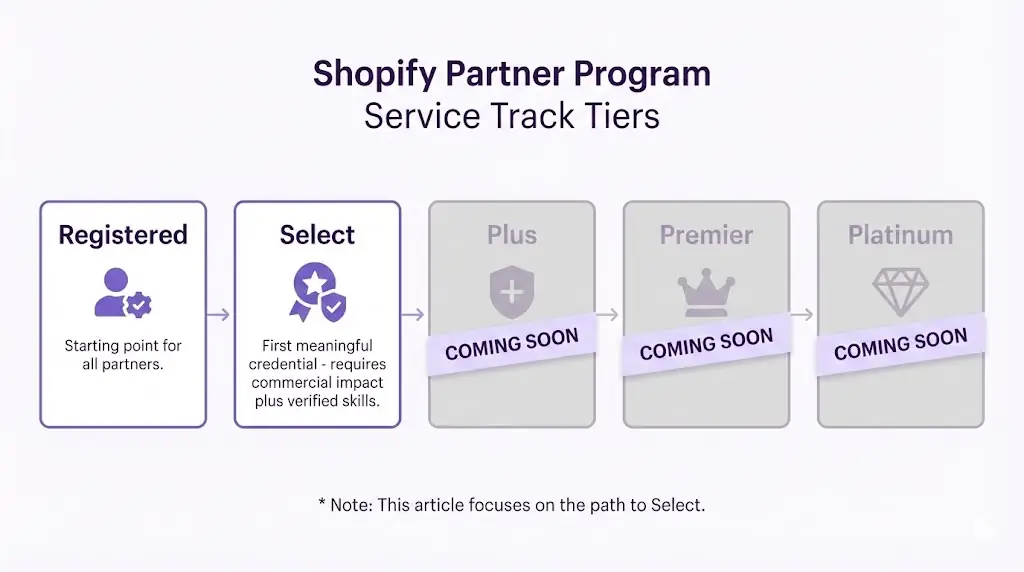
The first tier worth earning is Select Partner. So that’s mostly what we’re going to talk about today. Not because Registered Partner status is meaningless, it isn’t. Especially not in terms of getting hands on re learning Shopify’s ecosystem, but because Registered is essentially the starting line. Everyone gets it. By contrast. Select is where firms and freelancers first prove they actually belong there.
What Changed About the Partner Program
The previous Partner Program was confusing. Plus Partners, Shopify Experts, various certifications that may or may not have meant anything to merchants trying to figure out who to hire. Shopify sunset most of that in late 2024 and replaced it with two distinct tracks.
The first track is the Service Track is for expert agencies, consultancies, freelancers, and systems integrators who provide services to Shopify merchants. There are five tiers there, from Registered through Platinum. The second track is the Technology Track for app developers, ISVs, and ERP providers who build software that integrates with Shopify. Four tiers, and the top three are invitation-only.
Since you’re reading this on a website built to help merchants find and hire design, development, marketing, or e-commerce strategy specialists, I’ll more or less safely assume that you’re most interested in how the Service Track works. So that’s where I’ll focus here.
The Two Things That Shopify Actually Measures
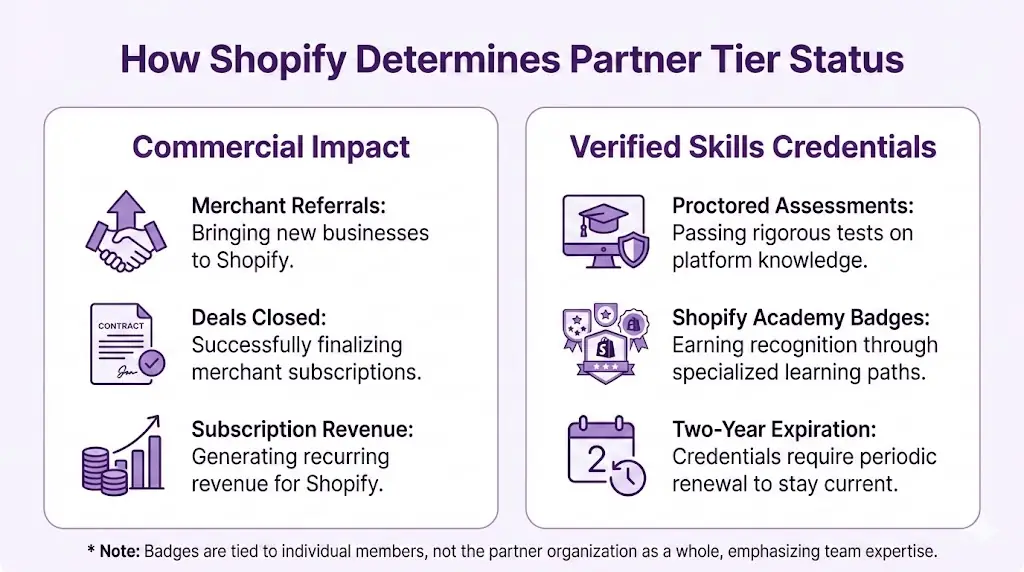
Tier placement comes down to two factors. Commercial impact and skill credentials. That’s it. No mystery, no favoritism, no gaming the system with marketing speak. Commercial impact means the revenue you’ve helped generate for Shopify. This includes merchant referrals, deals closed, and the subscription revenue those merchants produce. Shopify tracks this through your Partner Dashboard, so there’s no ambiguity about where you stand.
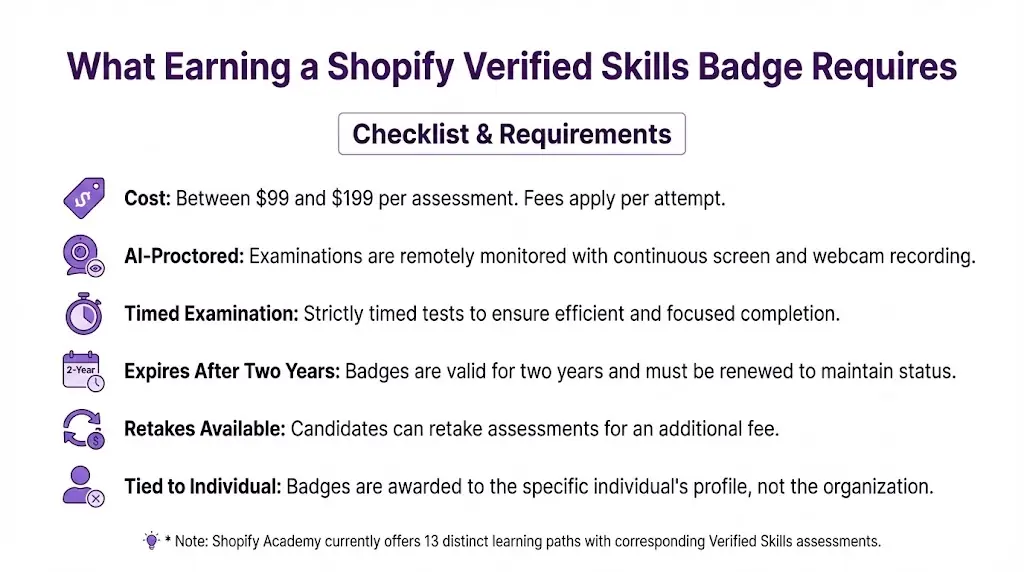
Skill credentials mean Verified Skills badges earned through Shopify Academy. These aren’t the old certifications you could get by watching some videos and clicking through a quiz. The new assessments are proctored, timed, and designed to actually test whether you know the material. They cost money to take. They expire after two years. And they’re tied to specific individual specialists, not to their organizations. That last point matters enormously for how freelance experts and agencies approach Select Partner status differently.
The Path Freelance Experts’s Take to Select Status
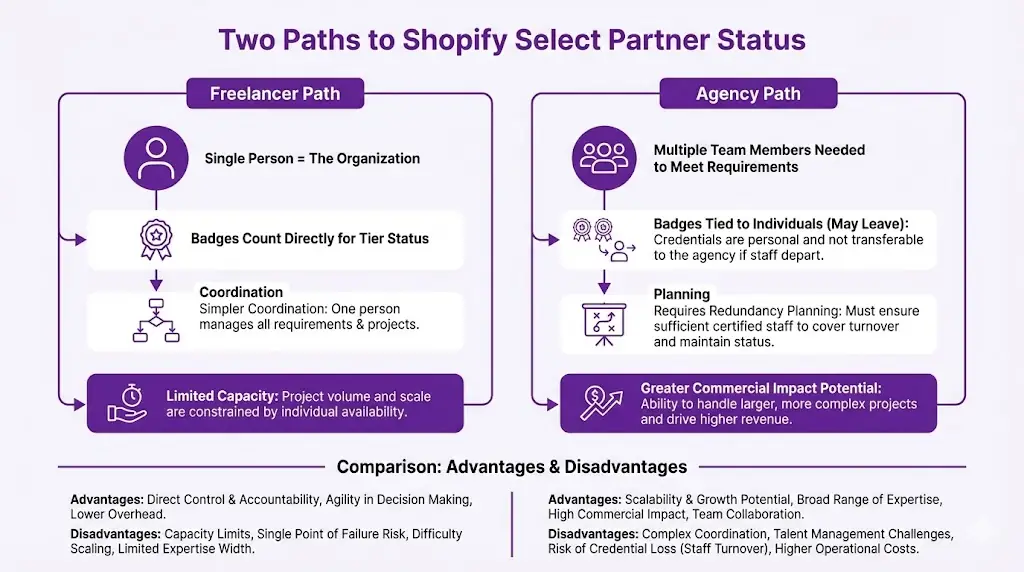
For independent marketing consultants and solo designers or developers the path is somewhat straightforward. They are the organization. Their Verified Skills badges count toward their status because they’re the individual earning them and the “Partner” they’re attached to.
Here’s what that looks like in practice.
First, they need to establish a commercial impact. This means referring merchants to Shopify, helping existing merchants grow, or both. The specific thresholds for Select aren’t published in Shopify’s public documentation, but the pattern is clear. They need to demonstrate that their work actually results in revenue for Shopify’s ecosystem. A handful of small projects won’t get them there. Consistent, measurable contribution will.
Second, they need Verified Skills badges. Shopify Academy currently offers thirteen learning paths with corresponding assessments. For Select status, you don’t need all of them. But you need enough in the right areas to demonstrate genuine expertise. If they’re developers, that means assessments like Shopify Development Fundamentals and Creating Solutions for Shopify Checkout. If they’re more strategy-focused, they’re looking at Solution Planning Fundamentals and Selling Shopify Fundamentals.
The assessments currently cost between $99 and $199 each. They’re “proctored” by AI, meaning that there’s software monitoring screen and webcam during the test. They can be retaken if someone fails one, but there’s a fee for that too. This isn’t designed to be easy. It’s designed to filter out anyone who can’t actually do the work.
For freelancers, the upside is efficiency. They’re not coordinating credentials across a firm. They’re not worrying about whether some junior developer from the third box on their zoom calls has passed their assessments too. Their expertise is their organization’s expertise. One person earning the right badges moves their entire Partner status forward.
The downside is flying solo. They’re one person. So. Their commercial impact is necessarily limited by how many projects they can personally handle. Growing their tier status might mean either taking on more work than is sustainable or raising their rates to work with merchants who generate more revenue. Neither is as easily done as it was for me to type.
How Expert Agencies Have to Earn Select Status
Expert Agencies face a different calculus entirely. Commercial impact is easier to achieve because they have multiple people generating revenue. But skill credentials are harder because Verified Skills badges attach to individuals, not to the company. This creates a specific dynamic worth understanding. If an agency’s best theme developer earns five Verified Skills badges and then leaves for another agency, those badges walk out the door with them. The agency’s Partner status just took a hit, and there’s nothing they can really do about it.
Shopify’s Service Track requirements include minimums for both the number of verified skills an organization holds and the number of people on the team who hold them. For Select status, agencies need multiple team members with credentials. They can’t just have a single superstar specialist carry the firm.
Here’s what that means in the real world.
Expert Agencies need a credentialing strategy. They have to decide which assessments matter most for their service offerings and create a plan for getting their team through them. Budget for the assessment fees. Budget for the study time. The ones who take this seriously treat it like professional development, not a checkbox exercise. They need redundancy. If Select status requires a certain number of credentialed team members, smart agencies maintain more than the minimum. People leave. Specialists get sick. They decide they’d rather work on their own projects. So. A buffer protects the agency’s tier status.
They need to track expiration dates. Verified Skills badges are valid for two years. If half an agency’s credentials expire in the same quarter and nobody noticed, they could drop a tier. The organized ones put renewal dates in their calendar systems and treat them like any other business-critical deadline.
The agency advantage is scale. More people means more potential commercial impact. They can take on larger projects, serve more merchants simultaneously, and generate the kind of revenue numbers that move them up the tier ladder faster than most freelancers can manage alone. The disadvantage agencies have is that complexity and turnovers cost. Like the need to invest in expert credentials when some of those experts won’t be with them in a few years. That’s manageable, but it does require real management.
What Select Status Actually Means
Lemme be super honest about what this credential represents. Select Partner status isn’t a guarantee of quality. But it does indicate that someone has cleared hurdles that Registered Partners haven’t. Partner Directory visibility improves at Select level, e-commerce retailers trying to find and hire Shopify help can filter by partner tier. If they’re filtering for Select and above, Registered Partners don’t show up at all. The partners who haven’t earned higher tiers become invisible to merchants trying to be careful about who they hire.
Select Partners get a tier badge for their marketing materials. This sounds minor until you’re comparing two agencies and one is Select while the other is Registered. You may not know exactly what the tiers mean, but you understand that one is higher (better) than the other. Access to Shopify resources expands at Select level. These partners get better support options, access to partner management depending on capacity, and eligibility for certain incentive programs that Registered Partners can’t participate in.
The real value of the tier system, from a store owner’s perspective, is external validation. The Shopify ecosystem is a pretty crowded place. Thousands of freelancers and agencies claim to be experts. Tier status is a credential that doesn’t come from marketing copy. It literally comes from Shopify saying yes, we tested these design or development specialists and they actually met our high standards.
That’s not everything. But it’s not nothing either.
How Long Does Going From Registered to Select Take?
How long does it take to go from Registered to Select? Good question. There’s no one right answer because it depends entirely on an expert’s starting point. Partners already doing a lot of Shopify work might qualify for Select status relatively quickly once they get the credential requirements. Their commercial impact might already be there. They just need the badges to demonstrate their skills.
Partners newer to the ecosystem face a longer runway. They’re building commercial impact and earning credentials simultaneously. Neither happens fast. Twelve to eighteen months is a reasonable expectation for someone starting from scratch and treating this seriously.
What this means for merchants is that Select status represents a meaningful investment of time and resources. Partners don’t stumble into it. They have to deliberately pursue it over months or years while maintaining enough client work to demonstrate commercial impact. The credential reflects sustained commitment to the Shopify ecosystem, not a weekend certification course.
What Merchants Should Look for Beyond Tier Status?
Tier status is a useful filter, but it’s not the whole picture. Here are some additional questions worth asking when evaluating a potential partner. Which Verified Skills badges do they actually hold? A Select Partner with credentials in Shopify Development Fundamentals is a different proposition than one with credentials in POS Operations and Retail. Make sure their demonstrated expertise matches your needs.
How long have they been at their current tier? Someone who just achieved Select status last month is in a different position than someone who’s been there for two years. Both meet the requirements, but one has a longer track record of maintaining them.
What happens to your project if their key people leave? For agencies, this is a real consideration. If the specific developer assigned to your project is the one carrying most of their credentials, and that person leaves mid-project, you should understand how the agency handles that transition.
These questions aren’t me trying to make you paranoid. I mean. Most Select Partners are exactly what they appear to be. I just want to be clear that the tier system gives you a starting point for evaluation, not final answers.
Remember, You Don’t Have Navigate This By Yourself
Select Partner status is the first meaningful milestone in Shopify’s new tier system, not the pinnacle. Plus, Premier, and Platinum tiers exist above it, each with greater requirements and greater benefits. For merchants, the tier system provides something that didn’t exist before. A standardized way to evaluate baseline qualification. It won’t tell you everything about whether a particular expert or agency is right for you. But it’ll you something. And in an ecosystem as crowded as Shopify’s, having any reliable signals isn’t just valuable, it’s essential.
The partners who’ve earned Select status have demonstrated commercial impact and passed proctored assessments in their areas of expertise. They’ve invested time and money in credentials that expire and must be renewed. They’ve chosen to participate in a specialist system that actually holds them accountable to measurable standards. That’s a serious starting point for figuring out who you’ll be able to trust with your online store. Ok. I think that’s gonna be it for me today. So. Until next time gang. Keep building something awesome! – Jay
Frequently Asked Questions (FAQ)
What Does a Shopify Agency do?Shopify expert agencies provide specialist services to e-commerce retailers and merchants operating on the Shopify platform. This typically includes store design and development, theme customization, app integration, migration from other platforms, conversion rate optimization, and ongoing technical support. Expert agencies range from small boutique firms focusing on specific niches to large consultancies handling enterprise-level Shopify Plus implementations. The common thread is deep expertise in Shopify’s ecosystem rather than general design or web development.
How Do I Choose a Shopify Expert Agency?
Short answer … Use Bold Match. ) Long answer … Start by verifying their Partner Program tier status in Shopify’s Partner Directory. Select Partners and above have met specific commercial impact and credential requirements that Registered Partners haven’t. Beyond tier status, look for agencies with Verified Skills badges in areas relevant to your project. Ask for references from merchants with similar business models to yours. And pay attention to how they communicate during the sales process. Agencies that ask detailed questions about your business before proposing solutions are usually better partners than those who jump straight to pitching their standard packages.
How are Shopify Expert Agencies Different from Expert Freelancers?
The primary differences are capacity and range of specializations. Shopify Agencies usually have multiple team members, allowing them to handle larger projects, provide faster turnaround, and offer broader expertise across design, development, and strategy. Freelancers usually specialize more narrowly but can offer more personalized attention and often lower rates for smaller projects. Both can achieve the same Partner Program tiers, but the path differs. A freelance expert’s credentials and commercial impact come from one person. Agency credentials must be distributed across multiple team members.
What is the Shopify Partner Program Service Track?
Well. The Service Track is Shopify’s program for agencies, consultancies, freelancers, and systems integrators who provide services to Shopify merchants. It replaced the older Shopify Experts and Plus Partner programs in January 2025. The Service Track has five tiers based on commercial impact and Verified Skills credentials. All service providers start at Registered and can advance through Select, Plus, Premier, and Platinum based on their performance and expertise.
What are Shopify Verified Skills Badges?
Easy. The “Verified Skills” badges are literally the credentials earned by passing proctored assessments through Shopify Academy. They demonstrate proficiency in specific areas like Shopify development, checkout solutions, POS operations, and solution planning. Unlike older certifications, these assessments are monitored in real-time, cost money to take, and expire after two years. Badges are awarded to individuals rather than organizations, which affects how agencies and freelancers approach credentialing differently.
How Long Does it Take to Become a Shopify Select Partner?
Honestly. The timeline varies too widely based on the freelancer or agency’s starting point to 100% say. Partners already doing substantial Shopify work may achieve Select status within a few months of earning required Verified Skills badges if their commercial impact numbers already qualify. Partners building both commercial impact and credentials from scratch should plan for twelve to eighteen months of focused effort. The key is pursuing both requirements simultaneously rather than completing one before starting the other.
Can an Individual Freelance Expert Become a Shopify Select Partner?
Yep. The Service Track doesn’t require a minimum team size. Lone world freelancers can earn Select Partner status by meeting commercial impact thresholds and earning required Verified Skills badges. In some ways, the path is simpler for freelance experts because they don’t need to coordinate credentials across multiple specialist team members. The challenge is that commercial impact requirements must be generated by one person’s work rather than distributed across an agency’s entire team.
What Happens if a Credentialed Specialist Leaves an Expert Agency?
Well. Their Verified Skills badges leave with them. Because badges are tied to individual specialists rather than to their organizations, employee departures can affect an agency’s tier status if they fall below the minimum credential requirements. This is why agencies pursuing higher tiers typically maintain redundancy by having more credentialed experts than the minimum requires. For e-commerce retailers, this is worth understanding when evaluating agency stability and asking about credential distribution across their team.