
Replatforming from Salesforce Commerce Cloud to Shopify+
Written and edited by: Eric
Hey everyone, Eric Boisjoli here. Hope 2026 is starting strong. ☕
So look. If you’re running an online store on Salesforce Commerce Cloud (SFCC) and you’ve found yourself staring at that contract renewal notice with a growing sense of dread, you’re not alone. Think I’ve had more conversations about SFCC-to-Shopify migrations over just the past 18 months give or take, than I’ve had in the past five years. Something shifted and honestly, it’s worth talking about.
Quick naming note before we dive in on this one gang. Salesforce recently rebranded Commerce Cloud to “Agentforce Commerce” as part of their broader AI agent push. You’ll still see SFCC and Agentforce Commerce used interchangeably everywhere including Salesforce’s own documentation, so I’ll mostly stick with Salesforce Commerce Cloud here since that’s what most merchants and web development agencies still call it. Just know we’re still talking about the same platform regardless of which name you encounter.
Here’s how this usually goes. You’re a mid-market brand and you adopted SFCC (back when it was called Demandware or shortly after Salesforce acquired it in 2016) because you were told it was what “serious” e-commerce operations used. The platform promised enterprise-grade features, scalability, and the full weight of the Salesforce ecosystem behind it. And for some brands, that worked out great. But for a lot of others? They wound up paying enterprise prices for capabilities they never fully used, have been stuck with development timelines that made simple changes feel like parliamentary procedure, and wondering why implementing Apple Pay took three months and cost five figures.
This is not gonna be a hit piece on Salesforce Commerce Cloud. The platform does genuinely powerful things for the right retailers. But Shopify Plus has matured dramatically since SFCC earned its rep, and the complexity-to-value calculation that made sense in 2018 or 2020 often doesn’t hold anymore. So. Let’s walk through what you should actually think about if you’re considering the move.
Why SFCC Retailers Start Looking Elsewhere
The conversations I have usually start with one of three frustrations, sometimes all three simultaneously.
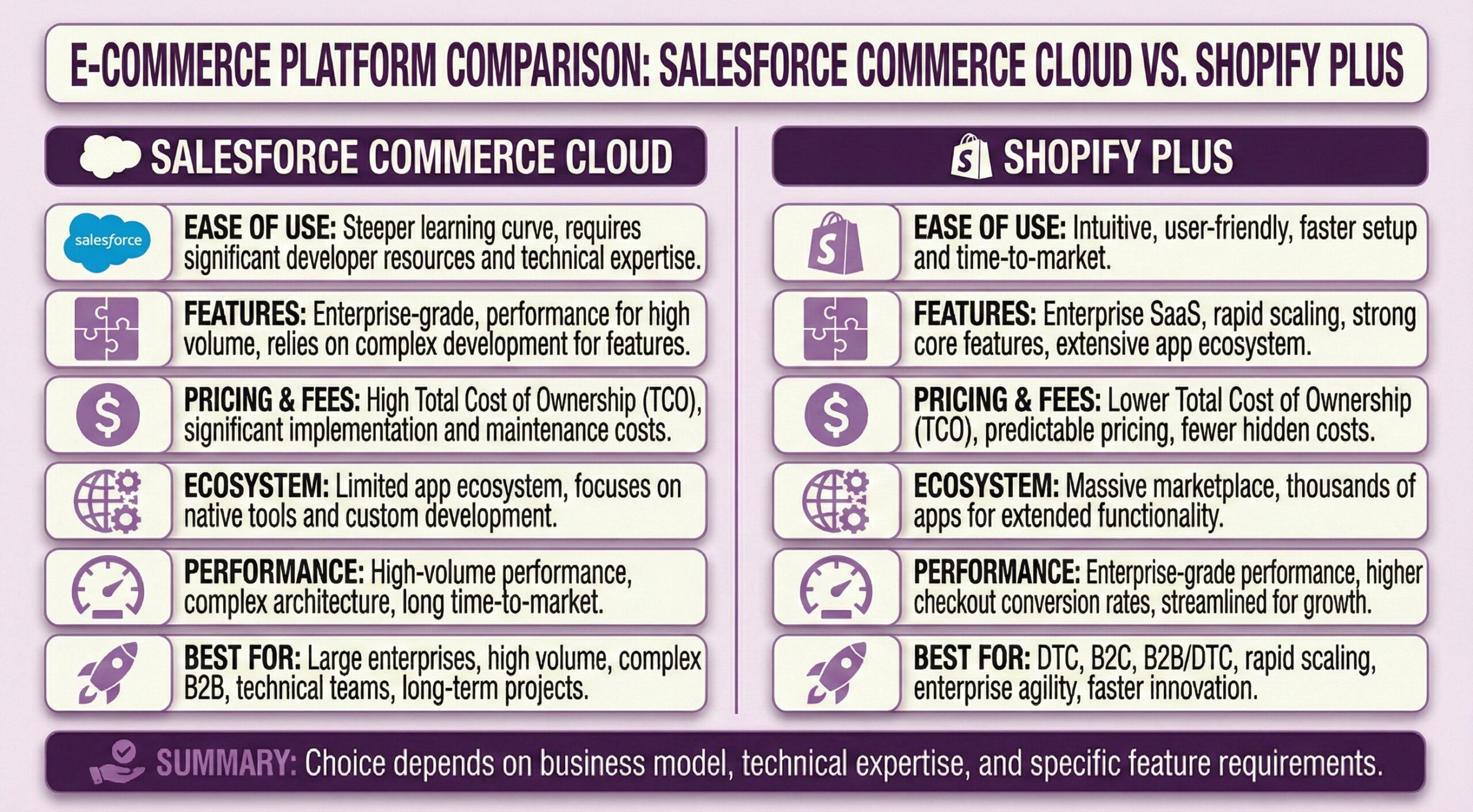
Cost creep that never quite stabilizes. Salesforce Commerce Cloud’s pricing model ties licensing fees to your Gross Merchandise Volume, usually somewhere between 1% and 3% depending on your tier and negotiating leverage. That sounds reasonable until you factor in implementation costs, ongoing development, integration work, and the specialized (read “expensive”) talent required to maintain everything. One Norwegian outdoor brand I read about described SFCC as “too big, too costly, and even though we had good IT people, we were restricted in what we could do ourselves.” A Dutch retailer mentioned their $60,000 annual license fee was just the beginning because every small change required developers billing premium rates. These aren’t edge cases. They’re representative.
Speed to market that feels like moving through molasses. SFCC’s proprietary architecture creates dependencies that slow everything down. The platform uses Demandware Script (a server-side JavaScript variant), ISML templates, and a unique page designer that require specialized knowledge. Developers fluent in Salesforce Commerce Cloud are harder to find and more expensive to retain than developers who work with more common technologies. A feature that might take days to ship on Shopify can take weeks or months on SFCC, not because the feature itself is complicated but because the platform architecture adds layers of complexity to everything.
Innovation that seems to happen elsewhere. Here’s a thing worth understanding about Salesforce as a company. They’re primarily a CRM business. Commerce Cloud represents a small slice of their overall strategy, which means platform development often focuses on integrating SFCC with other Salesforce products rather than advancing e-commerce capabilities specifically. Meanwhile, Shopify has been shipping major updates every six months with genuinely useful features. The Winter ’26 Edition alone included meaningful improvements to Sidekick, checkout extensibility, B2B functionality, and international selling. That pace of innovation matters when you’re trying to stay competitive.
What the Migration To Shopify Plus Involves
I’m not going to pretend SFCC-to-Shopify migrations are simple. They’re not. This is probably the most technically demanding replatforming work I know of, which is why choosing the right development agency matters more here than almost anywhere else.
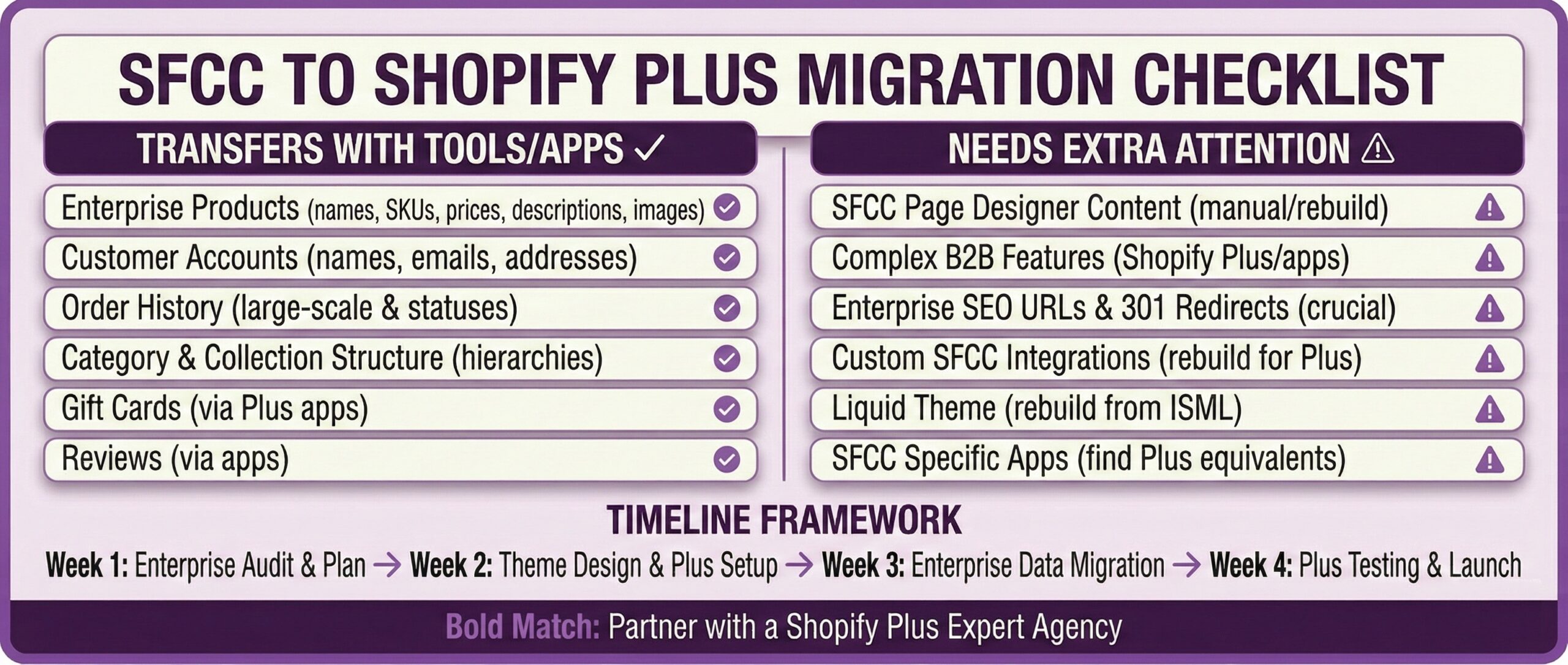
Data architecture translation. Salesforce Commerce Cloud and Shopify think about product data very differently. SFCC’s catalog structure with its master catalogs, storefront catalogs, and complex attribute systems needs to be mapped to Shopify’s product-variant-metafield model. Your price books become Shopify Markets configurations or B2B price lists. Product attributes get translated into metafields or tags depending on how they’re used. This isn’t just exporting CSV files and importing them somewhere else. It’s fundamentally restructuring how your product information is organized.
Business logic migration. Here’s where things get interesting (and by interesting I mean potentially expensive). Salesforce Commerce Cloud stores usually have years of accumulated business logic baked into pipelines, controllers, and custom scripts. Pricing rules, promotional logic, inventory allocation, shipping calculations. All of that invisible infrastructure that makes your store actually work. Some of it maps to native Shopify functionality. Some requires Shopify Flow automations. Some needs Shopify Functions (which replaced Scripts in 2025). And some might require custom app development. A proper migration audit needs to surface all of this before anyone starts building.
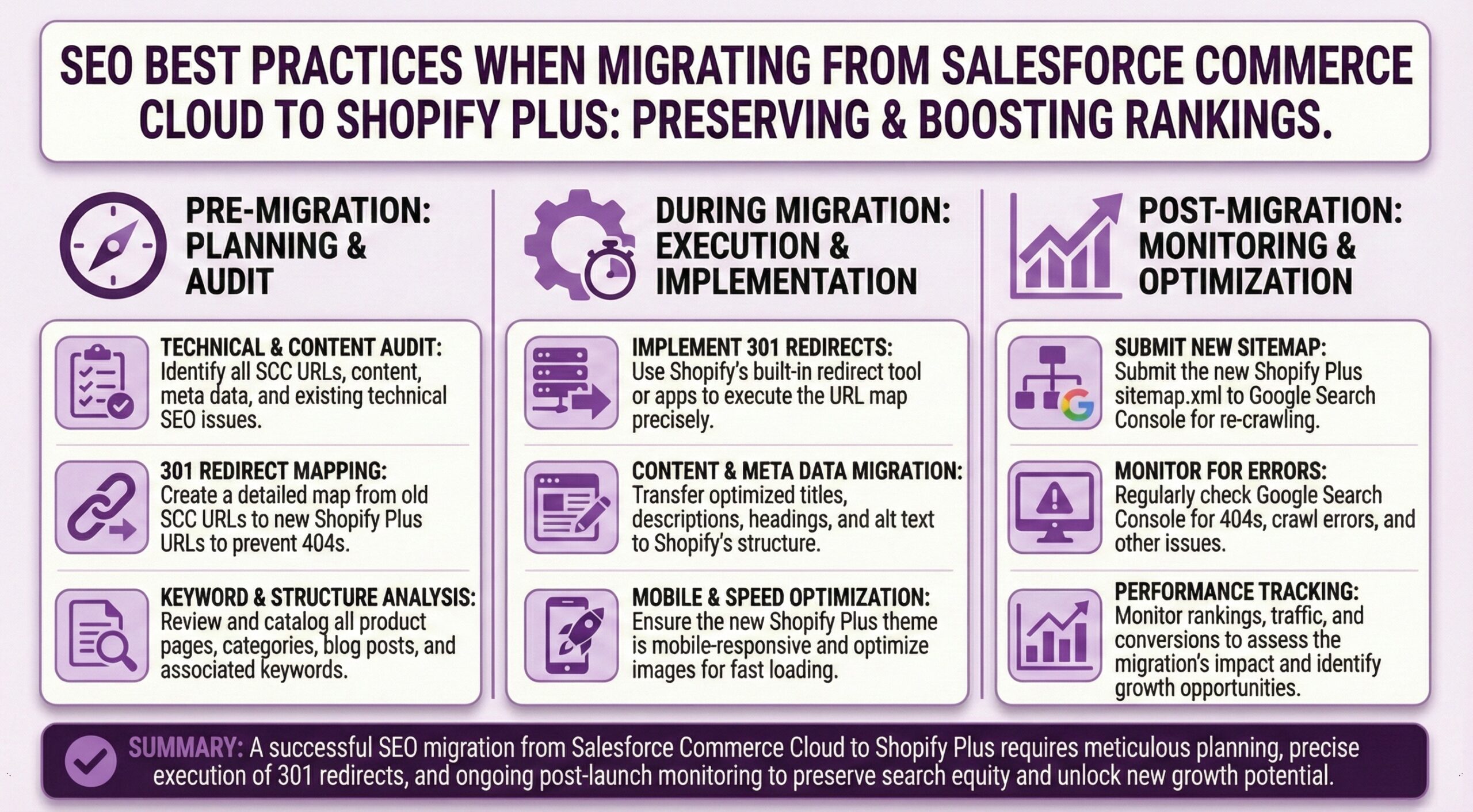
URL structure and SEO preservation. This deserves its own section because getting it wrong can devastate your organic traffic. SFCC URLs and Shopify URLs follow completely different patterns. Most Salesforce Commerce Cloud implementations use subdirectory structures for international sites (like /us/ or /uk/) which Shopify handles differently through its Markets feature. You’re looking at comprehensive 301 redirect mapping for potentially thousands of URLs. Meta titles, descriptions, structured data, canonical tags, everything needs to transfer correctly or you risk losing search rankings you spent years building.
Integration ecosystem rebuild. SFCC typically operates with fewer third-party integrations because so much functionality is built into the platform natively. Shopify’s architecture is almost the opposite. A typical Shopify Plus implementation might involve 10 to 15 core apps and integrations. Your ERP connection needs to be rebuilt. Your order management system integration needs updating. Payment gateways, tax calculation services, review platforms, loyalty programs. Each one requires evaluation and likely reconfiguration.
Customer password reality check. This one surprises people. Customer passwords cannot migrate between platforms because SFCC and Shopify use different hashing algorithms. Every single customer will need to reset their password on the new platform. Plan a thoughtful reactivation campaign. Email explaining the transition, simple password reset flow, maybe a small incentive for completing the process. Handle this poorly and you lose customers. Handle it well and it becomes an engagement opportunity.

What Shopify Plus Actually Offers Now
I mentioned that Shopify Plus has matured, so let me be specific about what that means for retailers considering the switch.
Native B2B that actually works. This was a legitimate gap for years. Shopify Plus now includes company accounts, custom price lists, payment terms, volume-based pricing, and the ability to run wholesale and D2C from a single admin. Is it as granular as Salesforce Commerce Cloud’s B2B capabilities at the highest complexity levels? Probably not. But for most mid-market brands running hybrid operations, the native tools handle the job competently.
Checkout customization through Extensibility. SFCC retailers often point to checkout flexibility as a reason to stay. Shopify’s Checkout Extensibility has closed that gap significantly. You can add custom fields, implement conditional logic, create post-purchase upsells, and modify checkout flows while maintaining Shop Pay compatibility and PCI compliance. Not quite unlimited flexibility, but far more than Shopify offered even two years ago.
International selling infrastructure. Shopify Markets lets you configure pricing, languages, and experiences per region from a centralized admin. Plus merchants get nine expansion stores included, which means you can create genuinely localized storefronts for different markets without paying separate subscription fees. The Winter ’26 Edition expanded cross-border payment options significantly, particularly in Europe.
The Automation that doesn’t require expensive developers. Shopify Flow provides visual automation building that handles most operational workflows. Tag customers based on behavior, route orders by criteria, trigger alerts on inventory levels, adjust pricing based on rules. The things that required custom SFCC development often become no-code configurations on Shopify.
Realistic Timeline for Shopify Plus Migration
Brands I’ve read about report migration timelines ranging from eight weeks for relatively straightforward implementations to six months or more for complex multi-market operations. The variables include catalog complexity (product count, variant structure, attribute requirements), integration depth (how many systems connect to your e-commerce platform), customization extent (how much business logic lives in your custom code) and international scope (how many markets, languages, and currencies you support).
Partner agencies who specialize in migrations occasionally even build custom tooling specifically for SFCC data extraction because the standard export processes don’t capture everything cleanly. And forgive me for the aside but the kind of specialized experience that leads to the development of a tool like that can matter a lot. I mean. A general Shopify agency doing their first Salesforce Commerce Cloud migration might make mistakes an experienced replatform partner has already and so has built processes to avoid.
The cost ranges I’ve seen quoted vary from $25,000 for minimal implementations to $150,000 or more for complex enterprise migrations. Add ongoing optimization, training, and post-launch support and you’re looking at a meaningful investment. But compare that to your current Salesforce Commerce Cloud total cost of ownership, including licensing, development, and maintenance, and the math often works out favorably within the first year or two.
Brands That Made the Switch To Shopify
It helps to know you’re not the first one down this path. O’Neill, the international sports brand, moved from SFCC to Shopify Plus because they “didn’t get the most out of the package we were paying for” and wanted something more compact and dynamic. Trimtex, a Norwegian outdoor brand, cited cost and the inability to make changes themselves despite having capable IT staff. Gaiam reported saving over $250,000 annually after migrating from what was then Demandware, plus a 70% increase in conversion rates after implementing features that were simply too expensive and slow to build on their previous platform.
The Cambridge Satchel Company, Bauer, Slam Jam, MZ Wallace, NYDJ, and Saje Natural Wellness all made similar moves. The pattern in these stories is consistent. Retailers who felt constrained by Salesforce Commerce Cloud’s complexity and cost found that Shopify Plus delivered more agility at lower total cost of ownership. Not unlimited capability (no platform offers that), but enough capability for their actual business needs.
When Staying on SFCC Makes Sense
I said at the top this isn’t a hit piece, and I meant it. SFCC remains the right platform for certain retailers.
If you’re a genuine enterprise with extremely complex B2B requirements involving multi-step approval workflows, advanced quoting systems, and EDI integration at scale, Salesforce Commerce Cloud’s depth might still be necessary. If you’re deeply embedded in the broader Salesforce ecosystem and getting real value from Marketing Cloud and Sales Cloud integration, that connectivity has genuine worth. If your development team already has deep SFCC expertise and you’re actually using the platform’s advanced capabilities rather than paying for features you ignore, the switching costs might not justify the transition.
The retailers who usually shouldn’t migrate are the ones who genuinely need what Salesforce Commerce Cloud uniquely offers and are actually using it. The ones who should consider moving are paying enterprise prices for a fraction of enterprise capability, waiting months for changes that should take days, or watching their competitors ship features while they’re stuck in development queues.
Getting Expert Help With the Transition
Salesforce Commerce Cloud (Agentforce Commerce) migrations just aren’t DIY projects. The technical complexity, the risk to SEO, the business logic translation, the integration rebuild. Those all require experienced partner agency support. The development agencies who do this work well usually have specific SFCC migration experience, not just general Shopify expertise. They understand the source platform architecture, they’ve built tooling for data extraction and transformation, and know exactly where common failure points hide.
That’s what Bold Match does. We connect Shopify merchants (and future Shopify merchants) with vetted partner agencies who specialize in exactly the kind of complex migration work SFCC transitions require. Free, no commissions, no pressure. If your Salesforce Commerce Cloud contract renewal is approaching and you’re wondering whether there’s a better path forward, we can help you find the right partner to evaluate your options honestly. Right. I should probably go review some XML export schemas. The outdoor rinks here in sunny Winnipeg are frozen enough for a good skate, so maybe I’ll squeeze that in later if the API configs cooperate. No, it’s not the same but any kind of skating is better than no skating. 🛹 Now get out there and make your tech stack work smarter, not harder! — Eric B.
Frequently Asked Questions (FAQ)
How long does a Salesforce Commerce Cloud to Shopify Plus migration take?Migration timelines vary significantly based on complexity. Straightforward implementations with moderate catalog sizes and limited integrations can complete in eight to twelve weeks. Complex multi-market operations with large product catalogs, extensive customizations, and numerous third-party integrations usually require four to six months or longer. The variables include catalog complexity, integration depth, amount of custom business logic requiring translation, and international scope.
What’s the difference between SFCC, Commerce Cloud, and Agentforce Commerce?
They’re all the same platform at different points in its naming history. Salesforce acquired Demandware in 2016 and rebranded it as Salesforce Commerce Cloud (SFCC). In late 2025, Salesforce began rebranding Commerce Cloud as “Agentforce Commerce” as part of their broader AI agent strategy. Most merchants, agencies, and documentation still use SFCC or Commerce Cloud interchangeably, and the underlying platform architecture remains the same regardless of which name you encounter.
How much does it cost to migrate from SFCC to Shopify Plus?
Migration costs range from approximately $25,000 for minimal implementations to $150,000 or more for complex enterprise transitions. Factors affecting cost include catalog size, number of integrations requiring rebuild, extent of custom functionality that needs recreation, and international market complexity. Most mid-market migrations fall somewhere in the $50,000 to $100,000 range when working with experienced Shopify Plus Partner agencies.
Can customer passwords transfer from SFCC to Shopify+?
No. Customer passwords cannot migrate between platforms because SFCC and Shopify use different encryption hashing algorithms. Every customer will need to reset their password on the new platform. Plan a thoughtful reactivation campaign with clear communication about the transition, a simple password reset process, and potentially a small incentive for completing the process. Handling this well turns a technical limitation into a customer engagement opportunity.
Will I lose SEO rankings when migrating from Salesforce Commerce Cloud?
You can preserve SEO rankings with proper planning, but the risk is real if migration is handled carelessly. SFCC and Shopify use completely different URL structures, and most SFCC implementations use subdirectory patterns for international sites that Shopify handles differently. Comprehensive 301 redirect mapping is essential. Meta titles, descriptions, structured data, and canonical tags all need to transfer correctly. Working with an agency experienced in SFCC migrations significantly reduces SEO risk.
Do I need a Shopify Plus Partner agency for an SFCC migration?
For Salesforce Commerce Cloud migrations specifically, yes. The technical complexity of translating SFCC’s architecture (pipelines, controllers, ISML templates, business logic) to Shopify’s model requires specialized expertise. Plus Partner Agencies with specific Salesforce Commerce Cloud migration experience have usually built custom tooling for data extraction and transformation, understand where common failure points hide, and can complete migrations faster with fewer errors than general Shopify agencies attempting their first SFCC project.
What SFCC features does Shopify Plus not support?
Shopify Plus handles most mid-market requirements but has some limitations compared to SFCC. Advanced B2B workflows like multi-step approval processes and complex quoting may require third-party solutions. Shopify’s URL structure is less flexible, which affects SEO strategy. The platform limits variants to 2,000 per product (increased from 100 in recent updates) and uses a different approach to catalog management. For most retailers, these limitations are manageable, but genuine enterprise operations may find gaps.
Which brands have successfully migrated from SFCC to Shopify Plus?
Notable migrations include O’Neill, Gaiam, Trimtex, The Cambridge Satchel Company, Bauer, Slam Jam, MZ Wallace, NYDJ, Saje Natural Wellness, Crabtree and Evelyn, and Muchachomalo. Most report significant cost savings, improved speed to market for new features, and conversion improvements after migration. Gaiam specifically reported saving over $250,000 annually and achieving a 70% increase in conversion rates after implementing changes that were prohibitively expensive on SFCC.
When should I NOT migrate from SFCC to Shopify Plus?
Stay on Salesforce Commerce Cloud if you genuinely use its advanced capabilities and get value from them. Specifically, if you have extremely complex B2B requirements with multi-step approvals and advanced quoting at scale, if you’re deeply integrated with Salesforce Marketing Cloud and Sales Cloud in ways that drive measurable business value, or if your development team has deep SFCC expertise and you’re actively using the platform’s enterprise features rather than paying for capabilities you ignore.