
The Differences Between a Shopify Premier Partner and the Shopify Plus Partners
Written and edited by: Jay
Happy New Year gang! 🥂
Jay Myers here again with the promised third installment in our Shopify Partner tier series. If you’ve been following along, you already know about Select Partners and Plus Partners. The previous posts covered the first two meaningful milestones in the service track of Shopify’s (still somewhat new) tiered Partner Program. Select status means a specialist, expert agency or freelance consultant has demonstrated commercial impact and earned Verified Skills credentials. Plus status means they’ve scaled that up with larger teams of experts, more credentials, and proven capacity for complex work. Now we’re climbing into the upper atmosphere. Premier Partners.
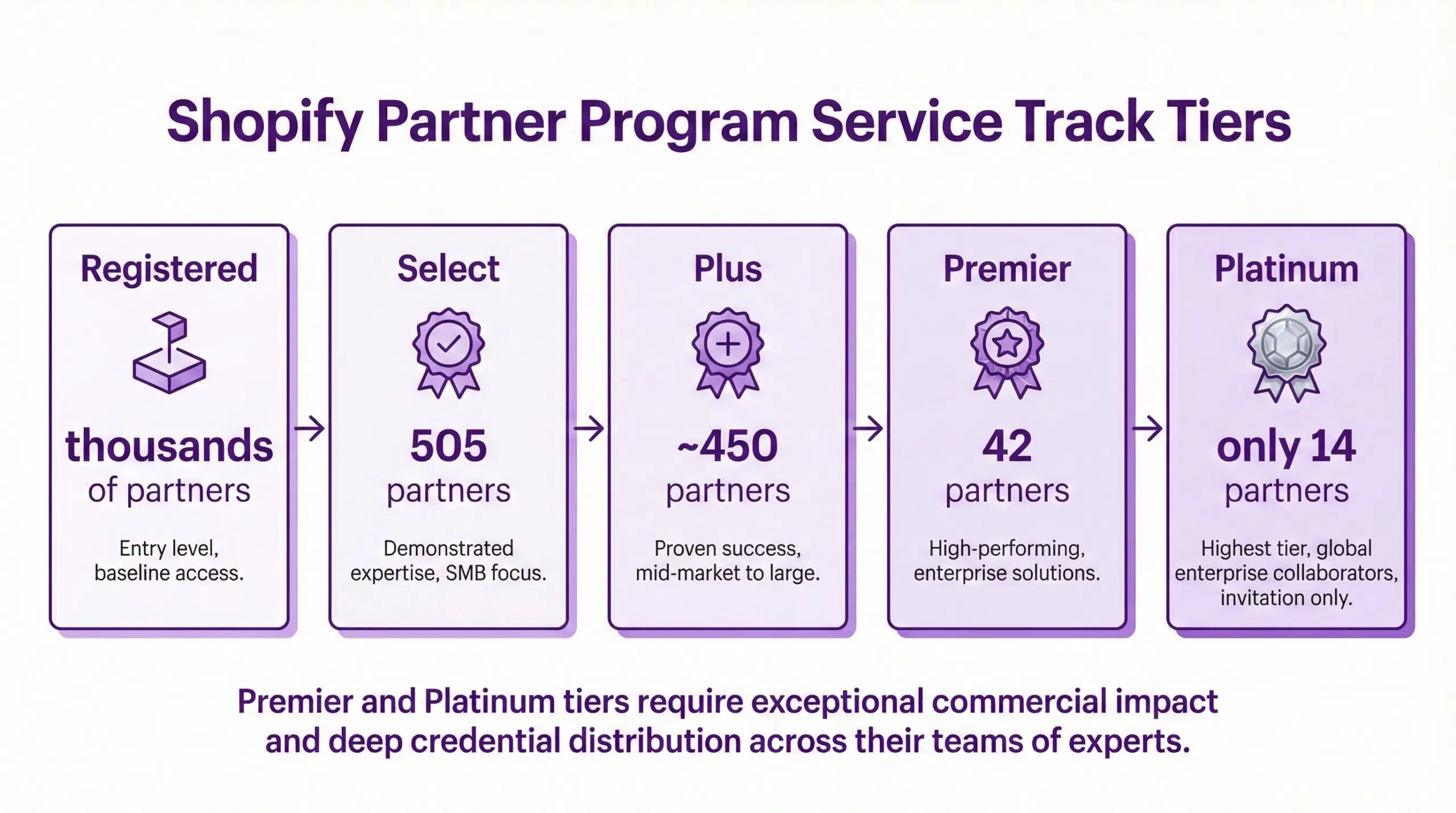
There are currently roughly 42 Premier Partners worldwide. That’s it. For context, there are around 450 Plus Partners and 505 Select Partners. When you’re looking at Premier tier, you’re looking at agencies that represent less than half a percent of all credentialed Shopify partners. Now. If your growing e-commerce operation is growing beyond Plus-tier capabilities, understanding what separates Premier from Plus will help you figure out whether that rarefied air is actually where you need to be shopping for new helping hands.

Differences Between Premier and Plus Partners
Premier Partners are where enterprise-level capabilities meet deep Shopify specialization. These experts and agencies have demonstrated exceptional commercial impact, maintain extensively credentialed teams, and usually work with household-name brands or complex global operations. For e-commerce retailers, Premier Partner status signals an agency equipped to handle challenges that would overwhelm most Plus Partners. Multi-market international rollouts. Enterprise-scale headless implementations. Complex omnichannel architectures that span Shopify Plus, physical retail, wholesale, and marketplace integrations simultaneously.
But most growing merchants don’t need a Premier Partner. And most Premier Partners aren’t particularly interested in projects below a certain complexity and budget threshold. The tier exists for a reason, and that reason isn’t to help a scrappy DTC brand doing $3 million annually offer their niche consumers a better checkout experience. Let me explain which differences differentiate these tiers.
What Do Shopify Premier Partners Actually Do?
Premier Partners occupy the enterprise consulting space within Shopify’s ecosystem. They’re the agencies someone somewhere calls whenever a Fortune 500 retail brand wants to migrate their entire e-commerce operation onto the platform. They’re the teams of elite experts who handle the technical implementations where “budget” means seven figures and “timeline” means eighteen months.
The typical Premier Partner handles projects that Plus Partners rarely see. Global enterprise migrations represent a core Premier competency. Moving a multinational retailer from SAP Commerce or Oracle ATG to Shopify Plus involves coordination across multiple markets, currencies, languages, and legal jurisdictions. These aren’t just bigger versions of single-store migrations. They’re fundamentally different engagements requiring teams with experience managing complexity that smaller agencies never encounter.
Headless commerce implementations at scale separate Premier from Plus. While Plus Partners can certainly build headless storefronts, Premier Partners have usually done it for brands where traffic spikes mean millions of concurrent users and performance degradation costs hundreds of thousands per hour. They’ve built the architectures that survive Black Friday for major online retailers.
Omnichannel integration across enterprise systems brings together Shopify, point of sale (pos), warehouse management, enterprise resource planning, order management, and customer data platforms into unified operations. Premier Partners don’t just connect APIs. They architect the entire data flow across commerce systems that were never actually designed to be able to talk to each other.
Strategic commerce consulting at the executive level is definitely what distinguishes the work of Premier Partners from that of implementation specialists. These agencies often sit in rooms with CMOs and CTOs, helping shape digital commerce strategy rather than just executing technical specifications some other someone else wrote. They’re partners in the strategic sense, not just vendors.
How Many Premier Partner Agencies Exist?
The numbers tell an interesting story. As of late 2025, Shopify recognizes approximately 42 Premier Partners worldwide. Now. These numbers are of course in constant flux as experts and agencies reach or fall off but it’s still helpful in an illustrative way to compare that 42 to around 450 Plus Partners and 505 Select Partners. What makes those numbers meaningful for merchants looking for one? Well. It means this. In Europe, only about 15 agencies hold Premier status. In Germany specifically, there are NO Platinum Partners, making Premier the highest expert tier available in the entire DACH region. Similar concentration exists in other markets. If you need genuine enterprise Shopify capabilities in a specific geography, your options narrow quickly. The scarcity isn’t artificial gatekeeping.
Premier requirements filter for agencies with sustained enterprise-level performance across commercial impact, team credentials, and project complexity. Most agencies, even successful ones, never reach the thresholds because they focus on different market segments entirely. For e-commerce retailers, this scarcity means a few practical things. Premier Partners can be selective about projects. They usually have waiting lists. And if you do engage one, you’re getting access to expertise that simply doesn’t exist outside a very small circle of specialists.
Requirements That Separate Premier from Plus
Shopify doesn’t publish exact thresholds for Premier status, but the requirements fall into the same categories that govern all tier advancement. Commercial impact, skill credentials, and increasingly at Premier level, strategic relationship with Shopify itself.
Commercial impact at Premier level means sustained enterprise-scale revenue contribution to Shopify’s ecosystem. This isn’t about referring a few Plus merchants annually. Premier agencies generate significant revenue through major enterprise deals, multi-store implementations, and ongoing relationships with large merchants who collectively represent substantial platform revenue.
For merchants evaluating Premier Partners, this commercial impact requirement signals something practical. These agencies have built their businesses serving enterprise clients. Their processes, team structures, and expertise all orient toward that market segment. That’s both a qualification and a potential mismatch signal depending on your actual needs.
Skill credentials at Premier tier require deep distribution across a larger team than Plus. Where Plus Partners need credentials spread across several team members, Premier Partners maintain extensive credentialed organizations. This isn’t a handful of developers with badges. It’s entire practices where senior and mid-level team members hold multiple Verified Skills each.
This credential depth means something for project continuity. If your engagement spans eighteen months and involves dozens of agency team members, a Premier Partner has the organizational depth to maintain quality even through normal team turnover.
Strategic collaboration with Shopify represents what truly separates Premier from Plus. Premier Partners receive prioritized access to Shopify’s enterprise sales team, account mapping for major prospects, and co-sell opportunities that Plus Partners rarely see. They’re not just using Shopify’s platform. They’re actively partnering with Shopify’s enterprise sales motion.

What Premier Partners Get from Shopify
The benefits at Premier tier extend well beyond what Plus Partners receive. Understanding these benefits helps merchants evaluate whether engaging a Premier Partner provides advantages relevant to their specific situation.
Premium support access means Premier Partners can escalate technical issues directly to senior Shopify engineering resources. When your implementation hits a platform edge case or requires functionality that doesn’t quite exist yet, Premier Partners have channels for getting answers and sometimes solutions that other partners can’t access.
Strategic collaboration with Shopify’s enterprise team means Premier Partners often know about major prospects before RFPs even go out. They participate in joint pitches with Shopify sales. They receive referrals from Shopify when enterprise prospects need implementation partners. This matters for merchants because Premier Partners in active co-sell with Shopify have current experience with whatever Shopify considers strategically important.
Marketing development funds at Premier level help these agencies maintain industry presence, sponsor major conferences, and invest in thought leadership. This explains why Premier Partners often have the most polished materials and strongest conference presence in the ecosystem.
Early access to enterprise features sometimes gives Premier Partners months of lead time on capabilities that won’t reach general availability until future releases. For merchants building innovative implementations, a partner who already understands features that don’t technically exist yet can provide genuine strategic advantages.
When You Really Do Need a Premier Partner
Most merchants don’t. That’s not dismissive. It’s practical. Premier Partners exist to serve enterprise needs. Their pricing, project minimums, and team structures all reflect that orientation. A growing DTC brand doing $5 million annually probably doesn’t need, and definitely doesn’t want to pay for, the overhead that Premier Partners necessarily carry.
Here’s when Premier Partner engagement actually makes sense.
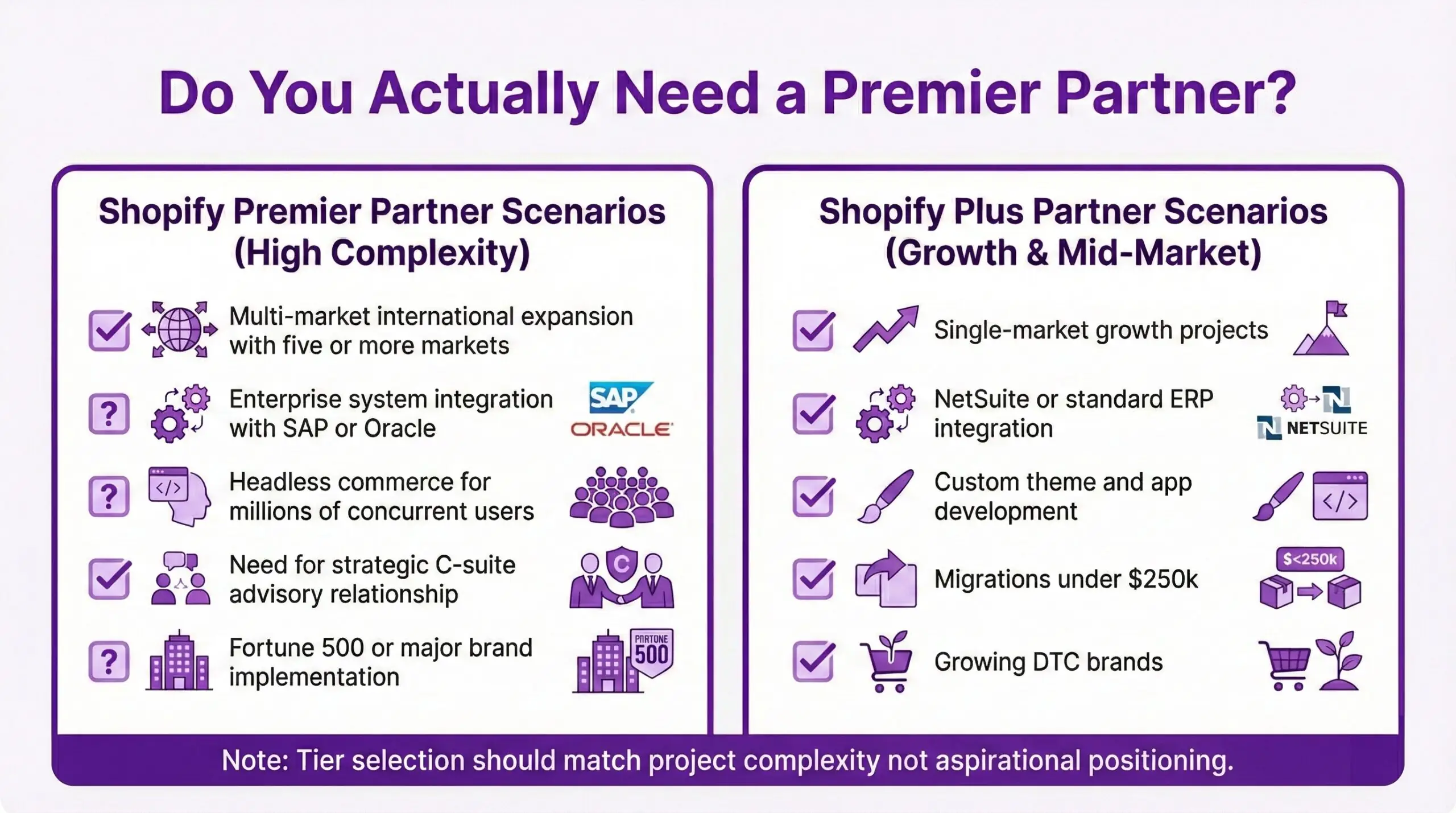
Multi-market international expansion at scale requires Premier-level orchestration when you’re launching simultaneously across a dozen markets with different currencies, languages, tax systems, and fulfillment networks. The coordination complexity exceeds what most Plus Partners have experienced.
Enterprise system integration becomes Premier territory when your Shopify implementation needs to connect with SAP, Oracle, or other genuine enterprise platforms. Plus Partners can handle NetSuite and typical ERP connections. Premier Partners have done the SAP HANA implementations with Fortune 500 retailers.
Headless commerce at genuine enterprise scale means millions of concurrent users, sub-second response time requirements, and traffic patterns that can bankrupt a brand if the architecture fails. Premier Partners have built and maintained implementations at this scale. Most Plus Partners haven’t.
Strategic partnership requirements emerge when you need an agency that can operate as a strategic advisor to your executive team rather than a vendor executing specifications. Premier Partners bring strategy experience that comes from years of executive-level client relationships.
The executive visibility factor matters when your e-commerce initiative requires board-level reporting and C-suite stakeholder management. Premier Partners have experience presenting to executives at major corporations in ways that smaller agencies simply don’t.
When Plus Partners Are Actually Better
For many projects, Plus Partners are genuinely the better choice over Premier Partners.
Mid-market projects between $50k and $250k often get better attention from Plus Partners. Premier Partners may accept these projects, but you’re rarely their priority. A Plus Partner where your project represents significant revenue will usually deliver better outcomes than a Premier Partner treating you as a minor engagement.
Specialized niche requirements often favor Plus Partners with domain expertise over Premier generalists. A Plus Partner that has built twenty fashion brand implementations knows things about size guides, lookbooks, and seasonal collection management that a Premier Partner focused on B2B industrial supplies won’t.
Speed and agility can actually suffer at Premier tier. Larger organizations have more processes, more approvals, more stakeholders. A Plus Partner that can kick off next week and iterate quickly may serve your needs better than a Premier Partner with a three-month onboarding process.
Direct founder access typically disappears at Premier level. At Plus tier, you might work directly with the agency principals. At Premier tier, you’re assigned account managers and project leads. Neither is wrong, but they’re different experiences.
The Elite Tier Above Premier Partners
Yes, there’s another tier. Platinum Partners represent the absolute apex of Shopify’s Partner Program, with only roughly 14 agencies globally holding this partner status. Huge names like Domaine sit here alongside really real technology giants like Google and Oracle.
Platinum Partners operate at true global enterprise scale. They’re implementing Shopify for literally the largest brands on the planet. They maintain teams spanning multiple continents. Their minimum project sizes start where some agencies’ annual revenue ends.
For most retailers, Platinum Partners exist in a different universe entirely. Even merchants with legitimate enterprise needs usually find Premier Partners more accessible and appropriately scaled. Platinum engagement makes sense for true Fortune 500 implementations with global scope and multi-year timelines. If you’re reading this article trying to figure out whether your brand needs Premier Partner capabilities, you almost certainly don’t need Platinum. That tier exists for a very specific segment that would already know if they belonged there.
Questions to Ask Premier Partners
When evaluating Premier Partners specifically, certain questions help reveal whether their tier status actually benefits your project.
-
- What percentage of your current projects are similar in scope to mine? This reveals whether you’re a typical client or an outlier. Premier Partners focused on $2M enterprise implementations may not give appropriate attention to a $300k project, even if they accept it.
- Who specifically will lead my engagement, and what’s their experience with projects like mine? At Premier tier, you’re often buying the organization’s reputation. Make sure the actual humans assigned to your project have relevant experience, not just the agency’s portfolio.
- What’s your typical client revenue range and project budget? Straightforward question that reveals fit. If their typical client does $500M annually and you’re at $10M, you may not get the attention you deserve.
- How does your engagement model work for mid-market projects? Some Premier Partners maintain separate practice areas for different market segments. Others treat smaller projects as secondary. Understanding their model helps set expectations.
- What distinguishes your approach from Plus Partner alternatives? A Premier Partner should be able to articulate specific capabilities, experience, or resources that justify their tier. If the answer is essentially “we’re bigger,” that may not translate to better outcomes for your project.
Remember, You Don’t Have To Navigate This By Yourself
Premier Partner status represents elite positioning in Shopify’s ecosystem. The approximately 42 agencies worldwide who currently hold this status have demonstrated exceptional commercial impact, built extensively credentialed teams, and proven capacity for enterprise-level complexity. For e-commerce retailers evaluating agencies, Premier status matters most when your needs genuinely require enterprise capabilities. Multi-market international rollouts. Complex omnichannel integration. And headless implementations at scale.
For most growing merchants, Plus Partners remain the sweet spot. They offer sophisticated capabilities, strong credentials, and the ability to handle complex projects without the overhead and minimum thresholds that the Premier Partner Agencies necessarily carry.
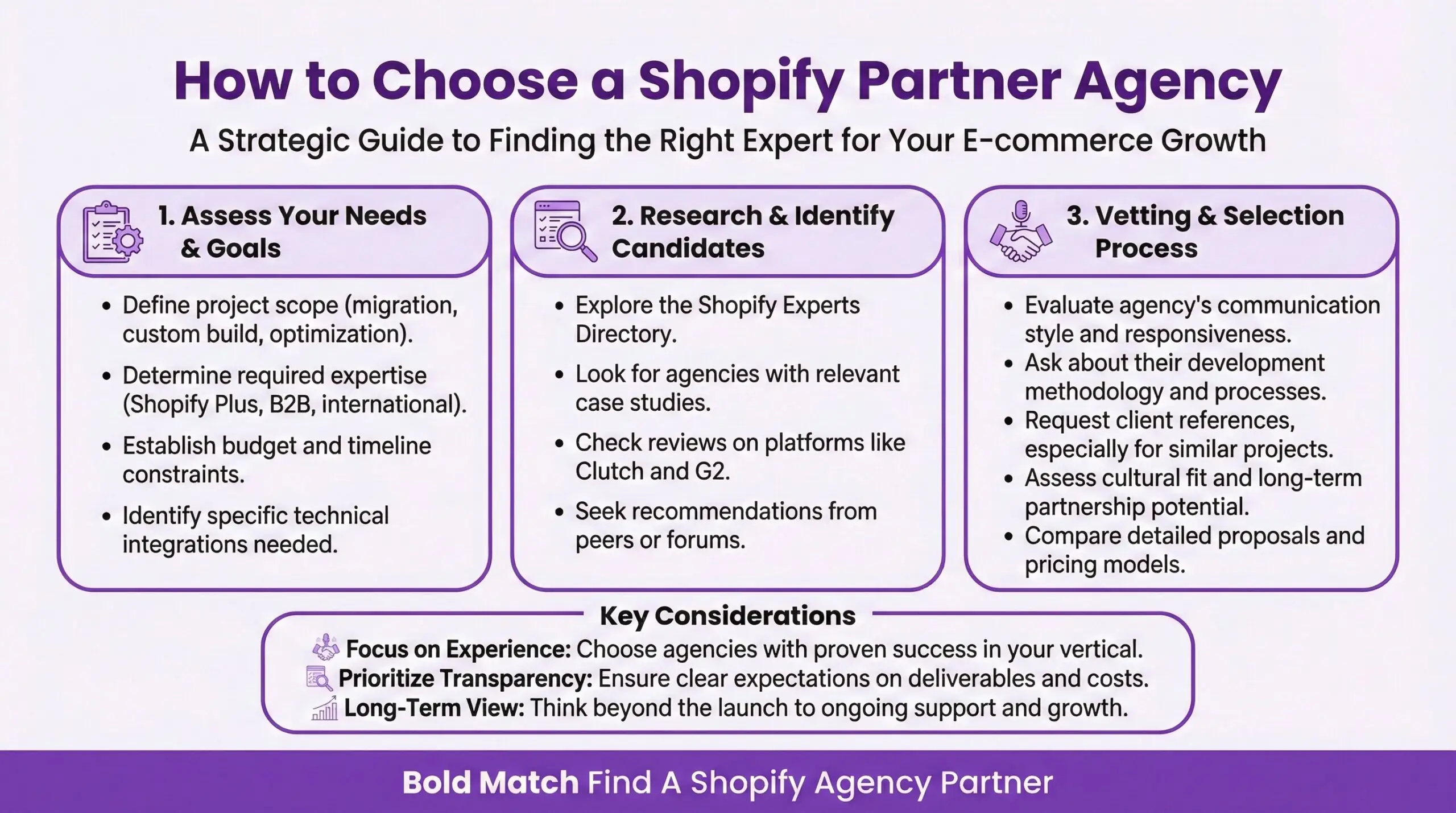
Use tier status as one input among several. Consider project fit, team availability, relevant experience, and working style. Sometimes the right partner is a Premier agency with perfect domain expertise. Sometimes it’s a Plus Partner with more appropriate scaling for your needs. Sometimes it’s a Select Partner who happens to specialize in exactly what you require. And if sorting through all this sounds like more work than you bargained for, well, that’s literally why Bold Match exists. We’ll do the vetting and matching for you for free. Yes free.
That wraps up the individual tier breakdowns. Next time we’ll either explain Platinum for fun or maybe put together a comprehensive decision guide that’ll help you figure out which tier actually fits your situation. Until then, do keep building something awesome! – Jay
Frequently Asked Questions (FAQ)
What’s the Difference Between Premier Partners and a Plus Partner?Premier Partners represent the tier above Plus in Shopify’s Partner Program. There are roughly 42 Premier Partners worldwide compared to around 450 Plus Partners. Premier Partners have higher commercial impact requirements, larger credentialed teams, and usually work with enterprise-level merchants and household-name brands. They receive additional Shopify benefits including strategic collaboration, premium support access, and prioritized co-sell opportunities with Shopify’s enterprise sales team.
How Many Shopify Premier Partner Agencies Are There Worldwide?
It fluctuates constantly for obvious reasons but at least as of late 2025, approximately 42 expert agencies hold Shopify Premier Partner status globally. About 15 of these are in Europe. For comparison, there are around 450 Plus Partners, 505 Select Partners, and only 14 Platinum Partners. The numbers shift as agencies advance or occasionally lose tier status based on their ongoing performance.
What Kinds of Projects Do Premier Partner Agencies Handle?
Premier Partners usually focus on enterprise-scale implementations. This includes multi-market international rollouts, large-scale platform migrations from systems like SAP Commerce or Oracle ATG, headless commerce implementations for high-traffic retailers, complex omnichannel integrations spanning e-commerce and physical retail and wholesale, and strategic consulting at the executive level. Projects often run seven figures and span twelve to eighteen months.
Do I Need a Premier Partner for My Shopify Store Project?
It depends honestly but probably not. Premier Partners exist to serve enterprise needs. Their pricing, minimum project sizes, and team structures all reflect that orientation. Most growing merchants are better served by Plus Partners who offer sophisticated capabilities without the overhead. Premier Partners make sense for genuine enterprise requirements, including multi-market expansion, SAP-level integrations, or implementations requiring C-suite stakeholder management.
What’s the Difference Between Premier and Platinum Partners?
Platinum Partners represent the highest tier in Shopify’s Partner Program, with roughly 14 agencies globally. These include major consultancies and technology giants like Google and Oracle alongside agencies like Domaine. Platinum Partners operate at true global enterprise scale with implementations for the largest brands on the planet. For most merchants, even those with legitimate enterprise needs, Premier Partners are more accessible and appropriately scaled.
How Do I Know If a Partner Agency is Actually Premier Tier?
This one’s easy. Just check their listing in the Shopify Partner Directory, which displays tier badges. Premier Partners will show Premier status on their profile. You can also ask them directly and verify through Shopify if you have any doubts. Some agencies may claim Premier status without holding it, so verification matters for enterprise engagements.
Can Plus Partner Agencies Handle Enterprise Projects?
Sometimes yes. Many Plus Partners successfully complete projects that technically qualify as enterprise work. The difference is usually scale and complexity. A Plus Partner might handle an ERP integration beautifully but struggle with a simultaneous twelve-market international rollout. For projects at the upper edge of complexity, Premier Partners have more likely encountered and solved similar challenges before.
What Should I Budget for a Premier Partner Project?
Usually Shopify Premier Partner projects start in the six-figure range and often reach seven figures for major implementations. Most Premier agencies have minimum project sizes, often $100k or higher, that filter for appropriate engagements. If your budget is under $100k, a Plus Partner will usually provide better attention and appropriate capabilities. Premier Partners’ overhead structures simply don’t support smaller engagements effectively.