
What’s a Shopify Developer? (And What Does a Dev Do)
Written and edited by: Eric

You know when you’re rolling up to a skatepark and some somebody’s already sessioning the one good ledge? You know how you size them up? Are they some weekend warrior who just learned kickflip tricks off YouTube? Or are they the real deal, someone who actually understands the physics of what makes a trick work, not just the look of it? That’s pretty much the question merchants ask about Shopify developers … Eric (it’s me Boisjoli by the way) what’s a Shopify developer? And what’s one actually supposed to be able to develop?
It’s a fair question. Because right now, roughly 5.6 million live stores run on Shopify worldwide. The platform generated over $11.5 billion in revenue last year. And behind most of the shops that are actually thriving, not just surviving, there’s usually a web dev who knows the platform down to the code level. Not someone who watched two or three theme customization tutorials to suss out changing hex colors.
So let me break this down the way I’d explain it to a friend over a double double or two (or a bowl of Old Dutch Rip-L . ) whichever.
The Short Answer (Before We Get Into the Long One)
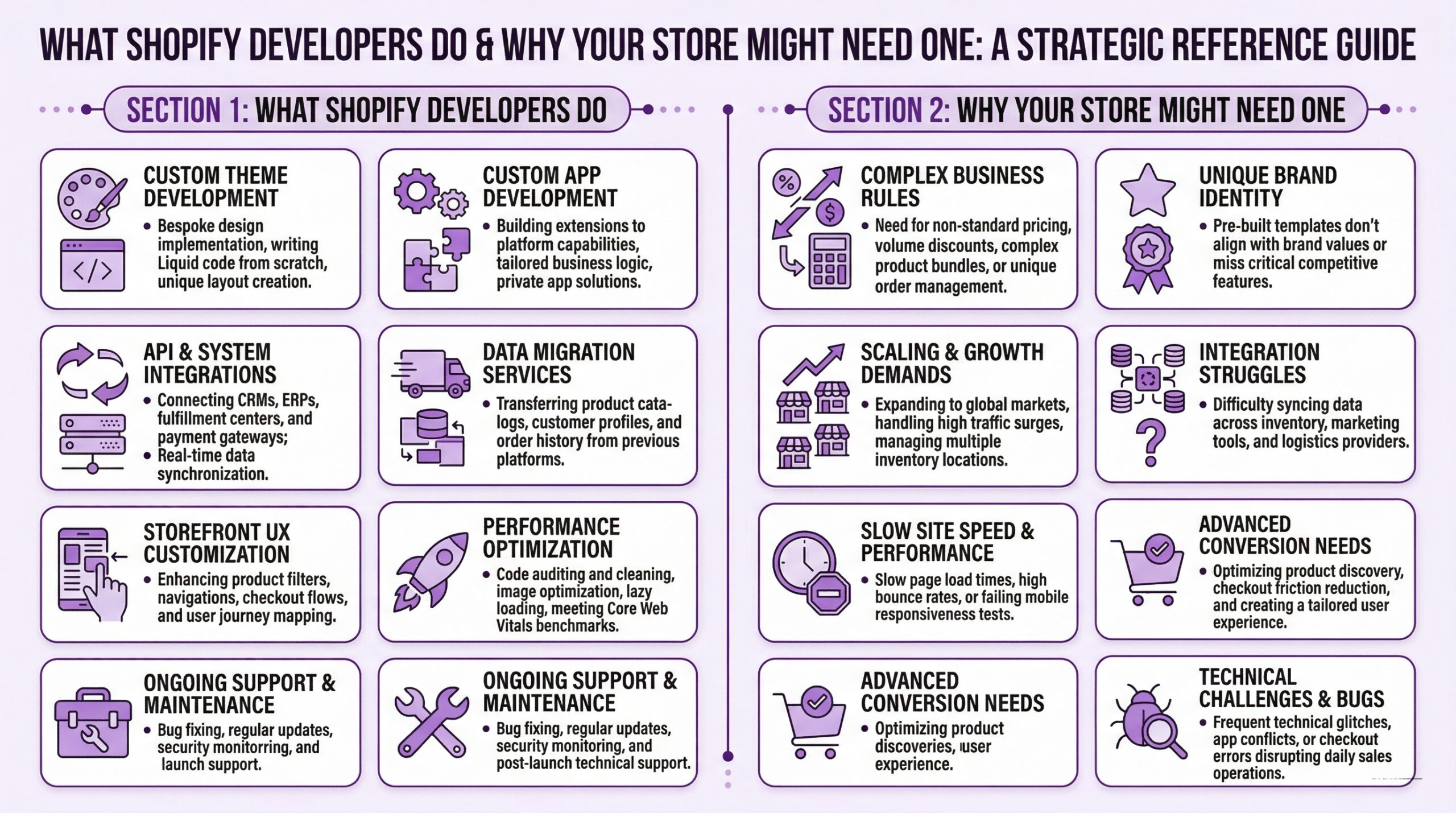
Shopify developers are the someones who build, customize, and maintain online stores on Shopify’s e-commerce platform using actual code. That means Liquid (Shopify’s templating language), HTML, CSS, JavaScript, and increasingly, React-based frameworks like Hydrogen for headless builds. Which sounds simple enough, but like weather or photography “Shopify developer” is one of those broad terms so broad that it’s easier than it should be to misunderstand. It covers everything from someone tweaking a theme template to someone developing a custom app from scratch that connects your shop to warehouse management systems in three separate countries. The range is wide. And the range matters because what you need, and what you pay for should actually match.
Before we go further, let’s get this distinction straight, because it trips up store owners constantly. A Shopify developer is not the same as a Shopify Expert with a capital E. “Shopify Expert” used to refer to professionals listed in Shopify’s now-discontinued Experts Marketplace (which shut down in late 2023). These days, the term gets used loosely to describe anyone with platform knowledge, from designers to marketers to developers. A developer is also not the same thing as someone who can navigate the Shopify admin. Your cousin who set up a store on a Saturday afternoon is not a developer. They’re a merchant. And that’s perfectly fine. But when your store needs something the admin panel and app store can’t provide, that’s when a developer will be worth every penny.
What Shopify Developers Actually Do (Day to Day)
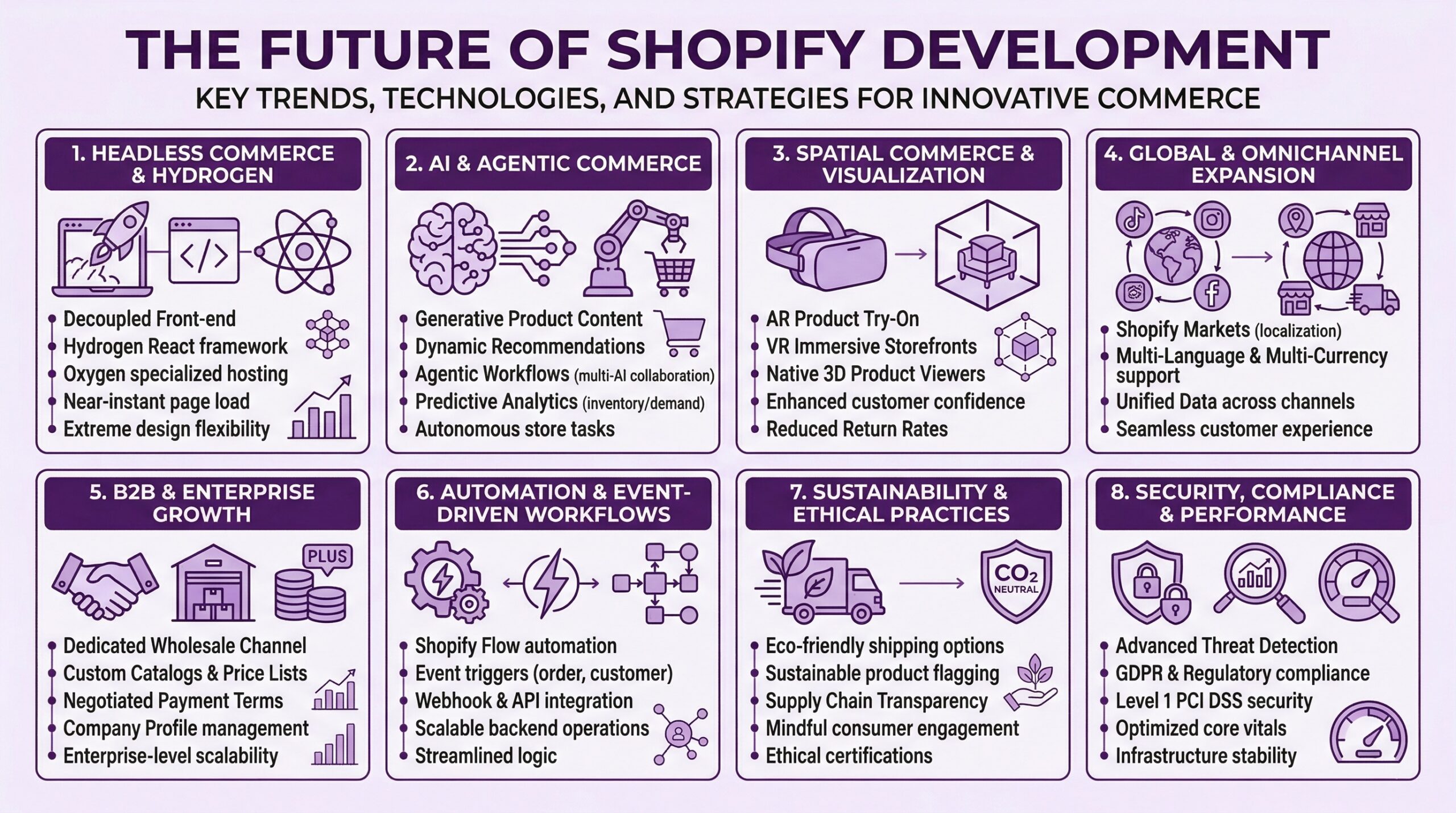
Development work falls into a few distinct categories, and most retailers need some combination of them all over the life of their store.
Theme Development and Customization. This is where most people first encounter developer work. Shopify themes are built in Liquid, and while the platform’s theme editor handles basic changes, anything beyond surface-level adjustments requires code. We’re talking about custom section builds, dynamic content blocks, responsive layout overhauls, and the kind of polished product page experiences that actually move shoppers from browsing to buying.
The average Shopify store converts between 1.4% and 1.8% of visitors. The top performers hit 3.2% or higher. The difference between those two groups almost always involves some custom conversion optimization development work on the storefront.
Custom App Development. Shopify’s app store has over 13,000 apps. But sometimes what your store needs doesn’t exist as a plug-and-play solution. Maybe you need a custom loyalty program that connects to your POS system. Maybe you need a product configurator that handles 47 different combinations of size, material, and color. Maybe you need something that ties your subscription model to your inventory forecasting.
That’s custom app territory. Developers build private and custom apps using Shopify’s APIs (both REST and GraphQL), and these apps can do everything from automating order routing to creating entirely new customer experiences.
Storefront Performance and Speed Optimization. Here’s a skateboarding analogy for you. Speed matters. If your board has flat spots on the wheels, you’re not making it across the park. Same deal with your store. Page load times directly affect conversion rates, search rankings, and whether shoppers stick around or bounce.
Developers dig into asset optimization, lazy loading, code splitting, unnecessary app bloat removal, and render-blocking resource management. The unsexy work that makes the sexy work possible.
Migration and Platform Transitions. Merchants outgrow platforms. It happens. If you’re moving from WooCommerce, Magento, BigCommerce, Squarespace, or any other platform to Shopify, a developer manages the technical side of that transition. Product data, customer records, order history, URL redirects, SEO preservation, the whole works. This is one of those areas where cutting corners costs you real money. A botched migration can tank your search rankings overnight and take months to recover.
Shopify Plus and Enterprise Development. Shopify Plus is a fundamentally different animal. It unlocks checkout extensibility, Shopify Flow automations, B2B wholesale pricing, Shopify Functions (replacing the deprecated Scripts), and headless commerce through Hydrogen and Oxygen. Plus developers usually command higher rates for good reason. The complexity jumps significantly, and mistakes at the enterprise level carry enterprise-level consequences. If you’re running a store that processes millions in annual revenue, this is not the place to go bargain hunting.
Integrations and Third-Party Connections. Your store doesn’t exist in isolation. It talks to your ERP, your CRM, your email marketing platform, your shipping provider, your accounting software, and probably half a dozen other systems. Developers build and maintain those connections through APIs and webhooks, making sure data flows smoothly between systems without anyone on your team having to manually copy-paste anything ever again.
Ongoing Maintenance and Support. Shopify evolves constantly. Themes need updates. Apps break. New features launch. Checkout extensibility requirements change. Someone needs to keep the lights on and the shelves stocked, digitally speaking. Many developers and agencies offer retainer arrangements for exactly this reason, usually running between $150 and $1,500 per month depending on your store’s complexity.
What Will it Cost to Hire a Shopify Developer?
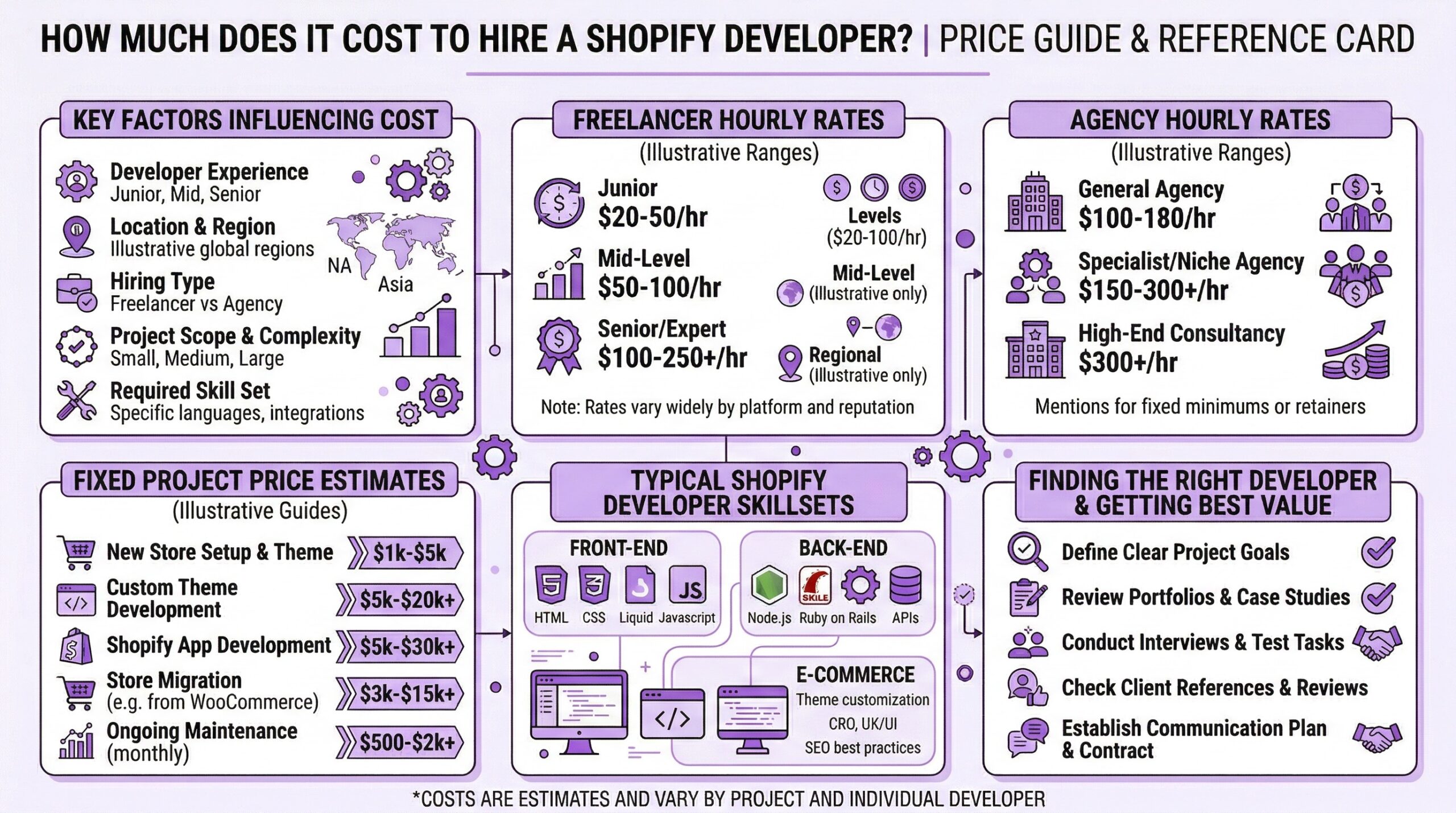
Real numbers, because you’re going to ask anyway. Freelance Shopify developers in North America usually charge between $75 and $150 per hour for experienced work. Senior Shopify Plus specialists and agency teams can run $125 to $250 per hour. Offshore web developers range from $15 to $40 per hour in South Asia and $30 to $70 in Eastern Europe.
For project-based development work, you’re looking at roughly $500 to $5,000 for theme customizations, $2,000 to $20,000 for custom app development, $5,000 to $50,000+ for full store builds, and $15,000 to over $100,000 for Shopify Plus or headless implementations.
The full-time salary for a Shopify developer in the United States averages around $110,000 annually, with senior specialists pulling closer to $150,000. The advice I always give store owners is this. Don’t just shop on price. Shop on fit. A developer who costs $40 an hour but takes three times as long and delivers something that needs to be rebuilt isn’t saving you anything.
How to Know When You Need Development Help
If your store’s conversion rate is sitting below that 1.4% average and you’ve already dialed in your product-market fit, there’s probably a technical problem a developer can identify. If you’re spending hours on manual workarounds that software should be handling, a developer can automate that. If your store loads slowly on mobile (and 79% of Shopify traffic comes from mobile devices), a developer can fix it. If you’re on Shopify Plus and not using checkout extensibility, Flow, or Functions, you’re leaving capability and revenue on the table. And if you’re about to migrate platforms, please don’t try to do it yourself. I’ve seen the wreckage. It’s not pretty.
Finding the Right Shopify Developer For Your Needs
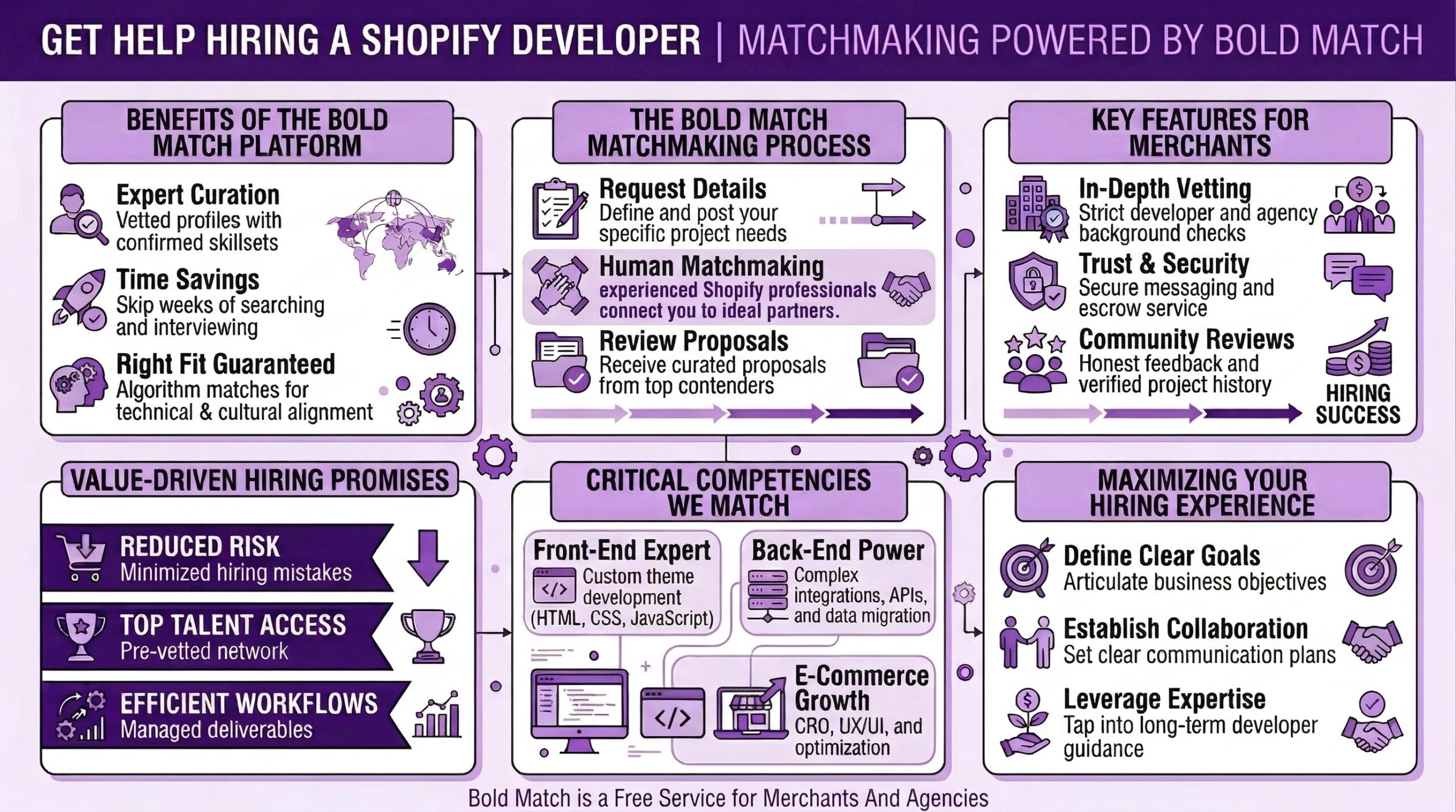
The Shopify’s Certified Service Partner Directory is a solid starting point. You can filter by service type, location, and budget. But finding the right developer or agency for your specific situation takes more than browsing a directory. That’s actually why Bold Match exists. This is all a 💯FREE matchmaking service that connects online merchants and e-commerce retailers with vetted Shopify Partner Agencies we can actually vouch for based on your store’s actual needs, budget, and goals. No commissions. No upsells. Just the right match. Alright, I gotta go do this exceptionally complex dev thing. But seriously, if you’ve got questions about what your store needs, please do reach out.
Breakdown Of The e-Commerce Development Services Shopify Developers Provide
|
Service Category |
What It Involves |
Who Needs It |
Typical Investment Range |
|
Theme Customization |
Modifying existing Shopify themes using Liquid, HTML, CSS, and JavaScript. Custom sections, responsive adjustments, branded design implementation. |
Store owners who’ve outgrown their theme’s default options and need a distinct storefront experience. |
$500 – $5,000 |
|
Custom Theme Development |
Building a theme from scratch to meet specific brand and functional requirements. Full creative control over layout, UX, and performance. |
Established retailers whose brand and conversion goals demand a fully tailored storefront. |
$5,000 – $30,000 |
|
Custom App Development |
Creating private or custom Shopify apps using REST and GraphQL APIs. Automates workflows, adds unique functionality, and connects store logic to business processes. |
Merchants who can’t find an off-the-shelf app that solves their specific problem. |
$2,000 – $20,000+ |
|
Shopify Plus Development |
Enterprise-level builds leveraging checkout extensibility, Shopify Functions, Flow automations, B2B pricing, and advanced storefront architecture. |
Mid-market and enterprise merchants on Shopify Plus who need performance and scalability beyond standard plans. |
$15,000 – $120,000+ |
|
Headless Commerce (Hydrogen/Oxygen) |
Decoupling the storefront from Shopify’s backend using React-based Hydrogen framework. Enables ultra-fast, fully custom front-end experiences. |
High-growth brands prioritizing page speed, omnichannel presence, and fully custom UI/UX. |
$60,000 – $200,000+ |
|
Platform Migration |
Moving store data, products, customers, order history, and SEO structure from another platform (WooCommerce, Magento, BigCommerce, etc.) to Shopify. |
Retailers switching to Shopify who need a clean transition without losing search rankings or customer data. |
$3,000 – $30,000+ |
|
Third-Party Integrations |
Connecting Shopify to ERPs, CRMs, email platforms, shipping providers, accounting software, and other business systems via APIs and webhooks. |
Any merchant whose store needs to communicate with external business tools and systems. |
$500 – $8,000+ per integration |
|
Performance Optimization |
Improving page load speeds through asset optimization, code splitting, lazy loading, app audit, and render-blocking resource management. |
Store owners experiencing slow load times, high bounce rates, or declining search rankings. |
$1,000 – $5,000 |
|
SEO and Structured Data |
Implementing technical SEO best practices including schema markup, meta optimization, URL architecture, and site structure improvements. |
Merchants looking to improve organic search visibility and AI/GEO discoverability. |
$1,000 – $5,000 |
|
Ongoing Maintenance and Retainer |
Regular updates, bug fixes, security patches, theme updates, app compatibility checks, and incremental improvements. |
Any store owner who wants consistent technical support without scrambling when something breaks. |
$150 – $1,500/month |
Frequently Asked Questions (FAQ)
What is a Shopify developer?Shopify developers are specialized professionals who build, customize, and maintain online stores on the Shopify platform using code. This includes working with Liquid (Shopify’s templating language), HTML, CSS, JavaScript, and APIs. They handle everything from theme customization and custom app development to platform migrations, performance optimization, and enterprise Shopify Plus implementations
What is the difference between a Shopify developer and a Shopify Expert?
“Shopify Expert” was originally a title for professionals vetted and listed in Shopify’s Experts Marketplace, which was discontinued in December 2023. A Shopify developer is a specific role focused on code-level work. The term “expert” now gets used more broadly to refer to freelance designers, marketers, consultants, and developers alike. Not all Shopify experts write code, but all Shopify developers have technical e-commerce web development skills.
How much does it cost to hire a Shopify developer?
In North America, experienced freelance Shopify developers usually charge between $75 and $150 per hour. Senior Shopify Plus specialists and agency teams range from $125 to $250 per hour. Project-based pricing varies from $500 for basic theme customizations to over $100,000 for complex enterprise builds. Offshore developers in South Asia and Eastern Europe can range from $15 to $70 per hour.
Do I need a Shopify developer or can I build my store myself?
Honestly it depends. Shopify’s admin panel and theme editor handle basic setup and customization without code. Many merchants launch and run successful stores on their own. However, you’ll usually need a developer when your store requires functionality beyond what the admin or app store provides, when performance issues affect conversions, when you’re migrating from another platform, or when you’re scaling to Shopify Plus.
What is the difference between a Shopify developer and a Shopify agency?
Well. Shopify developers are individuals who write code for Shopify stores. A Shopify agency is a certified service partner that provides a team of professionals, usually including developers, designers, strategists, and project managers, working together on your project. Agencies offer broader service coverage and structured project management but usually cost more than individual freelancers.
What programming languages do Shopify developers use?
Shopify developers work primarily with Liquid (Shopify’s proprietary templating language), HTML, CSS, and JavaScript. For custom app development, they use Shopify’s REST and GraphQL APIs. Headless commerce projects use React through Shopify’s Hydrogen framework. Back-end work may involve Node.js, Ruby, Python, or PHP depending on the integration requirements.
How long does it take a Shopify developer to build a store?
Timelines vary significantly based on complexity. A basic theme customization might take one to two weeks. A full custom store build usually runs four to twelve weeks. Complex Shopify Plus implementations with custom apps, integrations, and headless architecture can take three to six months or longer. Migrations from other platforms usually add two to six weeks depending on the amount of data and the SEO preservation requirements.
What should I look for when hiring a Shopify developer?
Well. Other than the Bold Match seal of approval you’ll want to look for demonstrated experience with Shopify specifically, not just general web development. Review their portfolio for stores similar in complexity to what you need. Check whether they have experience with your plan tier, particularly if you’re on Shopify Plus. Ask about their process for communication, timelines, and post-launch support. And make sure they understand your business goals, not just your technical requirements. A good developer asks about your customers, not just your codebase.