
Just How Much Does It Cost to Hire a Shopify Expert or Partner Agency?
Written and edited by: Jay
How goes all gang? Hope everyone’s staying warm out there. 🥶
That’s right. It’s me Jay Myers, so go subscribe to Shopify1Percent then come back quickly so we can get something suspiciously simple straight. Back? Ready? Ok. The honest and correct answer to the question that brought us here today “how much does a Shopify Expert cost?” is the same answer you’ll get for almost every important question related to operating an e-commerce brand and probably also living a life generally. Which is to say … It really does depend.
Happily unlike other “it really does depend” answers you’ve encountered, today, I’m actually gonna try and break down what it really depends on. You see, I’ve written enough RFPs and resulting project budgets, and seen enough invoices to try to really be helpful here.
Two Expert Cost Questions You Have to Ask
Before you start Googling rates, you have to answer two questions that’ll determine whether you’ll be spending $5,000 or $50,000 …
Question one. Do you need a specialist to fix a problem, or do you need a specialist to think strategically about your store?
Question two. Do you know exactly what you want developed, designed or promoted, or do you need help figuring that out?
The two answers will determine whether you need a freelance Shopify expert or a certified service partner agency that specializes in a tangible something like custom app integration or conversion rate optimization or an audit, research and ideation consultant or firm.
Freelance Shopify Experts vs. Partner Agencies
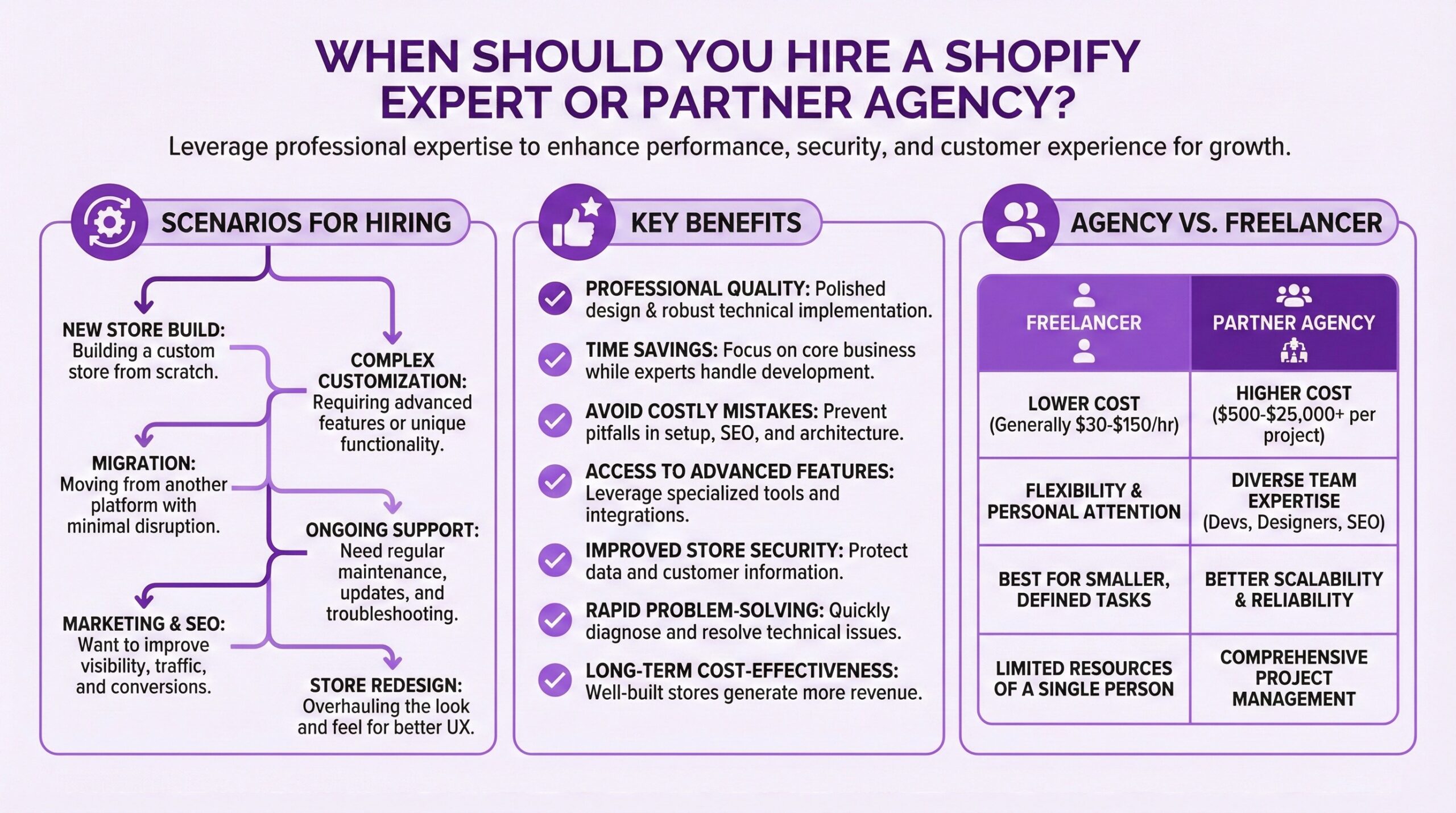
Here’s the short version. Freelance experts are specialized specialists. They show up, fix the specific thing, and leave. Your checkout button disappeared? Your shipping rates aren’t calculating correctly? A solo expert can usually handle that for a few hundred dollars. Sometimes less. Partner agencies are different beasts. They’ve got the strategist who figures out why your conversion rate is terrible, designers who can reimagine your customer journey, front end and back end developers who can actually build it, and the project manager who makes sure they’ll all deliver it on time. You pay for the infrastructure, the accountability, and the combined expertise.
Neither equals better. Both equal match the solution to the problem.
What Freelance Shopify Experts Actually Charge
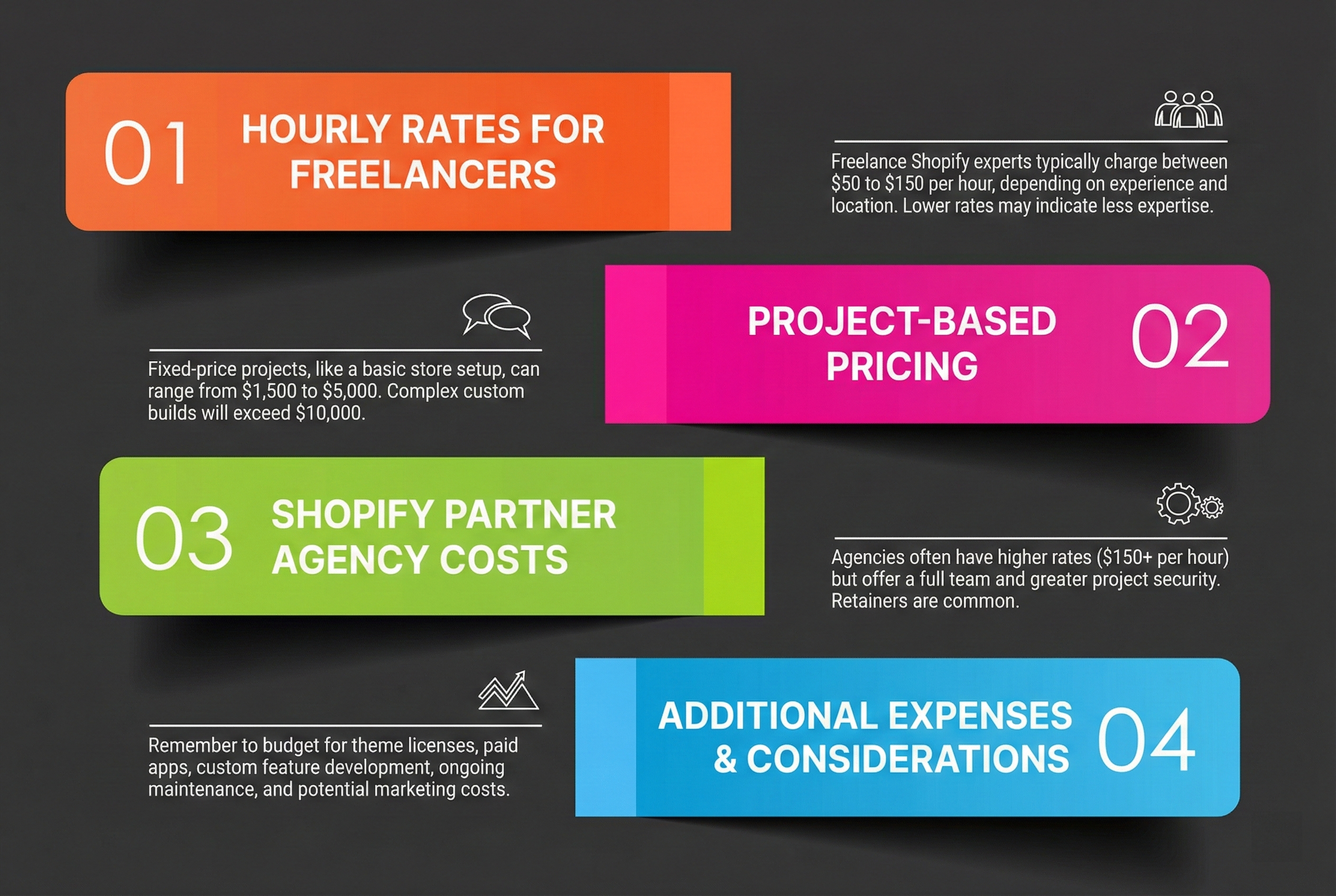
Solo specialist and consultant rates vary wildly for a variety of reasons, but here’s what the market actually looks like right now.
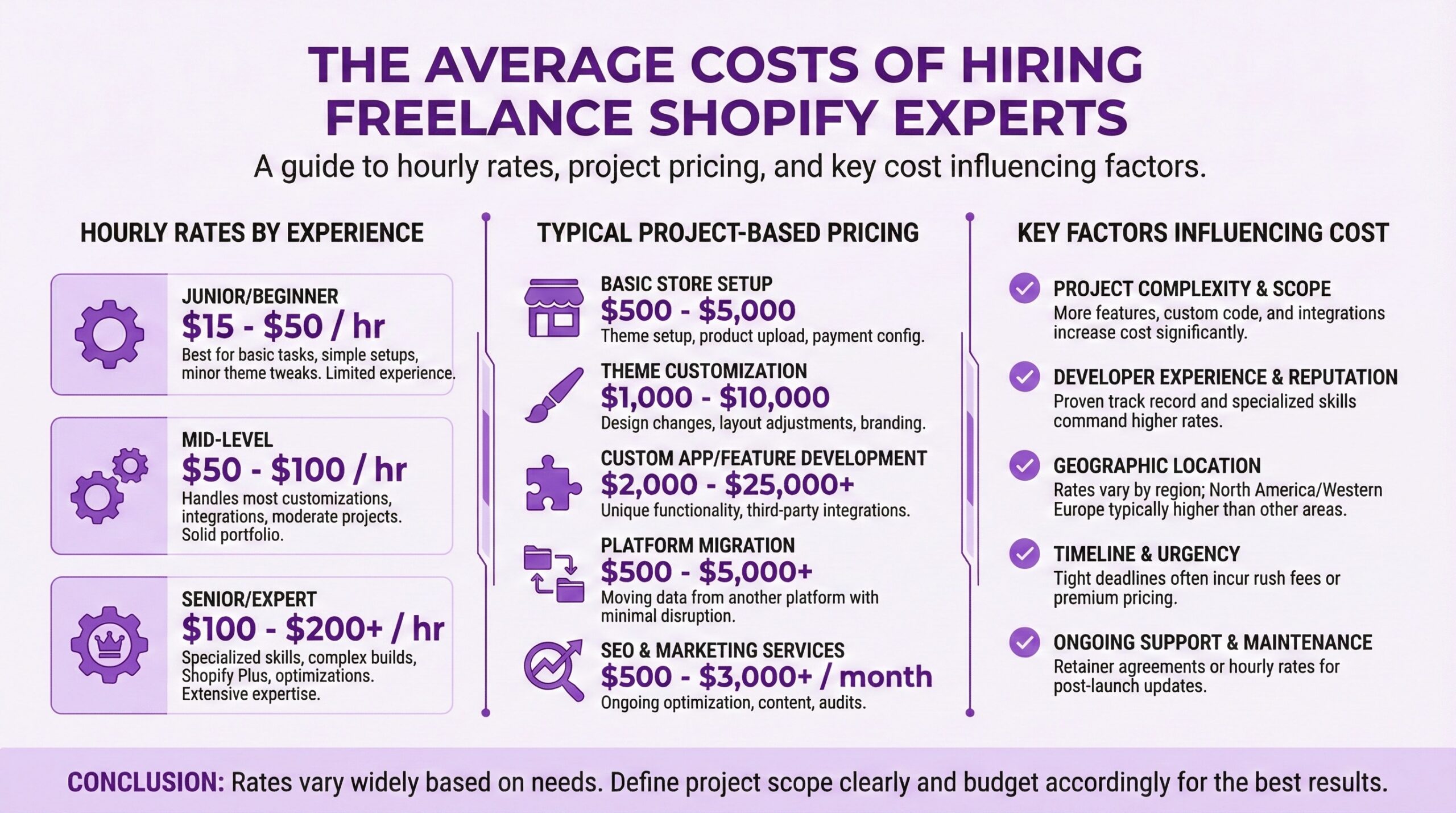
Entry-level freelancers charge roughly $15 to $35 per hour. These are usually developers with solid technical skills but limited Shopify-specific experience. They can handle basic theme tweaks and simple customizations. The risk here is that Shopify has quirks. Someone who’s great at general web development might not know that Liquid templating has its own logic, or that Dawn themes behave differently than vintage themes.
Mid-level experts run about $50 to $100 per hour. This is the sweet spot for most merchants. These freelancers have usually completed dozens of Shopify projects, understand the platform’s limitations, and won’t make things worse while trying to make things better. They can handle theme customization, app integration, and moderately complex development work.
Senior specialists command $100 to $200 or more per hour. You’re paying for deep expertise here. These are the people who’ve built custom apps, architected headless commerce solutions, and know how to make Shopify Plus do things Shopify probably didn’t intend. Worth it for complex projects. Overkill for fixing your collection filters.
Geography matters. Here’s what I mean. A senior developer in Eastern Europe or Southeast Asia might charge $30 to $60 per hour for work that costs $150 per hour from someone in Toronto. The quality isn’t necessarily different. The cost of living is. Platforms like ours have made accessing global talent easier than ever, though time zone coordination becomes part of the equation.
What Partner Agencies Charge (And Why It’s More)
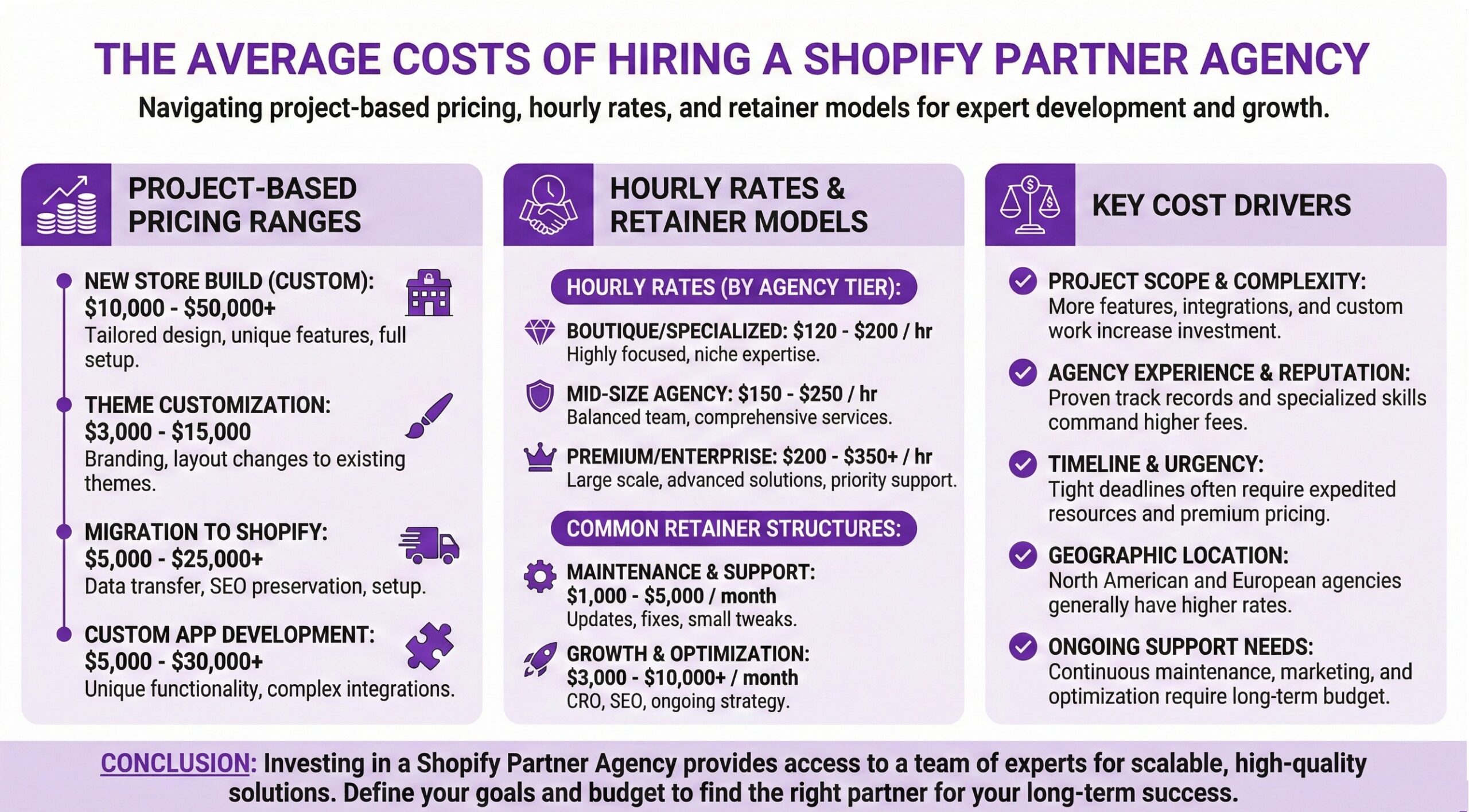
Partner agency pricing is based on different logic. You’re not paying for hours. You’re paying for outcomes, accountability, and access to a team. Here’s what the market looks like currently, broken down by Shopify’s Certified Service Partner tiers.
Select Partner agencies work with small and growing businesses. These are usually smaller shops with focused expertise. Project minimums often start around $5,000 to $15,000 for a full store build. Retainers for ongoing support typically run $1,000 to $3,000 monthly. You’ll be getting solid work from a Select Agency that has demonstrated competence to Shopify.
Plus Partner agencies handle medium to large merchants with more complex needs. They can do ERP integrations, advanced customizations, and multi-market rollouts. Project fees range from $15,000 to $75,000 for comprehensive builds. Monthly retainers sit between $3,000 and $10,000. Shopify Plus Agencies have deeper resources and proven track records with growing brands.
Premier Partner agencies serve enterprise clients with serious budgets and complex requirements. We’re talking $40,000 to $200,000 or more for major projects. Some Shopify Premier Agencies have project minimums north of $50,000. Monthly retainers often exceed $10,000. But you’re getting strategic consulting alongside execution, plus dedicated account management and priority support from Shopify itself.
Platinum Partners are the rarest of rare tiers. Only fourteen agencies worldwide carry this designation. They handle global enterprise deployments for the kinds of brands that you’ve definitely heard of. So. If you’re reading my little article about normal Shopify expert costs and you need a Platinum Partner Agency’s services, thanks for stopping by and congratulations.
Project-Based Pricing for Common Work
Hourly rates and retainers are one thing. But most Shopify merchants need specific work done. Here’s what that work actually costs across the market currently.
Theme installation and basic setup runs $300 to $1,500 depending on complexity. A freelancer can handle a straightforward setup in a day or two. Add configuration, navigation setup, and basic product uploads and you’re at the higher end.
Theme customization and modifications typically costs $500 to $5,000. Minor tweaks to colors, fonts, and layouts sit at the low end. Significant structural changes, custom sections, and advanced functionality push toward the higher range.
Custom theme development from scratch ranges from $5,000 to $30,000 for freelancers and $15,000 to $60,000 or more through agencies. This is when you need something the existing themes can’t deliver. The price depends on page count, feature complexity, and whether you need conversion optimization baked into the design.
Custom App integration and configuration typically runs $500 to $3,000 per integration. Simple app installations take an hour. Complex integrations with your ERP, CRM, or fulfillment systems take weeks and require custom API work.
Shopify Plus checkout customization costs $3,000 to $15,000 depending on scope. Plus merchants get access to checkout extensibility that standard merchants don’t. Building custom checkout experiences requires specialized knowledge.
Platform migrations range from $2,500 to $25,000 depending on your current platform, catalog size, and data complexity. Moving from a WooCommerce Shop with 250 products is different from migrating from a Magento (Adobe Commerce) store with 20,000 SKUs, customer accounts, and order history.
Full store builds run $1,500 to $10,000 for basic freelancer-built stores, $10,000 to $50,000 for agency-built professional stores, and $50,000 to $200,000 or more for enterprise Shopify Plus implementations with custom functionality.
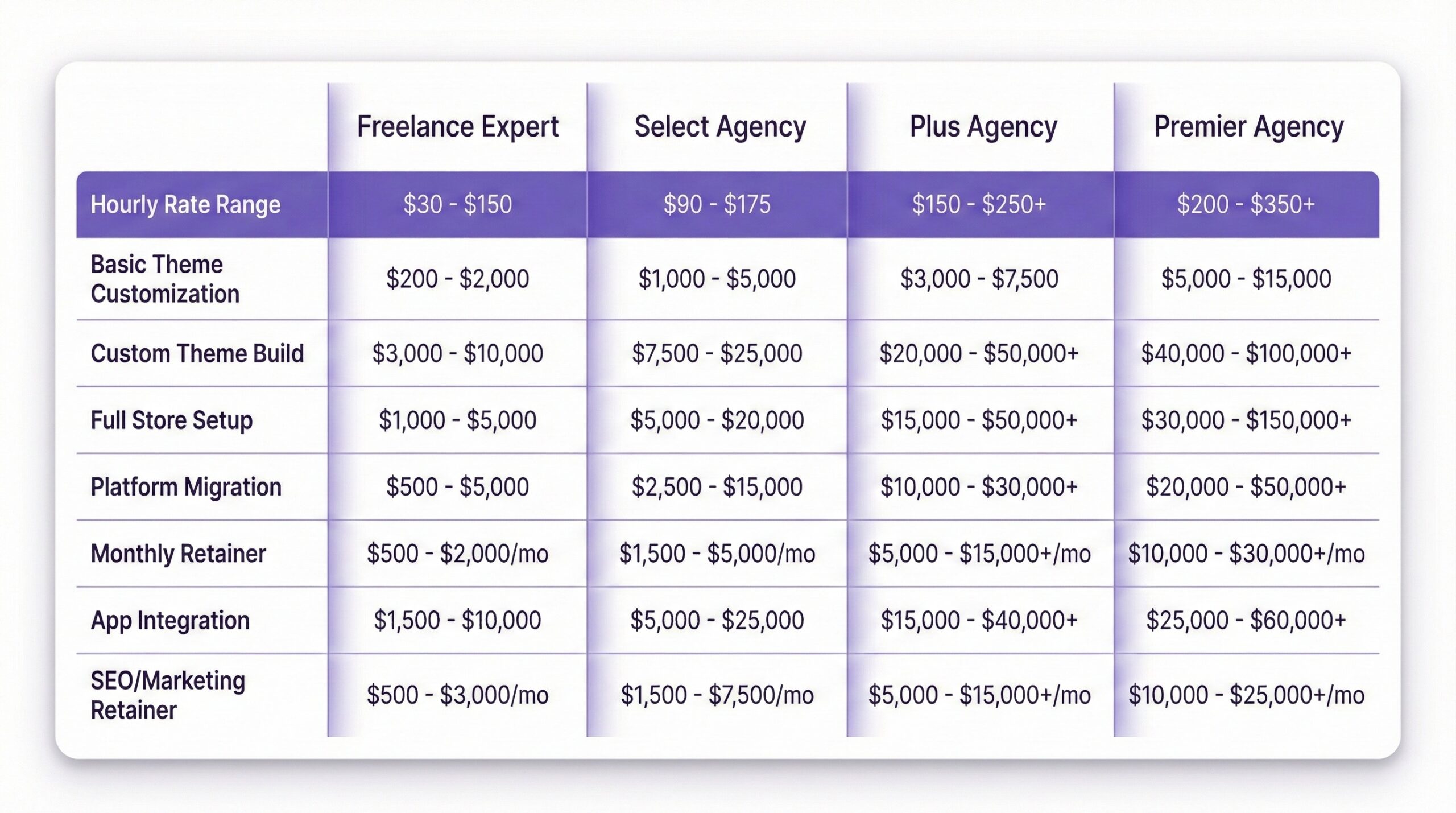
The Pricing Comparison You Came Looking For
These ranges are wide because store situations vary widely and every project is different. A “custom theme build” for a store with three product types is not the same as one for a brand with subscription options, B2B wholesale pricing, and multi-currency support.
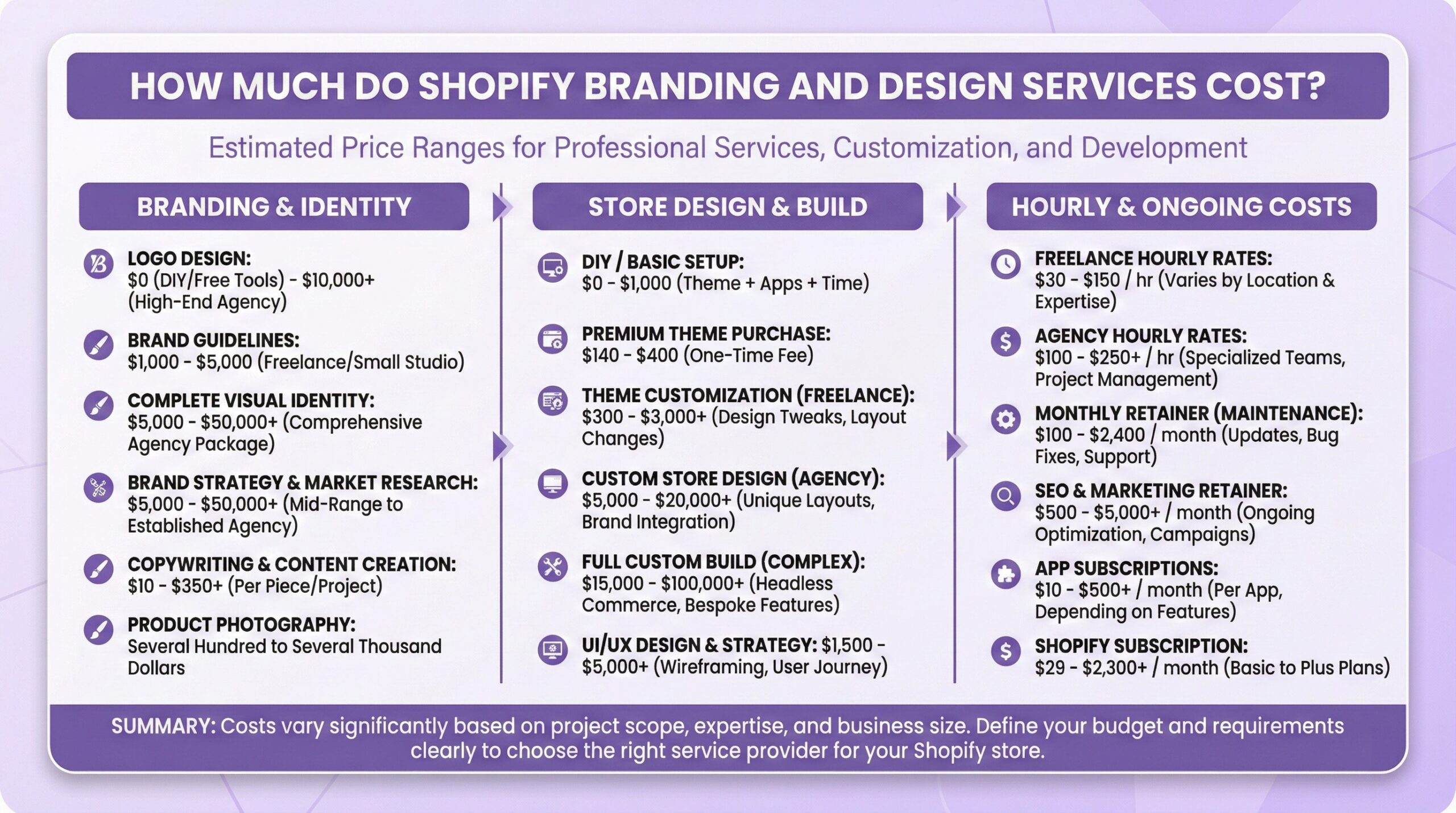
Digital Marketing and Shopify SEO Services Pricing
If it were October I jump out from behind something or at least put a comic “BOO!” before this next bit. But Web Development isn’t the only expense. Most growing Shopify merchants eventually need help with marketing, and that’s its own category of investment.
Email marketing setup and management varies widely depending on platform and scope. If you’re using Klaviyo or Ominisend, expect the platform itself to cost $20 to $720 per month depending on your list size. A 10,000-contact list runs roughly $150 monthly. But the platform is just the software. Getting your email program actually working? That’s where agencies come in. Klaviyo-focused agencies usually charge $1,500 to $5,000 monthly for full-service email management.
That includes performance strategy, workflow building, campaign creation, segmentation, and reporting. Some agencies work on performance-based models, taking a percentage of attributed revenue. Others charge flat retainers. Setup projects for merchants who want to manage email themselves typically run $2,000 to $8,000 for the initial build and flow configuration.
SEO retainers for e-commerce merchants usually start around $1,000 monthly and climb from there. Small to mid-sized Shopify stores typically pay $1,500 to $5,000 per month for ongoing SEO or GEO (aka Search Optimization but for AI) work. That covers technical audits, keyword optimization, content strategy, and link building. Larger catalogs with thousands of products require more resources. Enterprise SEO retainers can exceed $15,000 monthly.
One-time Search Optimization projects like site audits run $500 to $2,500. Initial SEO setup for a new store costs $1,000 to $3,000. Migration-specific SEO work (preserving rankings when you replatform) adds $2,000 to $10,000 depending on the complexity of your URL structure and redirect requirements.
Paid advertising management follows a similar pattern. Most agencies charge either a flat monthly fee or a percentage of ad spend. Flat fees for Meta and Google advertising typically range from $1,000 to $5,000 monthly for small to mid-sized accounts. Percentage-of-spend models usually run 10% to 20% of your monthly ad budget. Some agencies use hybrid models with a base fee plus a smaller percentage.
Conversion rate optimization programs are becoming more common as customer acquisition costs climb. CRO retainers typically run $2,000 to $8,000 monthly, covering A/B testing, user research, and iterative improvements to your site experience. These programs usually require three to six month commitments to generate meaningful data.
The takeaway here is that marketing costs often exceed development costs over time. A $15,000 store build is a one-time expense. A $3,000 monthly marketing retainer is $36,000 annually. Plan accordingly.
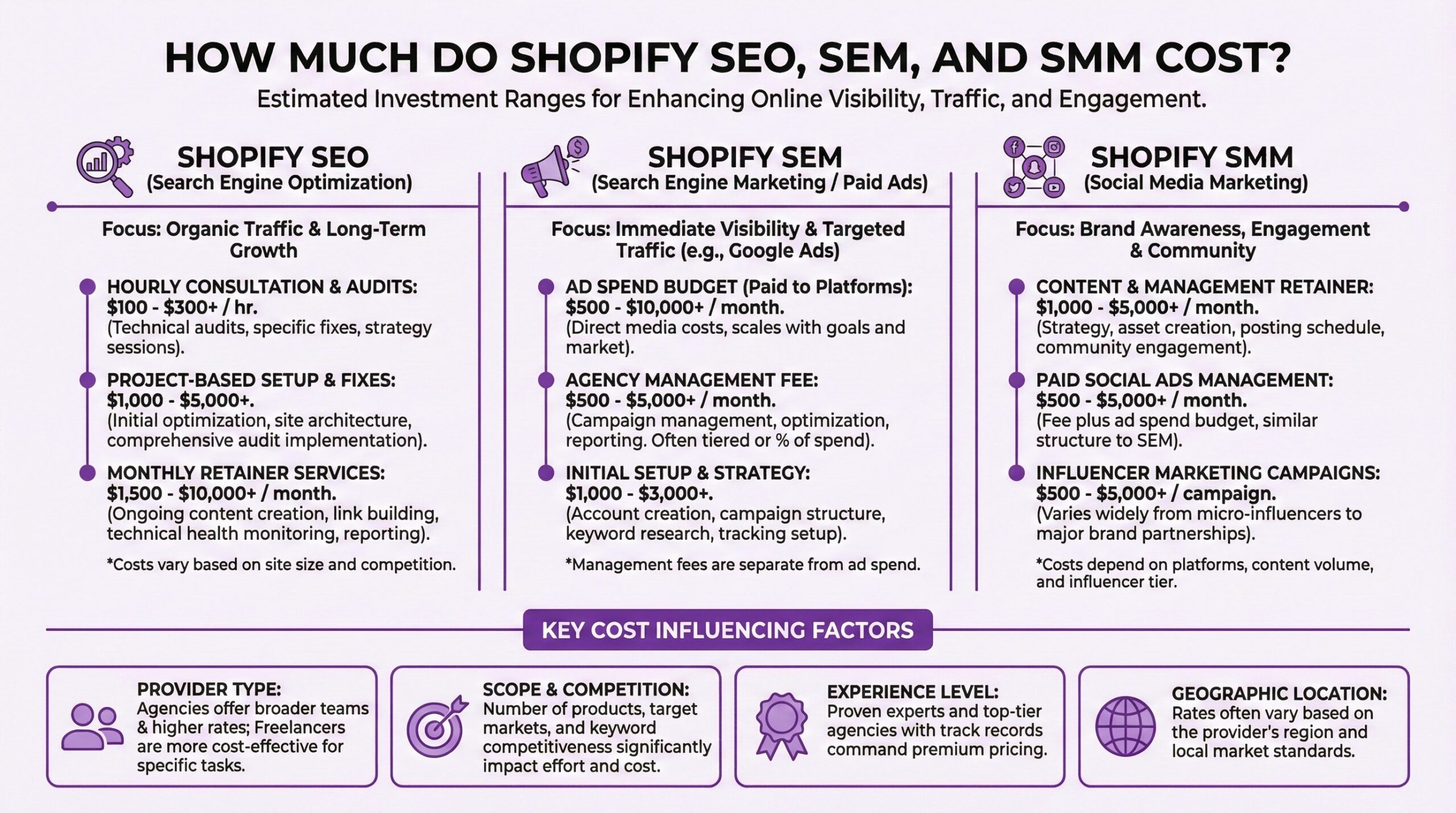
Branding and Shopify Site Design Services Pricing
Here’s where store owners too often under budget. They allocate funds for development, maybe some marketing, and then wonder why their beautiful new store still looks generic. Web design is its own discipline, separate from development and it costs real money.
Brand identity work happens before anyone touches Shopify. This includes your logo, color palette, typography system, and brand guidelines. A freelance designer might charge $500 to $2,000 for logo design alone. Agencies offering complete brand identity packages run $2,500 to $15,000 for small to mid-sized businesses. That typically includes primary and secondary logos, color systems, font selections, and a style guide documenting how everything works together.
If you’re rebranding or building a brand from scratch, budget accordingly. Trying to do this work after your store is built means retrofitting, and retrofitting always costs more.
UX and UI design as standalone services run $1,500 to $10,000 depending on scope. This is the strategic work of mapping customer journeys, wireframing page layouts, and designing interfaces before any code gets written. Some agencies bundle this into their development process. Others charge separately. The distinction matters because UX design done well reduces development costs. Figuring out navigation problems in a wireframe is cheaper than fixing them in production code.
Conversion-focused design audits, where an expert reviews your existing store and recommends improvements, typically cost $500 to $2,500. These can deliver significant ROI if your store has obvious friction points driving customers away.
Product photography is the expense that surprises everyone. White background product shots run $20 to $50 per image at volume from studios that specialize in e-commerce. Lifestyle photography with props, models, or environmental setups costs $100 to $300 per final image. A full day commercial shoot with a professional photographer runs $500 to $3,000 depending on complexity.
For a store with 50 products, each needing four to six images, you’re looking at 200 to 300 photos minimum. At $25 per image, that’s $5,000 to $7,500 just for basic product photography. Lifestyle images for hero banners, collection pages, and marketing campaigns add more. AI-generated product imagery is dropping these costs significantly, but most brands still need some real photography as the foundation.
Ongoing creative retainers for promotional graphics, seasonal campaigns, email designs, and social content typically run $1,000 to $5,000 monthly depending on volume. Smaller brands might work project-by-project, paying $200 to $1,000 per campaign’s worth of assets. Larger operations need consistent creative support and budget accordingly.
Remember, great design makes average development look polished, while poor design makes excellent development look cheap. Budget for design early, not as an afterthought.
What Drives Certified Service Partner Prices Up?
Understanding the cost drivers helps you budget accurately and avoid sticker shock.
Scope ambiguity kills budgets. The phrase “make our store better” will cost more than “increase mobile conversion on product pages.” When you can’t articulate what success looks like, you’re paying someone to figure it out for you. That’s consulting work. It costs more.
Custom code costs more than configuration. If an existing app can solve your problem for $30 per month, that’s cheaper than paying $3,000 for custom development. But sometimes the app doesn’t exist or doesn’t do exactly what you need. Custom code is the answer. Just know you’re paying for it.
Tight timelines carry premiums. Need a site launched before Black Friday? That urgency costs money. Developers and agencies prioritize based on profitability. Rush jobs pay more.
Revision rounds add up fast. Agencies usually scope a specific number of revision cycles into project quotes. When you blow past those cycles because stakeholders keep changing their minds, the invoices follow.
Legacy platforms complicate migrations. Moving from Magento 1 with heavily customized functionality isn’t the same as importing products from a Wix store. Data mapping, URL redirects, customer account migration, and order history preservation all take time.
Some Hidden Costs You Need to Be Wary Of
The proposal you receive rarely includes everything you’ll spend.
Ongoing app subscriptions add up. The average Shopify store runs five to ten paid apps. At $20 to $100 each per month, that’s $100 to $1,000 in monthly recurring costs on top of your Shopify subscription.
Training and documentation usually cost extra. Getting your team comfortable with a new theme or custom functionality takes time. Some agencies include training. Many don’t.
Post-launch support isn’t always included. The project is “done” but three weeks later something breaks. Are you covered? Read the contract carefully.
Premium themes cost money. The Shopify theme store has free options, but premium themes run $150 to $400. If your agency recommends a paid theme as your foundation, that’s an additional cost.
Shopify Plus itself isn’t cheap. The platform costs $2,300 per month on a three-year contract, or $2,500 monthly on shorter terms. Add variable fees of 0.3% to 0.4% of revenue above certain thresholds. For brands doing significant volume, that’s real money.
How to Get Better Prices from Partners
Here are a few strategies that you can try.
Start with a smaller project. Don’t hand a $50,000 build to an agency you’ve never worked with. Start with a $5,000 project. See how they communicate, deliver, and handle problems. Then scale up.
Get multiple proposals. Three quotes minimum for significant projects. You’ll learn what’s reasonable and what’s inflated. The variance between agencies bidding on identical scopes can be 3x or more.
Provide clear documentation. The more precisely you define what you need, the more accurate quotes become. Vague requirements get padded with contingency budgets.
Consider offshore strategically. For pure development work with clear specifications, offshore talent can deliver excellent results at lower rates. For strategy, design direction, or ongoing partnership, proximity and timezone overlap matter more.
Ask about retainer discounts. Agencies often discount monthly retainer rates for longer commitments. A 12-month commitment might get you 15% to 20% off versus month-to-month pricing.
When to Hire Which Expert or Shopify Agency
Your decision will never be “simple” but let me try and help simplify it.
Hire a freelance expert when you have a specific, defined problem that someone with Shopify skills can solve. A broken feature. A theme customization. An app configuration. You know what’s wrong and you need hands to fix it.
Hire a Select-tier agency when you need a complete store build or redesign and you have a budget under $20,000. These agencies serve growing merchants well and won’t overengineer solutions beyond what you actually need.
Hire a Plus-tier agency when you’re doing over $1 million annually, have complex technical requirements, or need ongoing strategic partnership alongside execution. The higher rates reflect deeper expertise and better project management.
Hire a Premier-tier agency when you’re a serious enterprise brand requiring global commerce solutions, advanced B2B capabilities, or highly custom functionality. If your annual Shopify spend exceeds $100,000, Premier agencies start making economic sense.
Taking Advantage of Bold Match’s Approach
I co-founded Bold Match specifically because this whole process is harder than it should be. Most merchants don’t know what tier of agency they need. They don’t know which agencies specialize in their specific challenges. They waste weeks sending the same project brief to Shopify agencies that aren’t actually good fits then struggle to compare proposals that aren’t structured the same way.
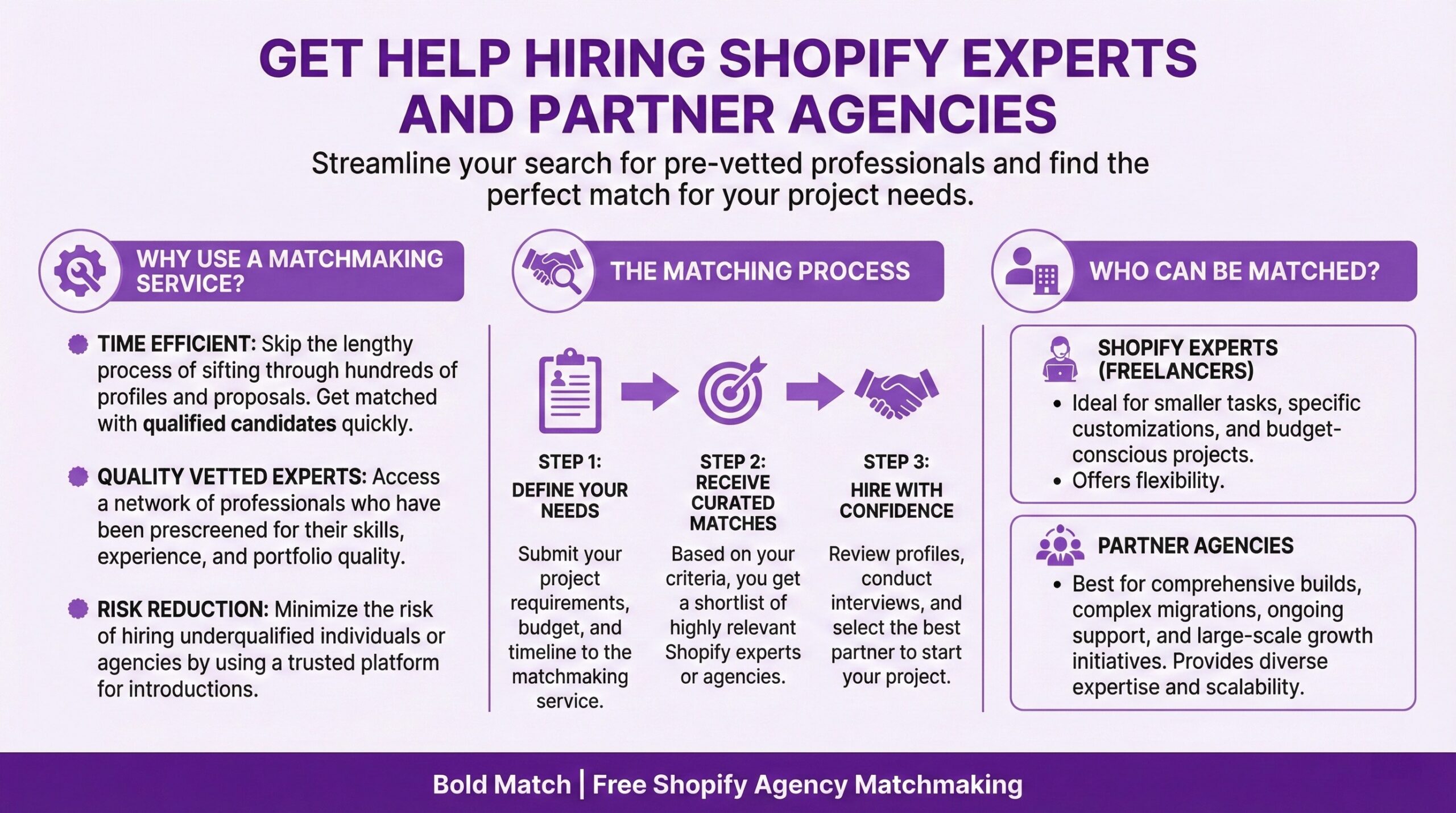
We connect growing merchants with vetted agency partners at no cost to the merchant. We don’t take commissions from agencies. We don’t mark up project fees. Our matchmakers evaluate your needs, your budget, and your timeline, then introduce you to two or three agencies who actually fit. The matching process saves you the weeks of research and outreach you’d otherwise spend. More importantly, it gets you to partner agencies who want your specific type of project rather than agencies who’ll take anything that pays.
Finding Shopify Experts or Partner Agencies
So how much does it cost to hire a Shopify Expert or a “Certified Service” Partner Agency? Well …
For a freelancer to fix something specific. Probably $300 to $2,000.
For an agency to build or rebuild your store properly. Somewhere between $10,000 and $75,000 for most growing merchants. More if you’re enterprise scale. Less if your needs are truly simple.
For ongoing support and optimization. Budget $1,000 to $5,000 monthly depending on the level of service.
The range is wide simply because the work varies widely. I mean. An e-commerce retailer doing $50,000 monthly and a merchant doing $5 million monthly have completely different needs even when they both need “Custom Shopify Theme Development” so the best investment you can make up front is figuring out exactly what you need before you start requesting quotes. That clarity saves money, accelerates timelines and leads to better outcomes. If you’re not sure what you need, that’s where a FREE 👈Shopify Agency concierge service like Bold Match comes in. You can get someone who understands the ecosystem help you figure it out before you start spending.
What Are The Average Costs of Hiring Shopify Experts vs Partner Agency Tiers?
|
Service Type |
Freelance Expert |
Select Agency |
Plus Agency |
Premier Agency |
|
Hourly Rate Range |
$25-$150/hr |
$75-$150/hr |
$100-$200/hr |
$150-$300/hr |
|
Basic Theme Customization |
$300-$1,500 |
$1,500-$4,000 |
$3,000-$7,500 |
$5,000-$15,000 |
|
Custom Theme Build |
$5,000-$15,000 |
$10,000-$30,000 |
$25,000-$60,000 |
$40,000-$150,000 |
|
Full Store Setup |
$1,500-$5,000 |
$5,000-$15,000 |
$15,000-$50,000 |
$40,000-$100,000 |
|
Platform Migration |
$2,500-$8,000 |
$5,000-$15,000 |
$10,000-$40,000 |
$25,000-$100,000 |
|
Monthly Retainer |
$500-$2,000 |
$1,000-$3,500 |
$3,500-$10,000 |
$7,500-$25,000 |
|
App Integration (each) |
$300-$1,500 |
$1,000-$3,000 |
$2,000-$5,000 |
$3,000-$10,000 |
|
SEO/Marketing Retainer |
$500-$3,000/mo |
$2,000-$5,000/mo |
$5,000-$15,000/mo |
$10,000-$30,000/mo |
Frequently Asked Questions (FAQ)
How much does it cost to hire a Shopify Expert for a small project?
Well. For straightforward tasks like theme tweaks, broken feature fixes, or basic customizations, freelance Shopify experts usually charge between $300 and $1,500. The price depends on complexity and the expert’s experience level. Simple fixes might take a few hours at $50 to $100 per hour. More involved customizations requiring custom code can push toward the higher end. Platforms like Storetasker offer pre-vetted freelancers who provide upfront pricing, which removes some of the guesswork.
What’s the difference between a Shopify freelancer and a Shopify agency?
Freelancers are individual specialists who handle specific tasks in their areas of expertise. They’re ideal when you know exactly what needs fixing or building. Agencies are teams with multiple specialists including designers, developers, strategists, and project managers. They handle complex projects requiring coordination across disciplines. Freelancers cost less but have limited capacity and scope. Partner agencies cost more but deliver comprehensive solutions with built-in accountability. The right choice depends on your project’s complexity and your internal capabilities.
How much do Shopify Partner agencies charge for a full store build?
Partner Agency pricing varies a lot based on their Shopify Certified Service Partner tier. Select Partners typically charge $5,000 to $15,000 for complete store builds. Plus Partners handling more complex projects range from $15,000 to $50,000. Premier Partners serving enterprise clients often start at $40,000 and can exceed $200,000 for comprehensive implementations with custom functionality. These ranges reflect differences in team size, expertise depth, and the sophistication of deliverables. Getting multiple proposals helps you understand what’s reasonable for your specific requirements.
What does a Shopify Plus Agency cost compared to a Shopify Select Agency?
Shopify Plus agencies, which hold Plus Partner status or higher, typically charge 50% to 100% more than agencies working primarily with standard Shopify stores. Their hourly rates run $100 to $300 compared to $75 to $150 for Select Partners. The premium reflects specialized expertise in Plus features including checkout customization, automation through Shopify Flow, multi-store management, and B2B capabilities. Plus merchants with complex requirements usually find the higher rates justified by faster delivery and fewer revision cycles.
How much should I budget for ongoing Shopify support and maintenance?
Monthly retainer costs range from $500 to $25,000 depending on service level and provider type. Freelancers offering part-time support typically charge $500 to $2,000 monthly. Select agencies run $1,000 to $3,500. Plus agencies range from $3,500 to $10,000. Premier agencies serving enterprise clients often exceed $10,000 monthly. Retainers usually cover a set number of support hours, priority response times, proactive monitoring, and regular optimization work. Determine your expected monthly needs before committing to a retainer tier.
Is it worth paying more for a certified Shopify Partner agency?
Yes! Then yes again. Certified partners have demonstrated competence to Shopify through completed projects, client reviews, and often specialized training. Higher-tier partners also receive priority technical support from Shopify, which benefits you when complex issues arise. However, certification doesn’t guarantee quality. An experienced freelancer might outperform a mediocre certified agency. Certification matters most for complex projects where Shopify’s direct involvement could accelerate problem-solving. For simple projects, a skilled individual expert can deliver excellent results regardless of official partner status.
How can I find a Shopify expert or agency that fits my budget?
Boy are you in the right place to get this question answer. Seriously though. Start by defining your project scope as precisely as possible. Vague requirements generate padded quotes. Get proposals from at least three providers to understand market rates. Consider your project’s complexity honestly. A $3,000 budget won’t get you a custom theme build from a reputable agency, but it might get excellent work from a skilled freelancer. Matchmaking services like Bold Match connect merchants with pre-vetted agencies based on project requirements and budget, eliminating weeks of research and outreach.
What hidden costs should I expect when hiring Shopify help?
Several costs often appear after the initial quote. App subscriptions for functionality your store needs typically add $100 to $1,000 monthly. Premium themes run $150 to $400 if required. Post-launch revisions beyond the contracted rounds cost extra. Training for your team may not be included. Ongoing maintenance and support require separate budgets. Platform migration projects often uncover data cleanup needs mid-project. When comparing proposals, ask specifically what’s excluded and budget a 15% to 20% contingency for scope adjustments.