
The Best Conversion Rate Optimization (CRO) Agency for Your Shopify Brand
Written and edited by: Dirk
Look. I hate to do it, I really do, but I’m about to share one of those numbers that should probably be keeping almost every Shopify merchant reading this up at night, (and for once won’t have anything to do with ad spend). Ready? Here goes. According to a survey of 2,800 stores, the average Shopify conversion rate sits between 1.4% and 1.8%. That means for every hundred people who visit a store, around ninety-eight of them leave without buying anything. They looked at the products, they maybe even add something to their cart, and then just… left. Like guests at a party who showed up, glanced around the room, and quietly slipped out the back door.
Now. If you’ve been pouring cash into paid ads, paid placements, partnerships with vertical influencers, and email campaigns to drive traffic, that 1.4% number should feel like a slow leak in the hull. Because it is one. You’re not short on visitors. You’re short on conversions. And the distance between a 1.4% conversion rate and a 3.2% one (which puts you in the top 20% of Shopify stores) isn’t some impossible leap. Happily. It’s the kind of improvement that competent conversion rate optimization agencies live to deliver.
But “competent” was doing a lot of work in that sentence. The CRO agency landscape’s crowded, expensive, and full of firms making promises that sound precise while remaining conveniently unmeasurable. So before you sign a retainer, you need to understand what conversion rate optimization actually involves, what it should cost, and how to tell the difference between a partner agency that will actually improve your performance, and one that will burn through your dev budget running inconclusive A/B tests for six months.
Why CRO Matters More Than It Did Two Years Ago
The math has just plain shifted. How do I mean? I mean that customer acquisition costs for e-commerce brands rose between 40% and 60% between 2023 and 2025 on average, according to multiple industry analyses. Google Ads CPCs climbed nearly 13% year-over-year last year, with Shopping ads seeing an even steeper increase. Meanwhile, major Chinese platforms like Temu and Shein have collectively poured billions into digital advertising channels, inflating costs across Google and Meta for everyone else in the process.
For a small-to-mid-sized e-commerce retailer, that means every visitor who arrives at your online store costs more to acquire than they did a year ago. And if your site converts at 1.4% while your competitor’s converts at 3%, your competitor is effectively paying half what you pay for every sale. Same traffic, same PPC ad spend, dramatically different outcomes. This is where conversion rate optimization is less of a “nice to have” and more of an economic survival strategy. A store converting at 2% that moves to 3% has just increased revenue by 50% without spending additional dollars on customer acquisition. That’s not marketing theory. That’s arithmetic.
What CRO Agencies Do (and What They Don’t Do)
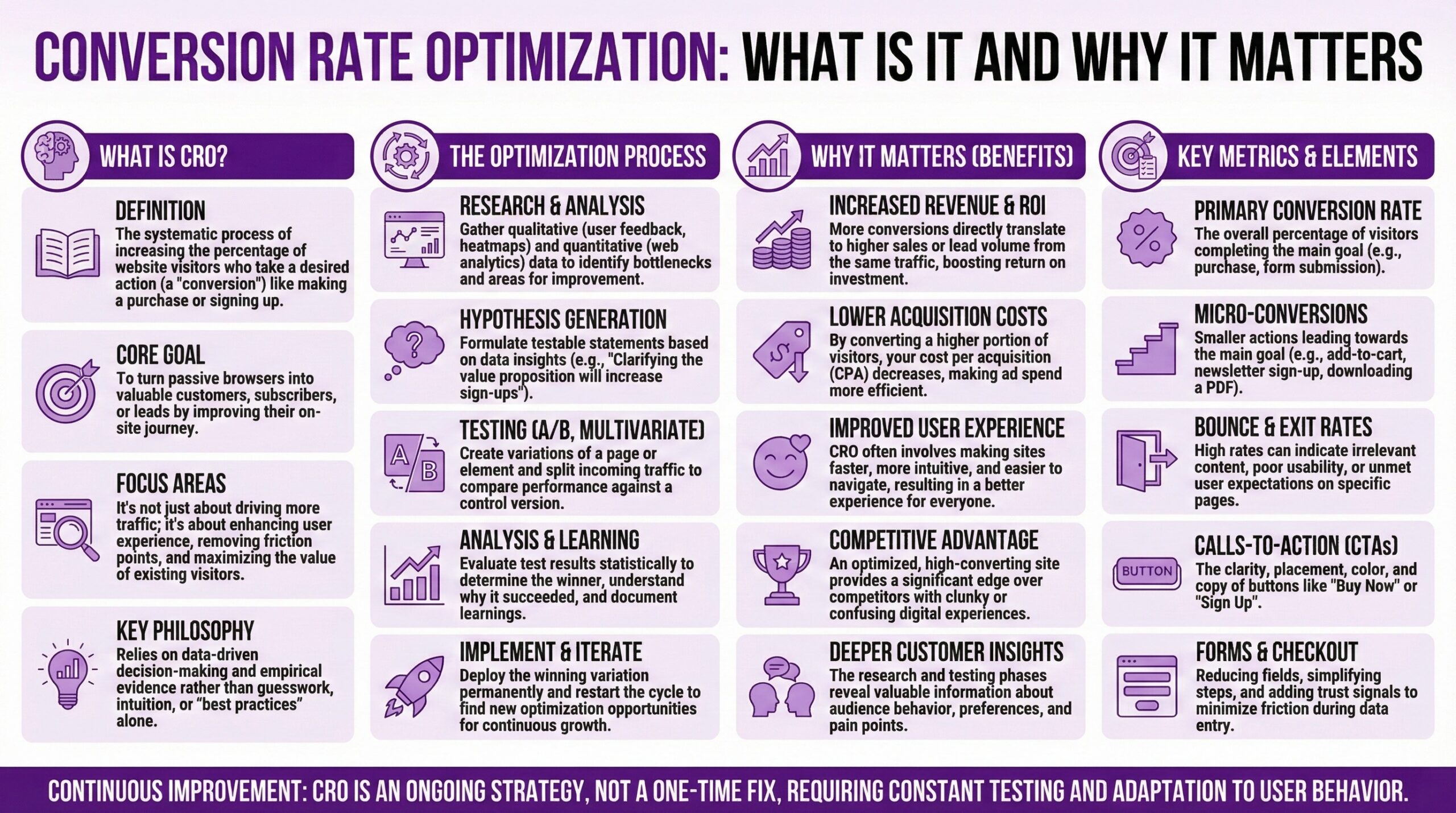
Conversion rate optimization sounds straightforward. Make more visitors buy things. In practice, a legitimate CRO engagement will involve several overlapping disciplines that most store owners just don’t have the time, tools, or statistical training to handle in-house.
Good (or rather competent) conversion rate optimization agencies will usually start with a top to bottom audit of your sales funnel. Where are your store’s shoppers dropping off? Is it at the product photography or customer reviews, in cart, or at checkout? Are mobile consumers bouncing at twice the rate of desktop visitors? (Hint: They probably are. Mobile devices account for roughly 79% of Shopify store traffic but convert at an average of only 1.2%–1.5%, compared to 1.9% to 3.1% on desktop.) The audit phase involves heatmap analysis, session recordings, customer surveys and a deep look at your analytics to identify where the friction lives.
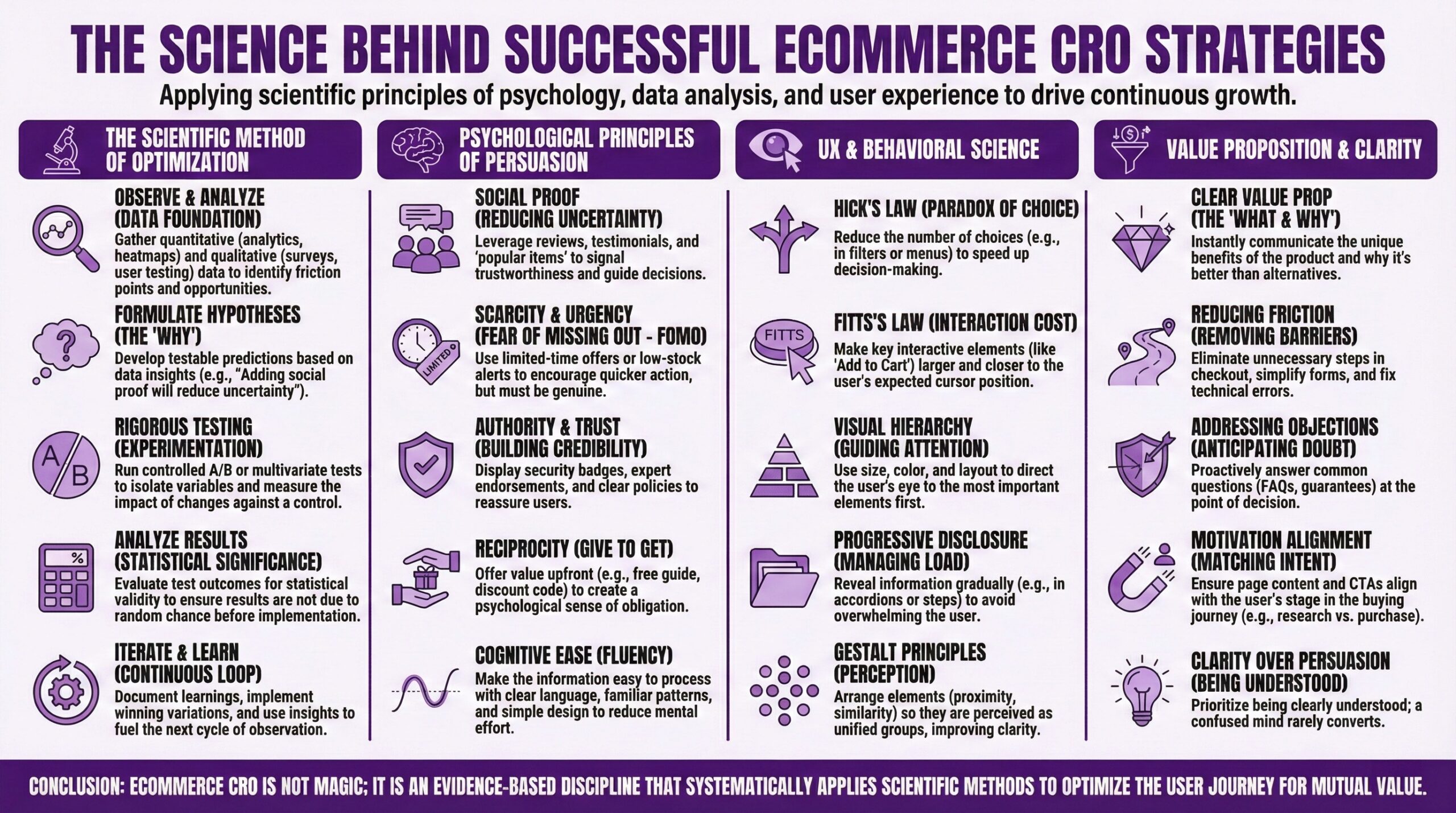
From there, the agency moves into hypothesis development and testing. This is the A/B testing phase that gets all the attention, but the testing itself is only as good as the hypotheses behind it. Randomly changing button colors isn’t CRO. Building a case for why changing the way demonstration videos display or simplifying your checkout from three steps to one might reduce abandonment by 25% (which research supports by the by) and then designing a controlled experiment to prove it… that’s conversion rate optimization.
The best partner agencies also think beyond individual tests. They build what practitioners call a “learning agenda,” essentially a prioritized roadmap of experiments organized by expected impact and ease of implementation. The first experiments on that roadmap are usually the high-impact, lower-effort wins. Checkout friction reduction. Mobile page speed improvements. Trust signal placement. Product copy adjustments that address the most common customer objections. The more nuanced experiments, things like pricing psychology, personalized recommendation strategies, and upsell sequencing, will come later once the foundation is solid.
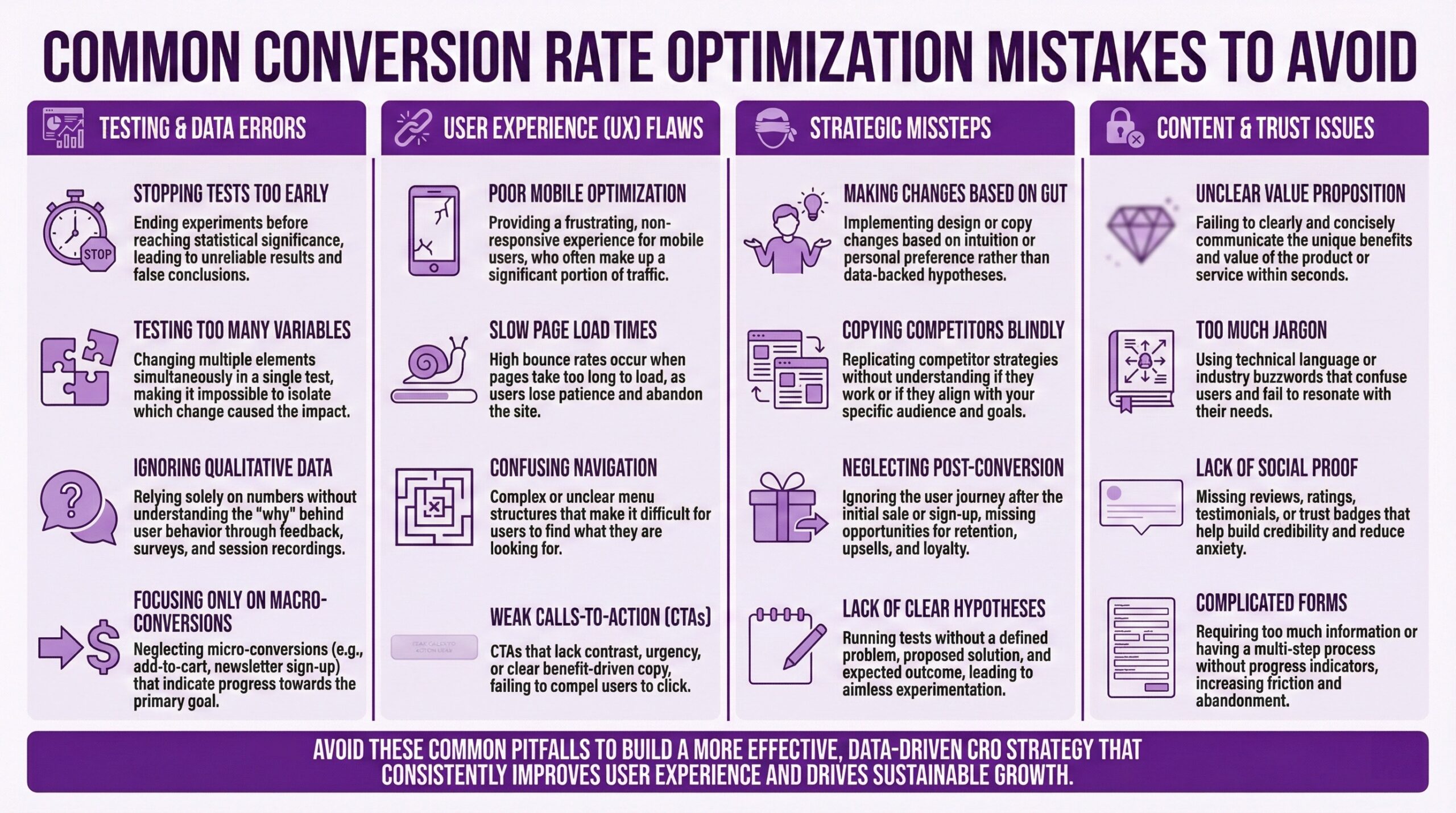
Responsible agencies will also be transparent about what CRO can’t do. It can’t fix a product nobody wants. It can’t compensate for traffic that has zero purchase intent. And it can’t produce statistically significant results overnight if your store doesn’t have enough traffic to turn into dispositive tests. If an agency promises results in weeks for a store with 500 monthly sessions, that’s not confidence. That’s fiction.
CRO Benchmarks You Should Know Before Hiring
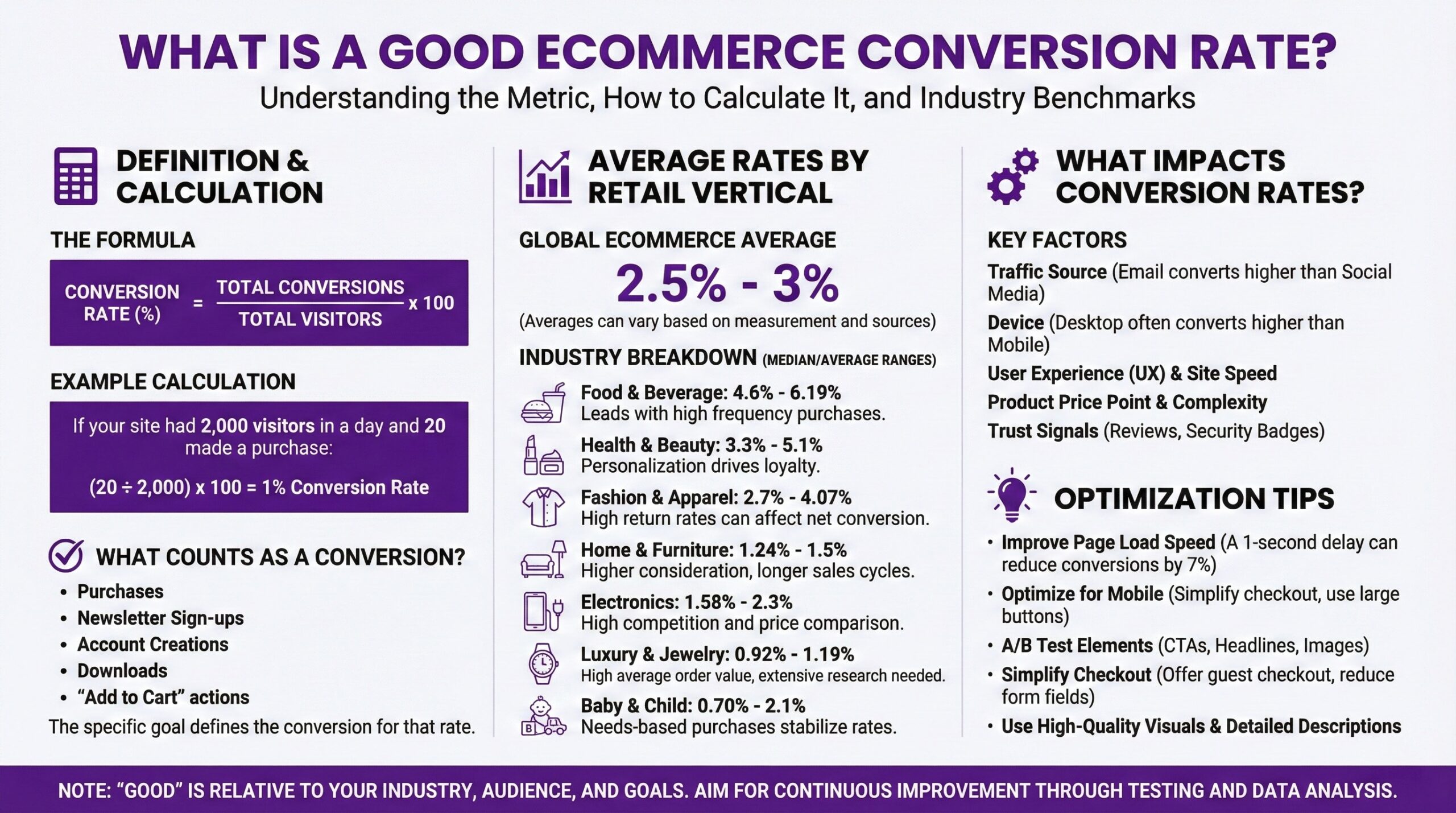
Walking into a conversion rate optimization agency conversation without benchmark knowledge is like negotiating a car purchase without checking market prices. You’ll get talked into things. Here’s what the data tells us about where Shopify stores actually stand. The average Shopify store converts between 1.4% and 1.8% of visitors into buyers. Stores in the top 20% exceed 3.2%. The top 10% clear 4.7%. And that all comes from an analysis of thousands of stores, and is broadly consistent with Shopify’s own numbers.
But those averages obscure a lot of variation. I mean. Health and beauty brands often convert around 3.5%. Electronics retailers hover closer to 1.2%. Fashion falls somewhere in between. Your benchmark isn’t “versus every other Shopify store” It’s as compared to other shops in your specific vertical, your price point, and your traffic mix. And then there are the variances by channel. Like. Organic search traffic converts at roughly 3.6% on average for Shopify stores, which is significantly higher than the platform baseline, because those shoppers tend to arrive with higher purchase intent.
Email marketing can push beyond 5% for engaged subscriber lists. Paid social traffic from Meta and TikTok? Usually somewhere between 0.8% and 1.2%. That gap matters enormously when you’re evaluating what a CRO agency can realistically achieve. If 70% of your traffic comes from paid social campaigns targeting cold audiences, your starting conversion rate reflects that reality, and a responsible agency will factor it into their projections rather than quoting you a generic “we’ll double your conversions” figure.
Mobile versus desktop performance is perhaps the most important thing here. With smartphones generating roughly 78% of global retail site visits (per Statista), the overwhelming majority of your traffic is mobile. And mobile shoppers convert at about half the rate of desktop visitors on Shopify. The average mobile conversion rate hovers around 1.2%, compared to 1.9% on desktop. Some of that gap is structural. People browse on phones and buy on laptops. But some of it comes down to poor mobile experience. Slow load times, clunky checkout flows, buttons sized for desktop cursors rather than thumbs. Any conversion rate optimization expert worth considering should have a specific, articulable strategy for closing that gap. If they can’t explain their mobile optimization approach in concrete terms, they’re not ready to work on your store.
What CRO Agencies Charge and What You Get
Shopify agency pricing varies wildly, which makes it both confusing and instructive. The inconsistency itself tells you something.
For e-commerce brands, monthly retainers usually range from $2,000 to $15,000, depending on the agency’s experience and the complexity of your store. Specialized conversion rate optimization firms with established track records and dedicated teams can run $10,000 to $30,000 per month. Project-based engagements for specific audits or optimization sprints fall between $5,000 and $50,000.
Then. At the lower end of that range ($2,000 to $5,000), you’re usually getting foundational work. Analytics setup, basic heatmap analysis, a handful of A/B tests per month. This tier makes sense for smaller retailers generating under $500K annually who need to get the fundamentals right.
Mid-range engagements ($5,000 to $15,000) usually include dedicated strategists, more sophisticated testing programs, customer research integration, and optimization across multiple funnel stages. This is usually where growing merchants in the $500K to $5M revenue range land.
Finally, there’s the premium tier. Agencies charging $15,000 or more per month are usually running high-velocity testing programs with dedicated teams of strategists, designers, developers, and data analysts. They’re building experimentation cultures, not just running isolated tests.
O’ and the agency’s pricing model probably matters as much as the number. Which I know might sound odd, but hear me out here. You see. Monthly retainers are the most common and usually the most effective for sustained improvement. Performance-based pricing sounds appealing (you only pay for results) but in practice it creates incentive misalignment. Partner agencies on performance deals occasionally chase quick, shallow wins rather than building the kind of systematic strategies that tend to compound over time.
Five Questions to Ask Before Hiring a CRO Agency
The difference between a CRO agency that transforms your business and one that burns through budget producing fancy slide decks usually reveals itself in the discovery conversation. These five questions will help you separate the practitioners from the presenters.
What does your research process look like before you run any tests? An agency that jumps straight to A/B testing without first conducting qualitative and quantitative research is guessing, not optimizing. You want to hear about user surveys, session replay analysis, heatmapping, funnel analytics, and competitive benchmarking. The research phase should take two to four weeks, minimum.
How many tests do you run per month, and what’s your historical win rate? Industry averages suggest roughly one in three A/B tests produces a statistically significant positive result. An agency claiming a 70% or 80% win rate either has an unusual definition of “win” or is running extremely conservative tests that don’t push boundaries. A win rate between 30% and 50% with meaningful revenue impact per win is realistic and healthy.
Can you show me results for a Shopify store in my revenue range? Optimizing a $50 million Shopify Plus store is fundamentally different from optimizing a $500K standard Shopify store. The traffic volumes, the testing capabilities, the organizational complexity, all of it changes. Make sure the agency has demonstrated results for merchants at your scale, not just impressive logos from enterprises operating in a different universe.
Who actually does the work? Some agencies sell you on senior talent during the pitch and then hand your account to junior staff. Ask specifically who will be your strategist, who runs the analytics, and who builds the tests. A functional team of conversion rate optimization experts usually equals a strategist, a UX designer, a front-end developer, and a data analyst.
How do you handle tests that lose? This question reveals more about an agency’s sophistication than almost anything else. Losing tests are not failures. They’re data. A good agency will explain how losing tests inform the next round of hypotheses and how they feed into a broader learning agenda. An agency that gets defensive about losing tests doesn’t understand how experimentation works.
Red Flags That Should Send You Running
Not all warning signs require explanation. Some of them practically glow in the dark.
Guaranteed conversion rate increases with specific percentages before the agency has even audited your site. Proprietary “secret” methodologies they can’t or won’t explain. Case studies without verifiable metrics or client names. Proposals that focus heavily on tool subscriptions you’ll need to purchase (some agencies profit from tool referrals as much as service delivery). And contracts requiring twelve-month commitments before they’ve demonstrated any value.
You should also be wary of agencies who position CRO as purely a design exercise. Changing fonts and button colors is not conversion rate optimization. Neither is redesigning your homepage based on what the agency’s creative director finds aesthetically pleasing. Conversion rate optimization is a research discipline that occasionally produces design changes. It is not a design discipline that occasionally references data.
When to Hire A CRO Agency (and When to Wait)
The sweet spot for hiring a conversion rate optimization agency is usually when you’re generating consistent traffic, your acquisition channels are established and relatively stable, and you’ve already addressed the obvious friction points but feel like you’ve hit a ceiling. You’ve done the easy stuff. The site loads quickly. Your product photos are professional. Your checkout works. But that conversion rate needle hasn’t moved in months, and you can’t figure out why.
There’s also financial readiness to consider. A CRO engagement at the $5,000 per month level will be a real investment for a store doing $500K annually. The ROI math needs to work. If your average order value is $50 and you’re getting 30,000 monthly sessions at a 1.5% conversion rate, you’re generating roughly $22,500 per month in revenue. Moving that conversion rate to 2.5% would add roughly $15,000 in monthly revenue, more than covering the agency fee. But that improvement takes time, and the first three months are usually research and early testing before the gains materialize. Budget accordingly.
If you’re watching your cost per acquisition climb quarter over quarter (and with ad costs rising the way they have been, you probably are), that’s the market telling you to optimize what you already have rather than paying more for what you don’t. Because at the end of the day, the difference between a 1.4% conversion rate and a 3.2% one isn’t about luck or some proprietary formula. It’s about finding the right people who know how to ask the right questions about your specific store, your specific shoppers, and your specific funnel.
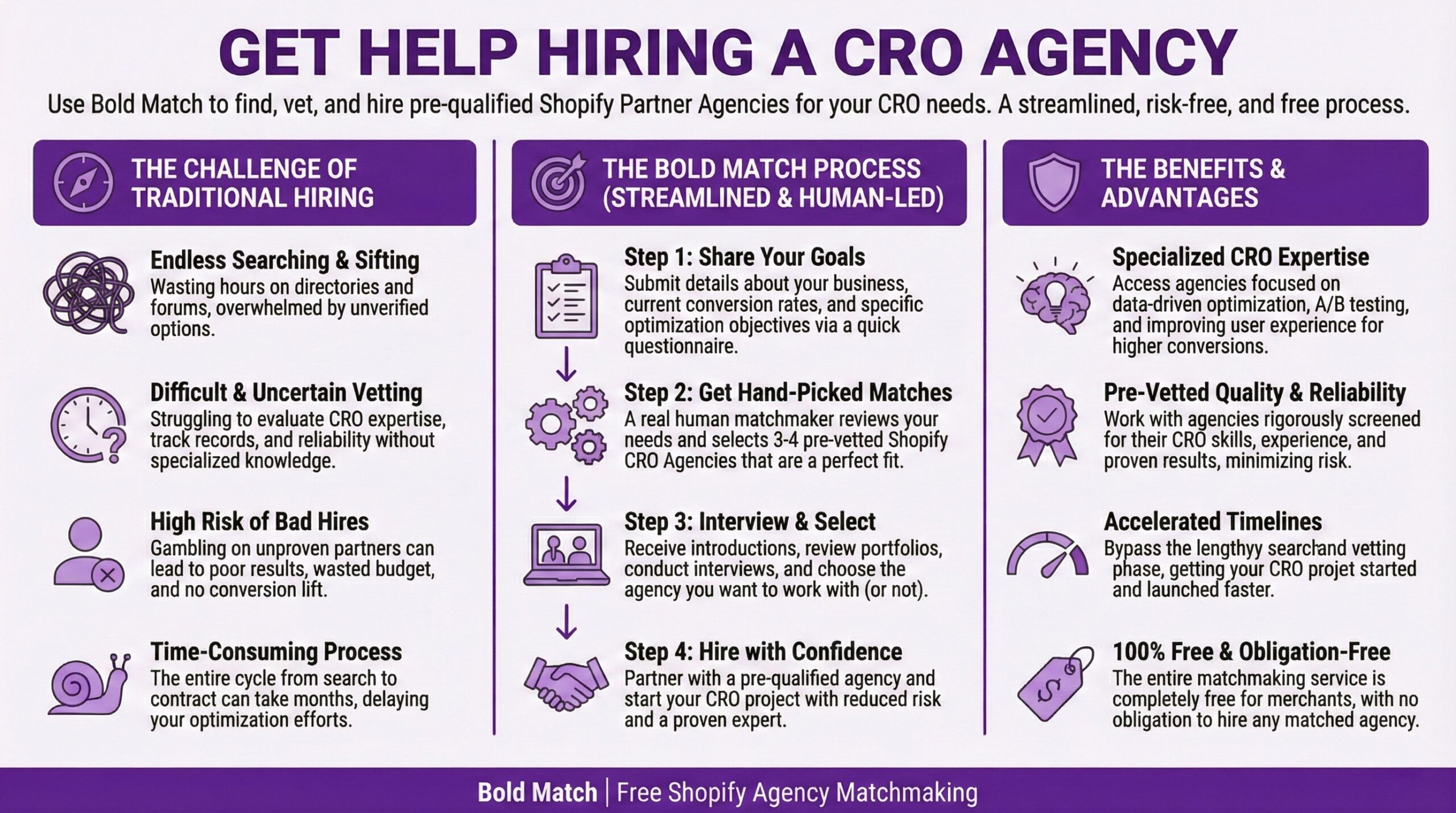
If you’re a merchant at this stage and the prospect of evaluating, vetting, and negotiating with potential conversion rate optimization agency partners feels like yet another full-time job you didn’t ask for, that’s understandable. It’s also the problem Bold Match solves. You describe what you need. We find agencies with proven experience at your scale. No middleman markups. No commissions inflating project costs. Just free introductions to Shopify Service Partners who’ve been evaluated for exactly the kind of work you need done.
Frequently Asked Questions (FAQ)
What does a conversion rate optimization agency do for Shopify stores?CRO agencies analyze how visitors interact with your Shopify store, identify where they abandon the purchase process, and run structured experiments to remove friction and increase the percentage of visitors who buy. This usually involves heatmap analysis, session recordings, user surveys, A/B testing, and ongoing funnel optimization. The goal is to extract more revenue from the traffic you already have rather than spending more on acquisition.
What is a good e-commerce conversion rate for a Shopify store?
That really does depend. The average Shopify store converts between 1.4% and 1.8% of visitors. Anything above 3.2% puts you in the top 20% of all Shopify stores, and exceeding 4.7% places you in the top 10%. However, “good” depends heavily on your industry, price point, and traffic sources. A health and beauty retailer converting at 3.5% is performing on par with category norms, while an electronics store at the same rate would be significantly outperforming.
How much do CRO agencies charge for e-commerce work?
Monthly retainers for e-commerce CRO agencies usually fall between $2,000 and $15,000, though specialized firms with established track records can charge $10,000 to $30,000 per month. Project-based audits and optimization sprints range from $5,000 to $50,000. The wide range reflects differences in agency experience, team size, testing velocity, and whether they provide full implementation or just recommendations.
How long does it take to see results from CRO?
Most partner agencies need two to four weeks for initial research and auditing before any tests go live. Meaningful results from A/B testing usually begin emerging after three to six months of consistent experimentation. Stores with higher traffic volumes (50,000-plus monthly sessions) reach statistical significance faster. Be cautious of any agency promising significant results in under 30 days, as that usually indicates either low testing standards or overpromising.
What is the difference between CRO and website redesign?
There’s certainly some overlap on the UI/UX design side but a “normal” redesign changes how your store looks based on aesthetic and branding decisions. CRO changes how your store performs based on data and behavioral research. They can overlap, but the approach is fundamentally different. A redesign starts with a creative vision. Conversion Rate Optimization starts with a research question. The best CRO experts and agencies will sometimes recommend against visual changes if the data suggests they won’t improve conversions, which is the opposite of how a design agency operates.
Can CRO help with mobile conversion rates on Shopify?
Yes. Yes it can. Mobile optimization is one of the highest-impact areas for Conversion Rate Optimization work on Shopify stores. Mobile devices generate roughly 79% of Shopify store traffic but convert at about 1.2% on average, compared to 1.9% on desktop. A CRO agency experienced with Shopify should have specific strategies for mobile checkout simplification, thumb-friendly navigation, accelerated payment options like Shop Pay, and mobile page speed improvement. Closing the mobile-desktop conversion gap is usually where the biggest revenue gains live.
How do I choose between a freelance CRO expert and a partner agency?
Well. A freelance Conversion Rate Optimization Consultant (usually charging $150 to $500 per hour) can work well for audits, strategic guidance, or oversight of internal teams. But effective CRO usually requires a cross-functional team, including strategy, UX design, front-end development, and data analysis. A solo consultant rarely covers all four disciplines at the depth needed for a sustained testing program. For Shopify merchants generating over $500K in annual revenue who want ongoing optimization rather than a one-time audit, an agency with a dedicated team is usually the stronger choice.