
It’s Time To Consider Replatforming from VisualSoft to Shopify+
Written and edited by: Eric
Been a bit. How’s everyone been? 🛹
So here’s a question. If you’re an online retailer running an e-commerce store on VisualSoft right now, have you looked around lately? Like, really looked? Because things have shifted. And not in that slow, barely-noticeable, “oh the sidewalk crack got a little wider” kind of way. More like how the skatepark near my place in Winnipeg went from packed every weekend to basically empty once they built the new one across town. The ramps were still there. The concrete was still fine. But the wood pushers had already moved.
That’s sort of what’s happening with VisualSoft’s retail platform right now. And if you’re a merchant still running your store on it, this is probably worth reading before you pour another fiscal quarter’s budget into something that’s not so quietly heading somewhere else.

Hold Up Now, What Even Is VisualSoft?
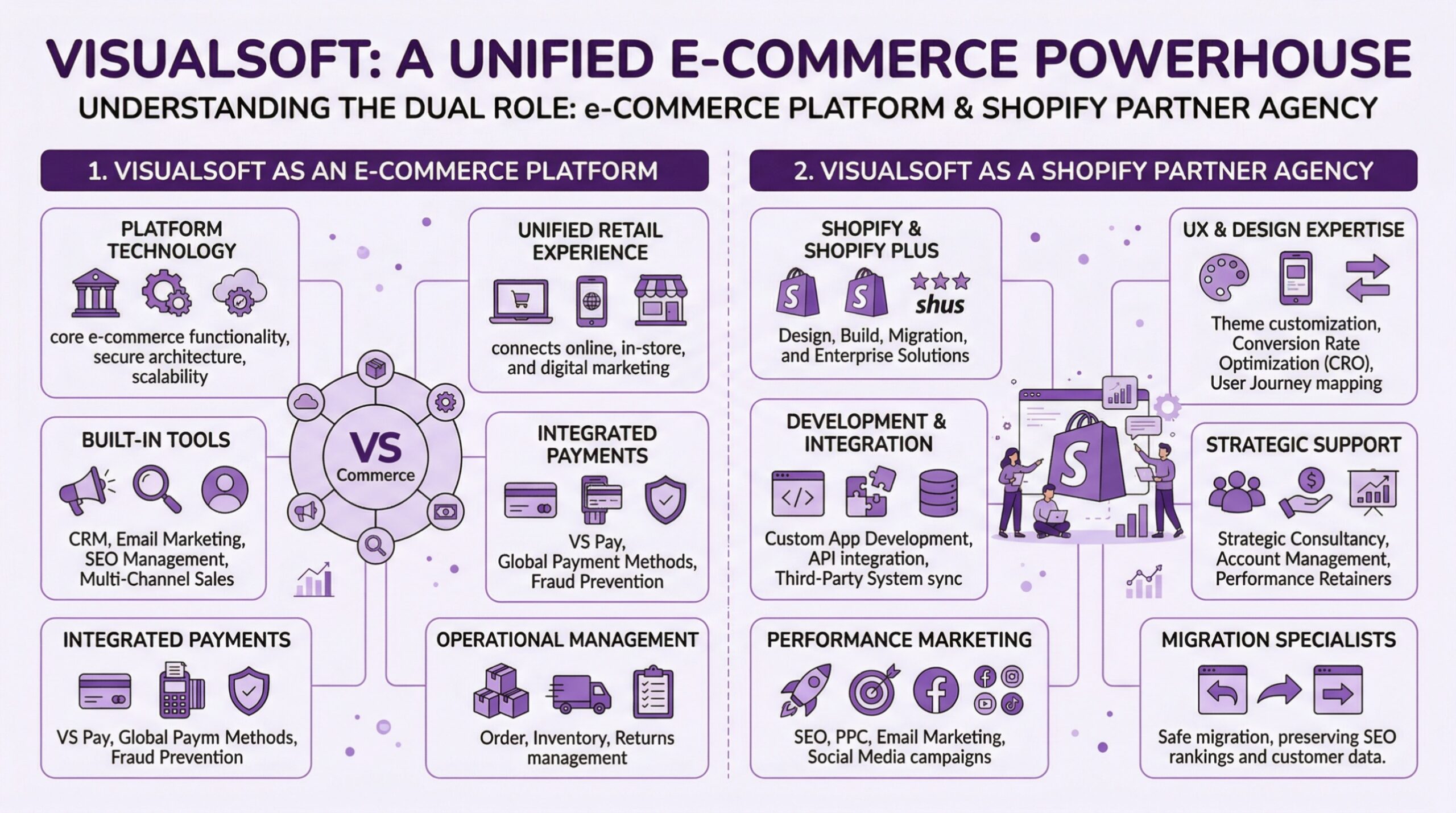
This is actually a fair question, and it’s one that trips up a lot of people. Because VisualSoft isn’t just one thing. It’s two things wearing the same jacket. They got their start back in 1998 in Stockton-on-Tees, England, as an e-commerce platform builder. Over the years, they grew into something unusual in the e-commerce world. They became both a proprietary e-commerce platform and a full-service digital marketing agency, all under one roof. Your hosting, your storefront design, your email campaigns, your SEO, your paid ads, your analytics. All of it managed by VisualSoft, on VisualSoft’s platform, by VisualSoft’s team.
If you’re a retailer who found them through search and couldn’t quite figure out whether they were a platform like Shopify or an agency like, well, the partner agencies you’d find through Bold Match, you’re not alone. The answer has always been “both.” They bundled the platform with the services and sold the whole package as a single monthly fee with no big upfront build costs. For a certain kind of UK-based retailer, especially in fashion, footwear, and home furnishings, that all-in-one pitch was genuinely appealing.
Now. For a while, it worked. At their peak, the platform powered well over 800 active stores, almost all of them in the United Kingdom. They built a reputation for being a solid, dependable option for small-to-midsize retailers who wanted professional e-commerce without managing a bunch of separate vendors. But the bad thing about “all under one roof” models is that eventually the roof starts determining where you can go.
Their Numbers Tell a Terribly Clear Story
Let’s talk about what’s actually happening with VisualSoft’s e-commerce platform. According to the publicly available data, there are roughly 684 live stores still running on the platform. That number has been heading in one direction for a while now. Stores decreased 19% year over year, and dropped another 4.3% quarter over quarter in that same period. Over the last 90 days or so of available tracking VisualSoft only gained FOUR new merchants from other platforms while losing 36 to competitors like Shopify.
Read those numbers again. Four in. Thirty-six out. That’s not going through a rough patch. That’s being in transition. And they would probably agree with me, because they’ve been making some very deliberate moves that point to where their future actually lies.
VisualSoft Is Becoming a Shopify Agency
VisualSoft became a Shopify Plus Partner in 2025. Not just a regular partner. A Plus Tier partner, which puts them in a category of agencies that Shopify has vetted for delivering enterprise-level work. They started migrating their own clients to Shopify. They hired a Director of Innovation, Liam Quinn, specifically to build tools and products that complement Shopify. They launched a Shopify POS offering. They brought on a Retail Product Lead. They appointed a new CRO and a new CFO. Every single strategic hire and product launch in 2025 pointed in the same direction. Toward Shopify. Away from the proprietary platform.
They even made an appearance on the Shopify Partners blog, with Shopify publishing a detailed case study about their “Unified First” approach that brings together Shopify Plus, POS, custom retail apps, and hardware installation. That’s not the kind of content Shopify creates about a company that’s just dabbling in partnership. That’s a full embrace.
So what does this mean for you as a store owner still on the platform? It means the company that built and maintains your store is actively redirecting its talent, its innovation budget, and its strategic focus toward a different platform. Your platform still works. But the best minds at VisualSoft are now thinking about Shopify, not about making the proprietary platform better. It’s like finding out your favorite skate shop started selling snowboards. Nothing wrong with snowboards. Great sport. But you might want to start thinking about where you’re going to get your next set of wheels.
Why Shopify Plus? (Why Not Regular Shopify?)
If you’re a VisualSoft merchant, your store probably does real volume. Their sweet spot has always been established retailers, often doing six or seven figures annually in a focused set of verticals like fashion, footwear, jewelry, and home goods. If that describes you, standard Shopify would feel like a downgrade. Shopify Plus is where your migration should land. Here’s why.
Shopify Plus starts at around $2,300 USD per month on a three-year contract, or $2,500 on a one-year term. That’s a real number, and it’s worth being upfront about it. But what you get for that investment is fundamentally different from what VisualSoft offers, and the gap is only going to widen.
Checkout customization is one of the biggest wins. On VisualSoft, your checkout is what VisualSoft gives you. On Shopify Plus, you can modify the entire checkout experience with custom fields, upsells, loyalty integrations, and conversion optimization that actually belongs to you. For mid-sized merchants, checkout improvements alone can justify the platform cost through increased conversion rates.
The app ecosystem is where Shopify Plus really separates itself. Shopify’s marketplace includes over 8,000 apps covering everything from email marketing and reviews to subscriptions, loyalty programs, and advanced analytics. Their integrated tools are decent, but they’re a closed system. If they didn’t build the feature, you usually can’t have it. On Shopify, if you need something, there’s almost certainly an app for it, and probably three or four competing options so you can pick the best fit.
Shopify Flow Automation lets you build complex workflows without touching code. Automated inventory alerts, customer segmentation, fraud flagging, order routing. The kinds of operational tasks that eat your team’s time on VisualSoft become set-it-and-forget-it processes on Plus.
Multi-currency and international selling is built into the bones of Shopify Plus. You get up to 10 expansion stores included in your plan, which means you can operate localized storefronts across multiple markets without paying per-store surcharges. For UK retailers looking to sell into Europe, North America, or the Middle East, this is a massive advantage over their UK-focused infrastructure.
B2B capabilities come built in on Plus. If you sell wholesale alongside direct-to-consumer, Shopify Plus lets you manage both from a single admin, with custom price lists, net payment terms, and company-specific catalogs. On VisualSoft, B2B usually means a separate conversation and possibly a separate system.
Then there’s the practical stuff. Unlimited staff accounts. A dedicated Merchant Success Manager. Access to Shopify’s partner and developer community, which is one of the largest in e-commerce. Early access to new features. Lower transaction fees that compound into real savings at enterprise volume.
The VisualSoft vs. Shopify Plus Comparison
Let’s put this side by side so you can see where things stand.
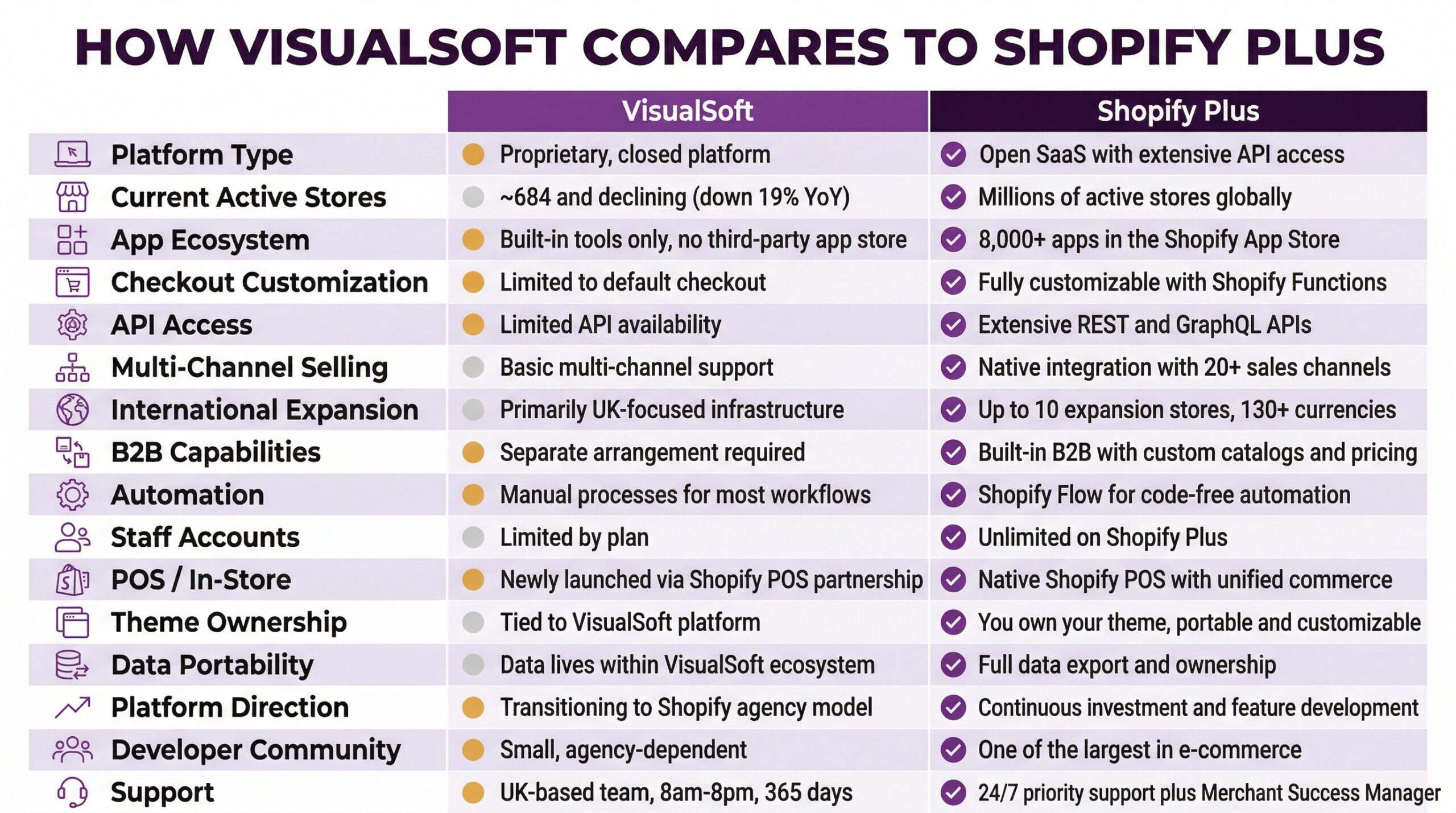
One thing jumps out from this table that I think is particularly worth highlighting. They now offer Shopify POS to its clients. Their in-store retail solution runs on Shopify. Their Innovation Director builds tools that complement Shopify. Their migration team specializes in moving stores to Shopify. Even VisualSoft’s own strategic direction validates Shopify Plus as the destination platform of choice.
What VisualSoft-to-Shopify+ Migration Will Look Like
Ok, let’s get practical. Because “you should migrate” is easy to say. Actually doing it is the part that makes store owners lose sleep.
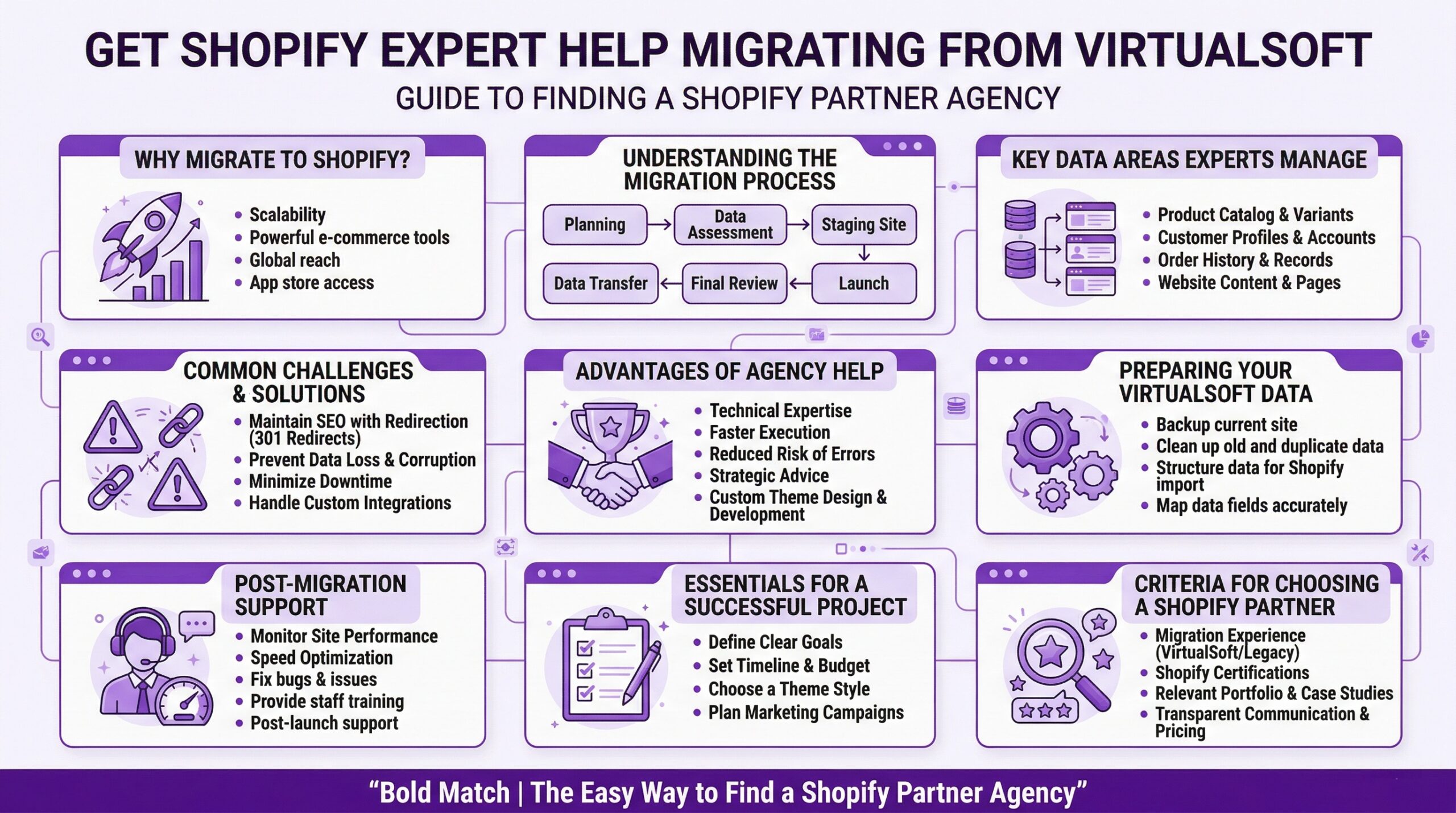
The good news is that VisualSoft-to-Shopify migrations are well-understood at this point. Multiple agencies, including VisualSoft themselves, have built repeatable processes for this exact move. A standard “lift and shift” replatform usually takes about two months. More complex custom builds with deep integrations can take three to six months. Here’s what the process usually involves.
Discovery and audit. A good migration partner starts by mapping your current setup in full. Products, categories, customer data, order history, integrations, custom features, and the weird little things that only your store does. If you’ve been on VisualSoft for years, there’s going to be some archaeology involved. That’s normal.
Data migration. Products, customers, orders, variants, reviews, content. All of it needs to be extracted from VisualSoft’s systems, reformatted for Shopify’s data structure, and imported cleanly. This is the part where cutting corners costs you the most, so make sure your agency partner has a testing and validation process for every data set.
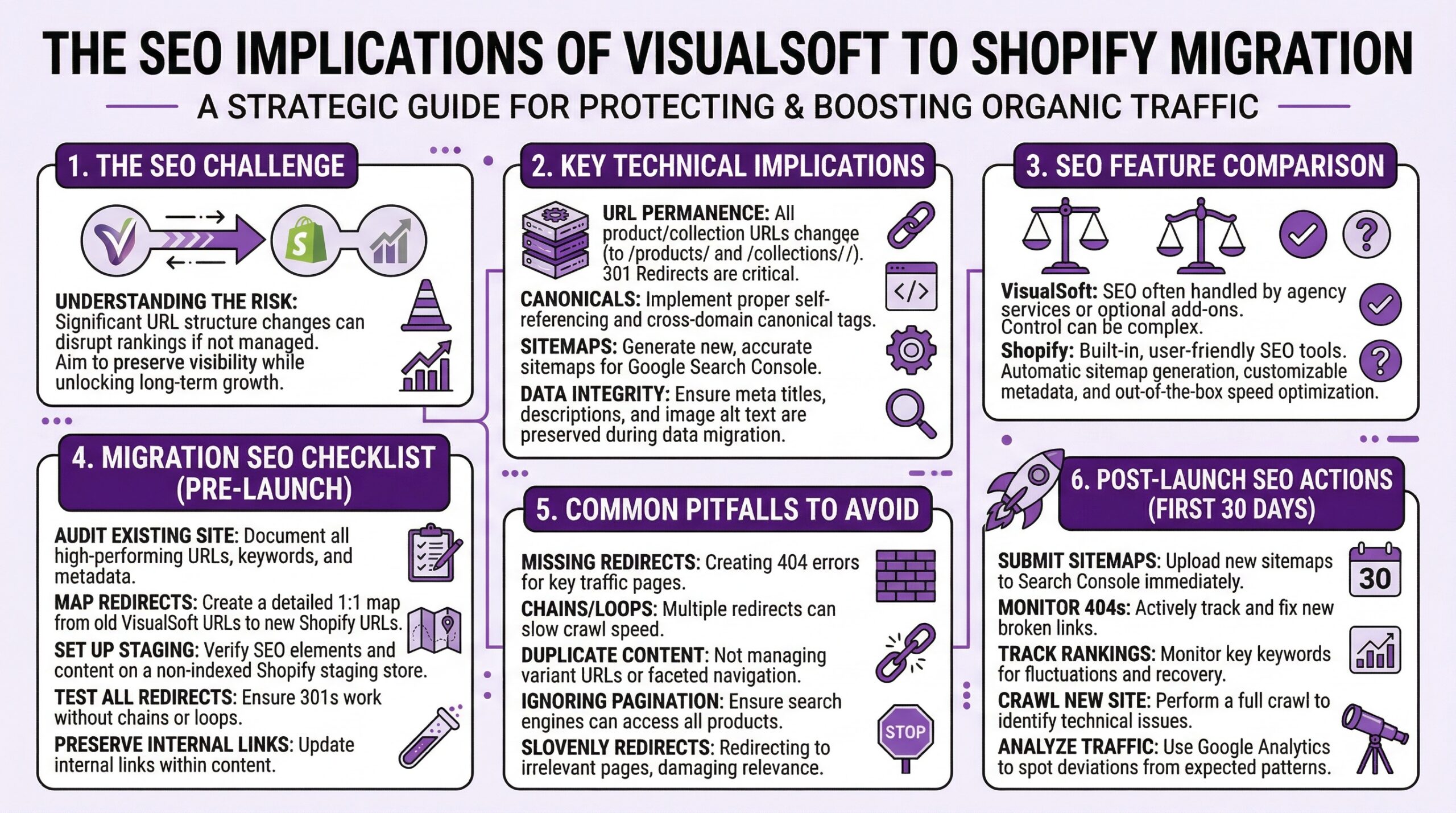
SEO protection. This is the one that keeps me up at night as a developer, honestly. Your search rankings represent years of accumulated authority. A sloppy migration can tank your organic traffic overnight. Proper URL redirects, metadata migration, sitemap updates, and structured data implementation are non-negotiable. If your migration agency doesn’t talk about SEO protection in the first meeting, that’s a red flag the size of a half-pipe.
Design and UX. This is your chance to level up, not just replicate. A migration is the perfect moment to rethink your customer experience, improve your mobile flow, and take advantage of Shopify’s theme architecture. Don’t just copy your VisualSoft storefront pixel for pixel. Build something better.
Integration setup. Whatever third-party tools you’re using for email marketing, reviews, inventory management, accounting, shipping. Those all need to be reconnected in the Shopify ecosystem. The upside is that most major tools have Shopify integrations that are way more mature than what you’ve been using on VisualSoft.
Testing and launch. Thorough QA across every device, every checkout scenario, every edge case your store handles. Then a coordinated cutover that minimizes downtime and confusion for your shoppers.
How to Find the Right Migration Agency
Brace yourselves because this one is kind of our whole thing. Not every Shopify agency is great at migrations. Building a new store from scratch and migrating an existing store with years of data, customer relationships, SEO authority, and custom functionality are two very different skill sets. You want a partner that has done VisualSoft-to-Shopify migrations specifically, or at the very least has deep experience migrating stores from comparable proprietary platforms.
Things to look for in a migration partner. They should have documented case studies from similar migrations. They should have a clear, phased project plan that they can walk you through before you sign anything. They should talk about protection early and often. They should have both design and development capabilities in-house, or through trusted partnerships. And they should be honest about timelines. If someone tells you they can migrate a complex online store in two weeks, run.
Bold Match literally exists to help you find the right agency for this. It’s literally what we built the service to do. You tell us what you need, and we match you with vetted Shopify agencies that have the right experience for your specific situation. It’s FREE, there’s no commission and nobody’s trying to sell you on a specific Shopify agency. We just want you to end up with the best partner for the work.
Timing Matters More Than You’d Think
There’s never a perfect time to migrate. There’s always a sale coming up, always a seasonal push, always a reason to wait. But the cost of waiting isn’t zero. Every month you stay on a declining platform is a month where you’re not benefiting from the ecosystem your competitors are using. It’s a month where the talent and innovation at your current platform provider is focused somewhere else.
The best time to start planning a migration is before you feel urgent pressure to do it. If VisualSoft’s platform is still working fine for your day-to-day operations, great. Use that stability to plan a thoughtful, well-executed transition instead of a panicked one.
For most merchants, the smart move is to start the discovery process now, plan the migration for a low-traffic period, and launch on Shopify Plus with enough runway to optimize before your next big selling season. If you’re a UK based retailer, that probably means getting on Shopify sooner rather than later. I gotta go finish debugging this integration thing, but honestly, if you’re on VisualSoft and you’ve been wondering what’s next, the answer is already pretty clear. The company that built your current platform is already telling you where to go. Maybe it’s time to listen.
Easy VisualSoft vs. Shopify Plus Comparison Chart
Here. Let Me put VisualSoft’s e-Commerce Platform and Shopify Plus side by side so you can clearly see how the two compare.
|
Feature |
VisualSoft |
Shopify Plus |
|
Platform Type |
Proprietary, closed platform |
Open SaaS with extensive API access |
|
Current Active Stores |
~684 and declining (down 19% YoY) |
Millions of active stores globally |
|
App Ecosystem |
Built-in tools only, no third-party app store |
8,000+ apps in the Shopify App Store |
|
Checkout Customization |
Limited to VisualSoft’s default checkout |
Fully customizable checkout with Shopify Functions |
|
API Access |
Limited API availability |
Extensive REST and GraphQL APIs |
|
Multi-Channel Selling |
Basic multi-channel support |
Native integration with 20+ sales channels |
|
International Expansion |
Primarily UK-focused infrastructure |
Up to 10 expansion stores included, 130+ currencies |
|
B2B Capabilities |
Separate arrangement usually required |
Built-in B2B with custom catalogs and pricing |
|
Automation |
Manual processes for most workflows |
Shopify Flow for code-free automation |
|
Staff Accounts |
Limited by plan |
Unlimited on Shopify Plus |
|
POS / In-Store |
Newly launched via Shopify POS partnership |
Native Shopify POS with unified commerce |
|
Theme Ownership |
Tied to VisualSoft platform |
You own your theme, portable and customizable |
|
Data Portability |
Data lives within VisualSoft’s ecosystem |
Full data export and ownership |
|
Platform Direction |
Transitioning to Shopify agency model |
Continuous investment and feature development |
|
Developer Community |
Small, agency-dependent |
One of the largest developer communities in e-commerce |
|
Support |
UK-based team, 8am-8pm, 365 days |
24/7 priority support plus dedicated Merchant Success Manager |
|
Pricing Model |
Monthly fee, contact for quote (starts ~$379/mo) |
From $2,300/mo (3-year) or $2,500/mo (1-year) |
Frequently Asked Questions (FAQ)
What is VisualSoft?VisualSoft is a UK-based company founded in 1998 in Stockton-on-Tees that operates as both a proprietary e-commerce platform and a full-service digital marketing agency. Unlike platforms like Shopify or BigCommerce that provide standalone software, VisualSoft bundles storefront design, hosting, SEO, email marketing, paid advertising, and analytics into a single managed service. This “platform plus agency” model means merchants get their e-commerce technology and marketing support from the same provider. VisualSoft has historically served small-to-midsize UK retailers in verticals like fashion, footwear, jewellery, and home furnishings, with roughly 91% of their merchant base located in the United Kingdom.
Is VisualSoft shutting down its e-Commerce Platform?
No. Not yet. VisualSoft hasn’t announced that they’re shutting down their proprietary platform. However, the company has been making a significant strategic pivot toward becoming a Shopify Plus Partner agency. Back in 2025, VisualSoft achieved Plus Tier status in Shopify’s Partner Program, hired a Director of Innovation specifically focused on building Shopify-complementary tools, launched a Shopify POS offering, and began actively migrating their own merchants to Shopify. Meanwhile, active stores on the commerce platform have decreased by 19% year over year, with roughly 684 stores remaining as of early 2026. The trajectory suggests the company’s future is as a Shopify agency rather than an independent platform provider.
How much does it cost to migrate from VisualSoft to Shopify Plus?
That’s hard to say. Migration costs vary based on the complexity of your store, but there are several components to budget for. Shopify Plus itself starts at $2,300 USD per month on a three-year contract or $2,500 on a one-year term. The migration project itself, including data transfer, design, development, and launch, can range from $5,000 for a straightforward lift-and-shift to $50,000 or more for complex custom builds with deep integrations. You should also budget for apps ($500 to $2,000 per month depending on your needs), a premium theme ($250 to $400 for a pre-built option, or $15,000 to $50,000 for custom), and post-launch optimization. For most mid-sized VisualSoft merchants, the total first-year investment including platform fees, migration, and apps usually falls between $40,000 and $80,000.
How long does a VisualSoft to Shopify migration take?
Well. A standard “lift and shift” migration from VisualSoft to Shopify usually takes about two months. Custom-built stores with more complex requirements, including migrations from other platforms or significant redesigns, generally take between three and six months. Larger, more complex builds with extensive integrations, multiple storefronts, or significant custom functionality can take longer. The timeline depends on factors like catalog size, the number of integrations, whether you’re redesigning or replicating, and how quickly your team can participate in review and approval cycles.
Will I lose my search rankings if I migrate from VisualSoft to Shopify?
No. Not if you do it right. Or rather. You shouldn’t lose rankings if the migration is handled properly, but this is one of the highest-risk areas of any replatforming project. A well-executed migration includes comprehensive URL mapping and 301 redirects from every old URL to its new equivalent, careful migration of title tags and meta descriptions, proper sitemap submission, structured data implementation, and monitoring through Google Search Console during and after the transition. Retailers who cut corners on redirect mapping or skip metadata migration often see significant organic traffic drops. This is one of the strongest reasons to work with an experienced migration agency rather than attempting a DIY approach.
What happens to my customer data during the migration?
During a properly managed migration, your customer data including names, emails, addresses, order history, and account information is extracted from VisualSoft, reformatted to match Shopify’s data structure, and imported into your new store. Customer passwords usually cannot be migrated directly due to encryption differences between platforms, so your shoppers will need to reset their passwords on first login. Most migration agencies handle this by triggering a branded password-reset email campaign at launch. Your order history should transfer intact, so returning customers can still view their past purchases through their new accounts.
What’s the difference between Shopify and Shopify Plus?
For most VisualSoft merchants, Shopify Plus is the appropriate destination because their typical customers have been established retailers doing meaningful revenue. Shopify Plus adds custom checkout capabilities, Shopify Flow for workflow automation, built-in B2B selling, up to 10 expansion stores for international selling, unlimited staff accounts, a dedicated Merchant Success Manager, and lower transaction fees. Standard Shopify plans (Basic at $39/month, Shopify at $105/month, or Advanced at $399/month) work well for smaller or newer stores, but they lack the enterprise features that VisualSoft merchants are accustomed to. The general guidance is that merchants processing $1 million or more annually usually see positive ROI from Shopify Plus.
Do I own my store data on VisualSoft?
This is an important question that many VisualSoft merchants don’t think about until they’re ready to leave. Because VisualSoft operates as a managed, proprietary platform, your store data lives within VisualSoft’s ecosystem. While you have access to your products, customers, and orders, the ease of extracting that data in full can vary. Before beginning any migration, you should confirm with VisualSoft exactly what data you can export, in what formats, and on what timeline. On Shopify Plus, by contrast, you have full data ownership and export capabilities, plus extensive API access that lets you move your data wherever you need it. Data portability is one of the less glamorous but more consequential advantages of open platforms over proprietary ones.