
How Shopify Agency Pricing Works (Retainers vs. Project Fees vs. Success Fees)
Written and edited by: Jay
How’s everyone doing out there in Shopify-Land?
Jay Myers here, taking some time off from the best Shopify Podcast in the known universe 🫅 and there’s curling on later so today instead of winding up first, I’m just gonna start this. Ready? Shopify agency pricing isn’t complicated because partner agencies want to confuse you. It’s complicated because there are genuinely different ways to structure a working relationship, and each one makes certain assumptions about risk, commitment, and what “success” will even mean. So sometimes there’s a mixup, misunderstanding or mistaken communication that ends in a retailer signing an e-commerce agency contract that makes zero sense in their situation.
Not because the agency was predatory, but because nobody explained what each pricing model actually optimizes for. The retailer wanted flexibility, signed a rigid retainer, then spent six months feeling trapped. Or they wanted ongoing strategic partnership, hired someone project-to-project and wondered why nobody was thinking about their business holistically. So. Let’s actually talk about this.
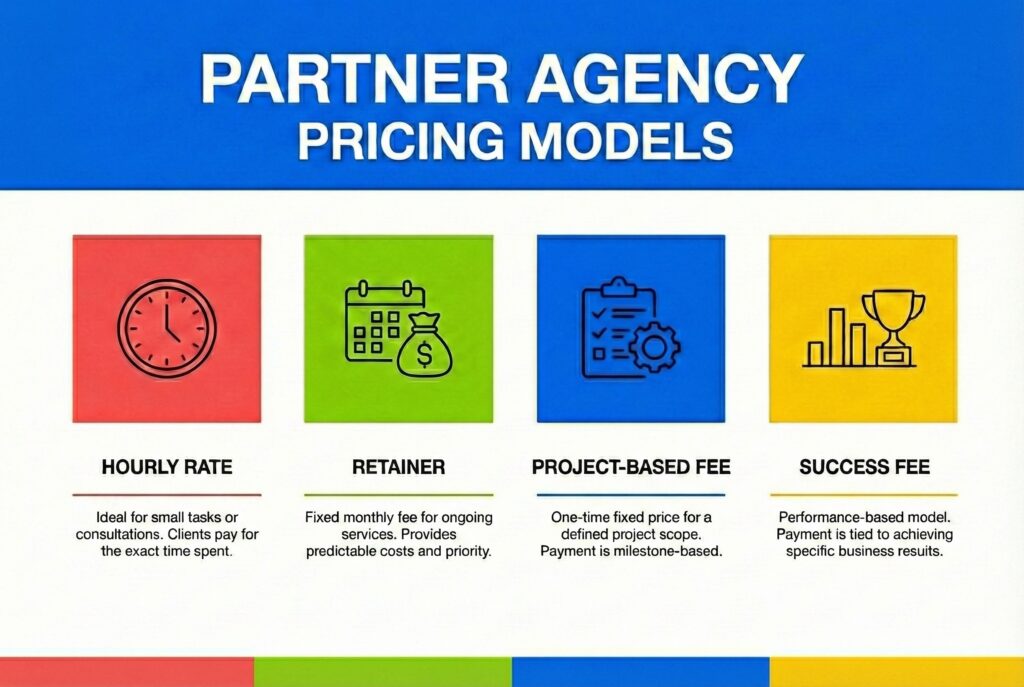
The Three Agency Pricing Models You’ll Encounter
Most Shopify agencies fall into one of three buckets when it comes to how they charge for their expert services. Some employ all three depending on the engagement in question. Others can be unexpectedly dogmatic about their approach. Neither is inherently better. But understanding the mechanics matters more than the plain cost of agency services and more than many merchants realize.
Project-Based Pricing. You have a thing that needs doing. They quote a price. You pay it. Done.
Retainer Pricing. You pay a fixed monthly fee for ongoing access to their team and services.
Performance or Success-Based Pricing. You pay based on results. More revenue, more conversions, better outcomes for you means higher compensation for them.
Now. Each pricing model sounds reasonable in the abstract. But things can get problematic when you pick the wrong model for your situation, or when you picked before you fully understood what you were actually buying.
Project-Based Partner Agency Pricing in Practice
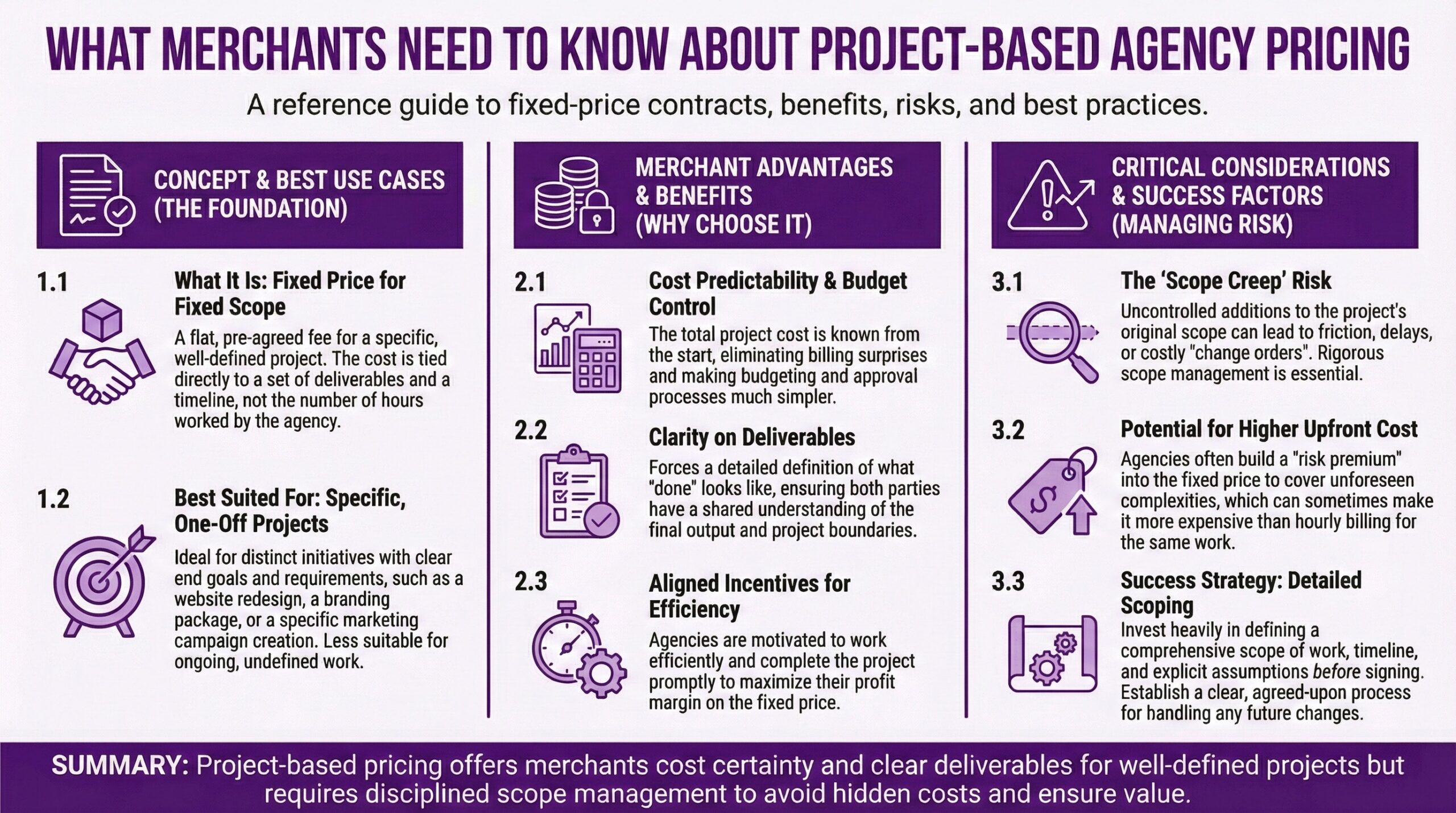
Project pricing makes intuitive sense. You need a store redesign. The partner agency quotes $15,000. You pay half upfront, half on completion. Simple transaction, clear deliverable, everyone knows what they’re getting. For discrete, well-defined work this remains the industry standard. According to 2025 data compiled across multiple industry sources, Shopify development project fees usually range from $500 for basic theme tweaks all the way to $25,000 or more for custom store builds with complex functionality. Full custom development with headless architecture or enterprise integrations can push well into six figures at premium agencies.
The actual numbers matter less than understanding what drives them. The store’s complexity. Developer experience level. Geographic location of the team. Timeline urgency. Whether you need strategy and design bundled with development or just execution.
When project pricing works well. You have clear requirements. You know exactly what you want built. The scope is bounded and unlikely to shift dramatically. You have internal resources to manage the completed project afterward.
When project pricing falls apart. Your requirements are fuzzy. You need ongoing optimization, not just initial build. You want strategic thinking, not just task execution. The project scope keeps expanding because you keep learning what you actually need.
The scope creep problem that can pop up with project-based pricing arguably warrants a post of its very own. I mean. You sign for a site redesign. Three weeks in you realize the checkout flow needs rework too. Then product filtering. Then the mobile experience needs more attention than budgeted. Each addition requires a change order, a new negotiation, a pause while everyone recalculates.
Good expert agencies build buffers into project quotes anticipating some scope expansion. Great partner agencies push back and help you define scope clearly before signing anything. Inexperienced e-commerce agencies quote low to win the work and then either deliver subpar results or nickel-and-dime you through change orders until you both resent each other.
Retainer Pricing and the Ongoing Partnership Model
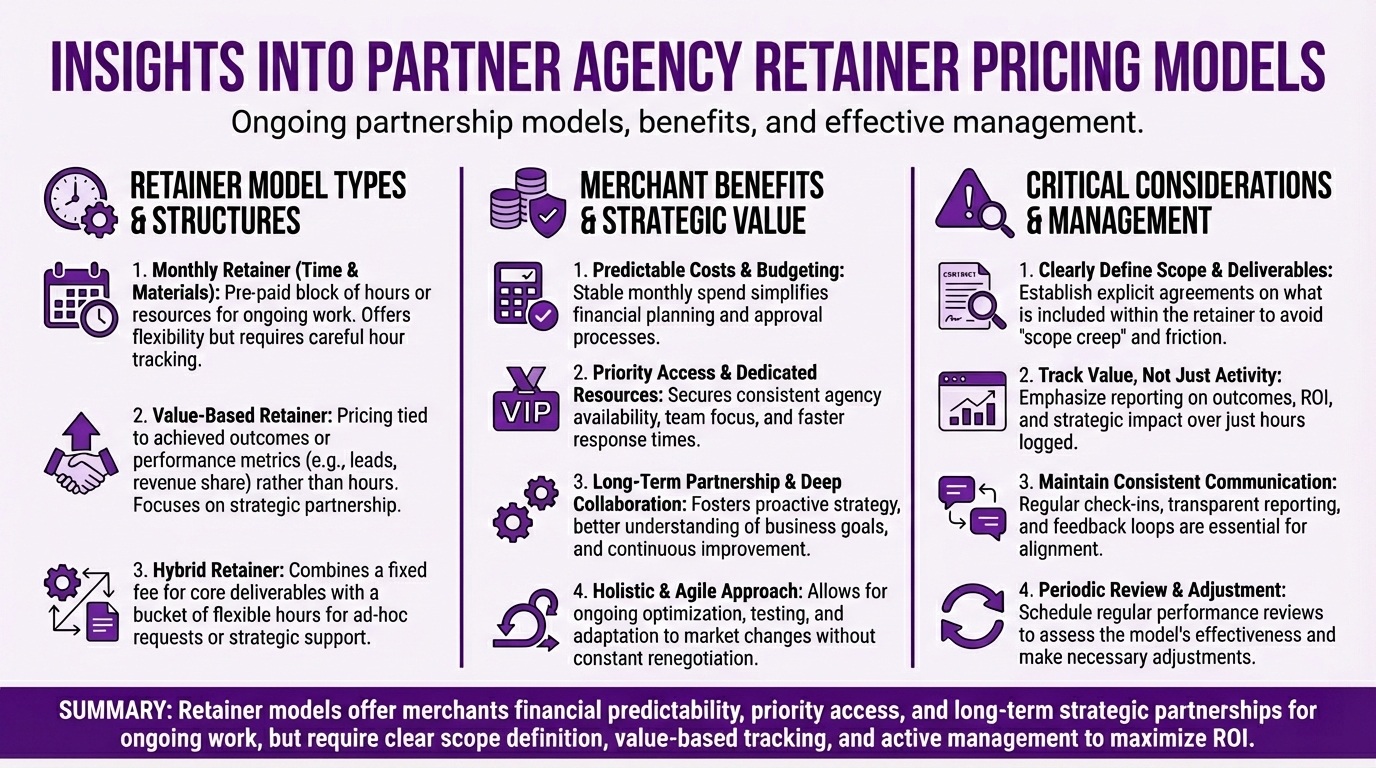
Retainers flip the dynamic. Instead of paying for specific deliverables, you’re paying for access and availability. Certified experts who know your business, understand your goals, and allocate time to you each month regardless of whether or not you have urgent projects. Monthly retainer fees for Shopify-focused agencies usually range from $500 to $5,000 for basic maintenance and support, scaling up to $7,000 to $15,000 or more for comprehensive ongoing development, optimization, and strategic work. Enterprise retailers working with top-tier Shopify Plus agencies often pay $30,000 to $150,000 annually for dedicated ongoing partnerships.
Most Shopify agency retainers structure around either hours or deliverables. An hour-based retainer might give you 20 or 40 hours monthly of development and design time. A deliverable-based retainer might specify a certain number of A/B tests, landing pages, or optimization cycles per month. Hybrid approaches combine elements of both.
When retainer pricing works well. You need ongoing attention to your store. You want someone thinking strategically about your business month over month. You value having familiar people who understand your brand, your tech stack, and your quirks. You hate the constant re-negotiation of project-to-project relationships.
When retainer pricing causes problems. Your needs fluctuate wildly. Some months you need 60 hours of work, other months you need 5. You don’t have internal capacity to keep an agency productively occupied. You sign a retainer hoping it will magically solve problems that actually require more strategic clarity on your end first.
The hidden dysfunction of retainers goes something like this. Month one, you’re excited. Lots of projects queued up. The partner agency delivers exactly what was promised. Month three, you’ve burned through the backlog of obvious improvements. The agency keeps asking what you need. You don’t know. Hours go unused or get filled with makework. By month six, you’re paying $8,000 monthly for what feels like not much.
This isn’t the agency’s fault. Retainers work when you have the operational maturity to use them well. They require someone on your side thinking ahead, prioritizing, and maintaining a roadmap. If you’re hoping the agency will create that direction for you, you need a higher-tier engagement with strategic planning built in, and that costs more. This Compensation Methodologies Survey found that 72% of agencies use fixed fee arrangements as their primary compensation model, with retainers being the most common structure. This isn’t because retainers are optimal for everyone. It’s because they’re predictable for agencies and familiar to clients.
Performance-Based and Success Fee Pricing
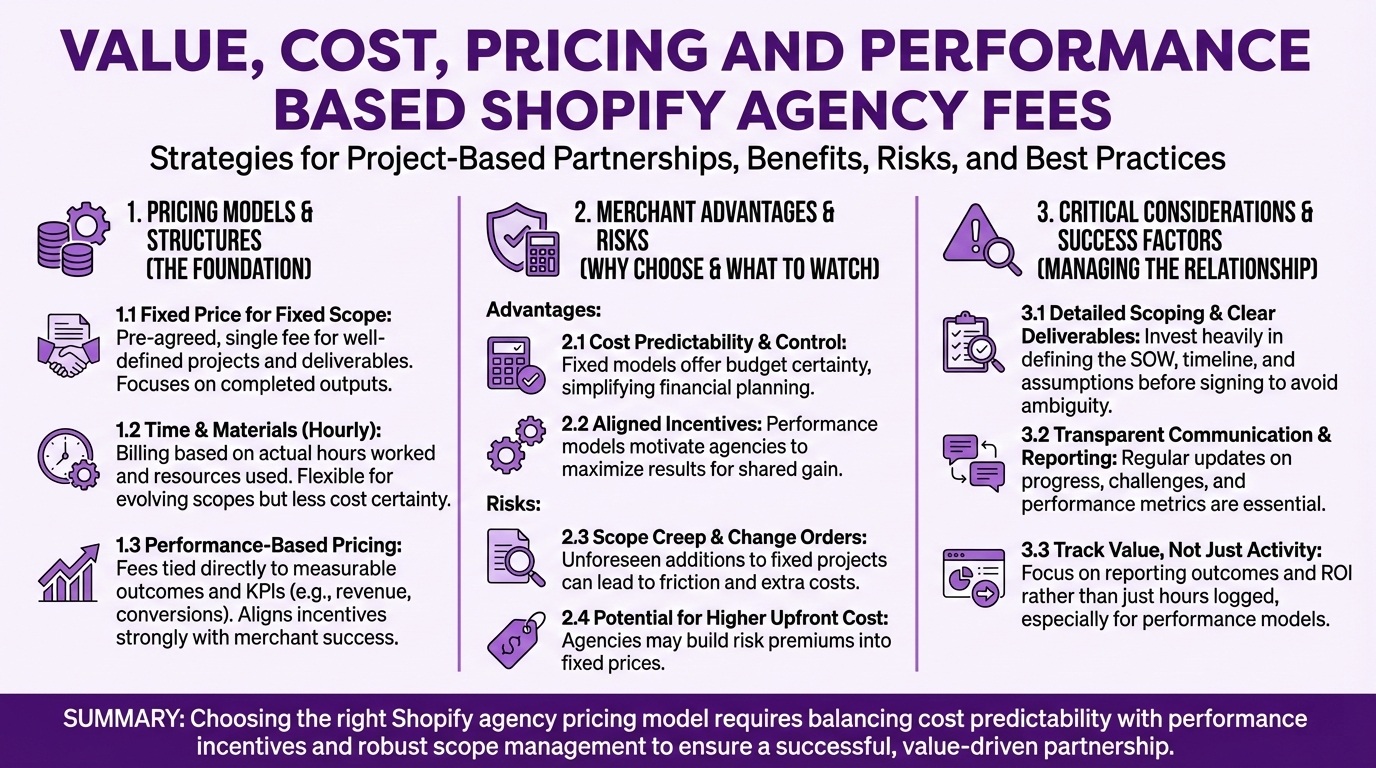
Performance pricing attempts to align agency compensation directly with outcomes. They only win when you win. Sounds like perfect incentive alignment. The reality is messier. Performance-based arrangements in e-commerce usually take a few forms. Revenue share models where agencies take 5% to 15% of incremental revenue they help generate. Goal-based bonuses where agencies earn extra for hitting specific conversion, traffic, or ROAS targets. Hybrid structures combining a lower base retainer with performance kickers.
Pure performance pricing with zero base fee is rare and usually a red flag. Any agency confident enough in their abilities still needs to cover operational costs during the ramp-up period when results haven’t materialized yet. An agency willing to work purely on success fees is either desperate, planning to deprioritize you the moment a paying client needs attention, or has defined “success” in ways that will technically pay out regardless of whether your business actually improves.
When performance pricing works well. You have clear attribution systems. Results are measurable within reasonable timeframes. The agency controls enough variables to actually influence outcomes. Both parties trust each other enough to share data transparently. You’re already successful enough that incremental gains matter more than fundamental transformation.
When performance pricing creates conflict. Attribution is murky. Your sales cycle is long. Multiple factors beyond marketing influence conversions. The agency starts gaming whatever metrics determine their compensation rather than optimizing for your actual business goals.
The attribution problem deserves emphasis. Your customer sees a Facebook ad, ignores it, later Googles your brand after a friend mentioned it, clicks a search result, browses for two weeks, and finally converts after an email reminder. Who gets credit for that sale? The agency running Facebook ads? The one managing your search presence? Your email platform? Your product team who built something worth recommending?
Performance-based pricing assumes you can answer that question cleanly. Usually you can’t. And the disputes about attribution eventually poison the relationship. According to this analysis of performance-based pricing, the most successful implementations require explicit baselines, agreed measurement windows, and clear attribution rules established before work begins. Most merchants don’t have the analytical infrastructure to support this level of rigor.
Comparing Partner Agency Pricing Models Honestly
Here’s a visual comparison that might actually help you think through the tradeoffs.
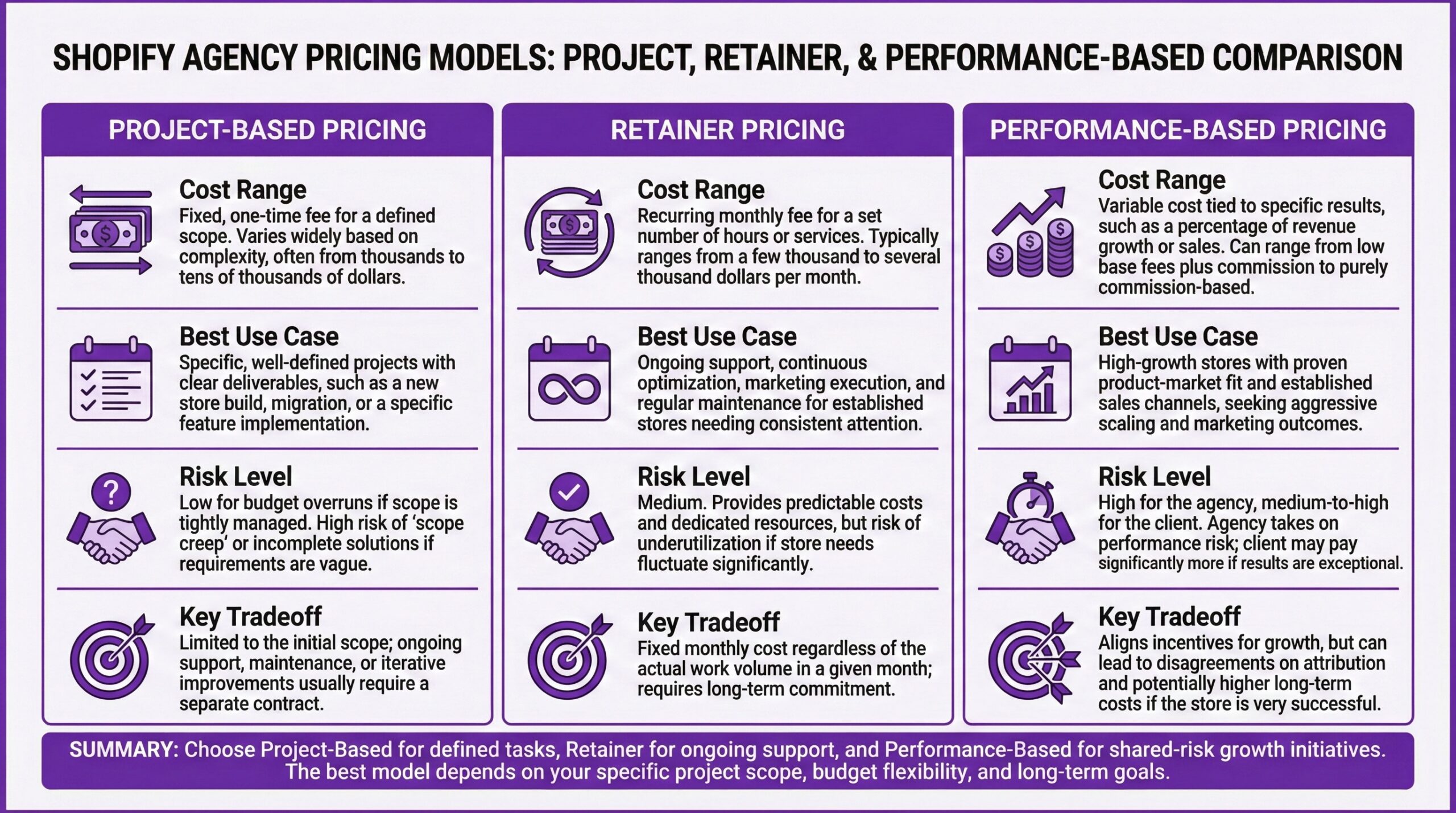
What You May Be Getting Wrong About Some of This
The biggest mistake isn’t choosing the wrong pricing model. It’s assuming the pricing model will solve problems that are actually about communication, strategic clarity, and operational readiness. Signing a retainer won’t make your store better if you don’t know what “better” means for your business. Paying for performance won’t align incentives if you can’t measure outcomes accurately. Project fees won’t deliver value if you can’t define scope clearly enough for anyone to quote accurately.
Before you negotiate pricing structure, answer these questions honestly.
Do you have a clear strategic direction? Not vague goals like “grow revenue” but actual priorities. Which customer segments matter most? What conversion rate would be transformational versus merely nice? Where does your store actually fail right now?
Can you keep an agency productively engaged? If you sign a 40-hour monthly retainer, do you have 40 hours worth of valuable work each month? Who internally owns the relationship and maintains the roadmap?
Do you have the attribution infrastructure for performance pricing? Can you actually track what different channels and campaigns contribute to conversion? Are you confident enough in that data to compensate someone based on it?
Is your business stable enough for each model’s cash flow implications? Project fees front-load cost. Retainers spread it evenly. Performance arrangements are variable. Each works differently depending on your own revenue predictability and cash position.
How I’d Think About It If I Were In Your Shoes
If you need a specific thing built and have clear requirements, start with project pricing. Get the redesign, the migration, the custom functionality done as a discrete engagement. Evaluate whether ongoing partnership makes sense afterward.
If you’re past the build phase and need continuous improvement, consider a retainer once you’ve validated that you can actually direct agency work productively. Start small. A 10-hour monthly retainer is better than signing for 40 hours you won’t use.
If you’re scaling paid acquisition and have solid attribution, performance components can make sense as part of a hybrid structure. A base retainer covering operational costs plus bonuses for hitting targets aligns incentives without forcing the agency to gamble their payroll on your success.
If you’re uncertain, err toward simpler structures. Project-based work lets you test the relationship without long-term commitment. You can always evolve toward retainers once you’ve established trust and proven the collaboration works.
Remember, Sometimes Agency Pricing’s Hybrid
In practice, sophisticated agency relationships often blend models. A retailer might pay project fees for a migration, transition to a retainer for ongoing optimization, and layer in performance bonuses for specific campaigns. This evolution makes sense. The relationship deepens over time. Trust builds. Both parties understand each other better. Pricing structures can become more nuanced because the foundation supports that nuance. Don’t feel pressure to solve everything in the first contract. The best agency relationships I’ve seen evolve organically. Start simple. Prove value. Adjust terms as both sides learn what actually works.
What This Means for Your Partner Agency Search
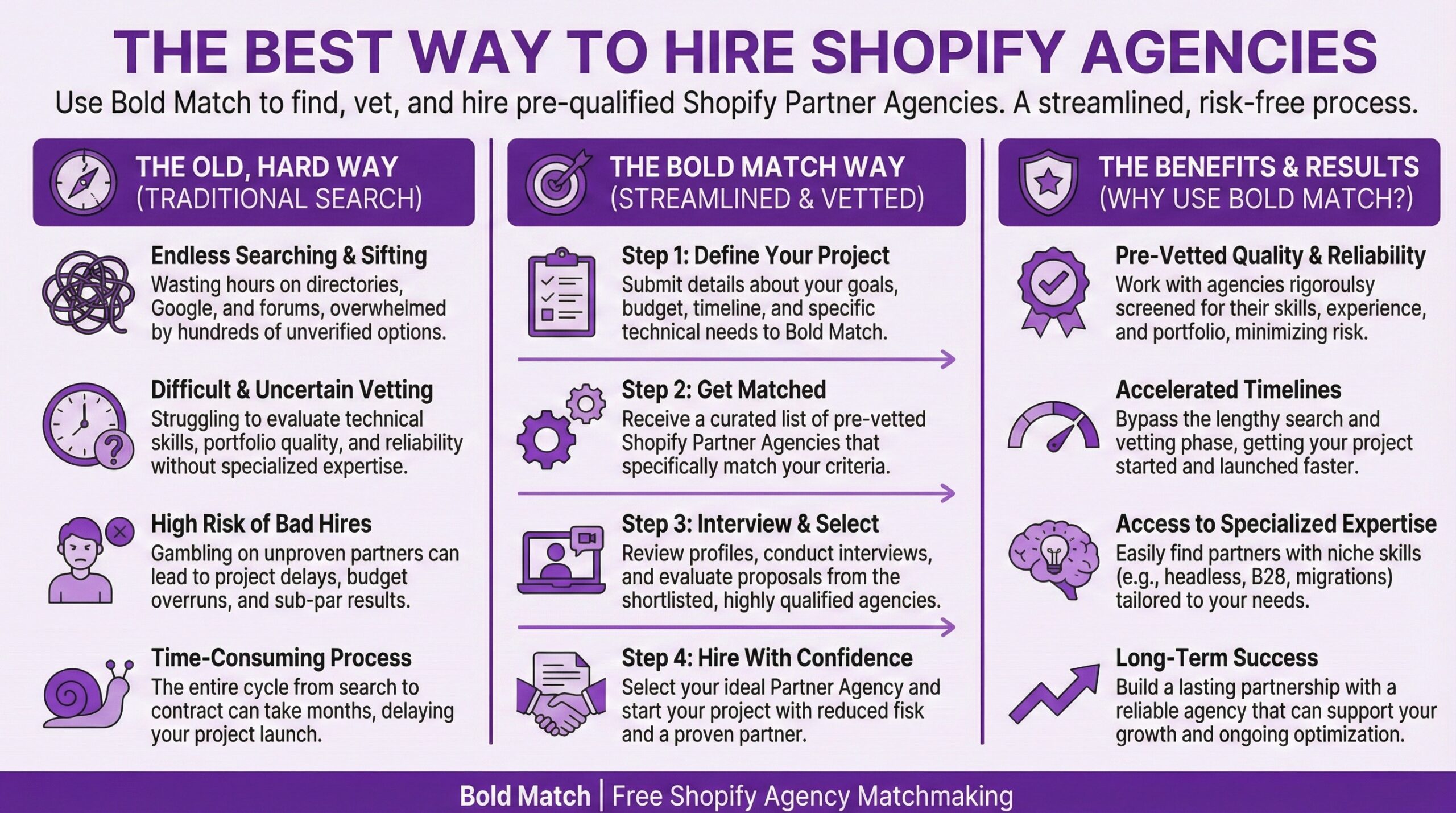
When you’re weighing your Shopify Agency options with help from Bold Match, pricing model preference tells you something about an agency’s philosophy and operational structure. Agencies that only do project work tend to be execution-focused. They’re good at defined deliverables, less equipped for strategic ambiguity. Partner agencies that prefer retainers are set up for ongoing relationships. They’ve invested in account management, strategic planning capacity, the infrastructure of continuous partnership. Shopify agencies pushing performance-based arrangements are usually either very confident or very hungry. Both can work. But understand which you’re dealing with.
None of these are inherently better. They’re just different operating models optimized for different situations. The right match depends on what you actually need, which brings us back to doing the strategic work before you shop for agencies. Know what you need. Understand your operational capacity. Be honest about your analytical infrastructure. Then pick the pricing model that fits your reality, not the one that sounds most appealing in the abstract. That’s how you avoid signing contracts you’ll regret six months later. — JAY
Shopify Agency Pricing – Project Fees vs. Retainers vs. Success Fees
|
Factor |
Project-Based |
Retainer |
Performance-Based |
|
Cost predictability |
High for defined scope |
High monthly |
Variable |
|
Budget range |
$500 to $100,000+ per project |
$500 to $15,000+ monthly |
Base plus 5-15% of results |
|
Best for |
Defined builds, redesigns, migrations |
Ongoing optimization, strategic partnership |
Paid media, CRO with clear attribution |
|
Risk distribution |
Mostly on merchant for outcomes |
Shared |
Mostly on agency |
|
Scope flexibility |
Low without change orders |
Medium |
High but may not align with your goals |
|
Strategic alignment |
Low unless built into scope |
Medium to high |
Theoretically high, often problematic |
|
Agency commitment level |
Per-project |
Ongoing but bounded |
Dependent on results |
|
Common pitfalls |
Scope creep, handoff gaps |
Unused hours, strategic drift |
Attribution disputes, metric gaming |
Frequently Asked Questions (FAQ)
What’s the normal hourly rate for Shopify agency work?
Hourly rates vary dramatically based on agency tier and location. Freelance developers usually charge $30 to $150 per hour depending on experience, while established agencies bill $100 to $250 or more per hour when you factor in project management, quality assurance, and strategic oversight. Offshore teams can run $20 to $50 hourly, though communication overhead sometimes offsets the savings.
How do I know if I need a retainer or If I should stick with project-based?
Well. If you have a clear, bounded thing to build and aren’t sure you’ll need ongoing help, start with project pricing. If you need continuous optimization, regular updates, or strategic guidance month over month, and you have internal capacity to direct that work productively, retainers usually make more sense. The test is whether you’ll consistently have 10 to 40 hours of valuable work to assign monthly.
What percentage do performance-based partner agencies usually take?
Revenue share arrangements usually range from 5% to 15% of incremental revenue depending on what the agency is responsible for and how much of the customer journey they control. Marketing-focused agencies often charge 10% to 20% of ad spend plus performance bonuses tied to ROAS or conversion targets. Pure percentage deals without base fees are unusual and often indicate either desperation or creative accounting.
Can I switch pricing models mid-engagement?
Yes, though it almost certainly require renegotiation. Many merchant-agency relationships start as projects and evolve into retainers once both parties validate fit. Some retainer arrangements add performance components as trust builds and attribution systems mature. The key is treating the initial structure as a starting point rather than a permanent commitment.
Is a cheaper partner agency actually worse?
Not necessarily. Lower rates can either mean junior teams or hyperspecialization because experts who do one thing over and over again can often do it pretty well in their sleep or, offshore developers with communication challenges, or agencies that underquote to win work and then deliver less than promised. The correlation between price and quality isn’t perfect, but it exists. A $50 per hour developer might be excellent. A $200 per hour agency might be mediocre. But on average, you tend to get what you pay for in this industry.
How do I avoid scope creep with project-based agency pricing?
Define requirements obsessively before signing. Get detailed specifications in writing. Establish a clear change request process with pricing implications spelled out upfront. Accept that some scope evolution is normal and budget 15% to 20% buffer for it. And choose agencies that help you define scope rather than just accepting whatever you hand them.
What’s a reasonable retainer commitment for a mid-sized Shopify store?
Most retailers in the $1M to $10M annual revenue range land somewhere between $2,000 and $8,000 monthly for comprehensive development and optimization retainers. Start smaller than you think you need. A $2,500 monthly retainer that gets fully utilized delivers more value than a $7,000 retainer where half the hours go unused.