
Finding the Right Shopify Development Agency for Your e-Commerce Brand
Written and edited by: Eric

Hey Happy Halloween everyone! (Devil’s Night actually, but that seemed kinda dark . ) 🎃
Eric Boisjoli here back on Bold Match again, and tonight we are going to tackle something that comes up whenever I’m chatting with my Shopify friends. You’ve hit that awkward growth stage where your DIY, used to be a side-hustle, store has grown up both gradually and all sudden like and it’s old, increasingly jimmy-rigged within an inch of breaking, setup feels like trying to run a half marathon in sandals in winter, and you know you need professional help but how do you actually find then hire a web dev agency who won’t waste your money?
Well. As I may have mentioned on an earlier occasion or three … ok twelve … I’ve been working in the Shopify ecosystem since 2012. I’ve seen development agencies absolutely nail projects and I’ve watched online retailers get burned by experts who really did; look great on paper, but couldn’t deliver on deliverable deadline day. So. I thought I would share what actually matters when you’re ready to level up.
So grab a snack sized snickers or a coffee whichever (Tim Hortons extra large for me, obviously), and let’s walk through this together.
Why This Decision Matters More Than You Think
The difference between a good web dev agency and a mediocre web dev can show up in your numbers pretty quickly. The average Shopify store converts around 1.4% of visitors into buyers. Top 20% stores hit 3.2% or higher. That gap? That’s real money. And usually reasons for that gap often comes down to whether an expert who actually understood conversion rate optimization built the store.
Now, I’ll be honest here (both to better make my next point and because it’s just like a whole stereotypical thing we do here in Canada . ) Web dev projects like Theme Development or Customization or Platform Migration or a Hybrid D2C + B2B Store Build can cost between $3,000 – $10,000 and $8,000 – $20,000 or $2,000 – $8,000 and $8,000 – $25,000 or $6,000 – $18,000 and $20,000 – $50,000 from a freelance Expert Developer or a Development Agency Partner respectively. Those aren’t “exotic” potential projects or edge case potential prices. Those are the norms. And that’s not money you want to hand to some specialists who’ll treat your store like it’s practice.
What Expert Agency Partners Bring to a Job
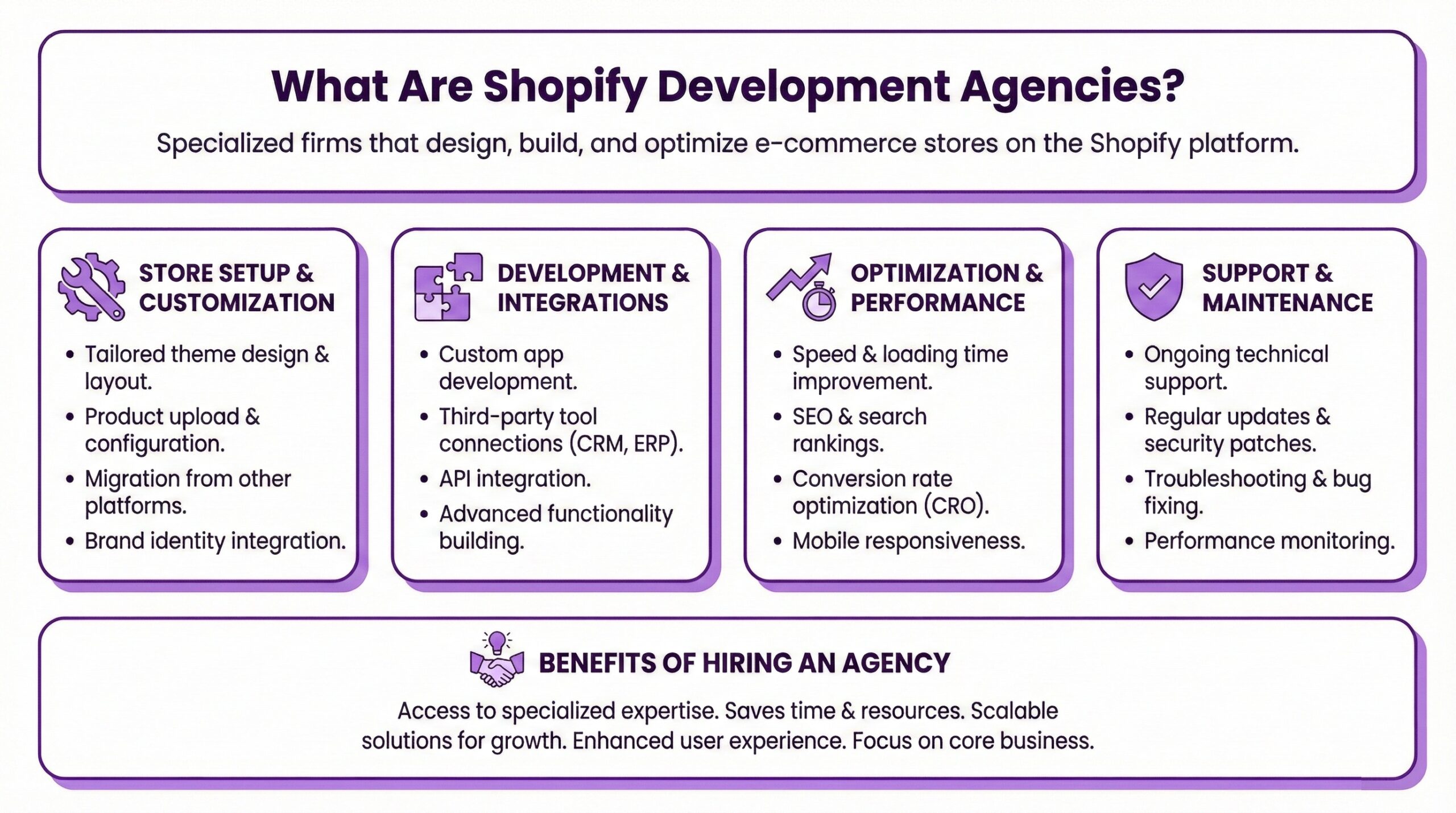
Before we get into how to pick one, let’s clear up some confusion I hear constantly. What does a Shopify development agency actually do that’s different from hiring a freelancer? A proper agency coordinates multiple specialists working together. Developers who understand checkout extensibility and the platform’s architecture. Designers who know the difference between what looks pretty in Figma and what actually converts on mobile. Project managers who keep everything moving without you having to chase people down. This is fundamentally different from hiring even a really talented solo freelancer. One person can’t simultaneously deliver professional design work, handle complex integrations, then provide strategic guidance. Agencies exist to coordinate those skill sets.
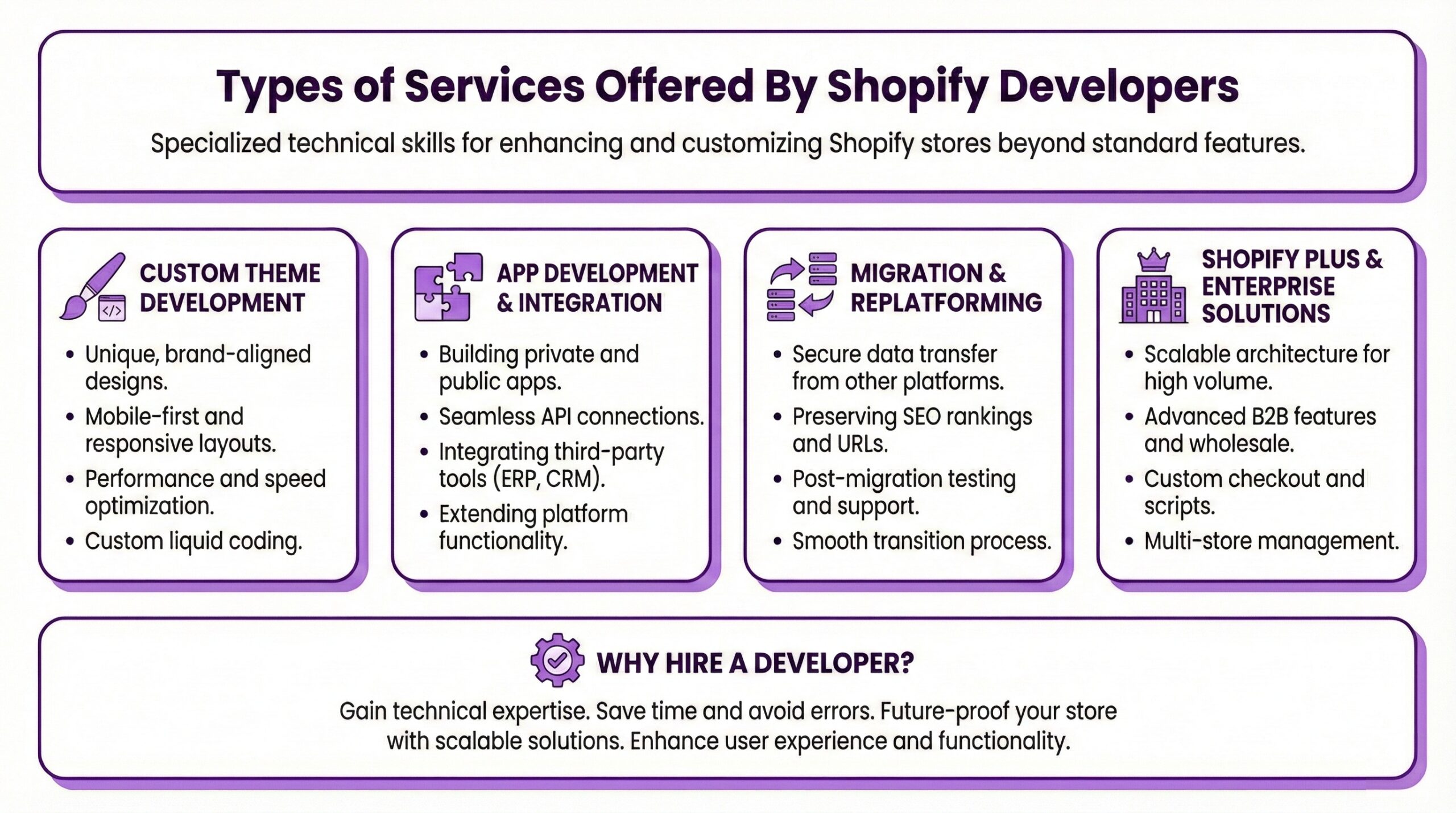
Think of it like skateboarding versus building a skate park. Freelance web devs are your talented friends who can even land a Nollie Inward Heelflip. Development agencies are the crews that designed the ramps, poured the concrete, handled the permits, and made sure the whole thing didn’t collapse when the downhill renegades showed up one Saturday. What agencies usually handle well includes custom theme development, app integrations, platform migrations, performance optimization, and ongoing technical support.
Seven Questions You Should Definitely Ask
Skip the generic questions about how long they’ve been in business. Here’s what to ask instead.
-
- Can I Talk to Three Store Owners Who Had Similar Projects?
References aren’t just for checking boxes. You want to speak with retailers who faced challenges similar to yours. A Shopify Expert agency that crushed some marketplace integration project somewhere might still struggle with your custom app development needs. The specifics matter more than overall reputation.
When you talk to those references, ask about communication during the project, how change requests were handled, and whether timeline and budget held. The honest answers usually come when you ask “what would you do differently next time?”
-
- Who Actually Works on My Project?
Some web dev agencies do a classic bait and switch. The senior team pitches you, then hands the work to junior developers or offshore contractors. There’s nothing inherently wrong with distributed teams, but you deserve to know who’s writing the code that runs your business. Be sure to ask to meet the real people who’ll be working on your project. Get their backgrounds. Understand how much senior oversight junior team members receive. The goal isn’t demanding only senior people (that can get expensive) but getting a good feel for the specialized expertise of the experts you’ll actually be paying for.
-
- What Happens When Something Breaks After Launch?
Every project has post-launch surprises. The cart abandonment rate hovers around 70% industry-wide, which means that even relatively small checkout glitches can turn into hemorrhaged revenue. What matters is how quickly problems get fixed.
Get specifics about support terms. Is there a warranty period? What’s the response time for urgent issues? How are bugs versus feature requests classified? An agency that goes quiet after collecting final payment is a liability waiting to happen.
-
- How Do You Handle Project Scope Changes?
Every e-commerce project evolves. You discover mid-build that you need additional functionality, or a competitor launches something you need to respond to. A good Shopify Partner agency has a clear process for handling changes without blowing up budget or timeline. Beware of development agencies who seem way too flexible here. “We’ll figure it out” often means “we’ll bill you much more later.” The best agency partners have documented change request processes to protect both of you
-
- What Does Your Discovery Process Look Like?
Dev Agencies that jump straight to proposals without thoroughly understanding your niche positioning in your brand’s vertical are usually optimizing for closing deals, not delivering results. A proper discovery process should feel slightly invasive. They should ask about your customer segments, your operational constraints, your competitive landscape, your growth targets.
If a prospective agency partner quotes you a price after a single call, they’re either very experienced with your exact situation or they’re making assumptions that’ll haunt you like a masked slasher killer later on. And honestly, usually, it’s the second one.
-
- Can You Show Me How You Approach Performance?
Mobile shoppers now account for roughly 79% of traffic to Shopify stores, but mobile conversion rates lag behind desktop significantly. Any design and development agency that treats performance as an afterthought is a web design not a web dev agency who’ll build you a store that’ll look great but frustrates live customers. Ask about Core Web Vitals, image optimization strategies, app bloat management, and how they test across devices. If they can’t speak fluently about performance, keep looking.
-
- What’s Your Experience With My Type of Business?
Look. An e-commerce store selling artisanal hot sauce or whisky tasting experiences faces completely different challenges than one selling industrial safety equipment or subscription beauty boxes. Partner agencies who specialize in your specific vertical already understand the common integration requirements, the seasonal patterns, and crucially customer expectations.
That said, don’t dismiss agencies without direct vertical experience if they have strong analogous projects. Someone who’s built complex B2B wholesale portals might be perfect for your business, even if they’ve never worked in your specific niche of our industry.

Understanding Shopify Partner Tiers (and Why Expert is Confusing)
If you’ve searched for Shopify development help, you’ve probably run into terms like “Shopify Expert,” “Shopify Partner,” “Plus Partner,” and “Premier Partner” thrown around like they mean the same thing. They don’t. But I can’t blame anyone for the confusion because I do it personally regularly and “we” do it here on Bold Match all the time because Shopify overhauled their entire partner ecosystem in late 2023 and early 2025, and the old terminology still circulates everywhere. So. Let me try to untangle that all for you.
The Old Experts System (Before October 2023): Shopify used to run something called the Shopify Experts Marketplace where vetted freelance specialists and consultants and marketing, design and of course web development agencies earned “Shopify Expert” status through completed projects and client reviews. Separately, there was a Shopify Plus Partner program for agencies serving enterprise e-commerce merchants. Two distinct programs with distinct requirements and distinct benefits.
The New Partners System (Since 2023-2025): In October 2023, Shopify replaced the Experts Marketplace with the unified Shopify Partner Directory. The “Shopify Expert” designation was “officially” sunset in December 2023. Then in January 2025, Shopify introduced a tiered Partner Program with five levels for what they call the Service Track. That’s agencies, consultancies, and freelancers. Placement depends on commercial impact and Verified Skills credentials earned through Shopify Academy. But again “officially” was doing a lot of semi-misleading lifting back there, because while only one set of designations has “official” meaning both sets are still in use everywhere from here and ShopExperts and StoreTasker to Agency websites and Shopify’s own site.
Here’s how the current tiers actually break down.
Registered is the entry level. Anyone who joins the Shopify Partner Program starts here. It signals familiarity with the platform but no formal vetting. Pretty much anyone who takes the time to sign up can become a Registered Partner.
Select represents the first meaningful tier. These Shopify partners have demonstrated commercial impact and earned Verified Skills credentials. Select status means they’ve proven themselves beyond just registering. Think of it as the “okay, this person actually does this professionally” threshold.
Plus partners have scaled up with larger credentialed teams, more Verified Skills, and proven capacity for complex mid-market work. There are roughly 450 Plus Partner Agencies worldwide. This tier handles most growing merchant needs competently. If you’re doing between $1M and $20M annually and need sophisticated work done, Plus Partners are usually your sweet spot.
Premier partners represent enterprise-level capability. Only around 42 Agencies hold Premier Partner status globally. They handle multi-market international rollouts, complex omnichannel implementations, and projects with seven-figure budgets. Unless you’re a household-name brand or expanding into a dozen countries simultaneously, you probably don’t need Premier.
Platinum is invitation-only, with roughly 14 partners including major consultancies and technology giants like Google and Oracle. This tier exists for Fortune 500 implementations. If you’re reading this article trying to figure out your options, Platinum isn’t one of them.
Why You’ll Still See “Shopify Expert” Everywhere
The term “Shopify Expert” remains in common use because merchants still search for it, agencies built their branding around it, and honestly “Shopify Expert” communicates something meaningful that “Registered Partner” simply does not IMO. When someone calls themselves a Shopify Expert today, they’re usually signaling deep platform knowledge rather than claiming a credential that no longer exists. When you’re evaluating partners, focus on their current tier status in the Partner Directory rather than legacy terminology. And if an agency prominently displays “Shopify Expert” but can’t tell you their actual service tier status, that’s worth a follow-up question.
How Much Do Shopify Developers Charge?
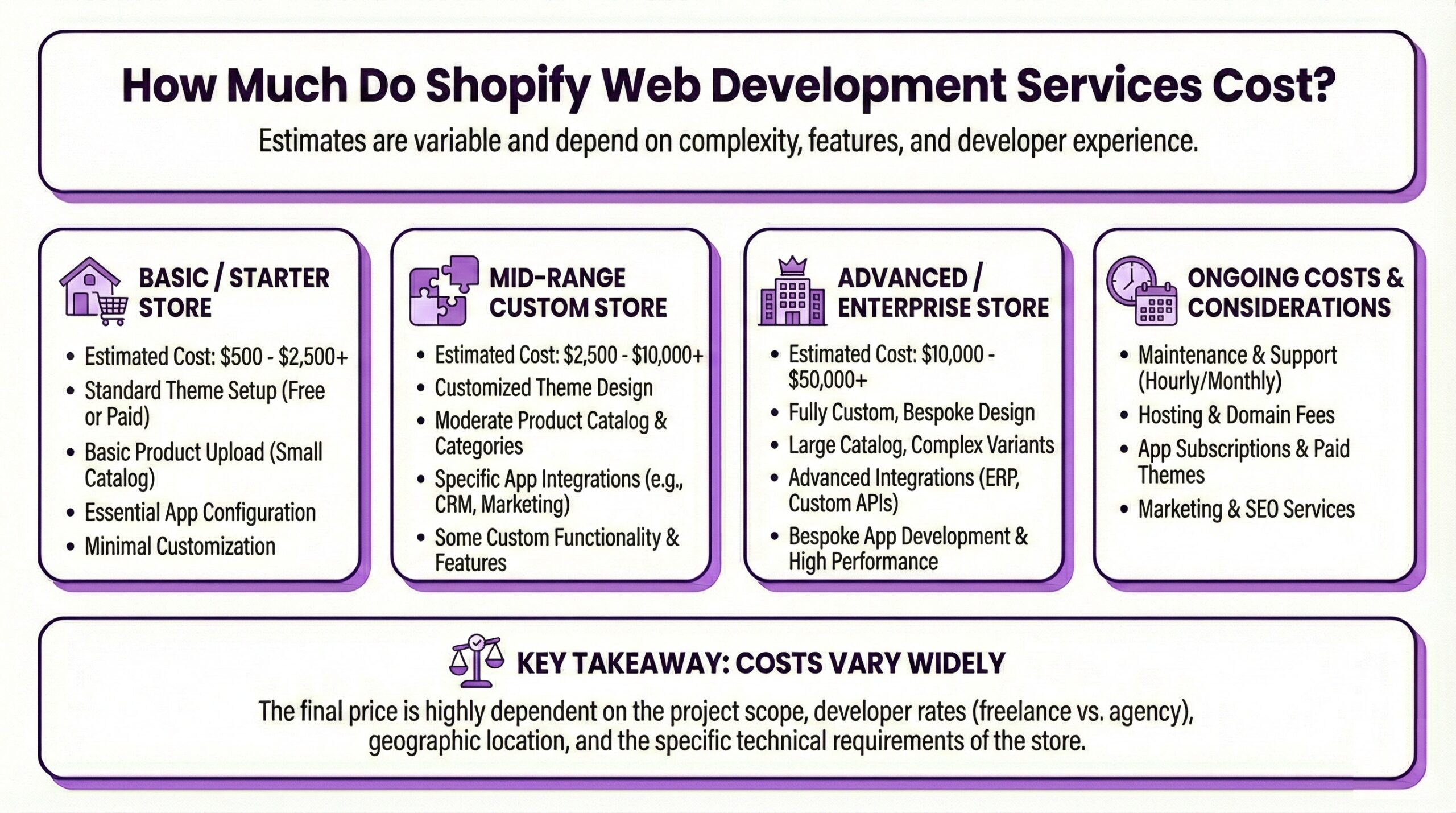
For a basic custom theme with moderate customization, expect to invest $5,000 to $15,000. More complex projects involving custom functionality and multiple integrations usually land between $15,000 and $50,000. Enterprise-level builds or complex migrations can run well past $100,000. Hourly rates for professional Shopify developers range from about $50 to $150 depending on location and experience level. North American and European agencies tend toward the higher end while offshore teams come cheaper but introduce communication and timezone challenges. You generally get what you pay for. The $2,000 partner agency will probably deliver $2,000 worth of work. Sometimes that’s fine for small projects. But if you’re betting your business on a major rebuild or migration, underspending is a false economy that usually costs more in the long run when you have to pay some other expert to fix it.
Red Flags That Should Send You Running
Having spent years of watching merchants get burned, certain warning signs have become pretty reliable indicators of trouble ahead.
Guaranteed results without seeing your data. Anyone promising specific conversion improvements before understanding your situation is selling snake oil. Real professionals know that outcomes depend on dozens of variables they can’t predict upfront.
Resistance to detailed contracts. Vague proposals and handshake agreements protect the agency, not you. Legitimate partners actually want clear scope documentation because it protects them too.
No questions about your business goals. If an agency treats every project like a technical exercise, they’ll build exactly what you described instead of what you actually need. Those are often very different things.
Previous clients who disappeared. If references are hard to come by or the agency can’t point to long-term client relationships, ask yourself why. Agencies that do good work usually keep clients around for years.
Pressure to sign quickly. Artificial urgency usually means they need your money more than they need the right fit. Good agencies have enough work that they can afford to let you make a considered decision.
The Best Shopify Agencies And Experts to Hire
-
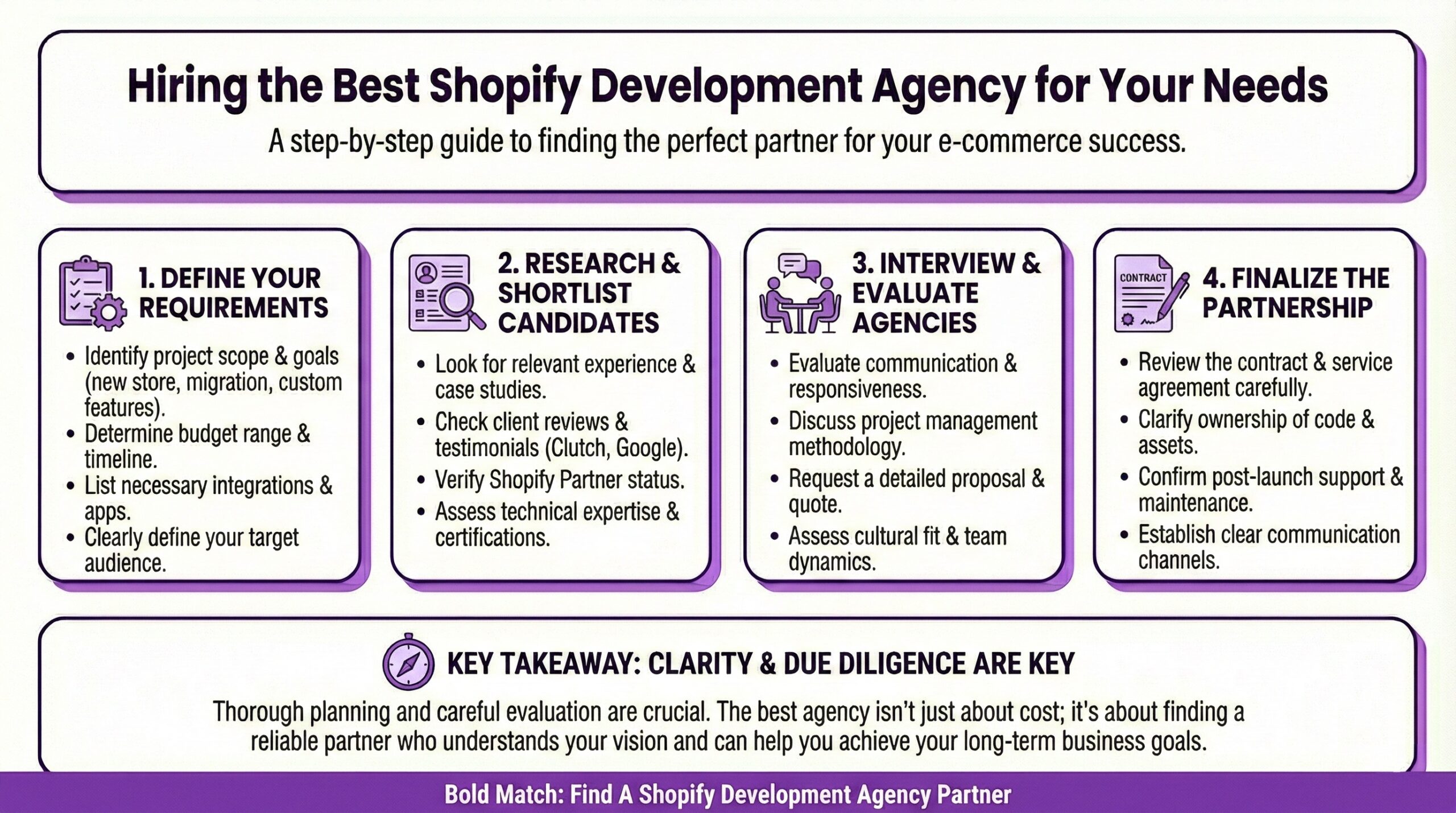
- Communication during the sales process. How an agency treats you before they bill you is the best version of how they’ll treat you.
- Clarity of their process. Agencies that’ve done this many times can explain exactly how projects flow from kickoff to launch.
- Cultural fit. You’ll be working closely with these people for weeks or months. If something feels off early on, trust that instinct.
Once you’ve selected a partner agency, document everything in writing before work begins. Assign a single point of contact on your side who has authority to make decisions. Be responsive when they ask for feedback. And plan for that relationship beyond your initial project.
The e-commerce merchants who wind up building the most valuable expert agency partnerships are the merchants who maintain ongoing relationships for support, optimization, and future development. And look, if you’re reading this and thinking “this is exactly the kind of evaluation process I don’t really have time to run myself,” that is literally why we built Bold Match. We’ve already vetted the development agencies and we can connect you with partners who match your specific needs. No commission, no markup, just the referral network you’d build yourself if you had an extra decade in this industry. Right, looks like I need to go debug a webhook handler that’s somehow firing twice for single events. The joys of async processing never end. Now go make your tech stack work smarter, not harder! — Eric B.
How Much Do Shopify Development Project Costs? Shopify Partner Agencies vs. Freelance Expert Developers
|
Type of Web Dev Project |
Freelance Shopify Expert |
Shopify Partner Agency |
|
Basic Store Setup |
$500 – $2,500 |
$2,500 – $5,000 |
|
Theme Customization |
$1,000 – $5,000 |
$3,000 – $8,000 |
|
Custom Theme Development |
$3,000 – $10,000 |
$8,000 – $20,000 |
|
Headless/Hydrogen Build |
$8,000 – $25,000 |
$25,000 – $75,000+ |
|
App Integration (single) |
$500 – $2,000 |
$1,500 – $4,000 |
|
Multi-App Integration Stack |
$2,000 – $6,000 |
$5,000 – $15,000 |
|
Custom App Development |
$2,500 – $12,000 |
$10,000 – $35,000 |
|
Platform Migration (basic) |
$2,000 – $8,000 |
$8,000 – $25,000 |
|
Platform Migration (complex/Plus) |
$8,000 – $20,000 |
$25,000 – $60,000 |
|
B2B/Wholesale Channel Setup |
$3,000 – $10,000 |
$10,000 – $30,000 |
|
Hybrid D2C + B2B Store |
$6,000 – $18,000 |
$20,000 – $50,000 |
|
Full Custom Store Build |
$5,000 – $20,000 |
$15,000 – $50,000+ |
|
Enterprise/Shopify Plus Build |
$15,000 – $40,000 |
$50,000 – $150,000+ |
|
Conversion Rate Optimization |
$1,500 – $5,000 |
$5,000 – $15,000 |
|
Site Speed/Performance Optimization |
$800 – $3,000 |
$2,500 – $8,000 |
|
Checkout Customization |
$1,000 – $4,000 |
$3,500 – $12,000 |
|
ERP/Inventory Integration |
$2,500 – $10,000 |
$8,000 – $25,000 |
|
POS Implementation |
$1,500 – $5,000 |
$5,000 – $15,000 |
|
Internationalization/Multi-Market |
$3,000 – $12,000 |
$12,000 – $35,000 |
|
Accessibility Audit + Remediation |
$1,500 – $4,000 |
$4,000 – $12,000 |
|
Hourly Rate Range |
$25 – $95/hr |
$75 – $150/hr |
|
Monthly Retainer |
$500 – $3,000 |
$1,500 – $10,000 |
Frequently Asked Questions (FAQ)
What does a Shopify Development Agency do?Specialized shopify partner agencies provide professional development, design, and sometimes marketing services specifically for the Shopify platform. Most agencies coordinate multiple specialists including expert developers who customize themes and build functionality, designers who create user experiences optimized for conversion, and project managers who keep timelines on track. Unlike individual freelancers, agencies can handle complex projects requiring diverse skill sets.
How do I choose a Shopify Development Agency?
Start by identifying partner agencies with experience in projects similar to yours, then request references from merchants who faced comparable challenges. Evaluate their discovery process, ask who’ll actually work on your project, clarify post-launch support terms, and understand how they handle scope changes. The right agency will ask detailed questions about your business goals rather than jumping straight to technical solutions
What is the difference between a Shopify Expert and a Shopify Partner?
Shopify Partners are development agencies or individual developers registered in the Shopify Partner Program, which represents the entry level of formal Shopify recognition. Shopify Experts have demonstrated additional competence through completed client projects and reviews within the Shopify ecosystem. They appear in Shopify’s Partner Directory (formerly the Expert Marketplace) and have been vetted for quality. Shopify Plus Partners specifically serve enterprise-level merchants with proven experience in high-volume implementations.
How much does it cost to hire a Shopify Development Agency Partner?
Custom Shopify web development from established partner agencies usually ranges from $5,000 to $20,000 for standard projects, with complex builds approaching $100,000 or more. Hourly developer rates range from approximately $50 to $150 depending on location and experience level. Basic theme customization starts lower, while enterprise migrations or custom app development can cost significantly more.
What’s the difference between a Shopify Web Dev Agency and Freelance Developers?
Specialist freelancers are individual consultants who usually specialize in one or two areas such as development or design. They offer more affordable rates and direct communication but have limited bandwidth and scope of services. Partner agencies employ teams of expert web developers coordinating development, design, project management, and sometimes marketing. They cost more but can handle larger, more complex projects and provide continuity if a single team member becomes unavailable.
How long do Shopify Development Agency projects take?
The timeline will be entirely dependent on the complexity of the project involved. Basic theme customizations might take two to four weeks. Full custom theme development usually runs six to twelve weeks. Complex migrations or builds involving custom functionality and multiple integrations can extend to three to six months or longer. Agencies should provide timeline estimates during the proposal phase.
What questions should I ask a Shopify Development Agency before hiring them?
Focus on references from similar projects, who actually works on your account, post-launch support terms, how scope changes are handled, what their discovery process looks like, how they approach site performance, and their experience with your type of business. Skip generic questions about company history and ask instead about specific processes and past project outcomes.
When should I hire a Shopify Development Agency instead of a Freelance Developer?
Consider a development agency when your project requires multiple skill sets working together, when the scope is complex enough that a single person can’t handle it, when you need ongoing support and can’t risk a freelancer becoming unavailable, or when you’re investing enough money that professional project management becomes worthwhile. Most online retailers reach this point somewhere between $500K and $2M in annual revenue.
What is the Shopify Partner Directory?
The Shopify Partner Directory replaced the old Shopify Experts Marketplace in October 2023. It’s a unified database where merchants can find and connect with vetted freelancers and agencies for development, design, and marketing help. Partners are listed with their tier status, Verified Skills badges, and client reviews. You can filter by service type, location, and budget to find partners who match your specific needs.
What happened to the Shopify Experts Marketplace?
Short version … Shopify shut it down. The Experts Marketplace was officially sunset in December 2023 and replaced by the Partner Directory. The “Shopify Expert” designation no longer exists as a formal credential, though you’ll still see plenty of freelancers and agencies using the term to describe their experience level. When someone calls themselves a Shopify Expert today, they’re usually communicating platform expertise rather than claiming an official status that Shopify still recognizes.
What are the Shopify Partner Program tiers?
Shopify introduced a five-tier system in January 2025 for service partners like expert agencies and freelance experts. From entry level to elite, the tiers are Registered, Select, Plus, Premier, and Platinum. Placement depends on commercial impact and Verified Skills credentials earned through Shopify Academy. Registered is open to anyone who signs up. Select and Plus represent the working tiers where most qualified partners land. Premier and Platinum serve enterprise merchants with complex global operations.
What’s a Shopify Select Partner?
Select Partners represent the first meaningful tier in Shopify’s Partner Program. They’ve demonstrated commercial impact through completed projects and earned Verified Skills credentials through Shopify Academy assessments. Select status signals that a partner has moved beyond just registering and actually does this work professionally. There are currently around 505 Select Partners worldwide.
What’s the difference between a Shopify Plus Partner and a Premier Partner?
Plus Partners handle sophisticated mid-market work and usually serve merchants doing between $1M and $50M annually. There are roughly 450 Plus Partners worldwide. Premier Partners operate at enterprise scale with only about 42 agencies holding that status globally. Premier agencies handle multi-market international rollouts, Fortune 500 implementations, and projects with seven-figure budgets. Most growing merchants work perfectly well with Plus Partners. Premier becomes relevant when your needs genuinely require enterprise-level coordination.
Why do people still say “Shopify Expert” if it’s not a real credential anymore?
I think it’s because the term communicates something useful that the new terminology doesn’t quite capture. “Shopify Expert” immediately signals deep platform knowledge to merchants searching for help. “Registered Partner” sounds like someone who filled out a form. Agencies and freelancers built their branding around the Expert designation for years, and plenty of merchants still search for that term. When evaluating partners today, ask about their actual tier status in the Partner Directory rather than relying on legacy terminology.
What are Shopify Verified Skills?
Verified Skills are credentials earned through Shopify Academy by completing learning paths and passing assessments. They demonstrate proficiency in specific areas like store setup, theme development, or migration. Partners display Verified Skills badges on their Directory profiles, and accumulating credentials contributes to tier advancement. For merchants, Verified Skills provide a standardized way to evaluate whether a partner has proven knowledge in the areas your project requires.